
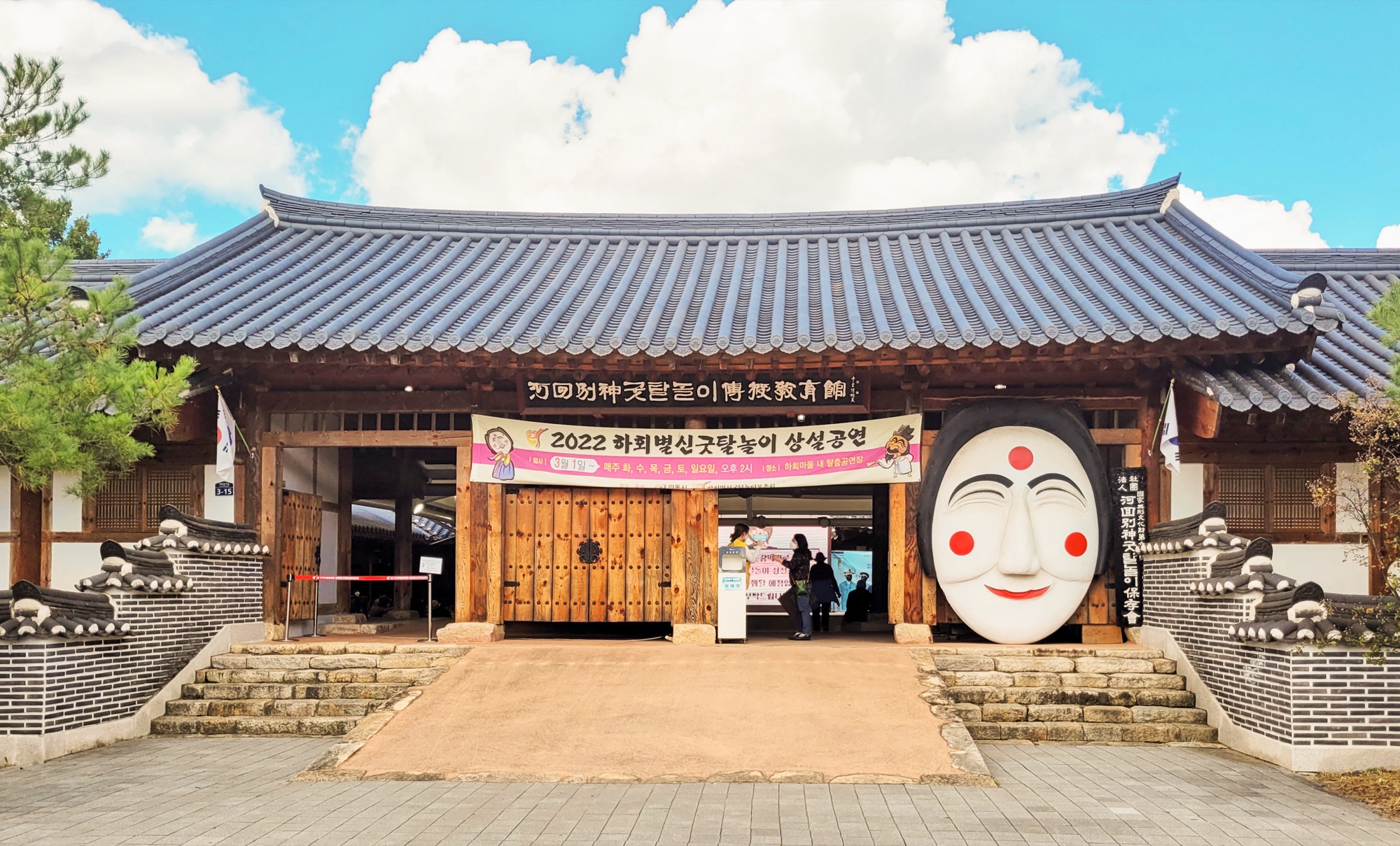
Free afternoon Hahoe mask satire play in Andong’s Hahoe Village
In Andong’s Hahoe Village, a free performance of Hahoe Byeolsingut Tallori, the village’s mask dance drama, starts at 2 p.m. Tuesday through Sunday. Behind the familiar smile of the Hahoe mask is a sharp comedy about aristocratic power, pretence and ordinary lives.
Masks that change with movement
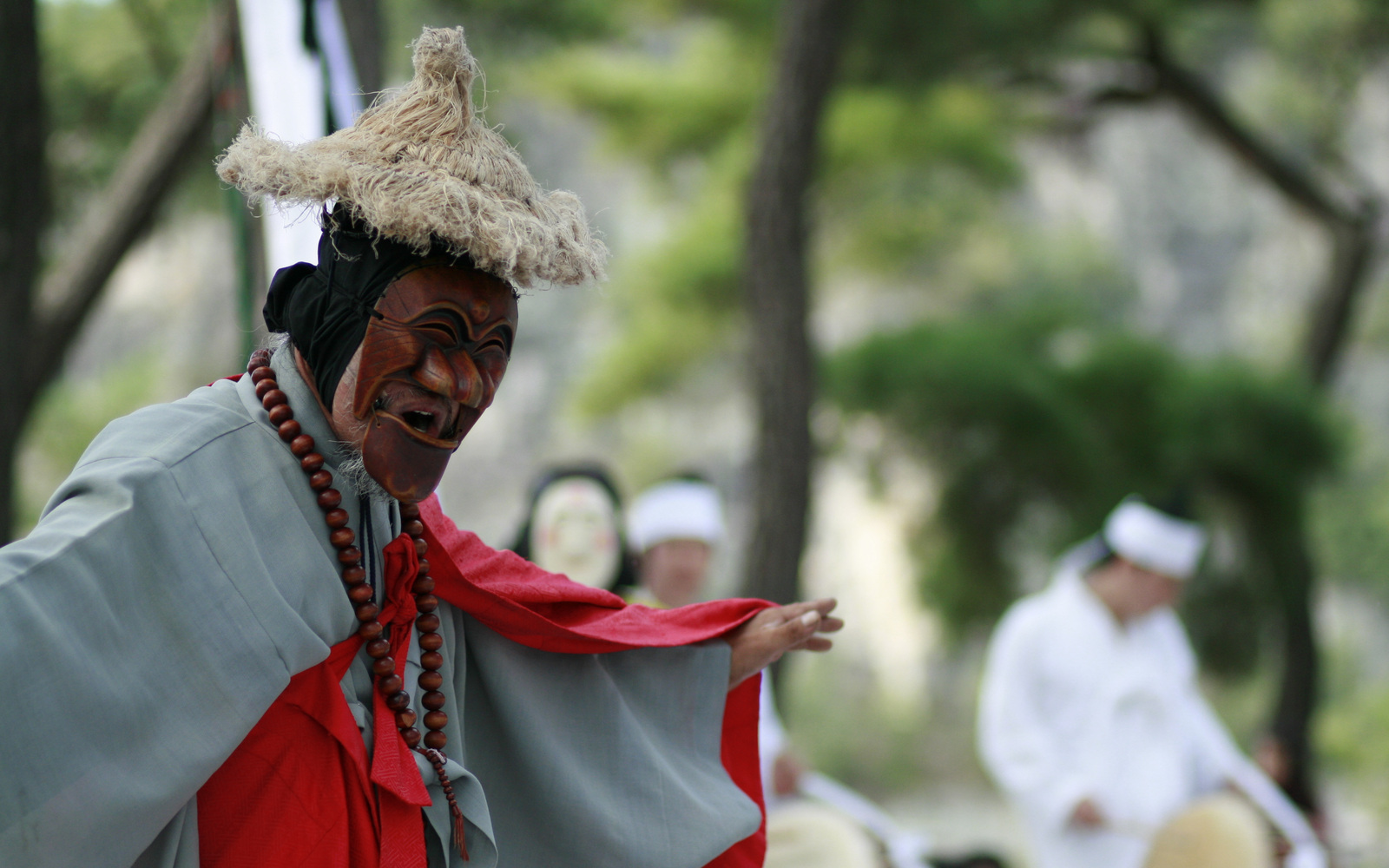
Andong’s official account of Hahoe masks says that lifting or lowering the face changes the emotion a viewer perceives, while separately made jaws help the performer animate speech. The angle of the head matters as much as the carved lines.
The performance combines movement, music, dialogue and the watching crowd. A dignified figure can become ridiculous without changing masks.
Clan village and satire
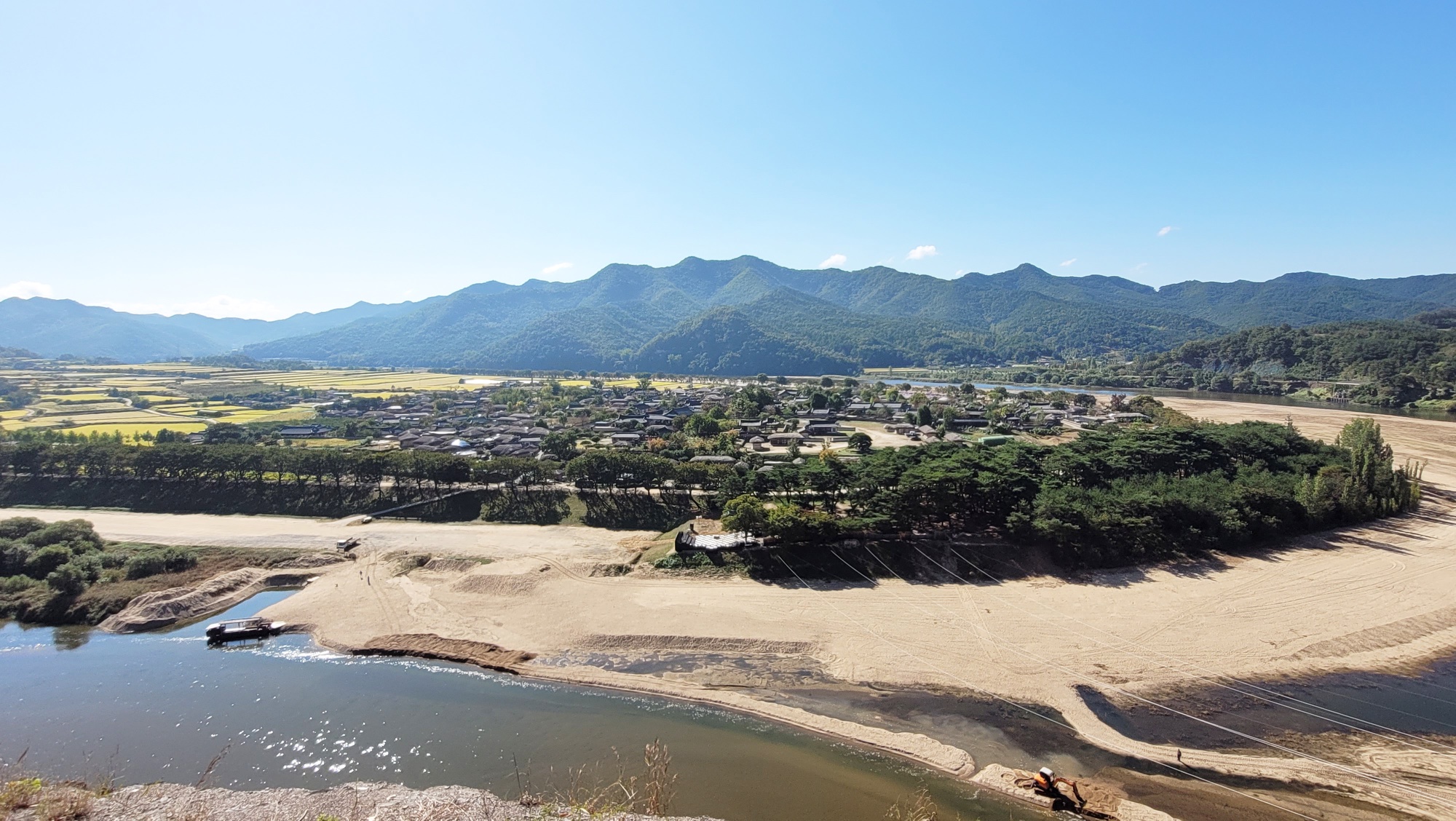
UNESCO describes Hahoe and Yangdong as clan villages shaped by Joseon-period Confucian culture, where the arrangement of leading families’ houses, smaller dwellings, pavilions and places of study makes the community’s social order visible.
The drama’s aristocrat and scholar hold respected positions, yet their vanity is open to ridicule. Linking the village layout with the stage satire is an interpretation, not evidence that every joke refers to a particular household.
The two UNESCO listings are separate. The historic villages of Hahoe and Yangdong were inscribed on the World Heritage List in 2010. Talchum, the broader Korean mask dance drama tradition that includes Hahoe, entered the Representative List of the Intangible Cultural Heritage of Humanity in 2022. One recognizes a place, the other a living practice.
Five characters
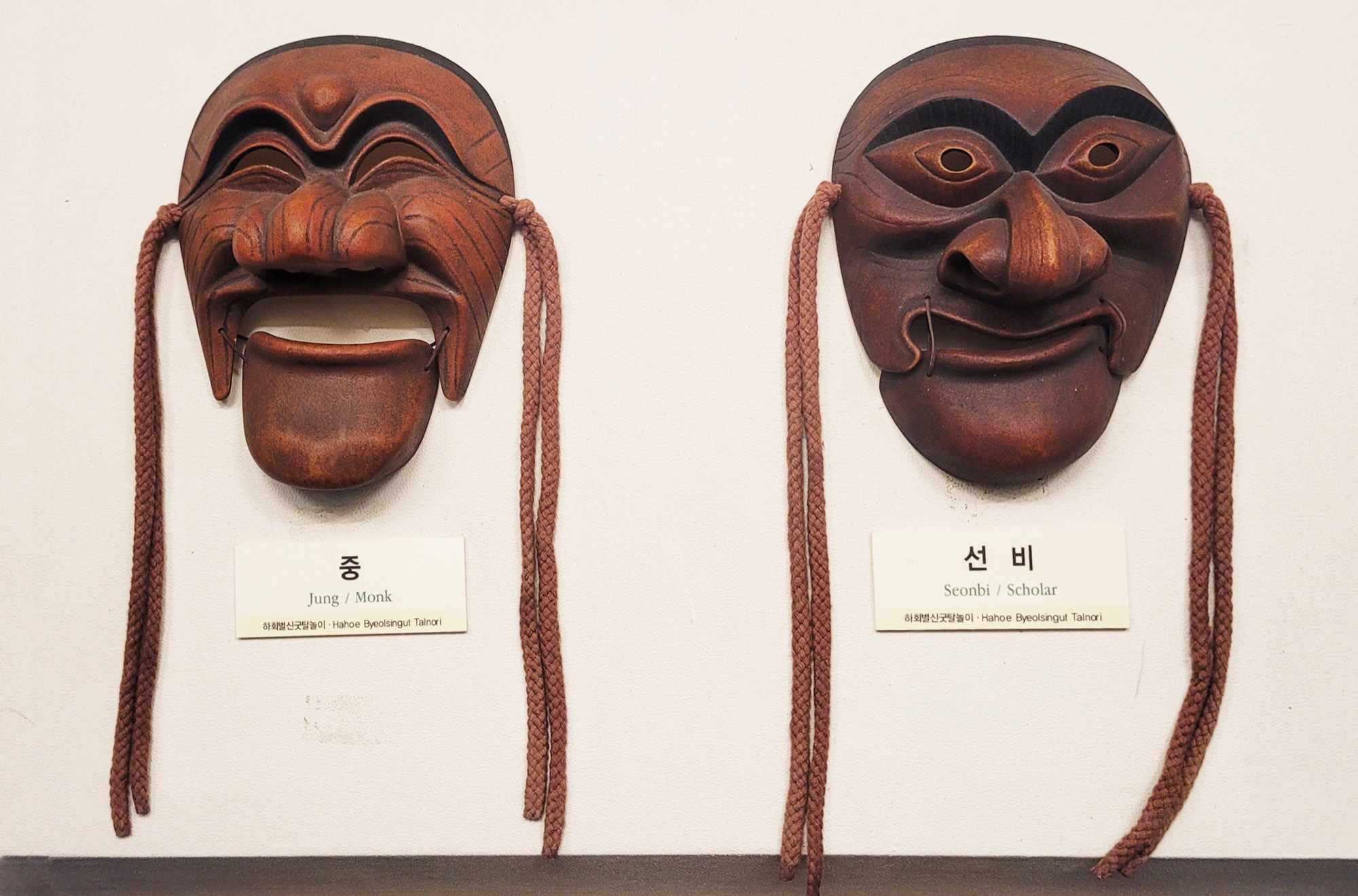
Yangban, the aristocrat, wears a broad smile, but his actions expose the weakness behind his status. Seonbi, the scholar, claims respect through learning. The aristocrat–scholar scene mocks the boasting and hypocrisy of both.
Choraengi, the aristocrat’s servant, interrupts and unsettles the dignity around him. Jung, the monk, fails to keep the discipline his position demands, and the wayward-monk scene turns that into comedy. Halmi, an elderly widow, sings a weaving song about hunger and the hardships of married life.
These five are the principal figures, not the full cast. The relationships of master and servant, rival men of standing, a cleric and his desires, and an older woman recounting hardship drive the scenes.
Dialogue and rhythm
Who addresses whom, who waits or interrupts and whose posture shifts reveal the relationships in each scene. The gestures are not a fixed code but the performers’ way of making social relations visible.
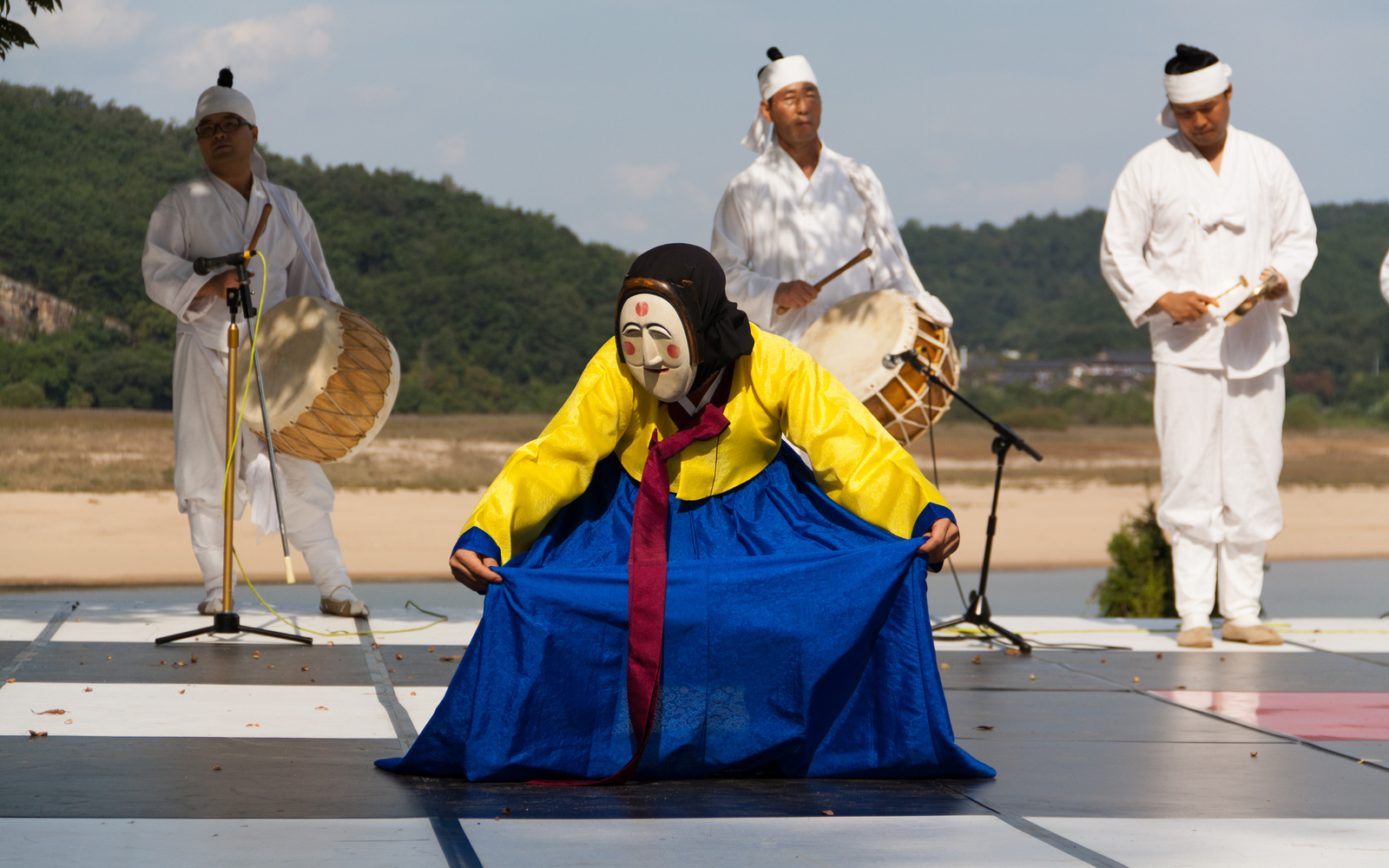
The official programme for the annual presentation lists musicians on gongs, drums and the taepyeongso, a wind instrument. Gestures lock into the rhythm, and dialogue gives way to dance.
According to Andong Tourism, the regular performance presents six scenes in its main hour, with an introduction at 13:50, the show from 14:00 and an audience finale at 15:00–15:10. It does not reproduce the full ritual, and audience participation follows the performers’ and venue’s directions.
A tradition revived
The Korean Studies Institute’s historical account says transmission stopped after the 1928 performance. A research group formed in 1973 began reconstruction from a recorded script and sought people who remembered the earlier event. Meeting Yi Chang-hui, who had performed as a young man, helped recover details the text alone could not supply.
Research in the mid-1970s led to revival performances and to designation as an important intangible cultural property in 1980. The same account dates the regular visitor performances to 1997; the older timetable it gives no longer applies.
A mask can survive in storage, but movement, costume, dialogue and scene order continue only if people learn and teach them. Calling the drama “unchanged for 800 years” obscures that work of recovery and transmission.
Without Korean
Without Korean, some dialect, wordplay and social references will be lost. The five characters, along with changes in pace, distance, gesture and gaze, still make the scenes readable.
UNESCO describes audience response as an essential part of talchum. Spectators are not expected to force a reaction or join in.
Current English or Japanese subtitles and live interpretation have not been confirmed. The preservation society can advise on language support.
Schedule and transport
The published regular schedule is Tuesday–Sunday, 14:00–15:00, from March through December, and Saturday and Sunday, 14:00–15:00, in January and February. The operator’s October 2026 calendar lists shows on October 13–18, 20–25 and 27–31; the Mondays, October 19 and 26, are blank.
Saturday, October 24 differs. The National Intangible Heritage Center lists the annual presentation from 13:00 to 16:00, with an invited performance and opening proceedings followed by the main Hahoe presentation of nine scenes at 14:00–15:30 and a finale until 16:00.
Andong Tourism lists bus 210 from Andong Station or the bus terminal to the Hahoe area; downtown, it stops opposite Kyobo Life. Departures and return services are on Andong’s live bus information system.
Venue and admission
The performances take place at the Hahoe Byeolsingut Tallori Training Center, 하회별신굿탈놀이 전수교육관, at 3-15 Hahoejongga-gil, Pungcheon-myeon, Andong, opposite the village-entrance management office. Visitors buy village admission at the parking area and take a free shuttle to the village entrance.
The show is free; village admission is ₩5,000 for adults, ₩2,500 for teenagers and ₩1,500 for children. Public parking and the Hahoe World Mask Museum are free. From October to March, admission closes at 16:30, though not every building stays open until then. The village is inhabited, and private courtyards are off-limits.
Information was checked on October 12, 2026, KST. The regular show requires no advance booking, but seats are not guaranteed. For groups, seating, subtitles or step-free access, contact the preservation society at +82-54-854-3664.
Sources & context
2026-10-13T23:37:28.396Z
hahoemask.co.kr ↗hahoemask.co.kr ↗hahoemask.co.kr ↗tourandong.com ↗UNESCO World Heritage Centre · Historic Villages of Korea: Hahoe and Yangdong ↗UNESCO Intangible Cultural Heritage · Talchum ↗hahoe.ugyo.net ↗hahoe.or.kr ↗hahoe.or.kr ↗tourandong.com ↗support.nihc.go.kr ↗Korea.net / Korean Culture and Information Service; photo: Andong Festival Tourism Foundation; via Wikimedia Commons · file-level CC BY-SA permission ↗Idobi; via Wikimedia Commons · file-level CC BY-SA permission ↗Creative Commons · CC BY-SA 2.0 ↗Creative Commons · CC BY-SA 3.0 ↗Archival Hahoe mask-dance photograph of a masked performer in grey and red robes. Captured 2008-09-28. Author/credit: Korea.net / Korean Culture and Information Service; photo: Andong Festival Tourism Foundation. Title: “Mask dance in Hahoe village (4459428890).jpg”. Source: https://commons.wikimedia.org/wiki/File:Mask_dance_in_Hahoe_village_(4459428890).jpg. License: CC BY-SA 2.0 (https://creativecommons.org/licenses/by-sa/2.0/). Modification: 8:5 crop removes 162 pixels from the lower edge, preserving the hat, mask and extended hand; proportionally reduced to 1600×1000 and recompressed as JPEG. No padding, stretching, retouching, generated content or text overlay. The original full frame is available at the source link. This adapted image remains under the same license. An archival image, not a view of the current venue.
Photo credit
Idobi; via Wikimedia Commons · CC BY-SA 3.0Archival Hahoe mask-dance photograph showing a performer in yellow and blue with percussionists behind. Captured 2012-09-28. Author/credit: Idobi. Title: “Hahoe 8747.jpg”. Source: https://commons.wikimedia.org/wiki/File:Hahoe_8747.jpg. License: CC BY-SA 3.0 (https://creativecommons.org/licenses/by-sa/3.0/). Modification: 8:5 crop removes 89 pixels from both the upper and lower edges, preserving the performer and the musicians; proportionally reduced to 1600×1000 and recompressed as JPEG. No padding, stretching, retouching, generated content or text overlay. The original full frame is available at the source link. This adapted image remains under the same license. An archival image, not a view of the current venue.
The houses and trees of Hahoe Folk Village, Andong, with mountains behind, seen across the river and its sandbank. Photo: Bernard Gagnon / Hahoe Folk Village 01 / Wikimedia Commons / CC0 1.0
The Monk (Jung, left) and Scholar (Seonbi, right) Hahoe masks hanging side by side at the Hahoe World Mask Museum, Andong. Photo: Bernard Gagnon / Hahoe World Mask Museum 06 / Wikimedia Commons / CC0 1.0
The entrance of the Hahoe Byeolsingut Tallori Training Center in Andong, with a banner for the regular performances and a giant mask sculpture beside it (photographed in 2022). Photo: Bernard Gagnon / Hahoe Byeolsingut Tallori Training Center 01 / Wikimedia Commons / CC0 1.0