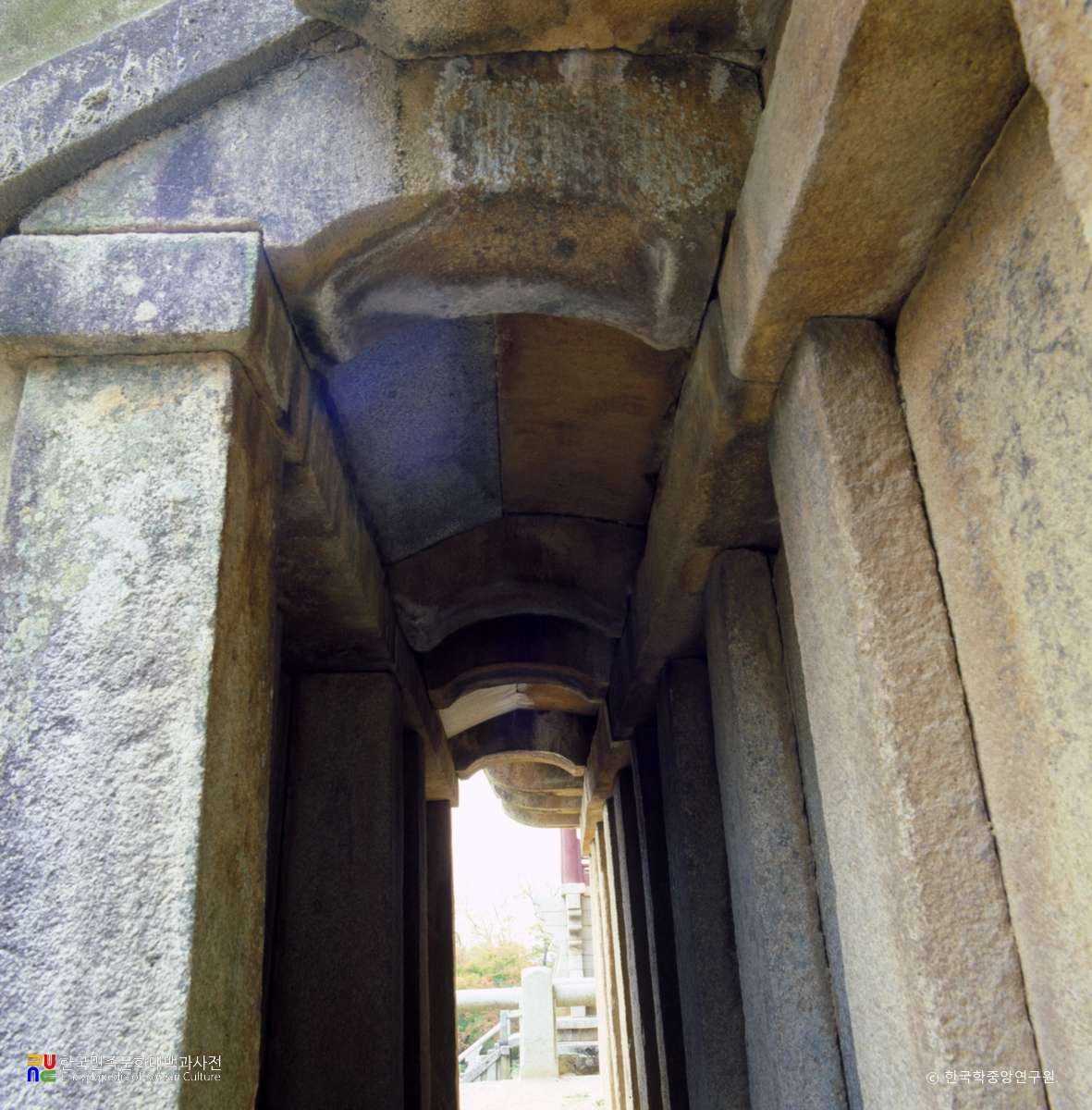
Beneath the stone stair bridges of Bulguksa temple, a semicircular hongye arch appears with a second curved band of stone above it. A field account calls the layered form “ssang-hongye,” or double arch. Viral claims that it is a unique, earthquake-proof invention are not supported by verified sources.
The doubled curve
The Encyclopedia of Korean Culture’s photograph of the left arch under Cheongungyo shows wedge-shaped stones forming a semicircular arch, with another curved stone course following the line above it. A Maeil Shinmun field feature describes this layered curve at Baegungyo as “ssang-hongye.”
No official basis was found for claims that the technique was the first or only one of its kind in the world.
How a hongye works
The Encyclopedia of Korean Culture defines a hongye bridge by its semicircular underside. Horizontal reactions at the supports act as compressive force through the span, a principle suited to stone, which resists compression well.
The Bulguksa bridges are presented among Korea’s early eighth-century hongye examples, built during the temple’s rebuilding, which began in 751 and lasted about 24 years.
Verified facts and viral claims
In the viral “1,300-year secret” story, claims that an elementary-school student first discovered the secret, that scholars were stunned, or that the bridge can never fail in an earthquake were not substantiated by the heritage and reference sources checked.
What is established: these are Unified Silla stone stair bridges, they use semicircular hongye arches, and their layered curved stonework is visible and has been described in field reporting. There is no separate engineering evidence on seismic intent or performance.