
How noraebang gave everyone a turn
In a noraebang, a Korean singing room, people find a song, enter its number and wait their turn while someone else sings. The rooms, which spread from Busan across Korea in the 1990s, turned listeners into performers and made operating a machine part of the shared fun.
Busan, 1991
The Royal electronic arcade near Dong-A University in Busan, in April 1991, is often cited as the starting point. A 2018 Kookje Shinmun history noted, however, that no official record establishing the “first” had been confirmed. It is more accurate to treat that period as the moment a new business format appeared in Busan than as a fixed invention date.
A 2016 study by Sangkil Yoon and Il Chang examines how Busan’s existing 1980s karaoke culture related to early-1990s rooms using computer accompaniment. Noraebang combined established singing culture, arcade-style use and separate rooms.
The merchants who wired the rooms
Seoul Museum of History’s 2010 survey of downtown merchants says noraebang spread from Busan and the Yeongnam region to Seoul in late 1991. Synchronising accompaniment with captions and producing adequate sound were early technical challenges, and merchants in Sewoon’s electronics district supplied and installed the equipment.
Customers saw a microphone and screen, but a working room required an accompaniment unit, amplifier and other equipment to be connected. Behind the loosely named “karaoke machine” sat several audio devices and the skill to install them.
Songbooks and remotes
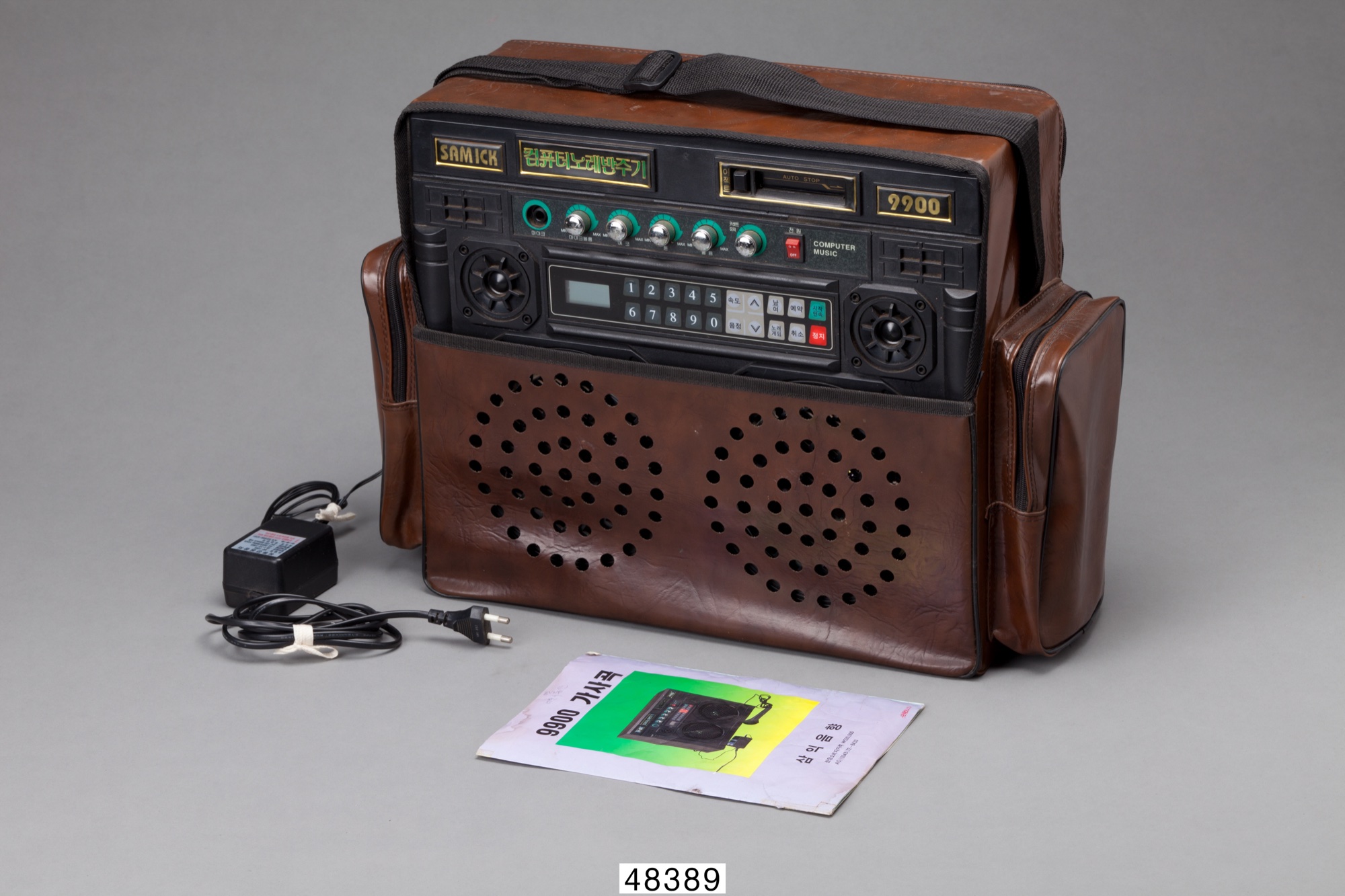
Number-based selection meant finding a title in a songbook and entering its number into the machine. A registered patent aimed at improving songbook selection describes this procedure. When the person choosing a song is not the person singing, selection and listening happen at the same time in the same room.
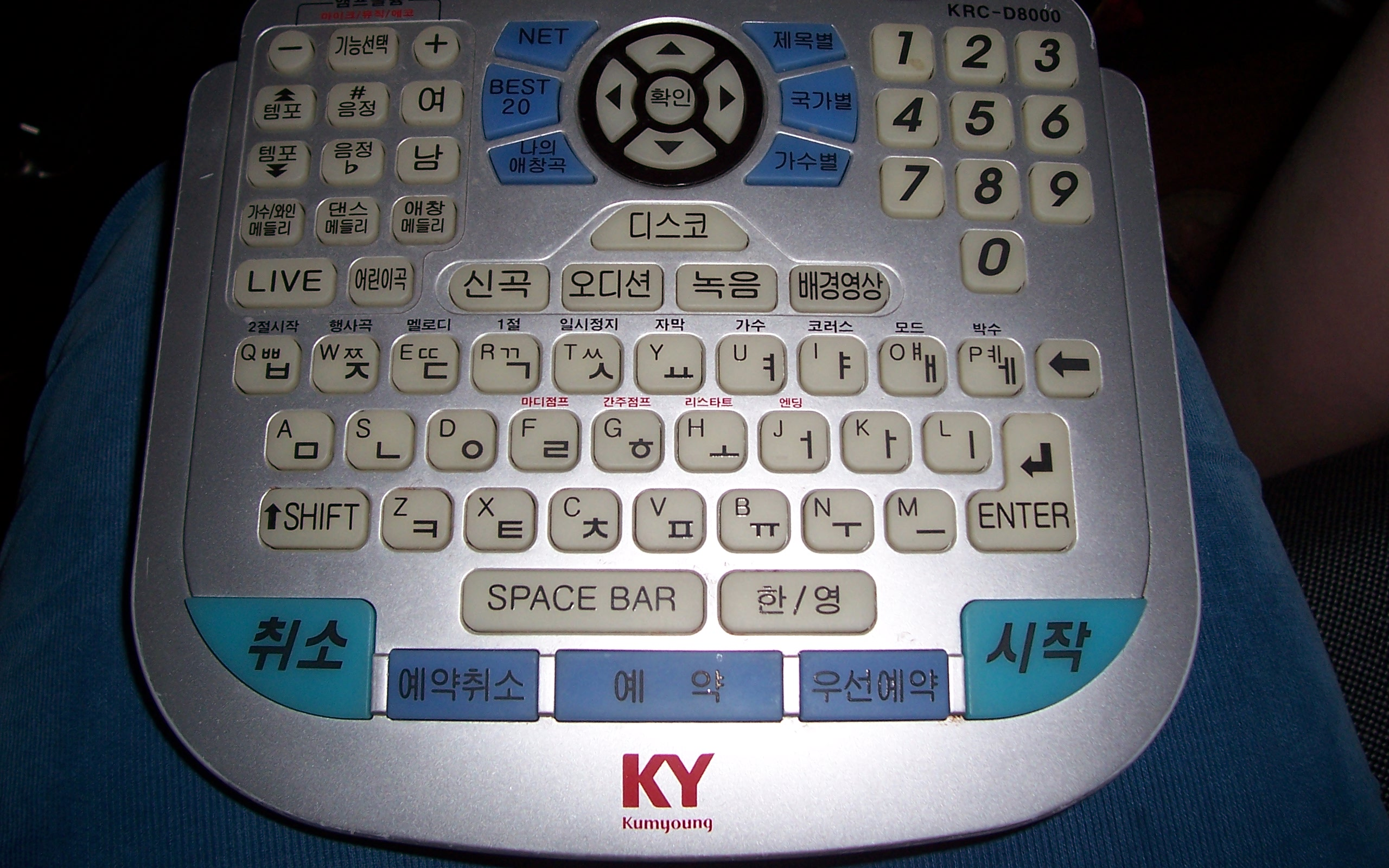
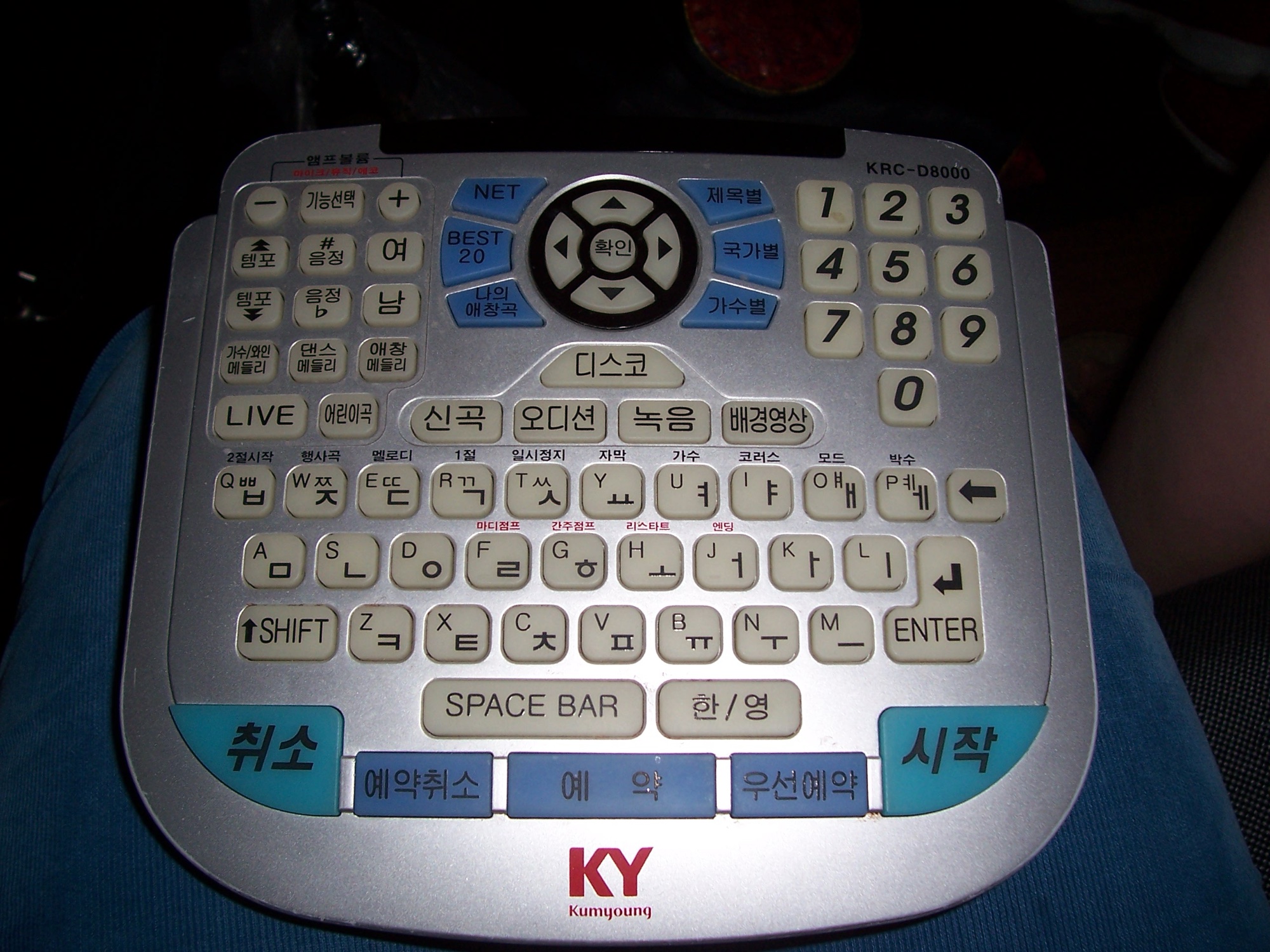
On a remote, reservation queues the next song, key changes pitch and tempo changes speed. The buttons are visible in the accompanying 2008 photograph of a Kumyoung remote, and Kumyoung’s current IPTV service information also lists key and tempo controls and a song queue. The photograph does not show the features of a 1991 machine.
Changing electronics
Treating noraebang as purely analog because of its books and buttons obscures its technology. TJ’s corporate history records a home computer-accompaniment product in 1989, and hard-disk video accompaniment and an internet-connected system in 2002.
A 1995 Electronic Times report on an Inkel product already described remote control, lighting control and the option to use external laserdisc or videotape footage as a background. The buttons stayed familiar while the electronics behind them kept changing.
The audience in the room
A door and walls matter as much as the microphone. In a separate room, the audience is the people who came in together. Choosing songs, waiting and responding to others are part of the experience alongside singing ability.
The room is not comfortable for everyone. The pleasure of singing together can come with self-consciousness. Who is present and who sets the order explain more than the claim that Koreans simply love to sing.
In the accompanying 2014 Gwangju photograph, people holding a microphone and a remote share a sofa, singing and selecting songs in the same room.
Coin noraebang
Coin karaoke is not simply a smaller version of the old room. Sharing a room by the hour and dropping in for a set number of songs use time differently. Reporting from Suyeong-gu in Busan in 2018, Kookje Shinmun documented customers arriving alone to sing. Solo singing is not a sudden new trend.
Nor has individual use replaced groups. A room for socialising and a room for practising alone meet different needs.
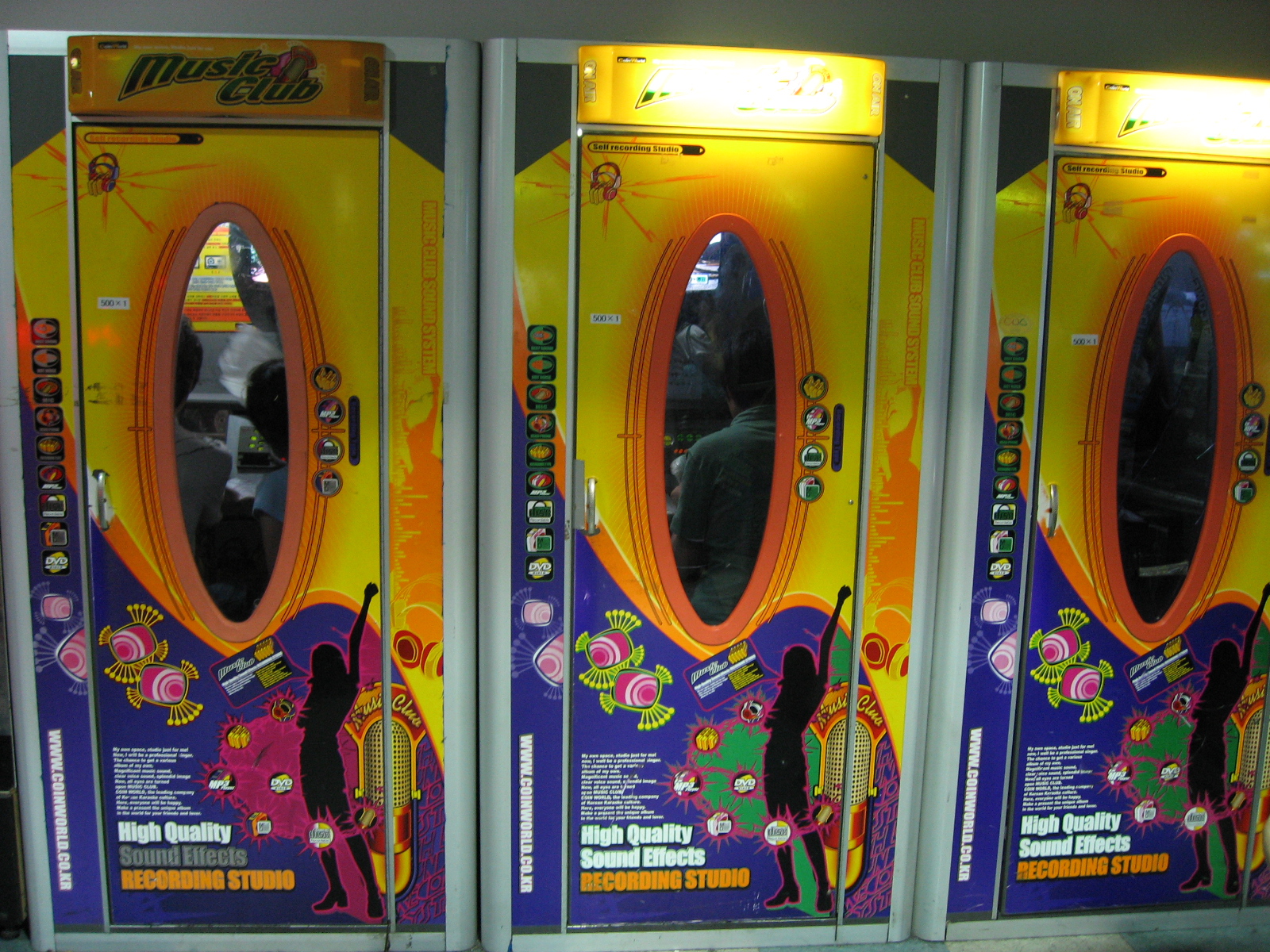
The 2006 photograph shows small singing booths inside a games arcade, a different format from the dedicated coin-noraebang shops of the 2010s.
Noraebang today
Official information for TJ’s A3 describes app-based song search and queuing, access to recordings, and coin or time-based management. That shows what the system can do, not what every business has installed. Song selection once done by flipping through songbooks continues through other interfaces.
Rooms vary as well. A 2023 Korea Tourism Organization feature describes a Hongdae venue whose front rooms are visible from the street through full-height windows. Buttons and screens have changed, but choosing the next song is still at the centre of the experience.
Sources & context
2026-10-13T23:37:28.396Z
Sangkil Yoon and Il Chang, Social Contexts and Media-Historical Meaning of the Early Noraebang Culture in Busan, 2016, pp. 164–199 ↗Kookje Shinmun · Noraebang history, January 2, 2018 ↗Seoul History Archive · Different types of karaoke machines, 2010 living-culture survey ↗Patent KR100764820B1 · Description of songbooks and number-based selection ↗Kumyoung Entertainment · IPTV song-selection, key and tempo functions ↗TJ Media · Company history ↗Electronic Times · Inkel accompaniment-system launch, June 19, 1995 ↗Kookje Shinmun · Reporting on solo and coin karaoke, January 2, 2018 ↗TJ Media · A3 official product information ↗Korea Tourism Organization · Room culture, October 17, 2023 ↗Original photo and rights: Catherine, Korean karaoke remote, Epping, Australia, 2008, CC BY 2.0 ↗Photo source and rights: cezzie901 · 2014-09-20 ↗Original photograph: cezzie901 · 2014-09-20 ↗Photo source and rights: Kai Hendry · 2006-07-11 ↗Original photograph: Kai Hendry · 2006-07-11 ↗Photo source and rights: Catherine / Sailor Coruscant · 2008-10-03 ↗Original photograph: Catherine / Sailor Coruscant · 2008-10-03 ↗Photograph licence: CC BY 2.0 ↗A controls detail from a Kumyoung KRC-D8000 remote in a Korean-style karaoke room in Epping, Australia, photographed on 3 October 2008. The keypad, queue, start/cancel, key and tempo controls and lower KY mark remain visible. Photo: Catherine. Original title: “Karaoke”. Taken 2008-10-03; uploaded 2008-10-30. Source: https://www.flickr.com/photos/sailor_coruscant/2986745144/ License: CC BY 2.0 (https://creativecommons.org/licenses/by/2.0/). Cropped 320 pixels from the top to create a 2560×1600 controls detail, then losslessly WebP-encoded; no resizing, colour change or distortion. The card and enlarge link show the same detail; the uncropped original is available at the source. This is not a photograph of a 1991 machine in Korea.
Photo credit
Kai Hendry / Flickr, CC BY 2.0 · CC BY 2.0Small singing booths in a games arcade, photographed on 11 July 2006 and tagged “korea” by the photographer; the exact venue is unrecorded. Photo: Kai Hendry. Original title: “Karaoke booths at a games arcade”. Taken 2006-07-11; uploaded 2006-07-13. Source: https://www.flickr.com/photos/hendry/188500849/ License: CC BY 2.0 (https://creativecommons.org/licenses/by/2.0/). Original file unchanged, without resizing. The card uses an 8:5 centered display crop; open the larger photo for the complete file. This is neither a 1990s photograph nor a 2010s dedicated coin-noraebang venue.
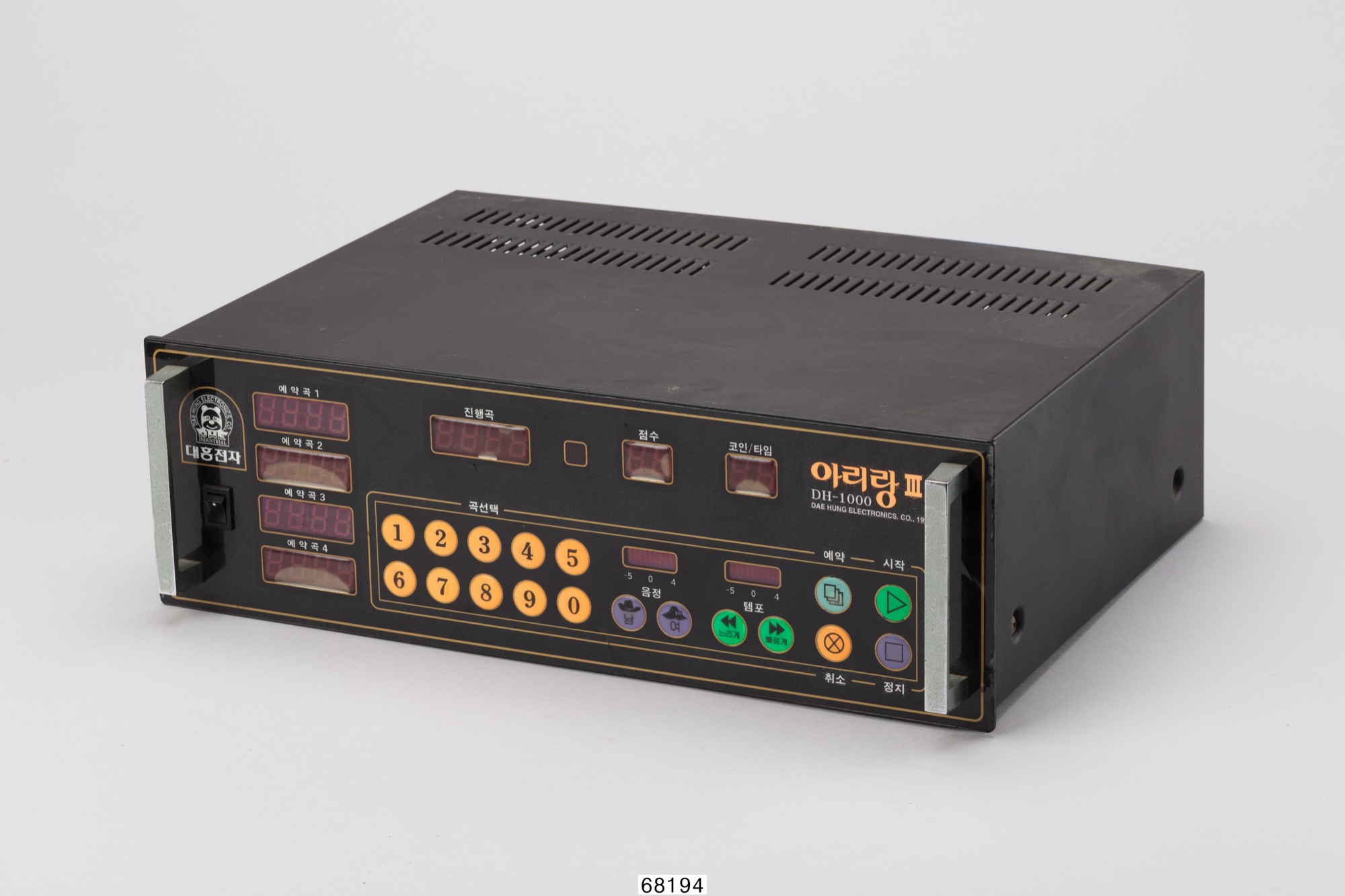
The Arirang III (DH-1000) karaoke accompaniment unit made by Daeheung Electronics in 1994, with number buttons for song codes and reservation displays on the front. Photo: National Folk Museum of Korea / Noraebang machine (068194) / NFM collection / KOGL Type 1
A KY (Kumyoung) remote used in a Korean-style noraebang in Epping, Australia, with a number pad, Hangul keyboard and Reserve, Cancel Reservation, Priority Reserve, Start and Cancel buttons. Photo: Catherine from Australia / Karaoke / Wikimedia Commons (Flickr) / CC BY 2.0
A portable “computer song accompanist” by Samick Sound, played by entering a song number; it has number, key and tempo buttons and a cassette slot, and comes with a booklet listing song titles and numbers. Photo: National Folk Museum of Korea / Computer song accompanist (048389) / NFM collection / KOGL Type 1