
Hwagak chambit: a bamboo comb with painted-horn decoration
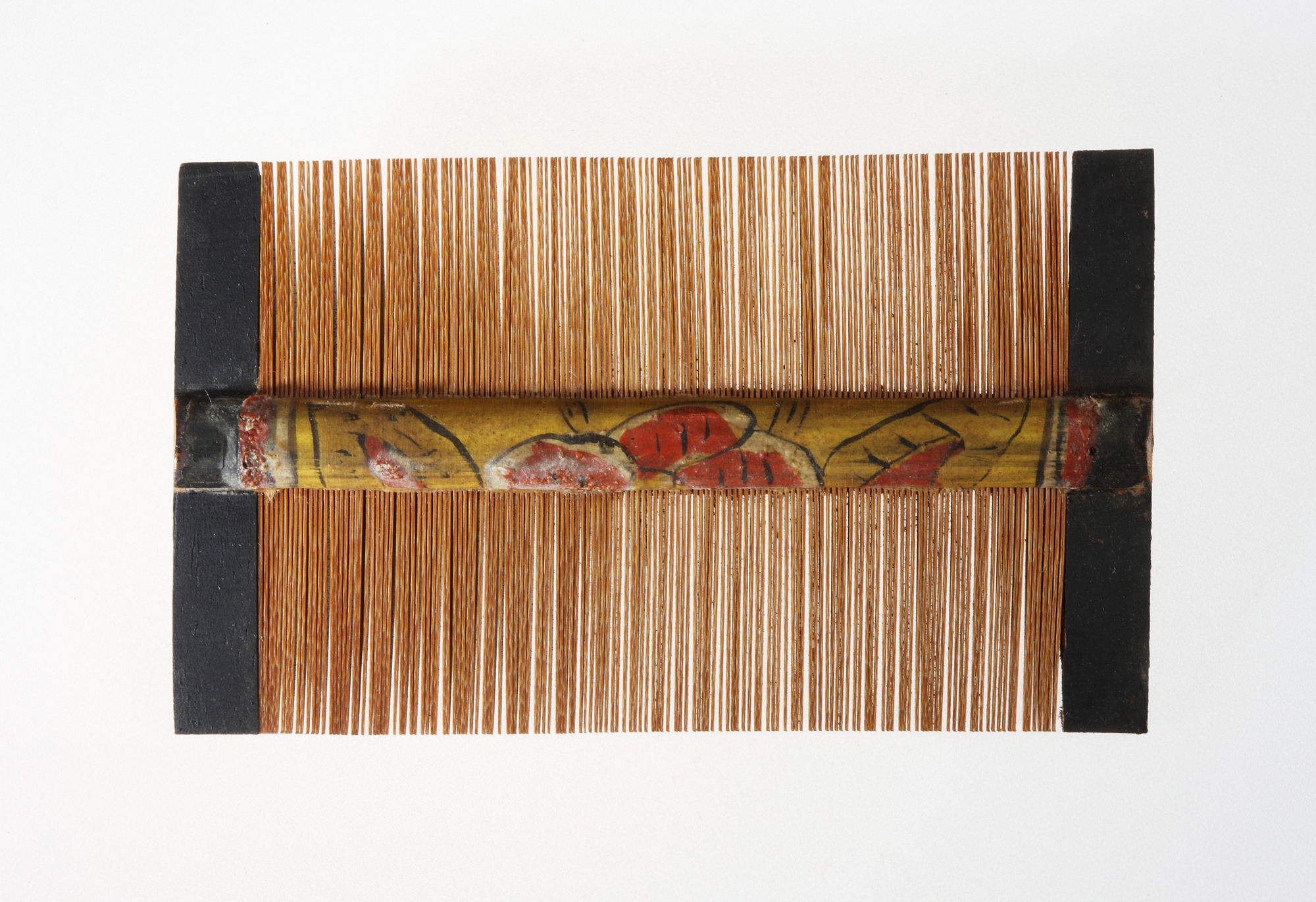
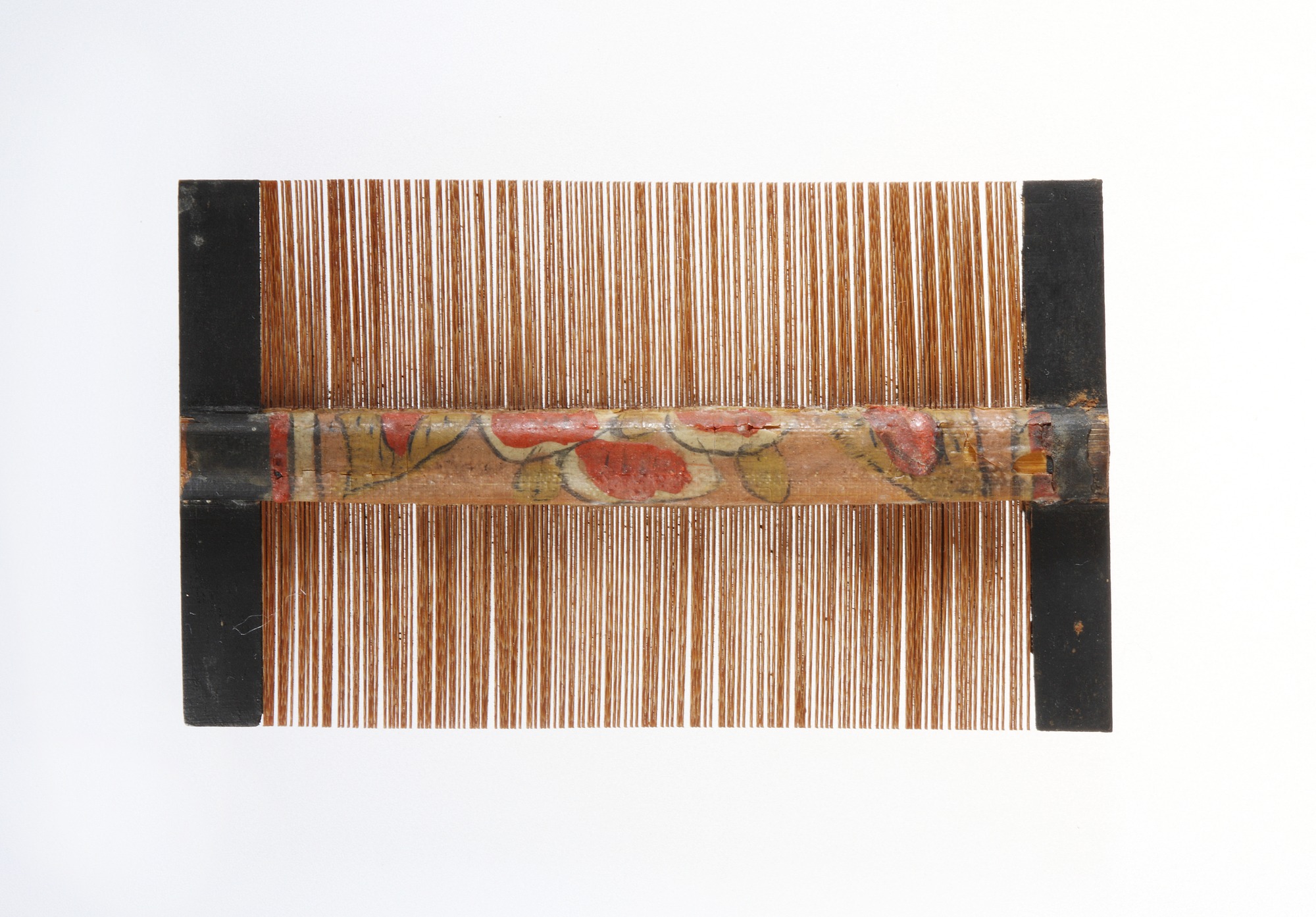
A band of red flowers runs between rows of fine teeth. This 20th-century hwagak chambit in Korea’s National Palace Museum is a bamboo comb decorated with painted ox horn. Just 7.9 cm wide, it shows both carefully aligned teeth and a decoration seen through translucent horn.
A 7.9 cm comb
The object is accession Gungjung 267 in the National Palace Museum of Korea. Its catalog records a width of 7.9 cm, a height of 4.6 cm, and materials of wood and ox horn. The closely spaced bamboo teeth smoothed the hair, and flower-painted horn decorates the central spine. The form is traditional, but the museum dates this example to the 20th century.
Teeth set one by one
According to the museum, broad bamboo pieces are fixed to the front and back of the centre, with fine teeth set closely along both sides, a different structure from a comb cut from a solid block.
The Academy of Korean Studies distinguishes the dense bamboo teeth of a chambit from the wider spacing of an eollebit, or coarse comb, and describes roughly 35 operations from cutting bamboo to completion. The even gaps between the teeth show the precision involved.
Flowers under horn
Hwagak decoration combines finely worked ox horn with painting. Describing a different Korean comb in its collection, New York’s Metropolitan Museum of Art explains that the painted face of a thin, translucent horn sheet is attached to wood, so the flowers are viewed through the horn.
On Gungjung 267, red flowers, dark outlines and a yellowish ground fill the central band among the fine teeth.
Two faces
The museum’s two photographs show the two faces of the same comb. One has a central red flower with leaves extending to the right; the other shows a different arrangement along the band. The dark frame and fine teeth are common to both. Together they show the division between the decorated spine and the working teeth.
These are collection photographs; their dates and the comb’s current display status are not given in the public record.
A Damyang maker today
Chambit are still made and sold. Jukhyang Chambit in Damyang, South Jeolla Province, lists eojungso as a traditional chambit, alongside saekdong and ojuk combs. The workshop’s products and Gungjung 267 are separate objects; the photographs show the museum piece and do not represent goods sold by the workshop or a shared lineage.
Sources & context
2026-10-13T13:05:46.356Z
gogung.go.kr ↗The Metropolitan Museum of Art · Double-sided comb 2024.301.13 ↗Academy of Korean Studies ↗chambit.kr ↗KOGL ↗One face of Hwagak chambit, Gungjung 267. 20th century; 7.9 × 4.6 cm. Collection and photograph: National Palace Museum of Korea. Collection photograph; capture date unspecified. KOGL Type 1, attribution required. Source: https://www.gogung.go.kr/gogung/pgm/psgudMng/view.do?psgudSn=366543&menuNo=800065 . License: https://www.kogl.or.kr/info/license.do#01 . Proportional downsampling and JPEG compression only; the original background and entire object are preserved. The centered 4:3 display trims only white margins.
The other face of Hwagak chambit, Gungjung 267. 20th century; 7.9 × 4.6 cm. Collection and photograph: National Palace Museum of Korea. Collection photograph; capture date unspecified. KOGL Type 1, attribution required. Source: https://www.gogung.go.kr/gogung/pgm/psgudMng/view.do?psgudSn=366543&menuNo=800065 . License: https://www.kogl.or.kr/info/license.do#01 . Proportional downsampling and JPEG compression only; the original background and entire object are preserved. The centered 4:3 display trims only white margins.