
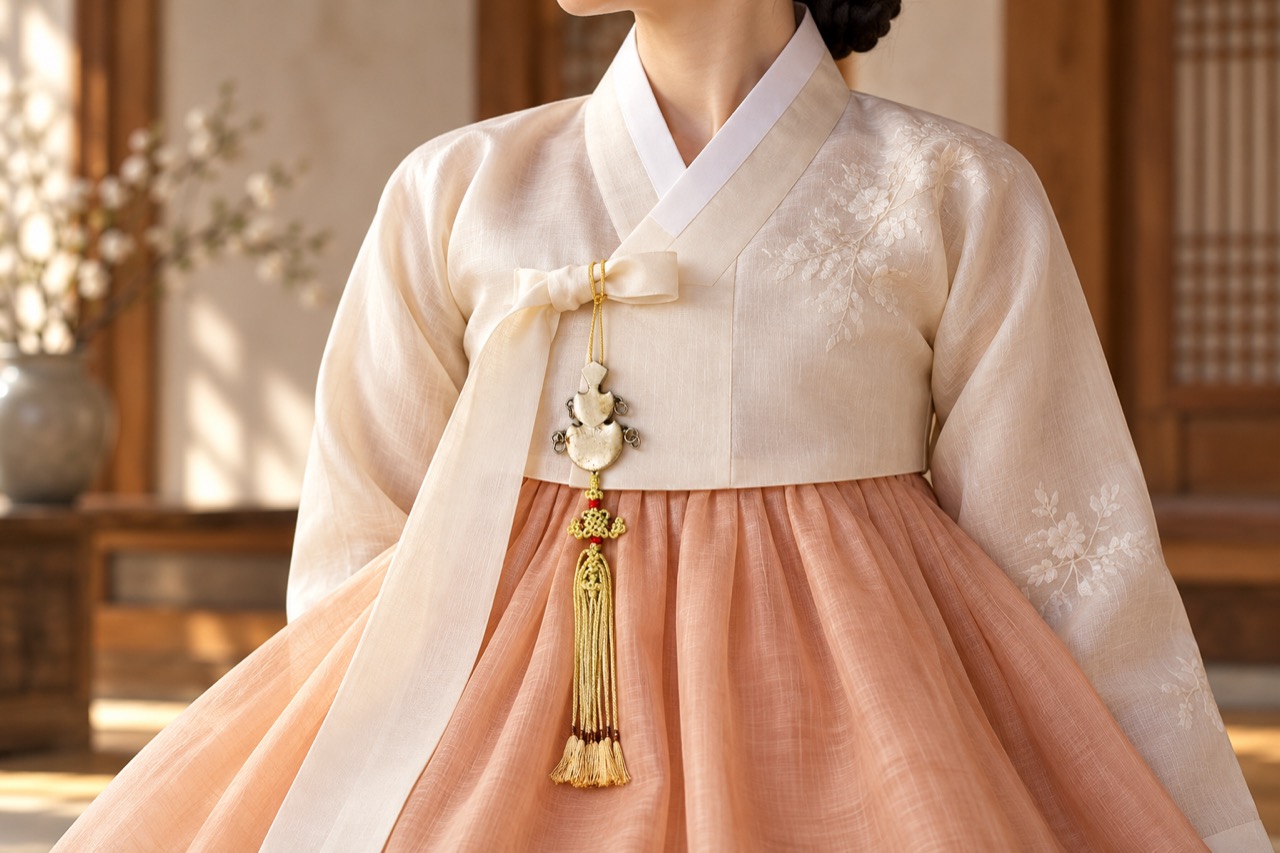
A needle case worn as a norigae with hanbok
Some norigae, the knotted and tasseled ornaments worn with hanbok, held sewing needles. The needle-case norigae turned an everyday tool into an accessory.
How norigae were worn
Norigae were attached to the ties of a hanbok jacket or the waistband of a skirt. An upper fitting or cord held the ornament in place, with its decoration and tassel hanging below.
A needle-case norigae has a small container for sewing needles built into its central ornament.
Why carry needles
The case kept frequently used needles within reach. According to the Korea Heritage Agency, needle cases were made of cloth, metal, leather or paper, and hair or powder was placed inside to prevent rust. The ornament held working sewing tools.
Examples in museum collections
The National Museum of Korea’s baekdong needle-case norigae, Jeung 6526, dates to the Joseon dynasty and measures 32.5 cm overall. A separate enameled example, Jeung 6666, measures 34.5 cm and has pink knots and tassels. Its Korean name, paran, refers to the enamel technique, not the color blue.
Two other cases shown here differ in material and form: a modern embroidered textile case at the Seoul Museum of History and a lacquered case at Dankook University’s Seok Juseon Memorial Museum. The Seoul museum describes the upper part of its textile case as a lid and the lower part as the needle holder.
The photos do not show the cases open or any needles, nor do they show those two cases worn with hanbok. The hanging tassel is decoration, not the needle compartment.
Sources & context
2026-10-09T15:59:00+09:00
National Museum of Korea ↗KOGL ↗Encyclopedia of Korean Culture ↗www.kh.or.kr ↗National Museum of Korea ↗museum.go.kr ↗museum.seoul.go.kr ↗encykorea.aks.ac.kr ↗An imagined scene illustrating a norigae worn with contemporary hanbok.
AI-generated concept imagery, not photographs of actual artifacts or reconstructions of a specific collection object.