
The Rules of Play Learned at Korea’s School-Front Stationery Shops
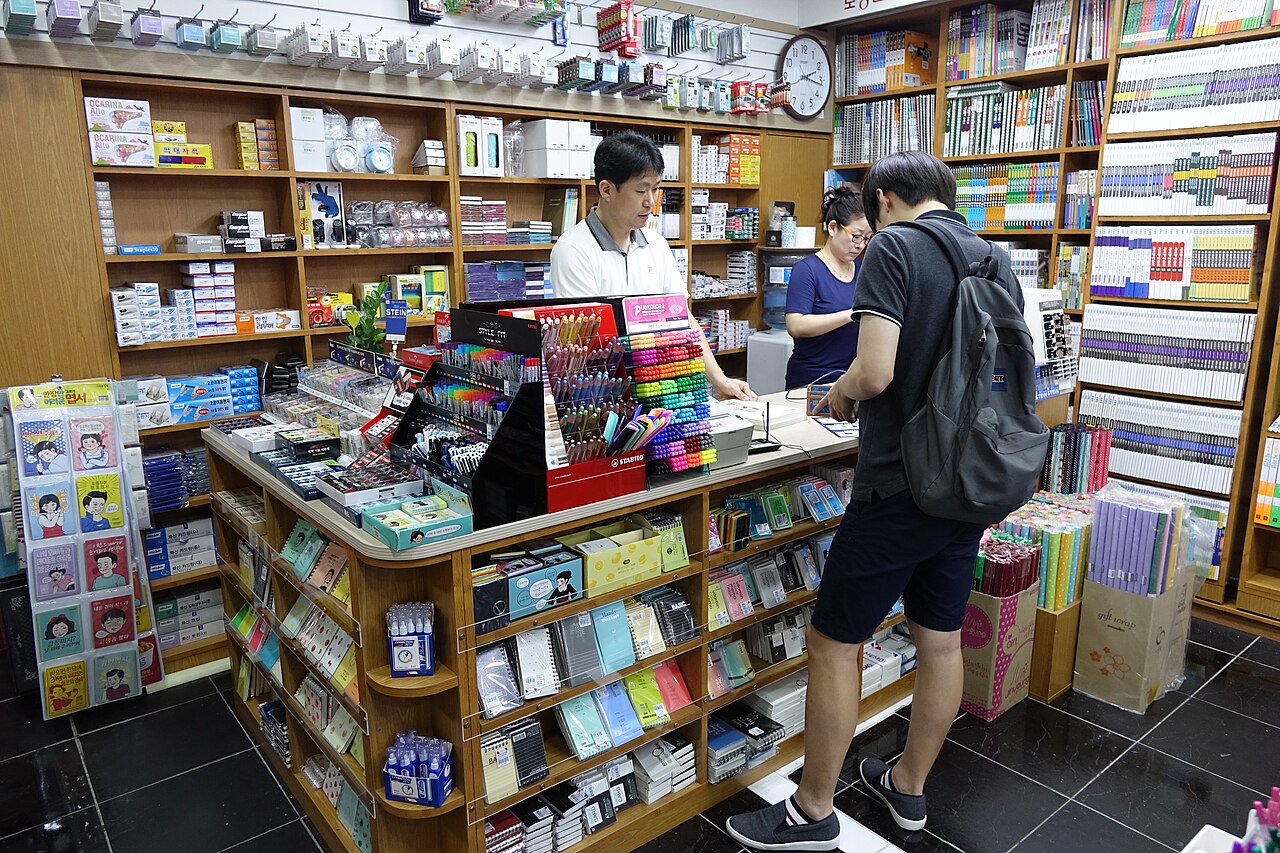
Korea’s school-front stationery shops sold school supplies and playthings on the same shelves. Older games such as ddakji, marbles and gonggi reached children there as shop-bought goods. Drawing on a National Folk Museum reconstruction, encyclopedia entries and city records, this piece traces the play culture around the munbanggu.
A shop between school and home
A munbanggu supplied school materials as well as playthings. In the National Folk Museum’s reconstruction of a Seoul neighbourhood in the 1970s and 1980s, the Hyeondae stationery shop displays magnetic pencil cases and insect-collecting tools alongside ddakji, paper dolls and snacks. Study and play shared the same shelves.
The reconstruction does not represent every Korean neighbourhood, but it offers a way to examine school-front shop culture of the 1980s and 1990s through objects and what children did with them.
Supplies and playthings
Buying a notebook or a classroom tool served a different purpose from choosing a toy, but at a stationery shop the two happened in the same space. Looking for something needed meant seeing and comparing things wanted. An errand for the next lesson could also bring break time and after-school play to mind.
Dooly Museum’s 2024 programme accompanying its stationery-shop exhibition covered 1980s–1990s stationery history alongside character merchandise, yo-yos and ddakji. Pictures, characters and friends’ games also shaped how children chose ordinary school items.
Ddakji
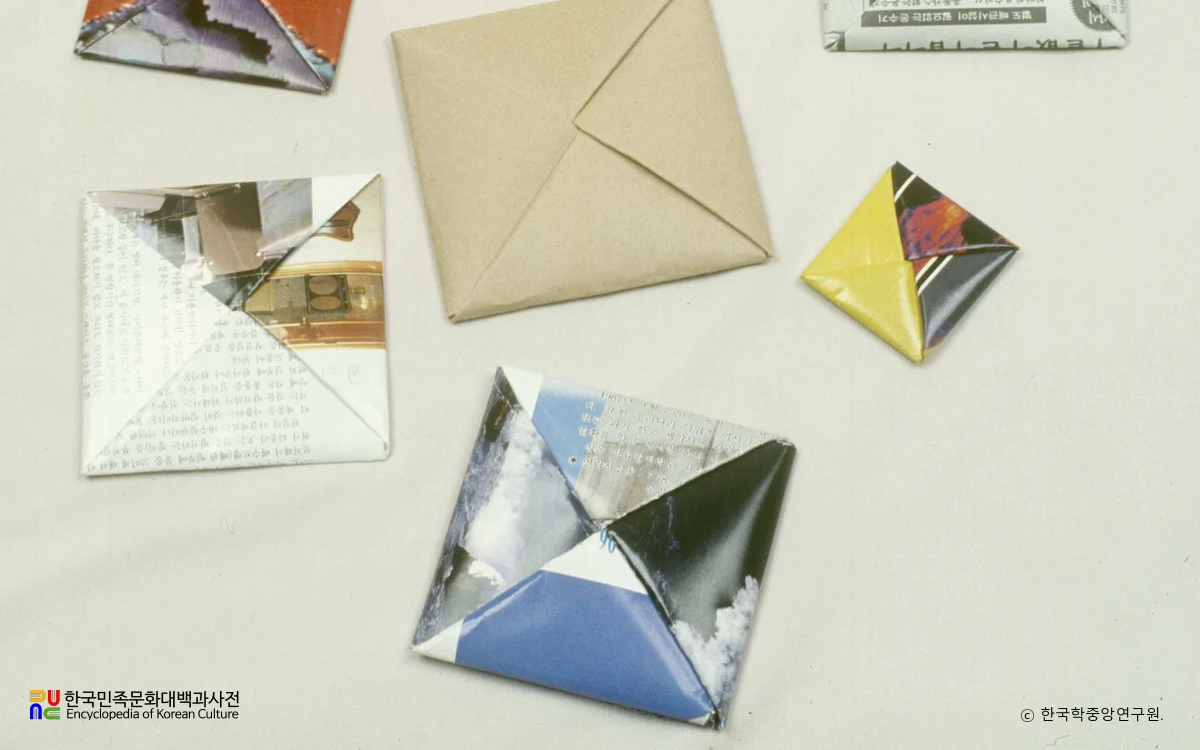
Ddakji tiles can be folded from layers of paper or cut from printed sheets. In the basic game described by the National Folk Museum, a player strikes beside an opponent’s tile on the ground with their own. A flipped tile is won; a miss passes the turn. Where to strike and how thick to fold the tile affect the outcome.
The game was not invented in the 1980s. The museum points to a newspaper reference from 1924. The shop brought an older game to children in new materials and commercial versions.
Marbles
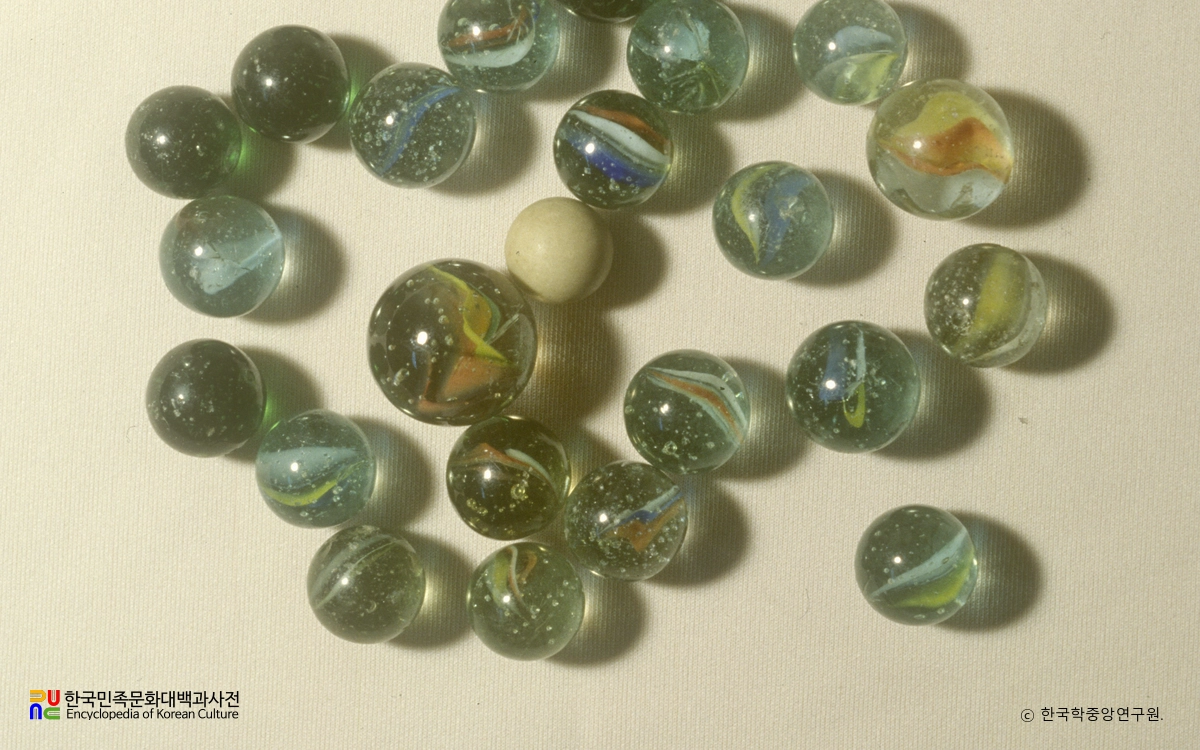
Marble games were not limited to flicking one marble at another. The Encyclopedia of Korean Culture records games involving marbles inside circles or triangles and games using holes dug in the ground. A familiar rule in one neighbourhood could be unknown in the next.
Players therefore had to agree on boundaries, turns and what counted as success before starting. The same marbles became a game only through that agreement.
Gonggi
In gonggi, a player tosses one piece, gathers pieces from the ground and catches the falling piece. The number picked up defines each stage; touching another piece or missing the catch passes the turn. The eyes follow the airborne piece while the hand works below.
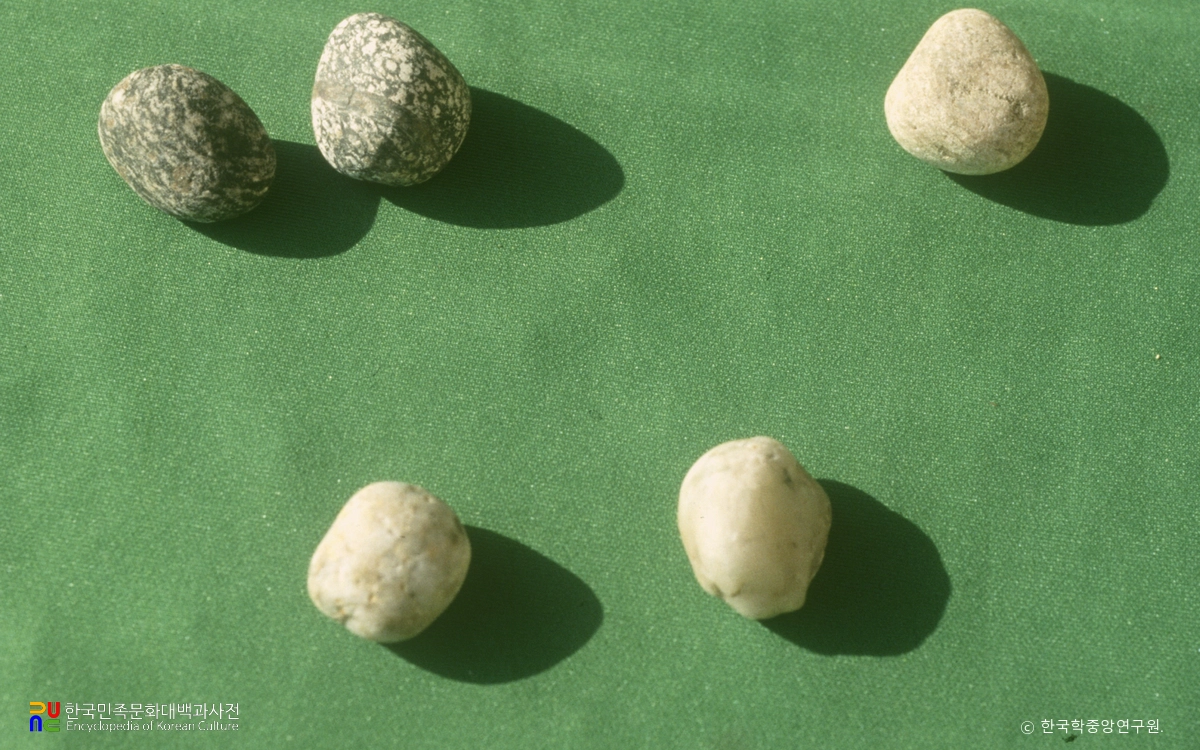
The names vary by region. The encyclopedia records jjagebatgi in Gyeongbuk and salgu in Gyeongnam. The photograph here shows actual stones, not manufactured plastic pieces. Children played with materials found close at hand long before shops sold sets.
Old games, new merchandise
Grouping folded paper tiles, glass marbles and character stationery together as “old things” hides their differences. Making something, choosing something to own and competing with friends using the same equipment were distinct pleasures, and school-front shop culture brought them together.
There is no basis for assigning a game permanently to boys or girls, or for assuming every child bought the same things. Memories differed according to what each child could obtain and who they played with.
How the shops changed
Smartphones alone do not explain the decline of these shops. In a 2019 support announcement, Busan Metropolitan City cited fewer pupils, schools buying classroom supplies in bulk, and spending shifting to large retailers and online stores. That was the city’s assessment at the time, not a count of shops across Korea today.
The accompanying 2015 photograph of a Gwacheon shop shows real shelves and a counter. It records that moment; whether the business still operates was not checked. Anyone trying ddakji or gonggi today quickly finds that players know different rules.
Sources & context
2026-10-12T12:36:11.240Z
National Folk Museum · Street of Memories ↗National Folk Museum · How ddakji is played ↗National Folk Museum · Folk games and their history ↗Academy of Korean Studies · Gonggi ↗Academy of Korean Studies · Marble games ↗Dooly Museum · 2024 stationery-shop exhibition programme ↗Busan Metropolitan City · School-front stationery shop support, June 24, 2019 ↗Photographs and collection: Academy of Korean Studies, Toys; individual images KOGL Type 1 ↗Original photo and rights: Choi Kwang-mo, Bookmart No. 2, Gwacheon, August 22, 2015, CC0 ↗Original photograph: Choi Kwang-mo · Wikimedia Commons · CC0 1.0 ↗Original photograph: “Ddakji,” Encyclopedia of Korean Culture · Academy of Korean Studies · KOGL Type1 ↗Original photograph: “Marbles,” Encyclopedia of Korean Culture · Academy of Korean Studies · KOGL Type1 ↗Original photograph: “Gonggi stones,” Encyclopedia of Korean Culture · Academy of Korean Studies · KOGL Type1 ↗Photograph licence: KOGL Type1 ↗Photograph licence: CC0 1.0 ↗Bookmart No. 2 in Gwacheon, photographed on 22 August 2015. This later view of a school-supply and book shop is not an 1980s–1990s scene or confirmation that it still operates. Photo: Choi Kwang-mo (최광모). Original title: “20150822최광모RX10DSC02346.JPG”. Taken and uploaded 2015-08-22. Source: https://commons.wikimedia.org/wiki/File:20150822최광모RX10DSC02346.JPG License: CC0 1.0 (https://creativecommons.org/publicdomain/zero/1.0/). Wikimedia’s 1280-pixel rendition is used unchanged. The card uses an 8:5 centered display crop; open the larger photo for the complete file, including original markings.
Photo credit
“Ddakji,” Encyclopedia of Korean Culture · Academy of Korean Studies · KOGL Type1 · KOGL Type 1A detail of folded-paper ddakji tiles. Some upper examples lie outside this crop; it does not show the complete original arrangement. Capture, publication and manufacture dates are not specified. Photo credit and rights holder: Academy of Korean Studies (한국학중앙연구원); individual photographer unlisted. Original title and required credit: [딱지] 한국민족문화대백과사전 (Encyclopedia of Korean Culture). Source: https://encykorea.aks.ac.kr/Article/E0048347 License: KOGL Type 1 (https://www.kogl.or.kr/info/licenseType1.do). Cropped the source area y=290–1040 to 1200×750 and losslessly WebP-encoded, without resizing, padding, colour change or distortion. Card and enlarge link show the same detail; the uncropped original is available at the source.
Photo credit
“Marbles,” Encyclopedia of Korean Culture · Academy of Korean Studies · KOGL Type1 · KOGL Type 1A detail of a group of glass marbles; some upper marbles lie outside the crop. Marbles support games of hitting other marbles, playing within boundaries and following holes in the ground. Capture, publication and manufacture dates are not specified. Photo credit and rights holder: Academy of Korean Studies (한국학중앙연구원); individual photographer unlisted. Original title and required credit: [구슬] 한국민족문화대백과사전 (Encyclopedia of Korean Culture). Source: https://encykorea.aks.ac.kr/Article/E0048347 License: KOGL Type 1 (https://www.kogl.or.kr/info/licenseType1.do). Cropped the source area y=296–1046 to 1200×750 and losslessly WebP-encoded, without resizing, padding, colour change or distortion. Card and enlarge link show the same detail; the uncropped original is available at the source.
Photo credit
“Gonggi stones,” Encyclopedia of Korean Culture · Academy of Korean Studies · KOGL Type1 · KOGL Type 1All five natural-stone gonggi pieces remain visible, rather than plastic shop-bought pieces. Background is trimmed above and below while preserving the five stones and original source/copyright marks. Capture, publication and manufacture dates are not specified. Photo credit and rights holder: Academy of Korean Studies (한국학중앙연구원); individual photographer unlisted. Original title and required credit: [공기돌] 한국민족문화대백과사전 (Encyclopedia of Korean Culture). Source: https://encykorea.aks.ac.kr/Article/E0048347 License: KOGL Type 1 (https://www.kogl.or.kr/info/licenseType1.do). Cropped the source area y=130–880 to 1200×750 and losslessly WebP-encoded, without resizing, padding, colour change or distortion. Card and enlarge link show the same detail; the uncropped original is available at the source.