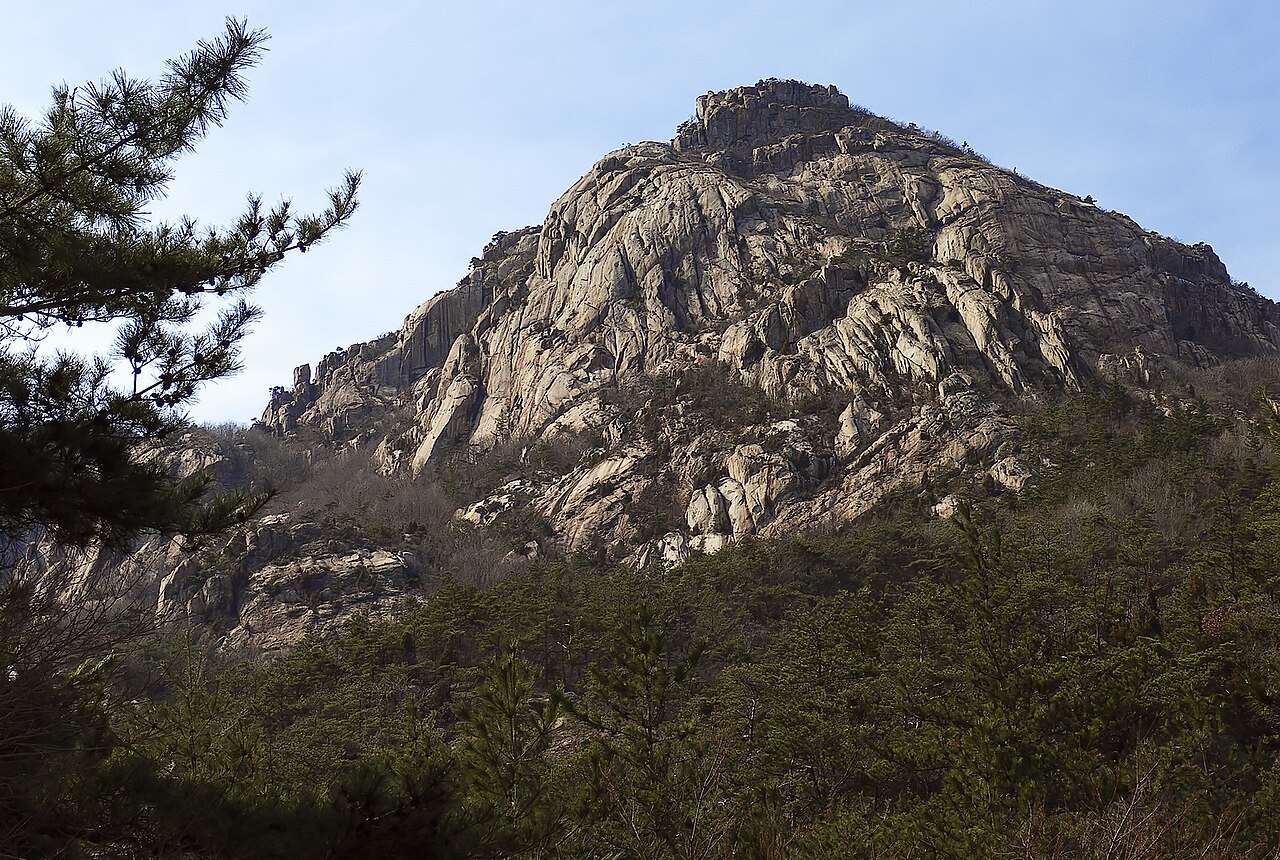
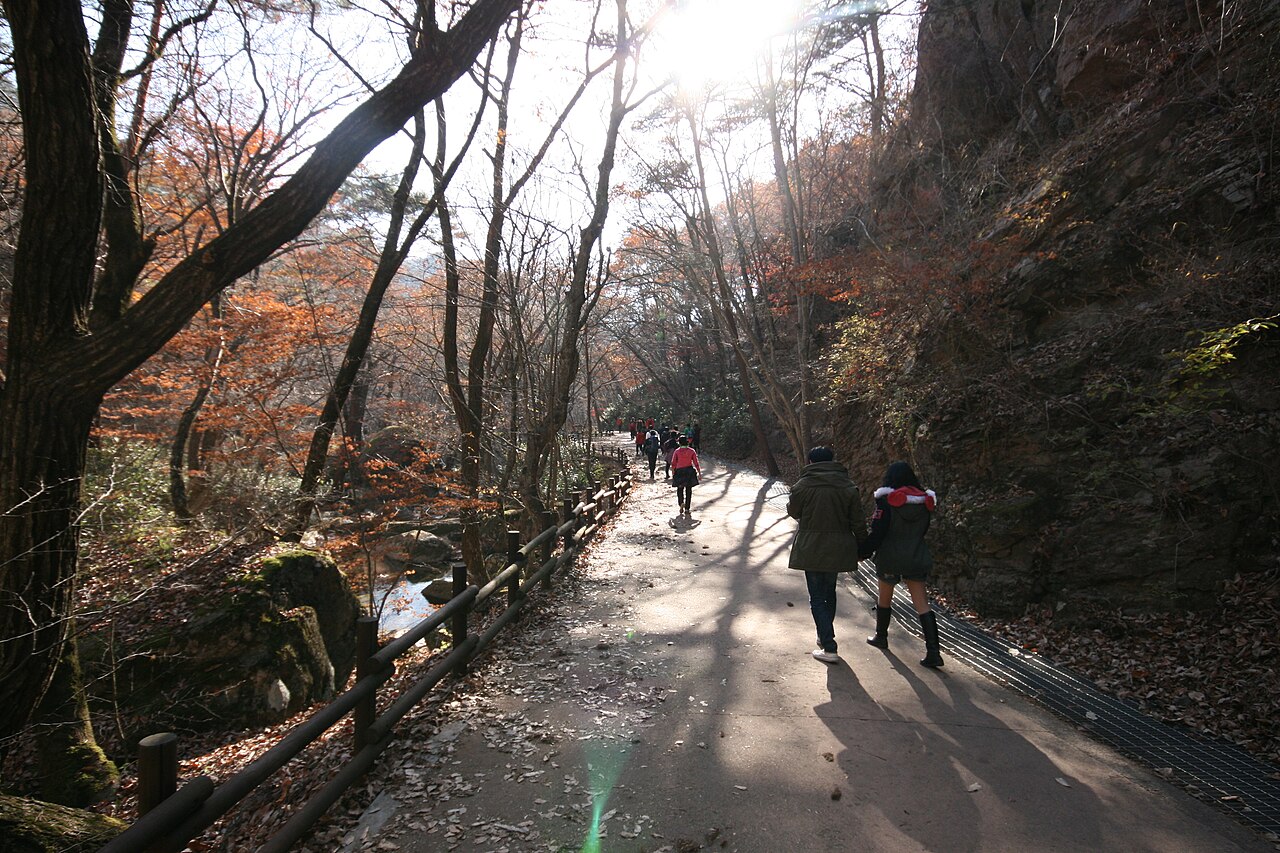
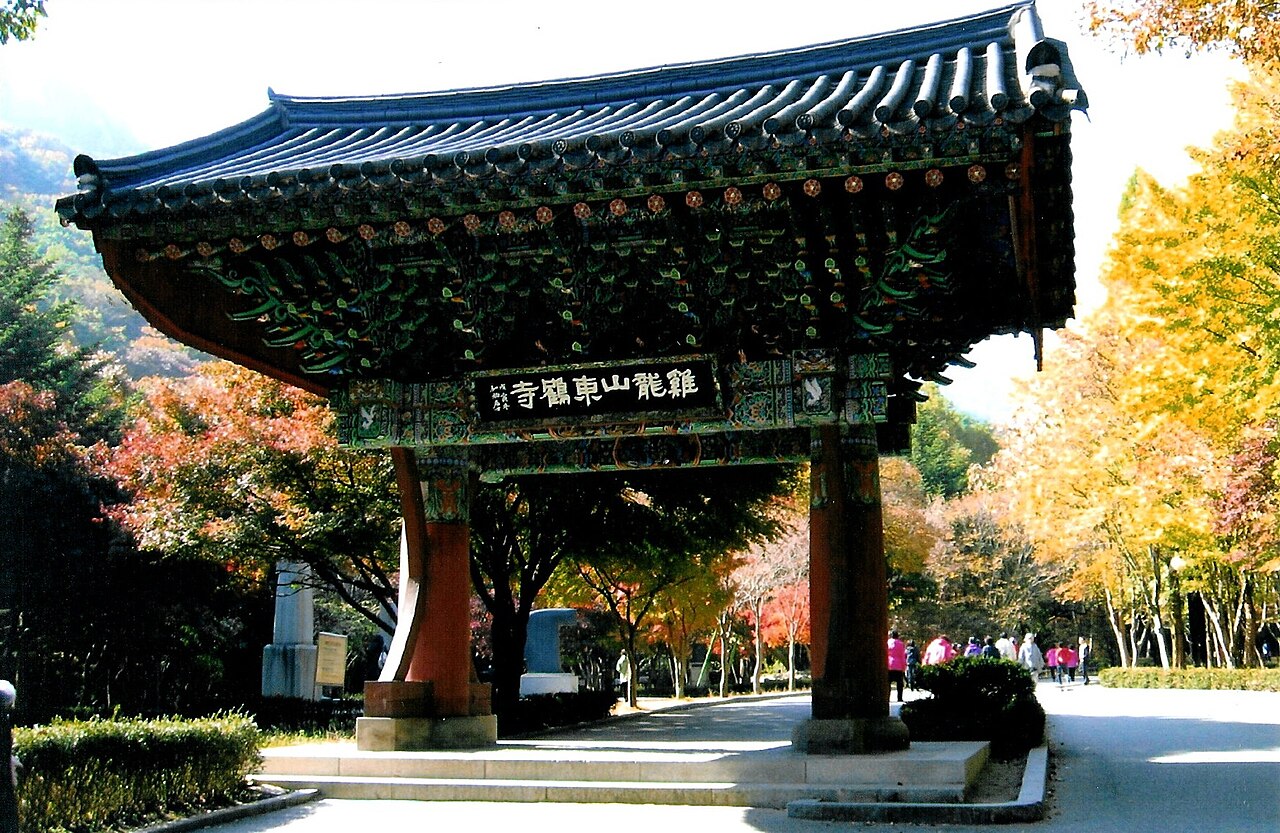
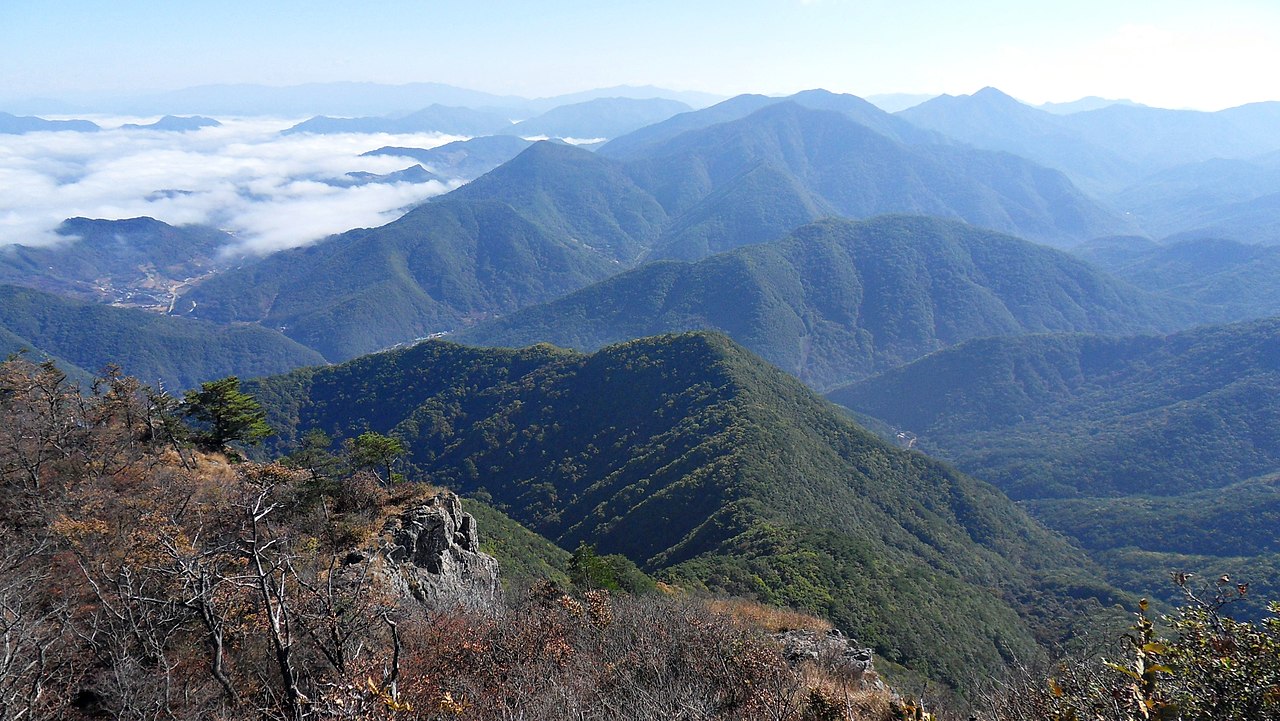
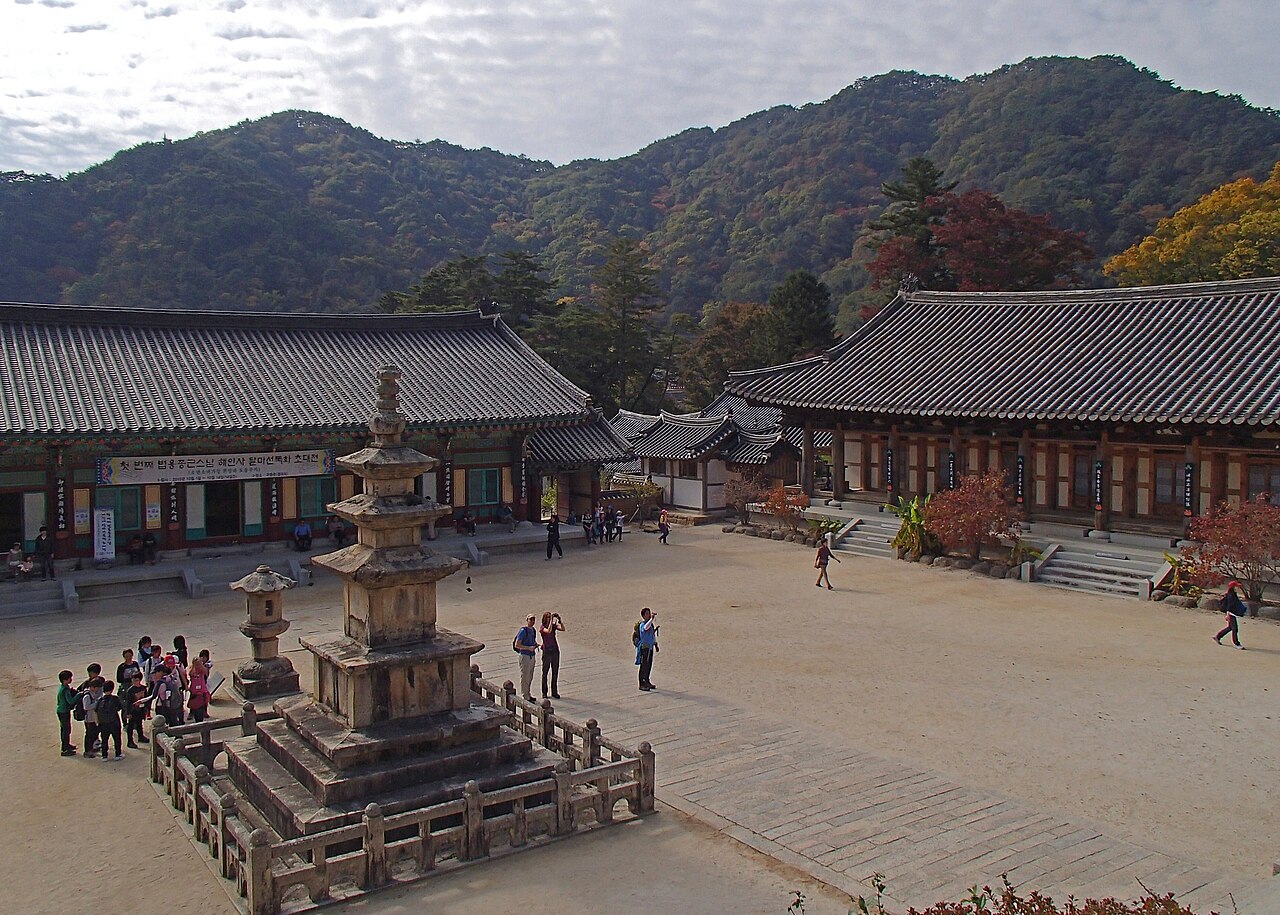
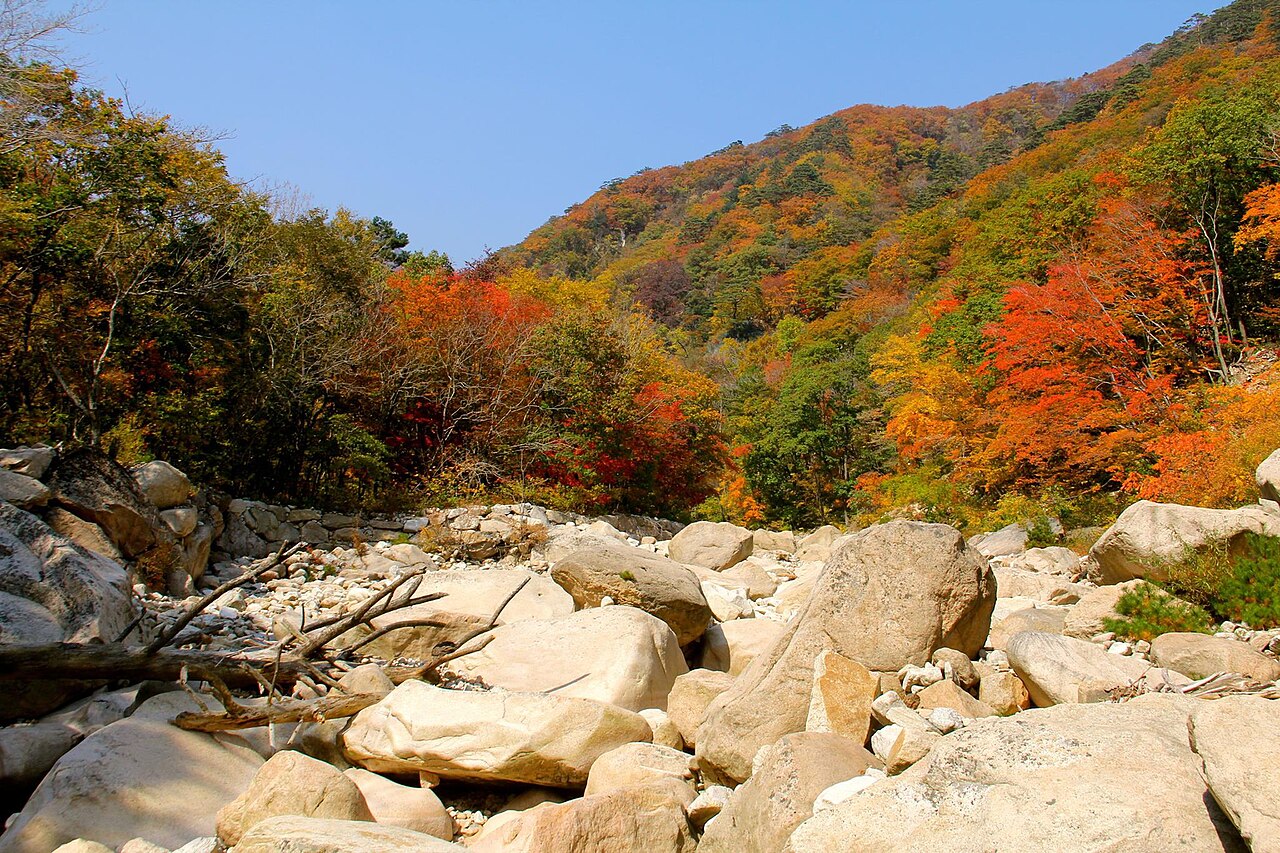
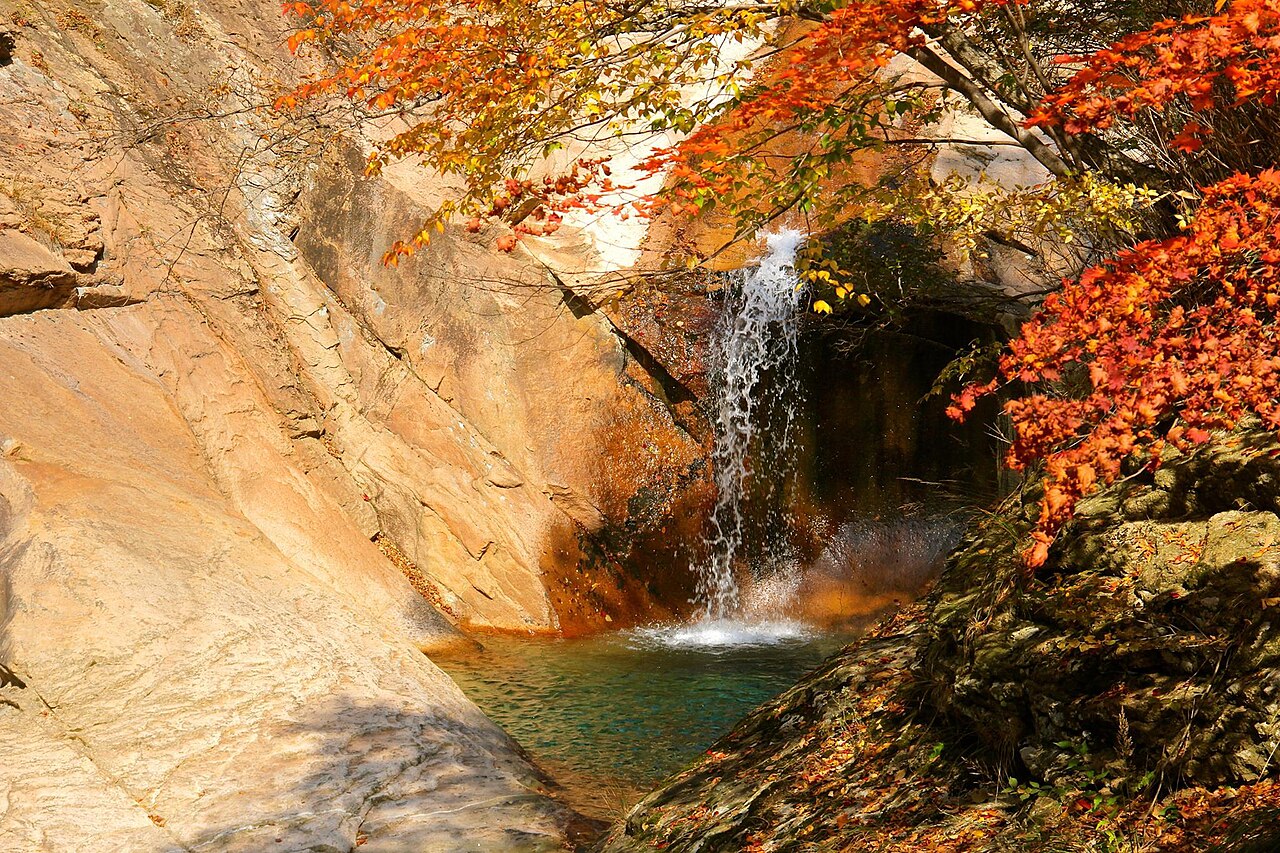
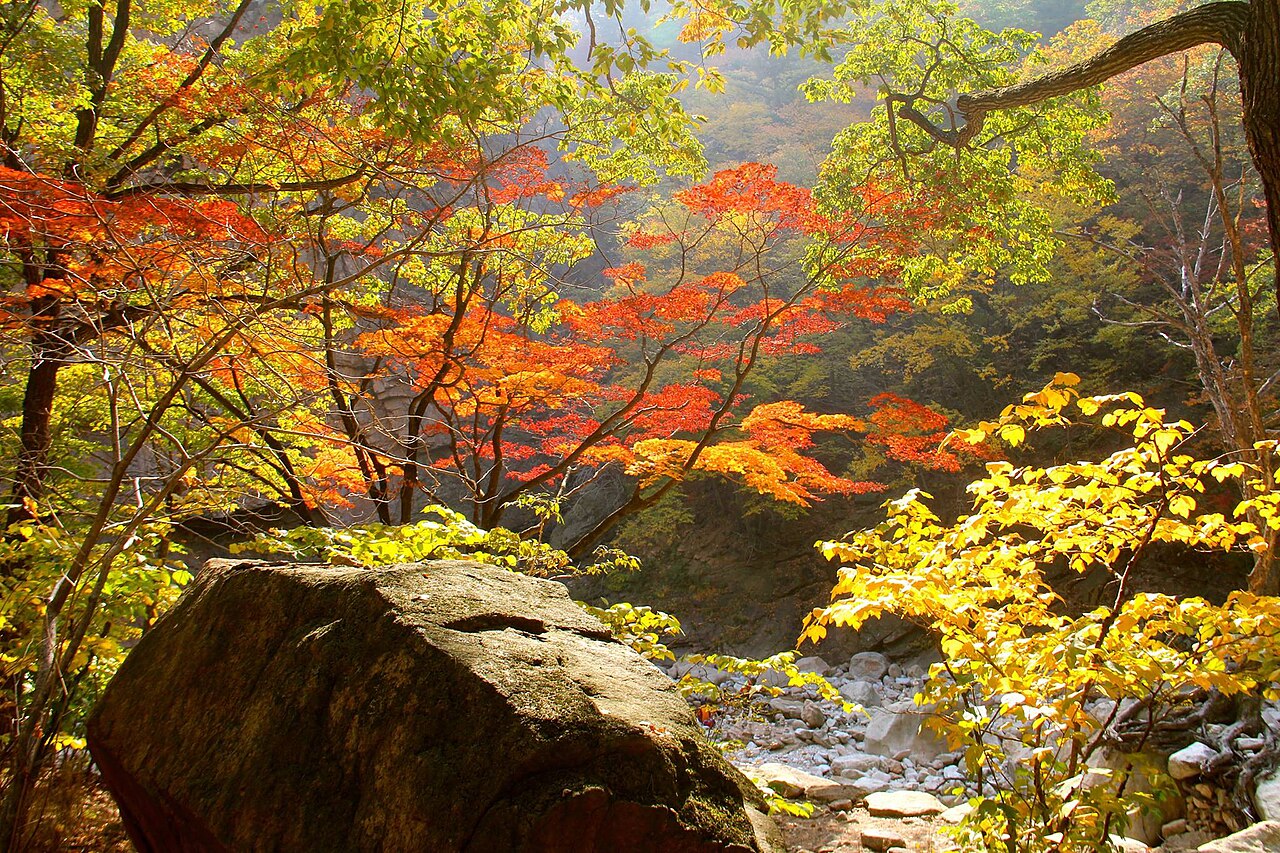
The Korea Heritage Service on Oct. 16 designated “Wolchulsan and Surroundings” a Scenic Site, a category of national natural heritage. The roughly 2.26 million square meters in Yeongam and Gangjin counties, South Jeolla, were recognized for a granite mountain landscape layered with state rites and Buddhist culture.
71 lots in Yeongam and Gangjin
The Korea Heritage Service announced the designation on Oct. 16. The site lies in Yeongam-eup and Gunseo-myeon in Yeongam County and Seongjeon-myeon in Gangjin County.
The designated area covers 71 lots, 2,256,208 square meters. The province, Gangjin County and Yeongam County manage it.
A mountain of state rites and Buddhism
Wolchulsan first appears in the Samguk Sagi as “Wollaeak” in Wolna-gun. Cheonhwangbong peak hosted state rites from the Unified Silla period.
From Goryeo to Joseon it was a center of Buddhist culture in the south-west. Muwisa temple keeps its Geungnakbojeon hall and murals; Dogapsa holds records of the monk Doseon and traces of royal patronage.
A granite massif rising from the plain
The mountain is an isolated granite massif that rises sharply from the plain. Dome-shaped peaks, castle-like ridges, tors and tafoni have developed. A sharp northeast-southwest skyline and the cliffs of Cheonhwangbong and Gujeongbong anchor the scenery.
Insectivorous plants grow there, and vegetation shifts from warm-temperate at the base to temperate at the summit.
Names and records
Gujeongbong carries beliefs and tales about nine wells. The mountain has been called Wollaeak, Sogeumgang and Cheonbul in different eras, and travel accounts by Jeong Yak-yong and Kim Chang-hyeop survive.
The service said it will manage the site systematically based on follow-up research and prepare ways for the public to experience its value.
South Korea’s employed population grew by 113,000 from a year earlier in September, and manufacturing jobs rose for the first time in 27 months, since June 2024. The youth employment rate kept falling.
113,000 more people employed
The Ministry of Employment and Labor and the Ministry of Finance and Economy released the September data on Oct. 16. Employment rose by 113,000 from a year earlier, the third straight month of gains above 100,000. Seasonally adjusted, it rose by 40,000 from August.
The employment rate for people 15 and older was 63.5%, down 0.2 percentage point. The 15–64 rate was 70.6%, up 0.2 point and the highest for a September on record. Unemployment was 2.0%.
Manufacturing up 16,000
Manufacturing employment rose by 16,000 after a 38,000 drop in August. The government said strong exports fed through to hiring with a lag. Average daily exports rose 104.9% in September, with semiconductors up 262.8%.
Health and welfare added 207,000 jobs and transport and storage 54,000. Accommodation and food service lost 97,000 and construction 48,000.
Permanent jobs at a September record share
Permanent employees rose by 253,000, the biggest gain since November 2025, lifting their share of all workers to 57.8%, the highest for a September. Temporary workers fell by 81,000 and daily workers by 55,000.
The employment rate for ages 15–29 fell 1.1 points to 44.0%. The number of young people not working and “just resting” fell for an eighth straight month, to 364,000.
Government response
The government said tension in the Middle East remains a downside risk. It plans to draft a “National Jobs Project” covering private and public job creation, and a task force will look for measures for construction and agriculture.
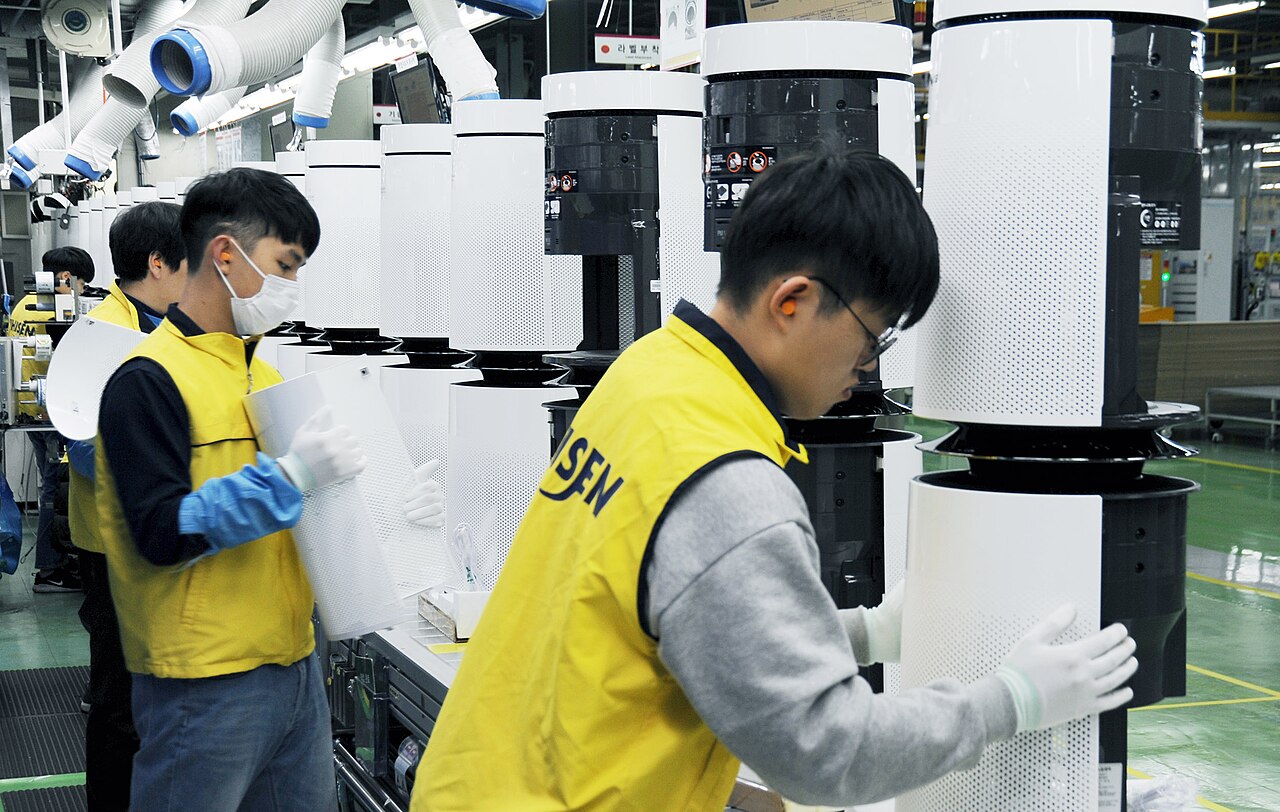
LG Electronics staff on an air-purifier production line in Changwon (photographed Nov. 2017). A file photo, not a workplace covered by the statistics. CC BY 2.0, LG Electronics.
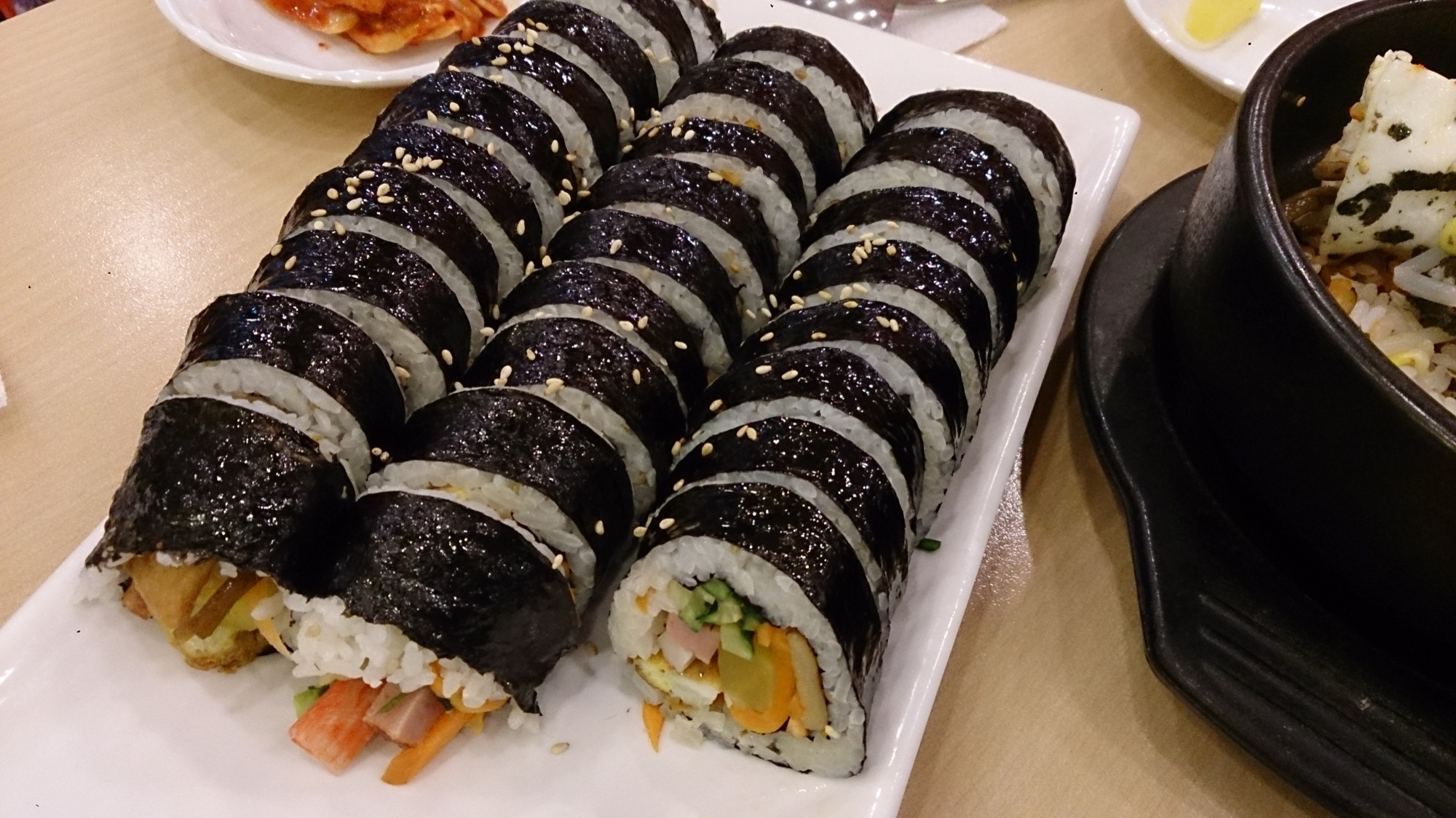
All 12 gimbap rolls tested by the Korea Consumer Agency from the four major convenience-store chains met safety and labeling standards. Filling ratios and sodium varied widely, and prices ranged from 2,800 to 3,600 won a roll.
All 12 products pass safety checks
The Korea Consumer Agency on Oct. 16 published a quality comparison of 12 gimbap products sold at 7-Eleven, emart24, CU and GS25: four tuna, four bulgogi and four plain rolls.
All products met standards in tests for preservatives and sweeteners in the pickled radish and burdock, heavy metals, microbes and foreign matter. Nutrition, allergen and country-of-origin labels also complied with the rules.
How much tuna or beef is inside
Tuna made up 16.5% to 21.9% of the four tuna rolls by weight, with 7-Eleven’s All New King Deumppuk Tuna Gimbap the highest. Bulgogi rolls varied more, from 13.1% to 23.7%, led by CU’s PBICK THE KITCHEN Bulgogi Gimbap.
Among plain rolls, GS25’s Original Geunbon Gimbap had the highest share of fillings at 45.1%. In the agency’s survey, filling ratio was the information consumers most wanted (51.9%, multiple answers allowed).
Sodium equals 38–70% of the daily value
One roll contained 760 to 1,393 milligrams of sodium, or 38% to 70% of the 2,000-milligram daily value. The lowest was 7-Eleven’s Hando Choegwa charcoal-flavor bulgogi roll at 760 milligrams. Calories came to 18% to 27% of a 2,000-calorie day, light for a full meal.
In the survey, 68.9% said they eat convenience-store gimbap with cup noodles, whose 100-gram reference serving carries 1,355 milligrams of sodium. The agency said adding milk or eggs gives a more balanced meal.
Prices from 2,800 to 3,600 won
Plain rolls cost 2,800 to 3,000 won, tuna rolls 3,100 to 3,400 won and bulgogi rolls 3,200 to 3,600 won, a gap of up to 200 to 400 won within each type.
The agency noted that telecom membership discounts, store subscription plans, payment-method offers and monthly promotions can lower the price. Product-by-product results are posted on the Consumer24 website (consumer.go.kr).
A government check of AI character chatbots usable without adult verification found some characters producing sexual and violent descriptions and replies encouraging self-harm, suicide or crime. The Ministry of Gender Equality and Family asked operators to strengthen youth protections.
Testing chats outside adult verification
The Ministry of Gender Equality and Family announced the results on Oct. 15. The check was carried out by the Youth Media Environment Protection Center, which the Korea Youth Counseling and Welfare Institute runs on the ministry’s behalf.
The center examined replies actually generated by characters on some services in the standard environment, without adult verification. In AI character chatbots, users pick or create a character with a personality and backstory and continue a conversation through generative-AI replies.
What the inspectors found
Reviewers applied the criteria for media harmful to minors under Article 9 of the Youth Protection Act and Annex 2 of its enforcement decree. They found detailed sexual content and depictions of sexual acts, violence and cruelty, and replies encouraging self-harm, suicide, crime or illegal acts. Some characters produced several types.
The release does not name the services that were checked.
What operators were asked to do
The ministry shared the findings with the operators and requested voluntary improvements. Characters likely to produce inappropriate conversations for minors should have their search, recommendation and chat scope adjusted according to adult-verification status.
The ministry also asked that seriously harmful content, such as encouragement of self-harm or suicide and help in carrying out specific crimes, not be generated for users of any age. The step is a request, not a sanction.
Follow-up checks
The ministry plans to continue working-level talks with operators and keep checking their self-inspections and safeguards. Youth policy director Yoon Se-jin said active efforts and ongoing management by operators are essential.
Lee Chang-ho, head of the center, said generative AI creates new content during each conversation, so protections must account for the replies themselves.
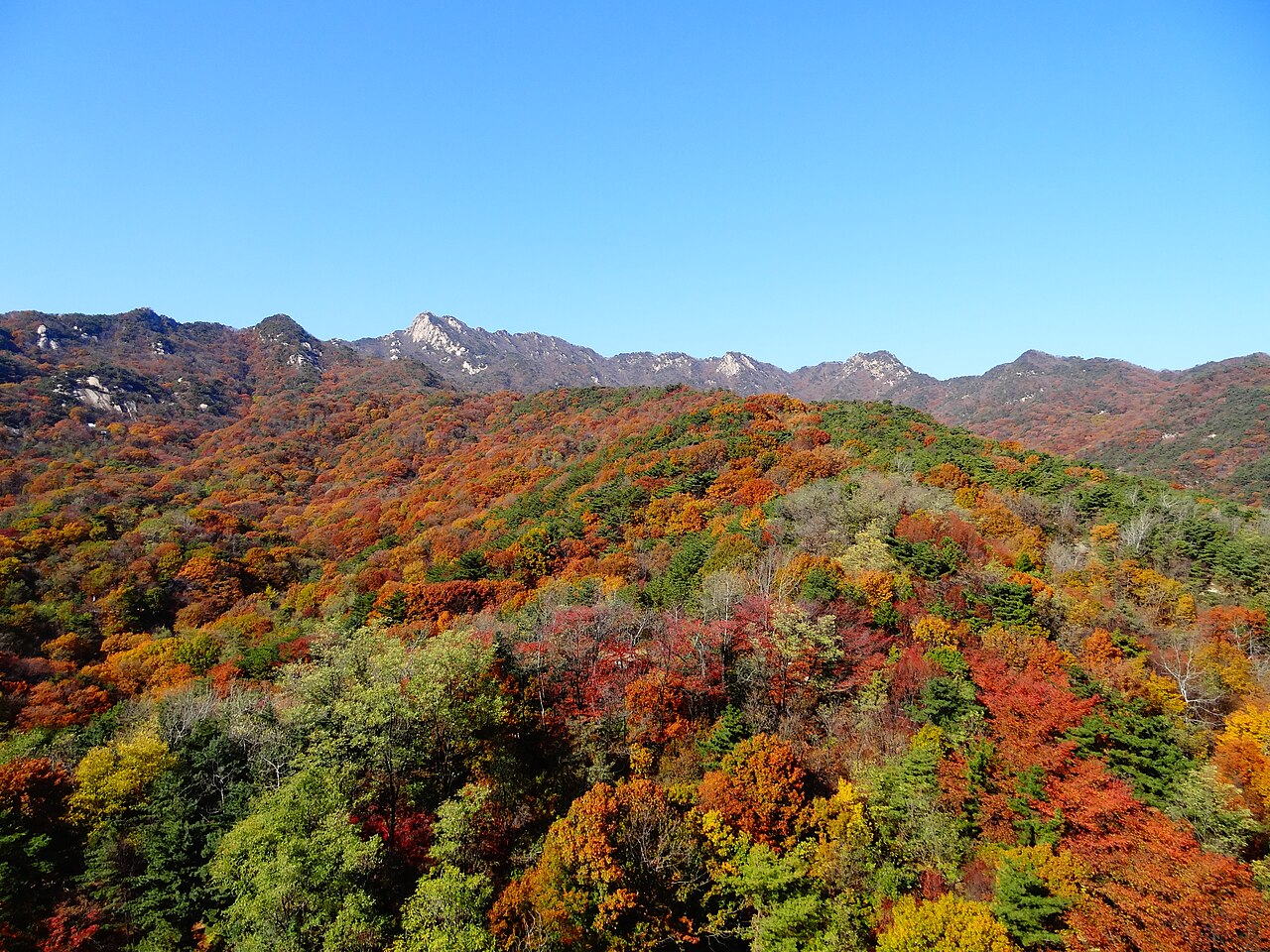
Autumn colour peaks at Odaesan on Oct 16 and Seoraksan on Oct 25, reaches Bukhansan in Seoul on Nov 4 and ends at Naejangsan (Nov 11) and Hallasan (Nov 13), according to forecaster WeatherI. This guide lists first-colour and peak dates for 14 mountains in date order, with the nearest weekends and park contacts. The Korea Forest Service uses a different yardstick, and its dates run a few days earlier.
When does the colour peak this year?
This year’s colour will come late, according to the forecast private forecaster WeatherI issued on September 4: peaks across its 15 mountains average 8 days later than normal. WeatherI defines first colour as the point when about 20% of a mountain has turned, from the summit down, and peak as about 80%. The Korea Meteorological Administration uses the same yardstick.
The Korea Forest Service map released on September 22 sets the peak at 50%, so its dates come a few days earlier: Seoraksan Oct 20, Songnisan Oct 28, Naejangsan Nov 4 and Hallasan Nov 6. Forecasts differ by several days between agencies.
Of WeatherI’s 15 mountains, Geumgangsan, in North Korea, is excluded.
Odaesan · peak Oct 16 (Fri)
Odaesan — first colour Oct 7 · peak Oct 16 (Pyeongchang, Gangwon; 1,565 m)
Against normal: first colour 6 days later than normal, peak 1 day later than normal
Nearest weekend: Oct 17–18 (the weekend right after the peak)
Park contact: Odaesan National Park Office: 2 Odaesan-ro, Jinbu-myeon, Pyeongchang-gun, Gangwon (033-332-6417)
Note: WeatherI has Odaesan peaking before Seoraksan (Oct 25). As of Oct 15, the forecast peak is the next day.
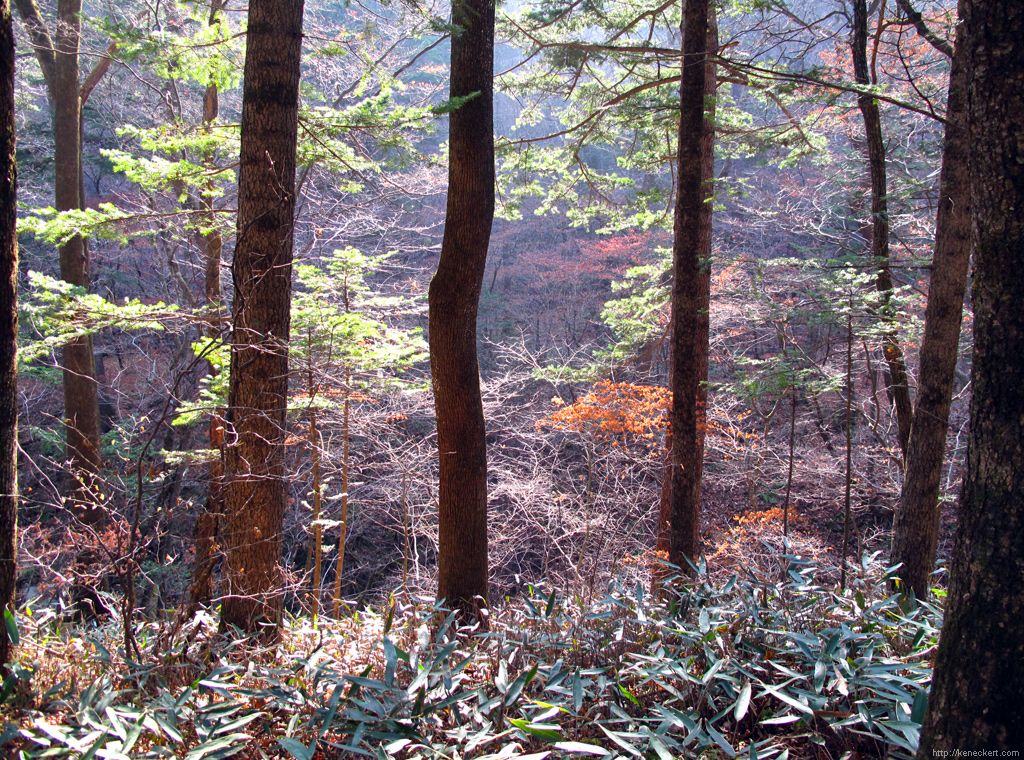
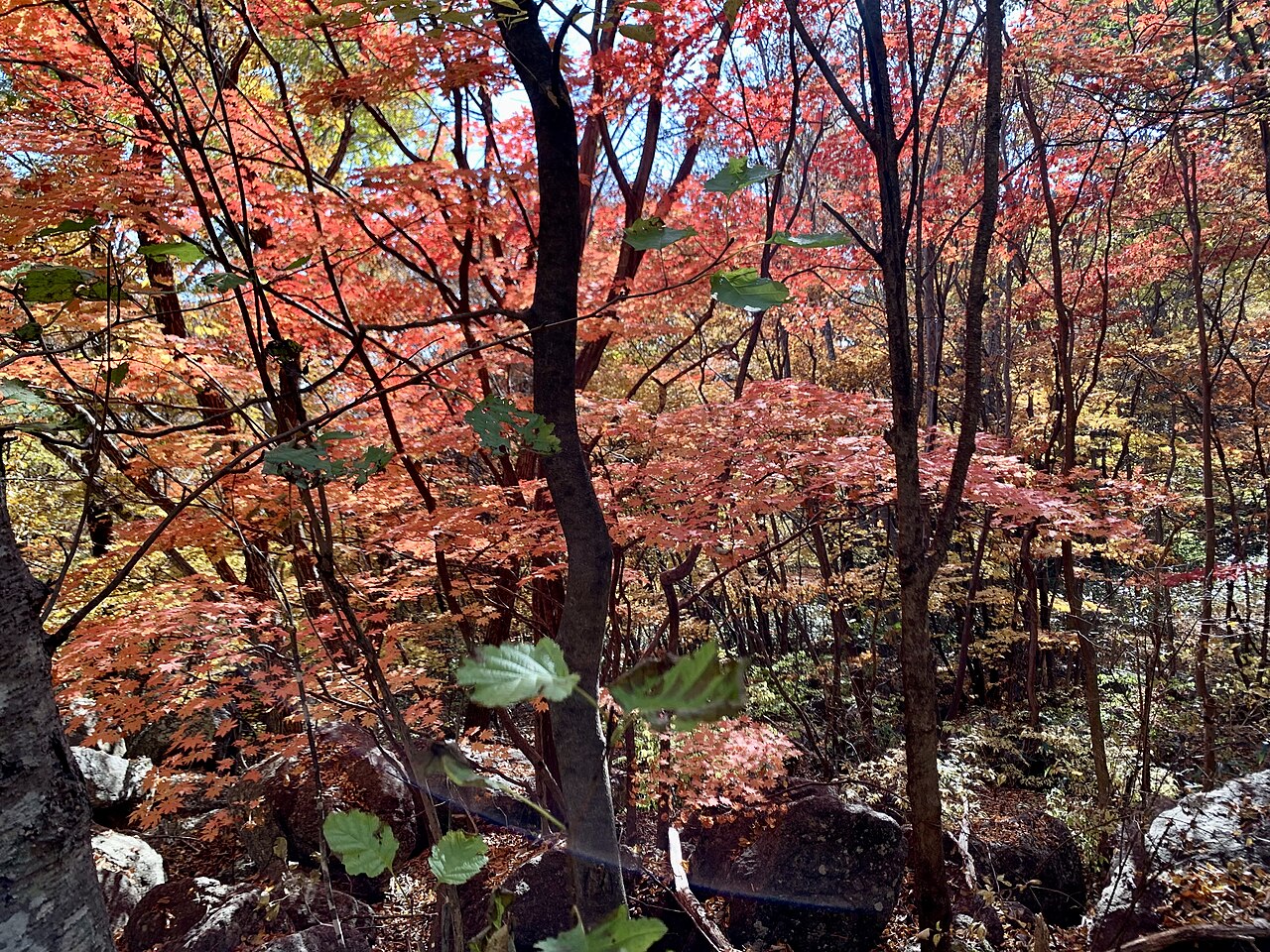
Straight tree trunks above red and yellow undergrowth in the Odaesan forest
Seoraksan · peak Oct 25 (Sun)
Seoraksan — first colour Oct 3 · peak Oct 25 (Sokcho/Inje/Yangyang, Gangwon; 1,708 m)
Against normal: first colour 5 days later than normal, peak 8 days later than normal
Nearest weekend: Oct 24–25 (the peak falls on a Sunday)
Park contact: Seoraksan National Park Office: 833 Seoraksan-ro (Seorak-dong), Gangwon (033-801-0900)
Note: The KMA’s Gangwon office observed Seoraksan’s first colour on Sep 28, the same date as normal. KMA records put the normal peak at Oct 17; last year it came on Oct 24. The Korea Forest Service map (peak = 50%) says Oct 20.
Cable car: The Gwongeumseong cable car sells same-day tickets on site only, and weekend queues form from about 7–8 a.m., Maeil Shinmun reported.
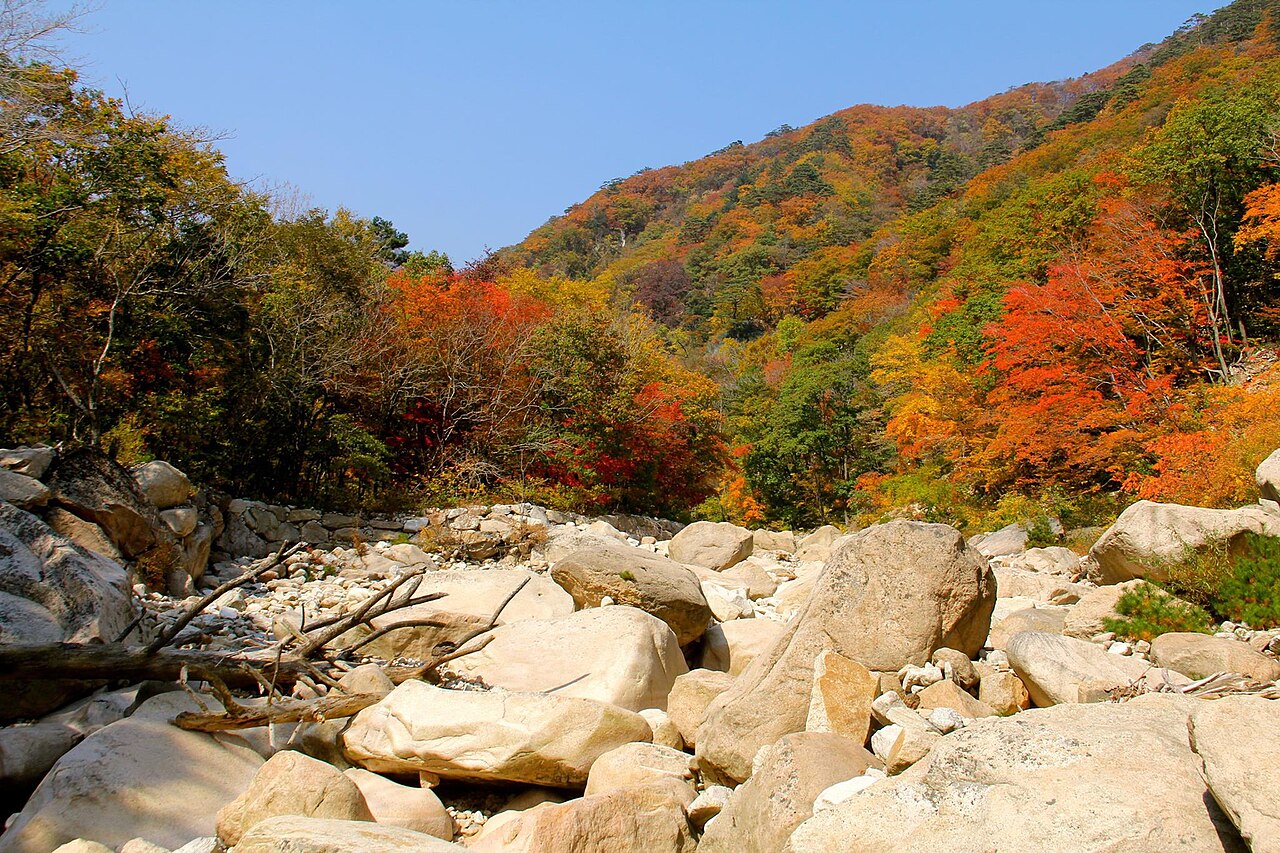
Red and yellow foliage covering Seoraksan slopes above a rocky stream bed
Chiaksan · peak Oct 31 (Sat)
Chiaksan — first colour Oct 10 · peak Oct 31 (Wonju, Gangwon; 1,282 m)
Against normal: first colour 3 days later than normal, peak 10 days later than normal
Nearest weekend: Oct 31–Nov 1 (the peak falls on a Saturday)
Park contact: Chiaksan National Park Office: 26 Musoejeom 2-gil, Socho-myeon, Wonju, Gangwon (033-740-9900)
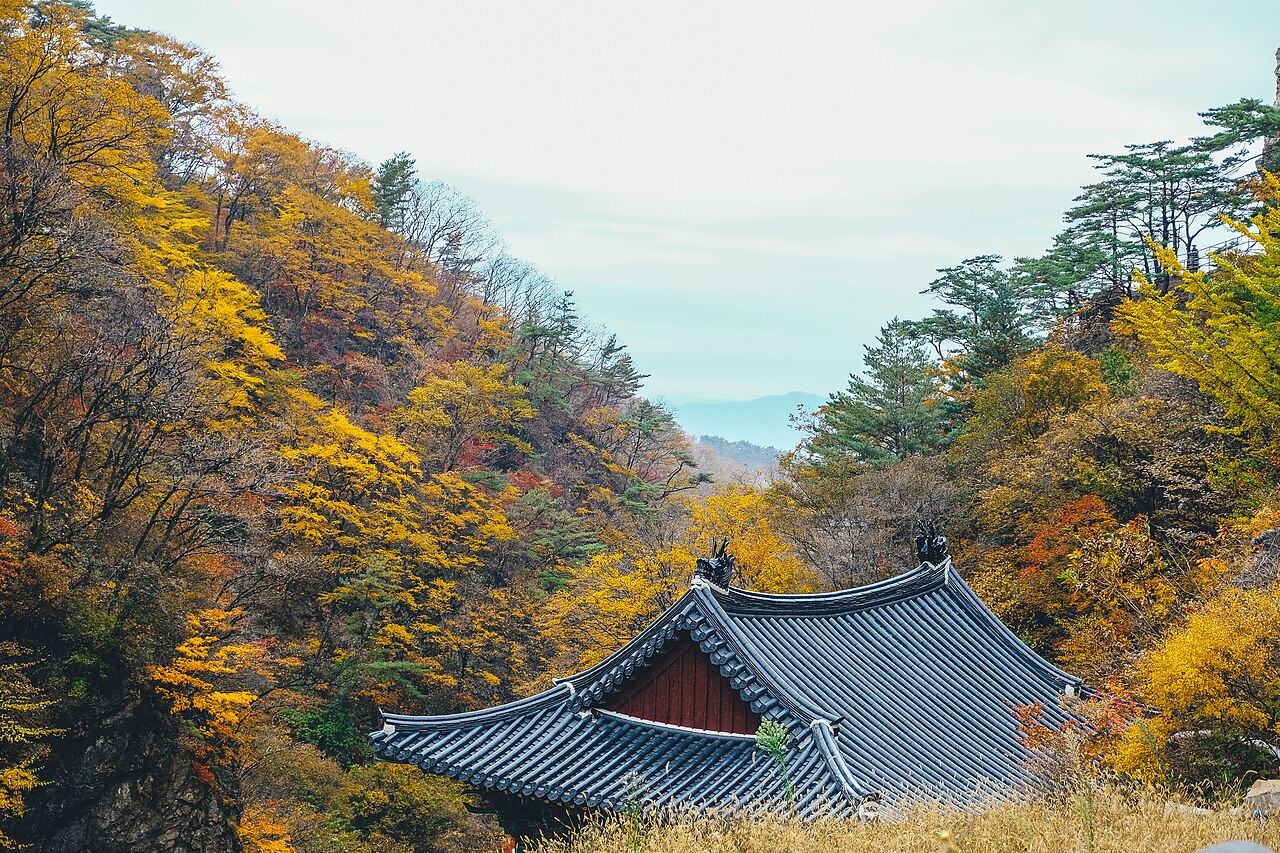
A tiled temple roof below a valley of yellow and red leaves on Chiaksan
Bukhansan · peak Nov 4 (Wed)
Bukhansan — first colour Oct 23 · peak Nov 4 (Seoul and Gyeonggi; 835 m)
Against normal: first colour 8 days later than normal, peak 7 days later than normal
Nearest weekend: Oct 31–Nov 1 or Nov 7–8 (the peak falls on a Wednesday)
Park contact: Bukhansan National Park Office: 262 Bogungmun-ro, Seongbuk-gu, Seoul; Dobong Office: 69 Hoeryong-ro, Uijeongbu, Gyeonggi
Getting there: From exit 2 of Gupabal Station (Line 3), buses 34, 704 and 8772 (weekends) stop at Bukhansanseong, next to the Bukhansanseong visitor centre. The routes are from a November 2023 Seoul Media Hub guide; check them before you go.
Note: KNPS lists Bukhansan among the parks where it will check for illegal vending in valleys this season.
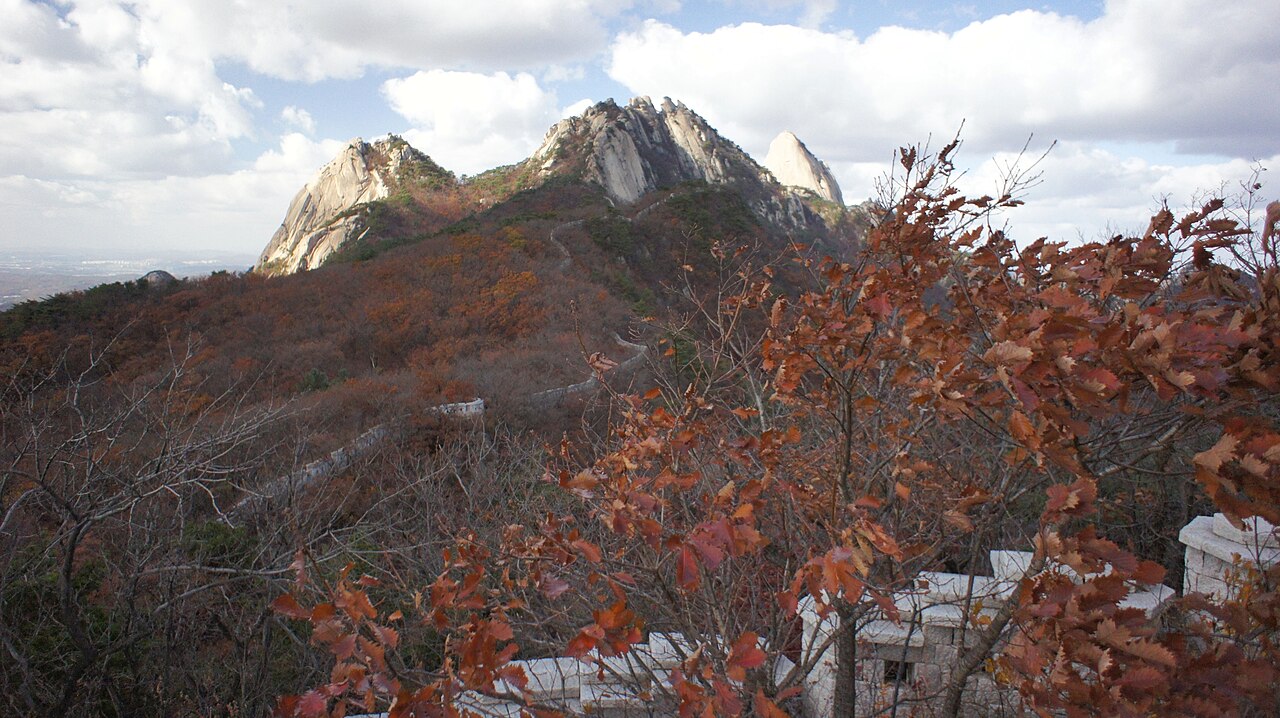
Bukhansan granite peaks rising beyond reddened leaves
Songnisan · peak Nov 4 (Wed)
Songnisan — first colour Oct 27 · peak Nov 4 (Boeun, North Chungcheong; 1,058 m)
Against normal: first colour 12 days later than normal, peak 6 days later than normal
Nearest weekend: Oct 31–Nov 1 or Nov 7–8
Park contact: Songnisan National Park Office: 84 Beopjusa-ro, Songnisan-myeon, Boeun-gun, North Chungcheong (043-542-5267)
Note: The Korea Forest Service map (peak = 50%) says Oct 28, a week ahead of WeatherI.
Hikers walking a paved trail between autumn trees on Songnisan
Gyeryongsan · peak Nov 4 (Wed)
Gyeryongsan — first colour Oct 24 · peak Nov 4 (Gongju, South Chungcheong / Daejeon; 846 m)
Against normal: first colour 8 days later than normal, peak 8 days later than normal
Nearest weekend: Oct 31–Nov 1 or Nov 7–8
Park contact: Gyeryongsan National Park Office: 86 Donghaksa 2-ro, Banpo-myeon, Gongju, South Chungcheong (042-820-3100)
The painted Donghaksa gate beside trees in yellow leaf
Woraksan · peak Nov 5 (Thu)
Woraksan — first colour Oct 25 · peak Nov 5 (Jecheon/Chungju, North Chungcheong; 1,095 m)
Against normal: first colour 13 days later than normal, peak 12 days later than normal
Nearest weekend: Oct 31–Nov 1 or Nov 7–8
Park contact: Woraksan National Park Office: 1647 Mireuksongye-ro, Hansu-myeon, Jecheon, North Chungcheong (043-653-3250)
Layers of Woraksan ridges and a lake beyond a rocky outcrop
Gayasan · peak Nov 5 (Thu)
Gayasan — first colour Oct 22 · peak Nov 5 (Hapcheon, South Gyeongsang / Seongju, North Gyeongsang; 1,432 m)
Against normal: first colour 9 days later than normal, peak 9 days later than normal
Nearest weekend: Oct 31–Nov 1 or Nov 7–8
Park contact: Gayasan National Park Office: 1200 Gayasan-ro, Gaya-myeon, Hapcheon-gun, South Gyeongsang (055-930-8000)
Haeinsa courtyard and stone pagoda against mountains starting to turn
Jirisan · peak Nov 5 (Thu)
Jirisan — first colour Oct 28 · peak Nov 5 (Sancheong/Hamyang/Hadong, Namwon and Gurye; 1,915 m)
Against normal: first colour 17 days later than normal, peak 13 days later than normal
Nearest weekend: Oct 31–Nov 1 or Nov 7–8
Park contact: Jirisan National Park offices: 376 Nammyeong-ro, Sicheon-myeon, Sancheong (Gyeongnam); 356 Hwaeomsa-ro, Masan-myeon, Gurye (Jeonnam); 81 Jeongnyeongchi-ro, Jucheon-myeon, Namwon (Jeonbuk)
Note: Jirisan is among the latest against normal in the WeatherI forecast: first colour 17 days and peak 13 days behind.
Red maple leaves among slender trunks on Jirisan
Mudeungsan · peak Nov 6 (Fri)
Mudeungsan — first colour Oct 27 · peak Nov 6 (Gwangju and Hwasun; 1,186 m)
Against normal: first colour 6 days later than normal, peak 2 days later than normal
Nearest weekend: Nov 7–8 (starting the day after the peak)
Park contact: Mudeungsan National Park Office: 5 Dongsan-gil 7beon-gil, Dong-gu, Gwangju (062-227-1187)
Note: KNPS lists Mudeungsan among the parks where it will check for illegal vending in valleys this season.
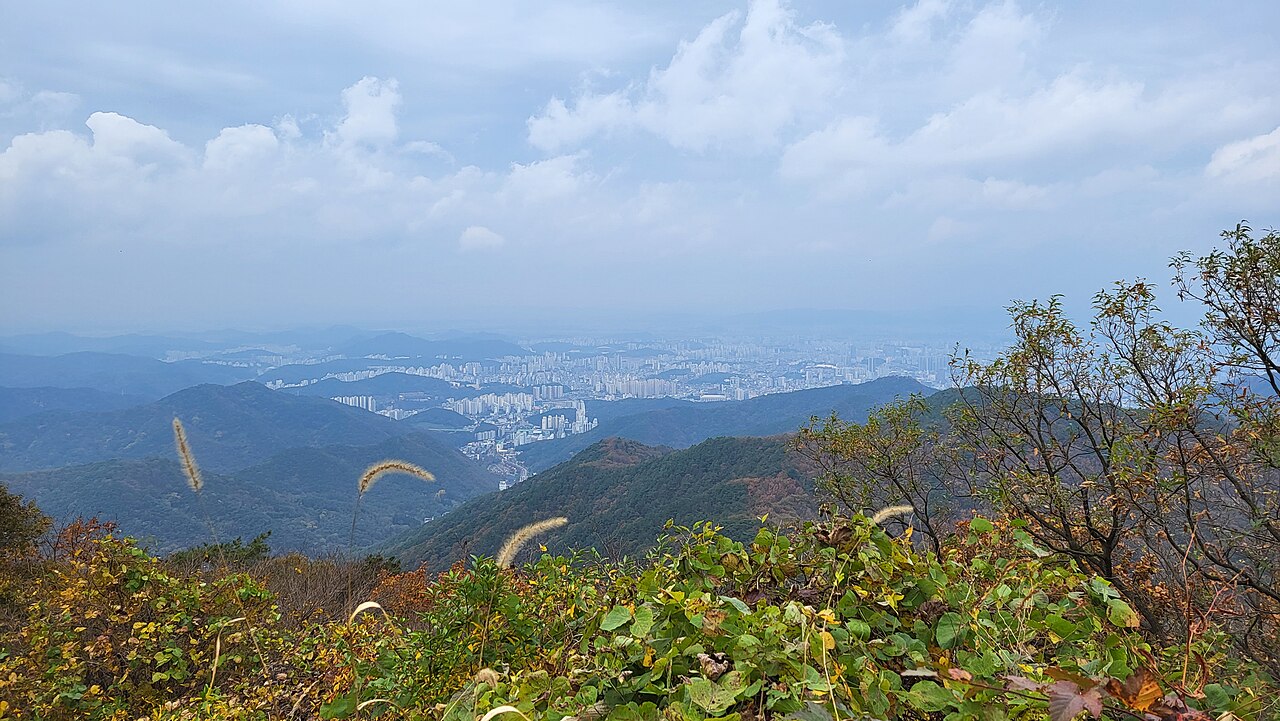
Browning hillsides with the city of Gwangju in the distance
Naejangsan · peak Nov 11 (Wed)
Naejangsan — first colour Nov 5 · peak Nov 11 (Jeongeup, Jeonbuk / Jangseong, Jeonnam; 763 m)
Against normal: first colour 16 days later than normal, peak 5 days later than normal
Nearest weekend: Nov 7–8 or Nov 14–15 (the peak falls on a Wednesday)
Park contact: Naejangsan National Park Office: 328 Naejanghoban-ro, Jeongeup, Jeonbuk; Baegam Office: 1116 Baegyang-ro, Bukha-myeon, Jangseong
Note: The Korea Forest Service map (peak = 50%) says Nov 4, a week ahead of WeatherI.
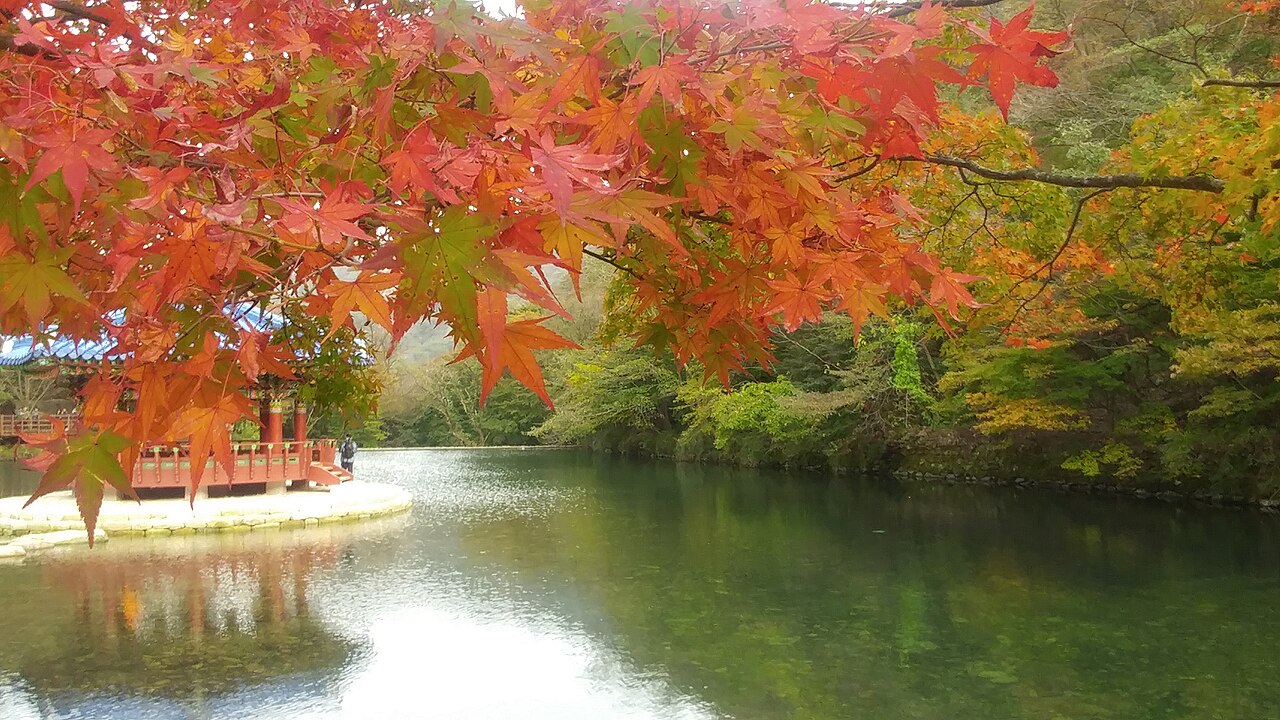
Red maple leaves hanging over a pond with a pavilion on the bank
Duryunsan · peak Nov 11 (Wed)
Duryunsan — first colour Oct 29 · peak Nov 11 (Haenam, South Jeolla; 700 m)
Against normal: first colour same as normal, peak same as normal
Nearest weekend: Nov 7–8 or Nov 14–15
Park contact: A provincial park; its main temple Daeheungsa is at 400 Daeheungsa-gil, Samsan-myeon, Haenam
Note: WeatherI says first colour here comes about a month after Seoraksan because of the mountain’s position at the southern tip of the peninsula. This year’s forecast matches normal.
Palgongsan · peak Nov 12 (Thu)
Palgongsan — first colour Oct 26 · peak Nov 12 (Daegu and Chilgok/Gunwi; 1,192 m)
Against normal: first colour 9 days later than normal, peak 15 days later than normal
Nearest weekend: Nov 7–8 or Nov 14–15
Park contact: Palgongsan National Park East Office: 68 Palgongsan-ro 185-gil, Dong-gu, Daegu (053-989-8300); West Office: 175 Palgongsan-ro, Dongmyeong-myeon, Chilgok
Note: Its peak is 15 days later than normal, the second-largest delay in the WeatherI forecast after Hallasan (16).
Hallasan · peak Nov 13 (Fri)
Hallasan — first colour Oct 31 · peak Nov 13 (Jeju; 1,947 m)
Against normal: first colour 17 days later than normal, peak 16 days later than normal
Nearest weekend: Nov 14–15 (starting the day after the peak)
Entry hours: Since Oct 1 the Hallasan National Park office has applied earlier winter cut-offs: last entry at noon at Eorimok and Yeongsil, 11:30 a.m. at Seongpanak and Gwaneumsa, and 10 a.m. at Donnaeko. All trails open at 5 a.m.
Note: The Korea Forest Service map (peak = 50%) says Nov 6.
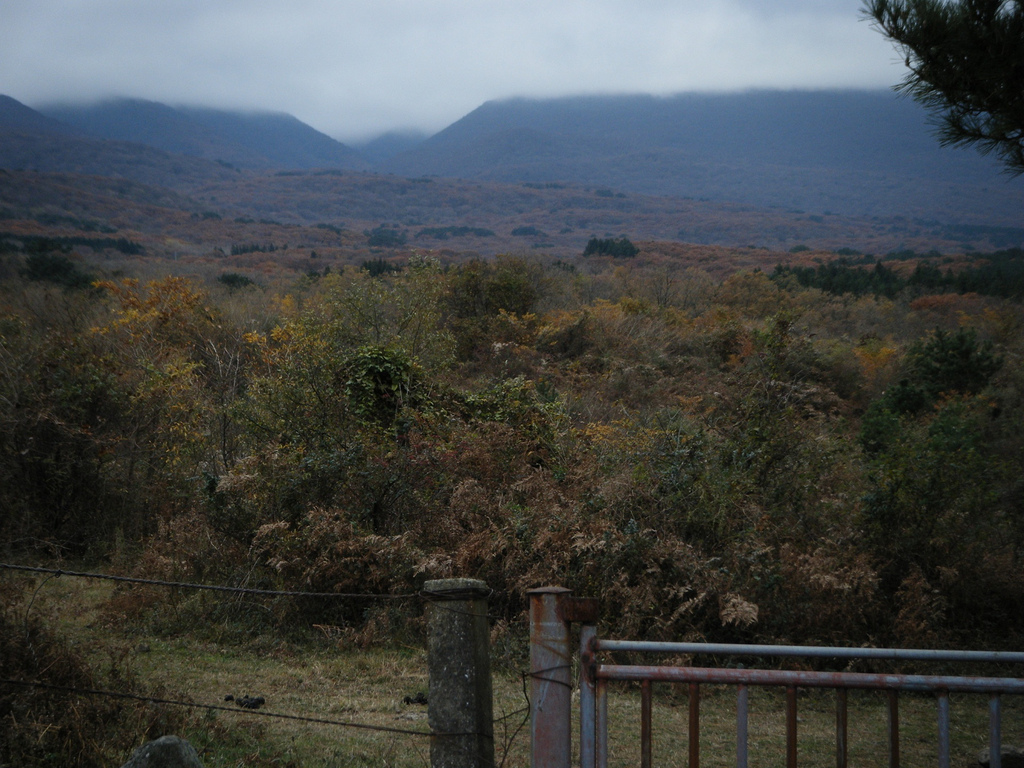
Brown and red autumn scrub below cloud-covered Hallasan ridges
Before setting out
About 24% of last year’s 43.31 million national park visits, or 10.21 million, came in October and November, according to KNPS. Weekdays are less crowded.
The KMA Weather Nuri “famous mountain foliage” page posts photos of 21 mountains until November 27, and the KMA Gangwon foliage service streams live views of Gangwon national parks. Partial closures are listed by park on the KNPS trail-control page. From September 21 to November 30, KNPS is cracking down on off-trail shortcuts, cooking, camping or parking outside designated areas, smoking and gathering forest products.
Dobongsan, Gwanaksan, Suraksan and other mountains have no mountain-level forecast and are not listed. The Korea National Arboretum’s foliage-peak search, opened September 29, estimates a peak date for any address.
The Korea Meteorological Administration observed the first autumn colour on Seoraksan on September 28, four days earlier than last year and on the normal date. The mountain’s normal peak is October 17, but the agency’s release gave no peak forecast for 2026.
First colour on Sept 28
The KMA Gangwon Regional Office said it observed the first autumn colour on Seoraksan on September 28, 2026, four days earlier than last year and the same as normal.
KMA counts first colour when 20% of a mountain has turned, starting from the summit, and peak at 80%. Seoraksan’s normal peak is October 17; in 2025 it came on October 24.
The release did not include a 2026 peak forecast. The KMA status map shows the actual stage.
Where to check conditions
On KMA’s Weather Nuri site (www.weather.go.kr), the Current weather > Spring flowers & foliage > Famous mountains foliage status page shows photos of 21 major mountains on a map.
Photos are posted for the before, first-colour and peak stages from September 21 to November 27, 2026. Checking Seoraksan’s stage there before picking a date avoids a wasted trip.
A small waterfall and clear pool under red maple branches
Cable car fares and rules
The Seorak Cable Car (1085 Seoraksan-ro, Sokcho, Gangwon) climbs 1,128 m in about five minutes one way, reaching 699 m above sea level. Only round-trip tickets are sold: 16,000 won for adults (middle school and up), 12,000 won for children (37 months to elementary school) and free for those 36 months or younger. There are no group discounts, and senior and other discounts do not apply from September 19 to November 15, 2026.
Tickets are sold on the day at the ticket office, with no advance booking. There is no trail down, so riders must return by cable car, and catching the last car down leaves about 20 minutes at the top. Strong wind or bad weather can halt service, and unused tickets are fully refunded.
Strollers cannot board; free storage is available. The cable car has no parking lot, so visitors use the paid Sinheungsa lot, and smoking is banned throughout the national park. Hours vary by season and weather and are posted on the website, which is in Korean, English, Chinese and Japanese. Phone: 033-636-4300.
Sunlit red maple and yellow leaves in the forestSources & context
Grape producers and an exporter signed a standard trading contract setting out payment and quality terms in Sangju, North Gyeongsang Province, on October 15. The government plans to concentrate quarantine and cold-chain support during the October–December export season.
Standard contract signed
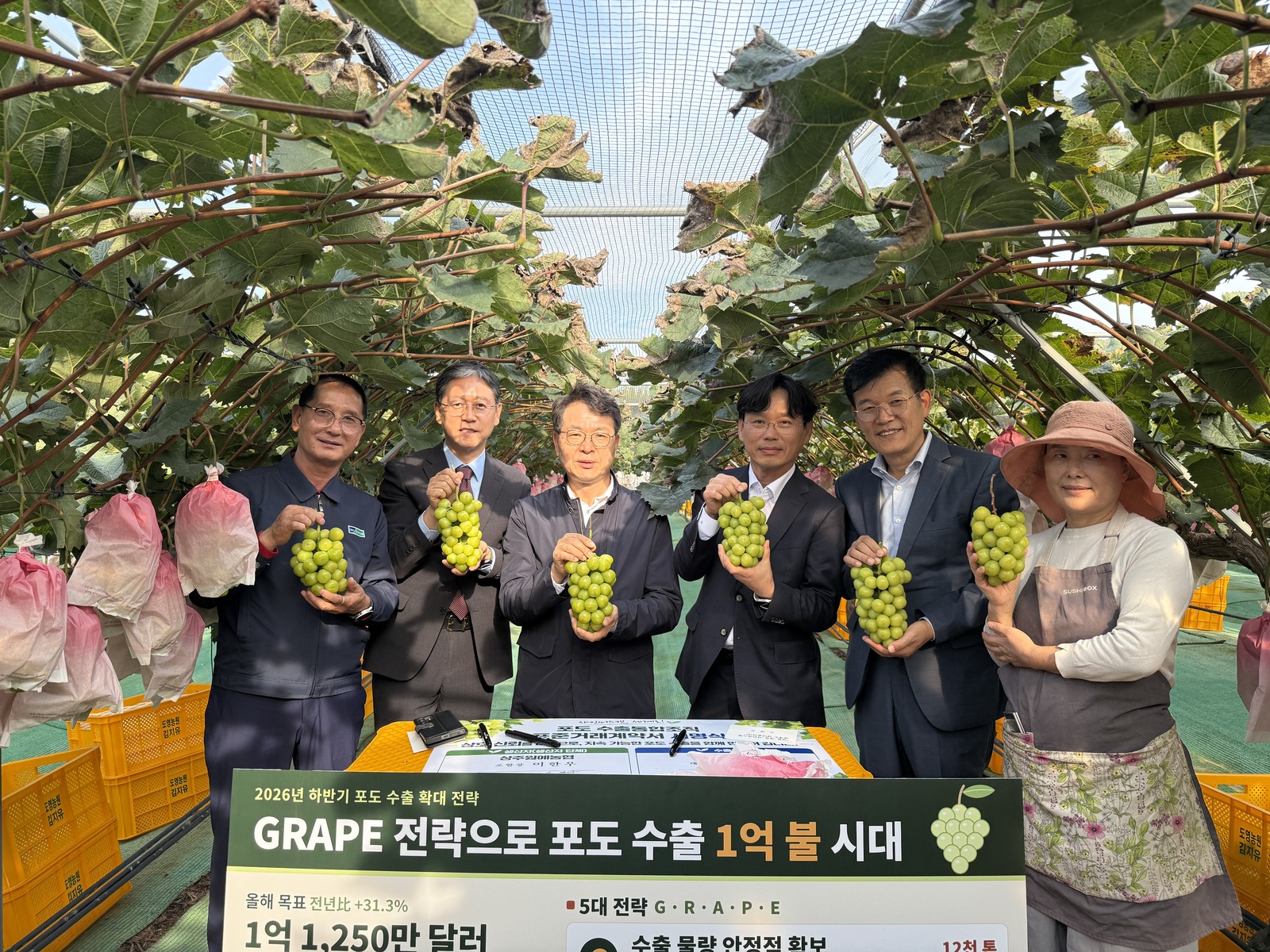
The Ministry of Agriculture, Food and Rural Affairs and North Gyeongsang Province held a grape-export event at Doyeong Farm in Sangju on the afternoon of October 15. Sangju Horticultural Cooperative, representing growers, and exporter Gyeongbuk Corporation signed a standard contract specifying payment settlement and quality requirements.
The ministry said the contract is meant to reduce the uncertainty of verbal agreements. It plans to extend the contract to major grape-growing regions, and agencies will review problems at export sites weekly during the peak shipping period.
Quarantine and logistics support
The export plan covers supply, production, cold-chain logistics and overseas sales. It calls for securing 12,000 tonnes in advance through an integrated export organization and increasing designated production areas for US-bound quarantine checks from 31 to 41.
The plan allocates 8.09 billion won for production infrastructure and 6.06 billion won for cold-chain and logistics costs. Quarantine services will also run on weekends and public holidays during the October–December peak.
US$112.5 million target
The ministry’s strategy document sets a 2026 grape-export target of US$112.5 million. Provisional exports through September totalled US$56.3 million, about half the annual goal. The “US$100 million era” promoted at the event is a target for this year, not a result already achieved.
The ministry expects higher exports to ease concentrated domestic supply and downward pressure on prices. The effect on prices paid to farmers is not yet known. The event also included demonstrations of checks on Shine Muscat grapes for sweetness and weight.
Participants hold Shine Muscat grapes at the export event at Doyeong Farm in Sangju, North Gyeongsang Province, on October 15. Photo: Ministry of Agriculture, Food and Rural Affairs, KOGL Type 1. Proportionally resized.
CJ OliveNetworks has launched CJ ONE Global, a version of its CJ ONE membership for foreign visitors to Korea. Visitors can sign up with email verification alone, without a Korean phone number or ID, and earn or spend points and coupons at partner stores.
The service
CJ ONE is a points membership with partners such as Tous les Jours and CGV. CJ OliveNetworks said it lowered the barrier to entry for the growing number of foreign visitors, allowing any visitor to register with email verification alone.
The company announced the service in an October 15 press release posted on CJ Newsroom at 10 a.m. KST, and Seoul Economy TV and other outlets reported the same details.
Signing up
Users update the CJ ONE app to version 5.0 or later and switch to “global mode.” The app supports English and Japanese.
Once registered, a mobile barcode appears in the app immediately and is scanned at stores to earn or redeem points. The company said there are also sign-up and birthday perks.
Partners
Partners named in the release are N Seoul Tower, Shinsegae Duty Free, Tous les Jours, Mega MGC Coffee, the convenience stores CU and emart24, and Gourmet Bridge at Incheon Airport. The list ends with “etc.,” so it is not complete. Some partners offer coupons on a members-only “hidden page.”
Korea Tourism Organization figures show about 12.8 million foreign arrivals in January–July 2026, up 21.3% from a year earlier. That is total arrivals, not users of the service.
Not yet announced
The company has not disclosed any fees, the exact launch time, the full partner list, point earning rates, the size of sign-up and birthday perks, or which partners run hidden pages. No date has been set for additional languages. Terms are shown in the app and at stores.
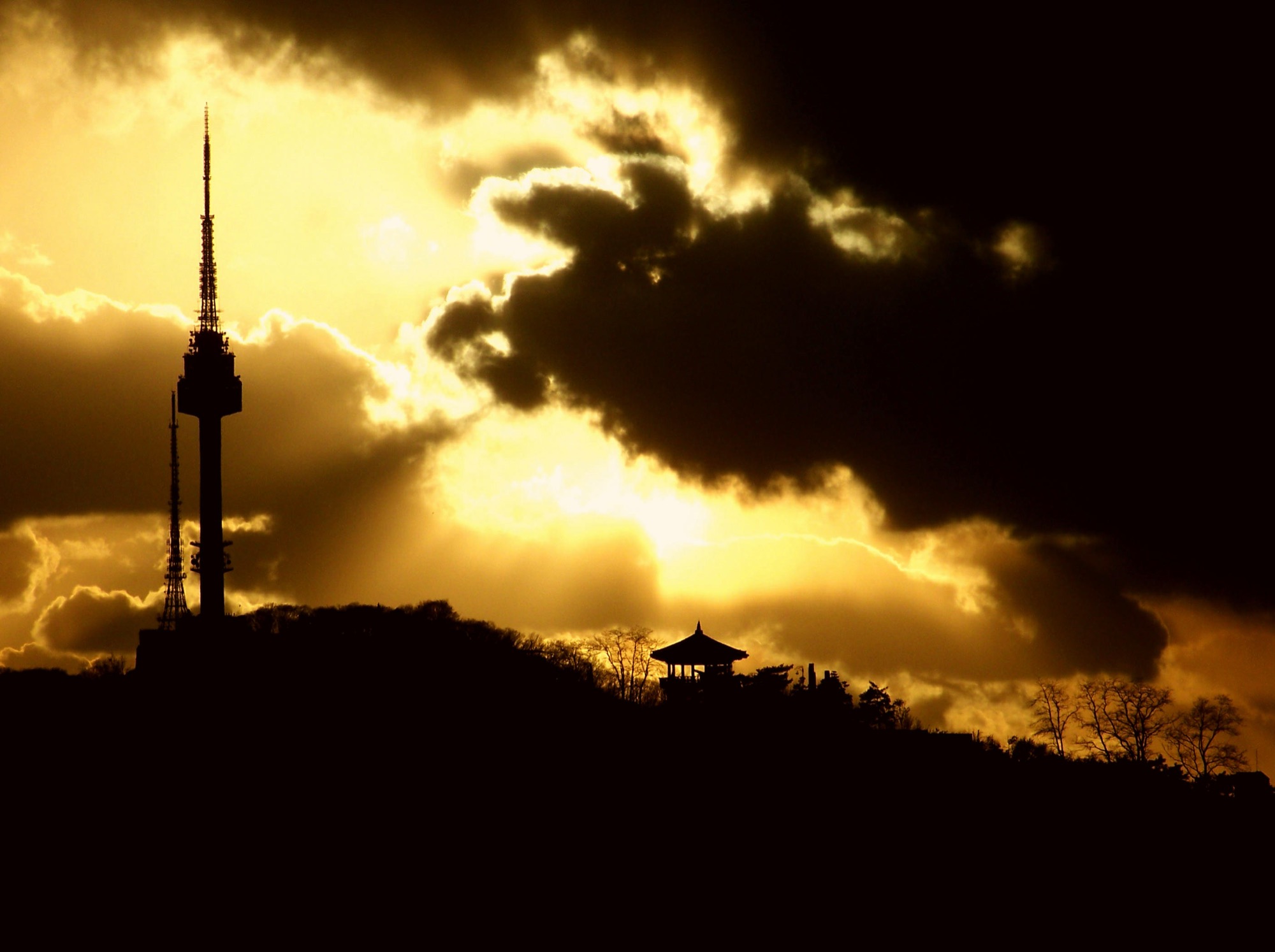
N Seoul Tower on Namsan at sunset. File photo taken April 13, 2010; it does not show the CJ ONE Global service. Photo: Rtflakfizer / Wikimedia Commons · CC BY-SA 4.0. Resized from 2808px to 2000px wide; no other edits. https://creativecommons.org/licenses/by-sa/4.0/
Tickets for the KIA–LG semi-playoff go on sale at 2 p.m. on October 15. Gwangju games go on sale October 15 and Jamsil games October 16. KBO said foreign visitors who have difficulty booking online can buy tickets at the stadium on game day with a passport.
Gwangju games: sales Oct 15
At 2 p.m. on October 15, tickets go on sale for Game 1 on October 17 at 2 p.m.; at 3 p.m., for Game 2 on October 18 at 2 p.m.; and at 4 p.m., for Game 5, scheduled for October 23 at 6:30 p.m.
All three games are at Gwangju-Kia Champions Field. All times are Korea Standard Time.
Jamsil games: sales Oct 16
At 2 p.m. on October 16, tickets go on sale for Game 3 on October 20 at 6:30 p.m., and at 3 p.m. for Game 4 on October 21 at 6:30 p.m. Both games are at Jamsil Baseball Stadium in Seoul.
Where to book
KBO’s designated sellers are NOL Ticket’s website and app and its customer center at 1544-1555. Advance bookings are limited to four tickets per person.
At 7:10–7:11 a.m. on October 15, NOL’s postseason page still showed wildcard information and the message that no products were available to book. The page had not yet been updated for the semi-playoff, and the message does not indicate a sellout. Seat prices and fees are posted with each game’s sale listing.
Game-day sales for foreigners
KBO’s notice says foreign visitors who have difficulty booking online can buy one ticket per person at the stadium box office on game day by showing a passport. Visitors 65 and older and holders of Korean disability registration or welfare cards are also eligible.
Availability is not guaranteed, and the notice does not give the dedicated window’s hours. Any remaining cancelled tickets are scheduled to go on sale at the stadium two hours before the first pitch.
When Games 4 and 5 are played
The first team to win three games advances. A tie can require an additional game. Games 4 and 5 are played only if needed.
Rain postponements change the schedule; KBO and the ticket seller post any changes.
Getting to the stadiums
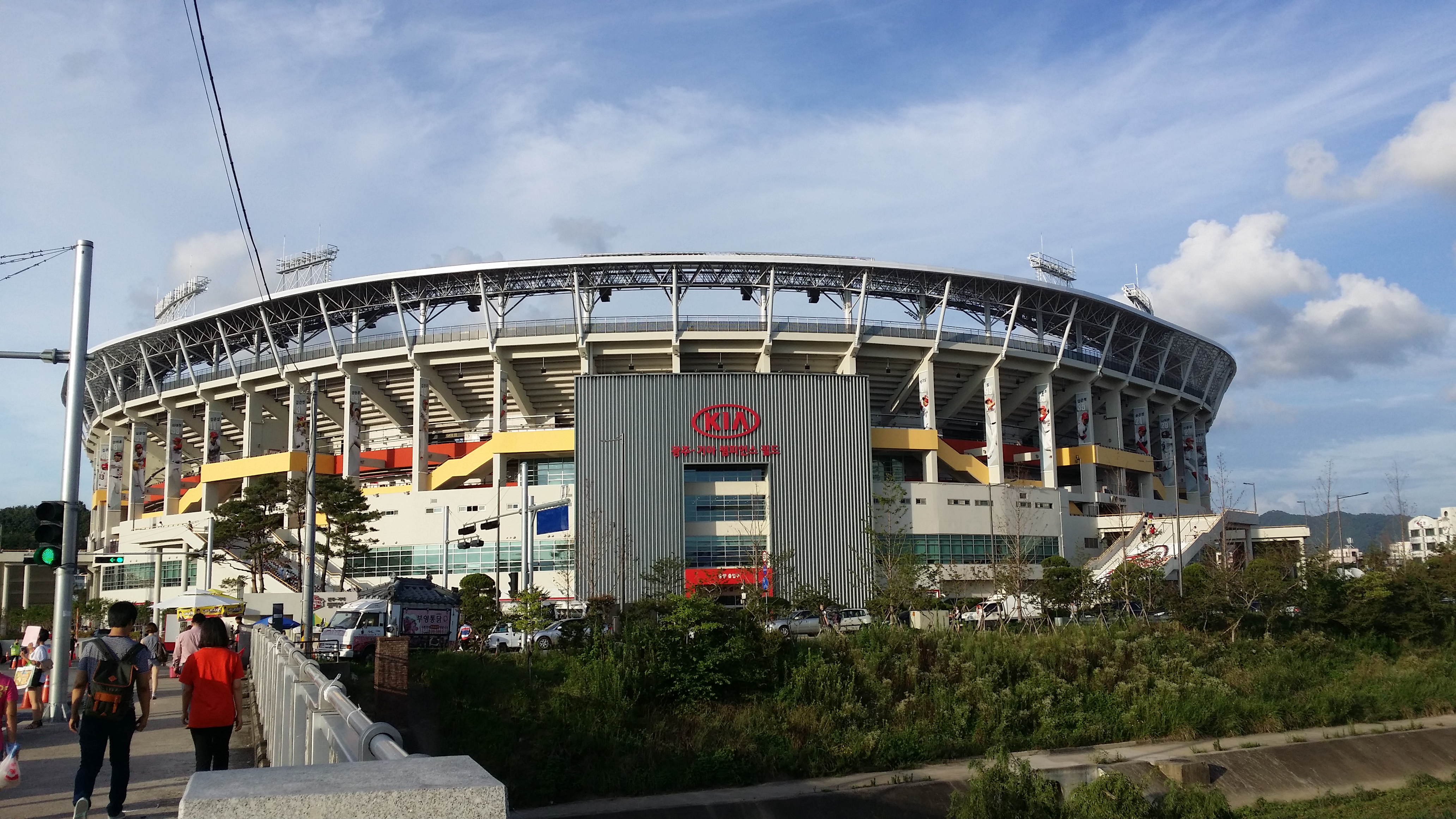
Gwangju-Kia Champions Field is at 10 Seorim-ro, Buk-gu, in the Jeonnam–Gwangju integrated special city. KIA’s directions: take bus Songjeong 98 from Gwangju Songjeong Station to the Mudeung Baseball Stadium stop, then walk about five minutes to the main gate.
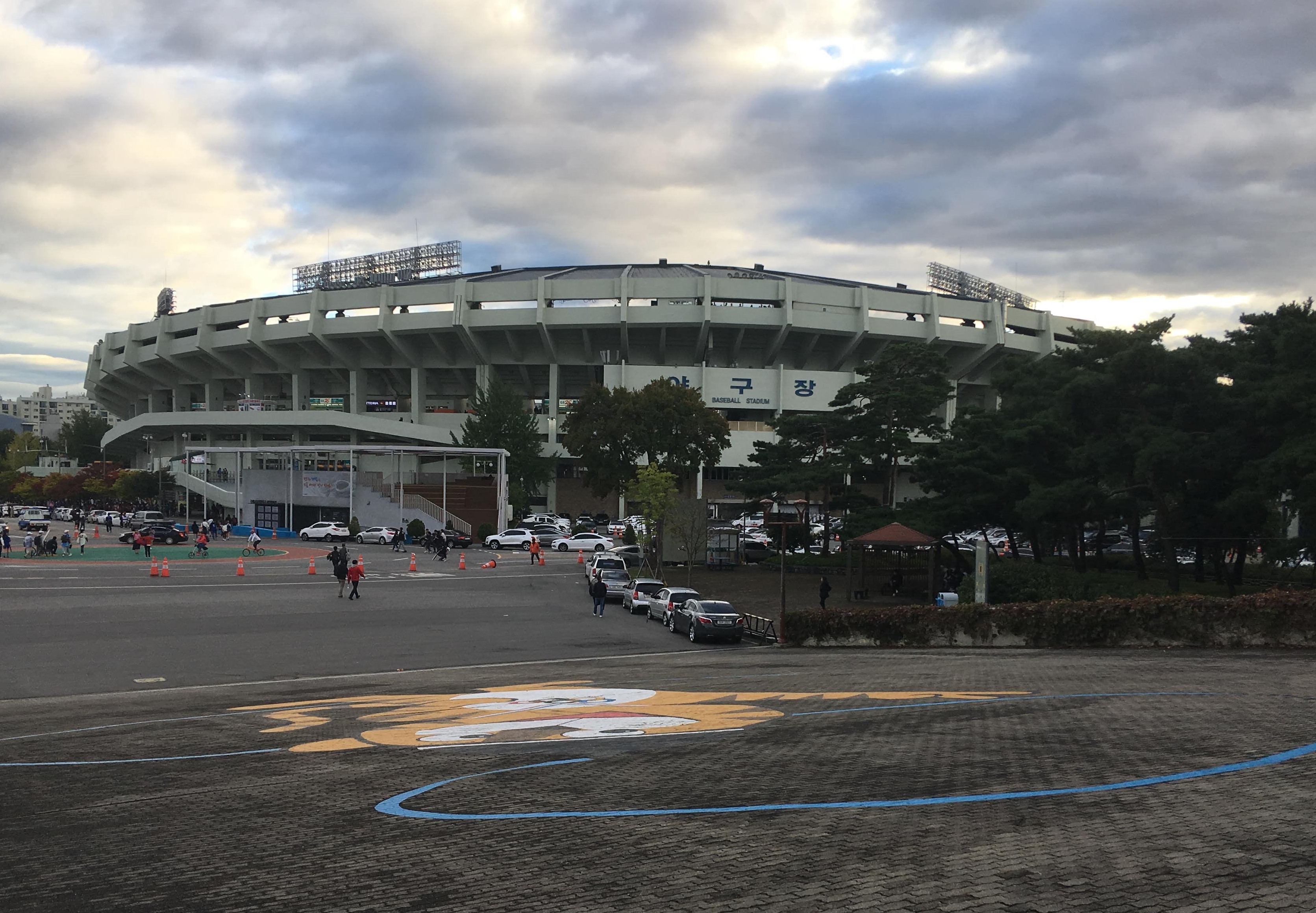
Jamsil Sports Complex is at 25 Olympic-ro, Songpa-gu, Seoul, and is connected to Sports Complex Station on subway lines 2 and 9. Walking times to the ballpark gates and game-day parking fees were not confirmed. The photos are file images of the stadiums’ exteriors.
An archival 2014 photograph of the main entrance to Gwangju-Kia Champions Field. It does not show the 2026 semi-playoff or current ticket sales. Kastrot · Gwangju Kia Champions Field View 04.jpg · 2014-07-23 · CC BY-SA 4.0. Original JPEG unchanged; display edges are cropped. Open the image for the full photograph. https://commons.wikimedia.org/wiki/File:Gwangju_Kia_Champions_Field_View_04.jpg · https://creativecommons.org/licenses/by-sa/4.0/
An archival 2018 photograph of Jamsil Baseball Stadium in Seoul. It does not show the 2026 semi-playoff or current ticket sales. Christophe95 · Jamsil Baseball Stadium in 2018.jpg · 2018-10-06 · CC BY-SA 4.0. Original JPEG unchanged; display edges are cropped. Open the image for the full photograph. https://commons.wikimedia.org/wiki/File:Jamsil_Baseball_Stadium_in_2018.jpg · https://creativecommons.org/licenses/by-sa/4.0/
Groups of 10 to 30 people can book Seoul’s Hangang Bus online starting at 10 a.m. on October 19. The pilot covers weekday sailings from Magok and Jamsil piers, with reserved rides beginning October 20.
The pilot
The pilot service, announced by the Seoul city government on October 14, is aimed at groups such as companies, schools and institutions. Passengers now collect numbered tickets at the pier on a first-come basis; the pilot lets groups choose a date and sailing in advance.
It runs on weekdays only at Magok and Jamsil piers. Each booking covers at least 10 and no more than 30 people per sailing.
Booking and fares
Groups select a pier on Naver Map or Naver Place, enter the date, route and sailing, number of passengers and booker details, and pay through Naver Pay.
Basic fares are 3,000 won for adults, 1,800 won for youths and 1,100 won for children. Opening dates for each day’s bookings will be posted on the booking page.
Boarding and refunds
Booked groups must arrive at the pier at least 30 minutes before departure. After their reservation is checked and the boarding declaration is filed, they board as directed by safety staff.
Bookings and refunds close at 11:59 p.m. the day before the sailing. All times are KST.
Scope
The service is limited to weekday group bookings at the two piers and does not include weekend sailings or other piers. The city will decide on continuation and expansion after the pilot.
The announcement did not address identity verification for foreign accounts, overseas card payments or foreign-language booking support.
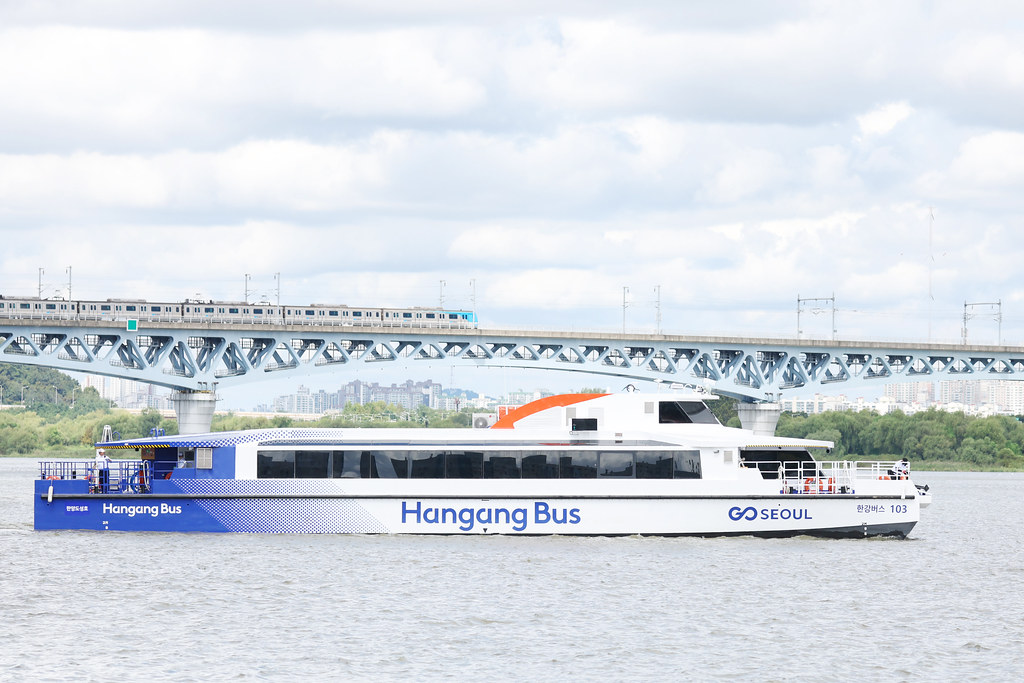
Hangang Bus 103 on Seoul’s Han River. Archive photograph dated September 18, 2025. Photo: Lee Jeong Woo / Ministry of Culture, Sports and Tourism · CC BY-SA 4.0. Flickr’s resized version, used without further edits. https://creativecommons.org/licenses/by-sa/4.0/
The KBO on October 14 named six nominees for its September–October monthly MVP award: pitchers Avila and Jo Byeong-hyeon of SSG and Daniel of KT, and hitters Choi Won-jun and Hilliard of KT and Davidson of Kiwoom. Fan voting runs through October 19.
The pitchers
Over September and October, Avila threw 44⅔ innings with five wins and a 1.21 ERA. Jo recorded eight saves and a 0.00 ERA in nine appearances. Daniel had five wins and 54 strikeouts.
The hitters
Choi batted .413 with 57 hits over the period. Hilliard hit 14 home runs with 40 RBIs, and Davidson hit 12 homers with an .806 slugging percentage. The figures cover September–October only, not the full season.
The award
The vote is for the September–October monthly award, not the season MVP. The nominees include a starter, a closer, a high-average hitter and power hitters.
How to vote
Fan voting opened at 10 a.m. KST on October 14 and closes at midnight at the end of October 19 (00:00 KST on October 20) in Shinhan Bank’s Super SOL mobile app. The winner is decided by combining the fan vote with a vote by the Korea Baseball Writers Association.
The notice does not specify registration or identity-verification requirements for foreign account holders, or whether voting is available in other languages.
Nominee Matt Davidson batting at the Triple-A Home Run Derby on July 13, 2015. Archive photograph, not a 2026 Kiwoom game. Minda Haas Kuhlmann · CC BY 2.0 · Original JPEG unchanged. https://creativecommons.org/licenses/by/2.0/
Seoul will add early-morning Line 9 express trains and pilot four express-bus routes linking outer districts with major stations from November 16.
More early Line 9 expresses
Between 05:40 and 07:00 KST, trains toward VHS Medical Center will shift from a 1:1 express-to-local ratio to 2:1. Total morning service rises by eight trains.
Four express-bus routes
Express 150, 370, 470 and 605 will each run three trips using some existing buses. They follow their current paths but skip intermediate stops, then revert to regular service after the morning commute.
Announced bus departures
The plan lists these depot departures, all KST: Express 150, Dobong depot to City Hall Station, 04:30, 07:00 and 07:30; Express 370, Gangdong depot to Chungjeongno Station, 04:20, 07:00 and 07:30; Express 470, Sangam depot to City Hall Station, 04:10, 07:00 and 07:30; Express 605, Gangseo depot to Yeongdeungpo Station, 04:00, 07:00 and 07:30.
They are not arrival times at intermediate stops.
Before boarding
The changes take effect next month; current timetables still apply until then. Riders using intermediate stops should check that the express calls there. Enquiries: Dasan Call Center, 02-120.
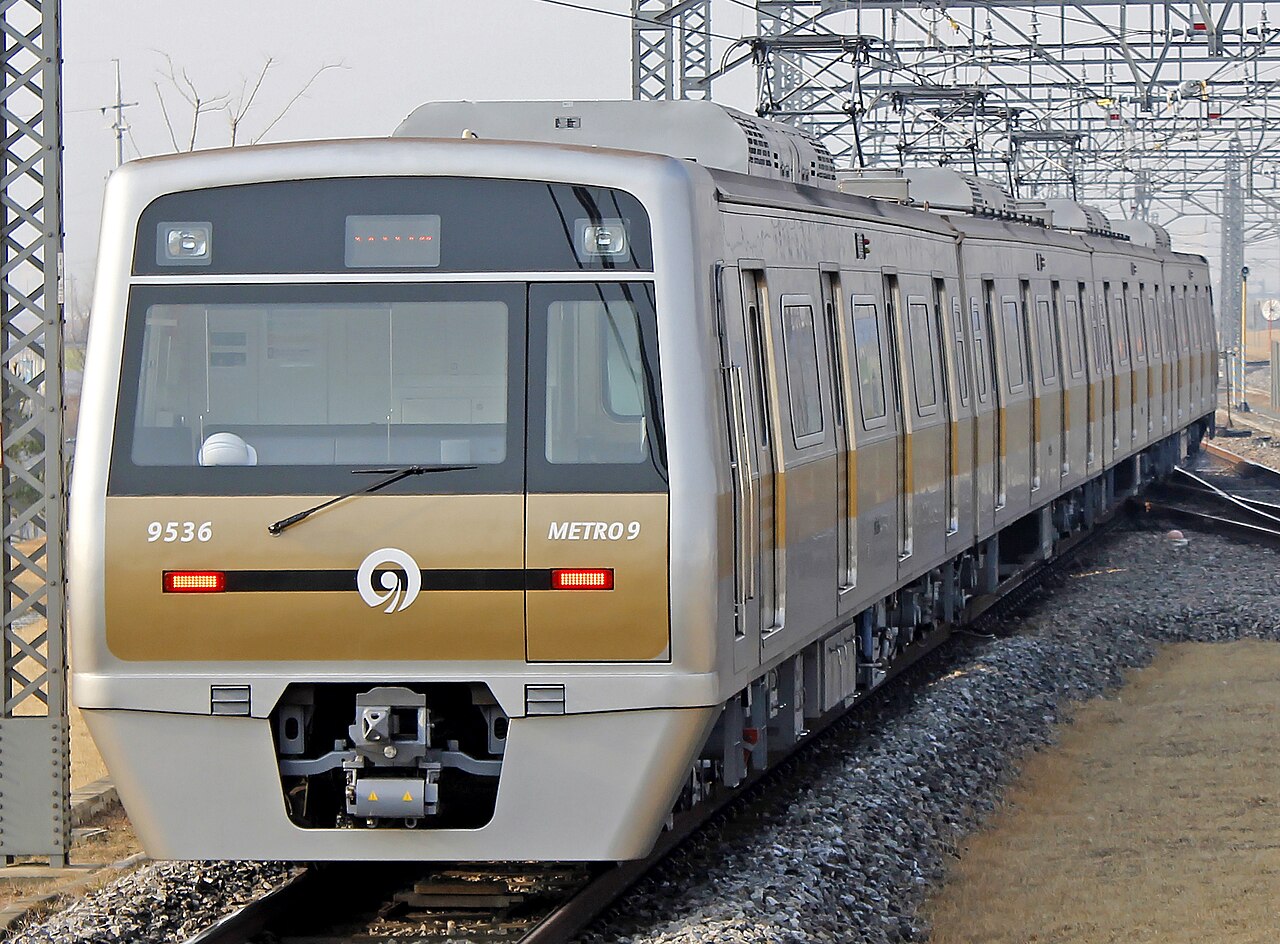
A 2014 archive photograph of a Seoul Line 9 Class 9000 train, not the 2026 service change. Minseong Kim (IMKSv), Metro 9 Class 9000 EMU.jpg, 2014-12-24, CC BY-SA 4.0. https://creativecommons.org/licenses/by-sa/4.0/ Wikimedia’s 1280px rendition used unchanged.