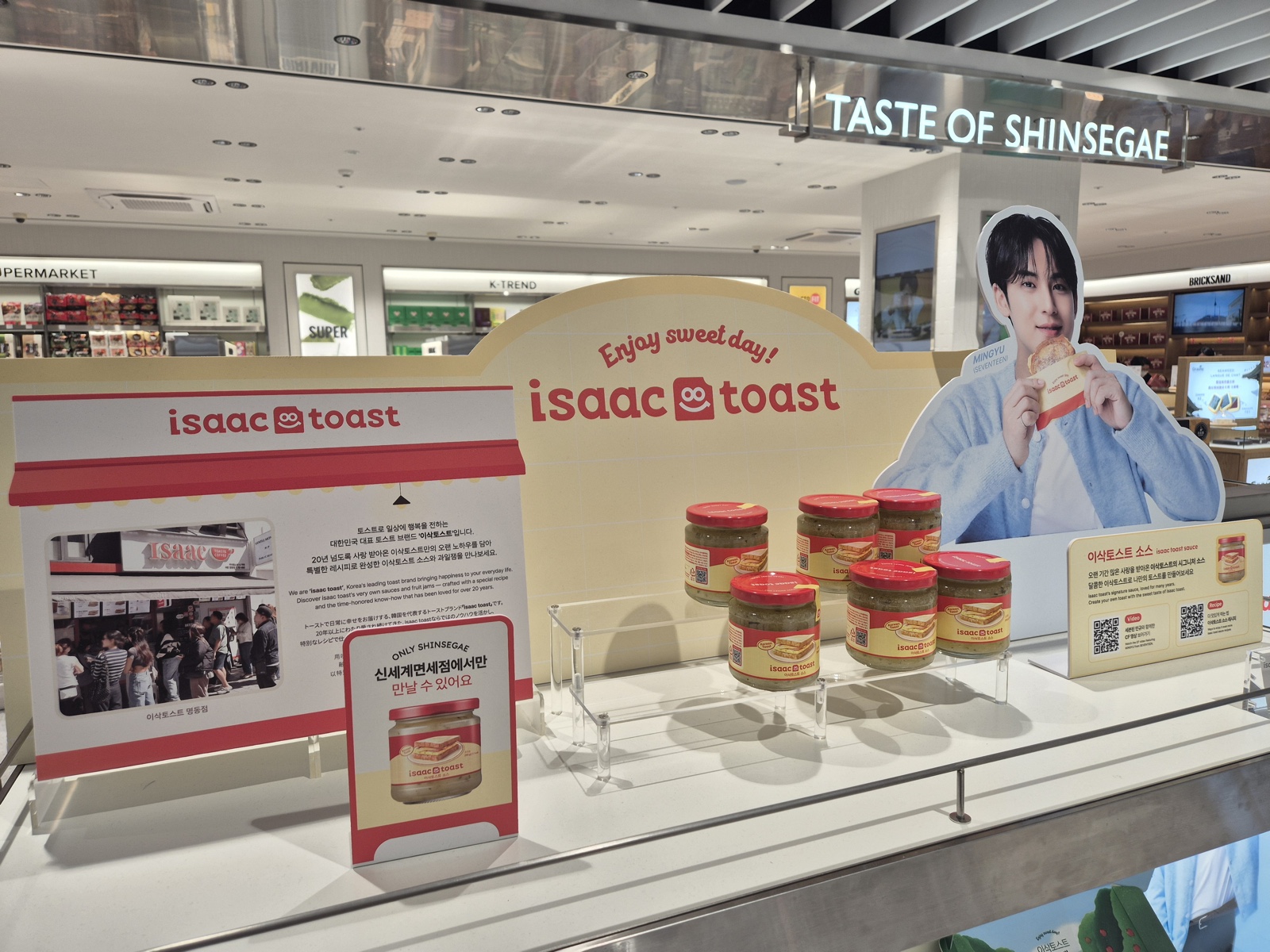
A sauce Koreans cannot buy at the supermarket now leads the airport's duty-free rankings, ahead of cosmetics and liquor, driven by foreign visitors.
Ahead of cosmetics and liquor
Isaac Toast's signature sauce ranked No. 1 on the overall best-products list of Airstar Duty Free, Korea JoongAng Daily reported Oct. 2.
Airstar Duty Free is the online shopping platform run by Incheon International Airport Corp. Its overall ranking spans cosmetics, fashion and liquor, according to Wikitree. In September, the sauce was the only food item in the platform's top eight. In June, it ranked first across all categories on Shinsegae Duty Free's online mall.
Not sold in Korean stores
The sauce is a duty-free-only product sold through Shinsegae Duty Free. It is not available at Korean convenience stores or supermarkets.
It went on sale in late April at Shinsegae Duty Free's Myeongdong store, Financial News reported. A late-May batch sold out in a day, and purchase limits followed. The company says it keeps the sauce off Korean shelves to protect its franchise owners' toast sales.
A taste to take home
Foreign tourists drive the demand. Visitors who try Isaac toast at shops in Myeongdong or Hongdae buy the sauce on the way home to recreate it.
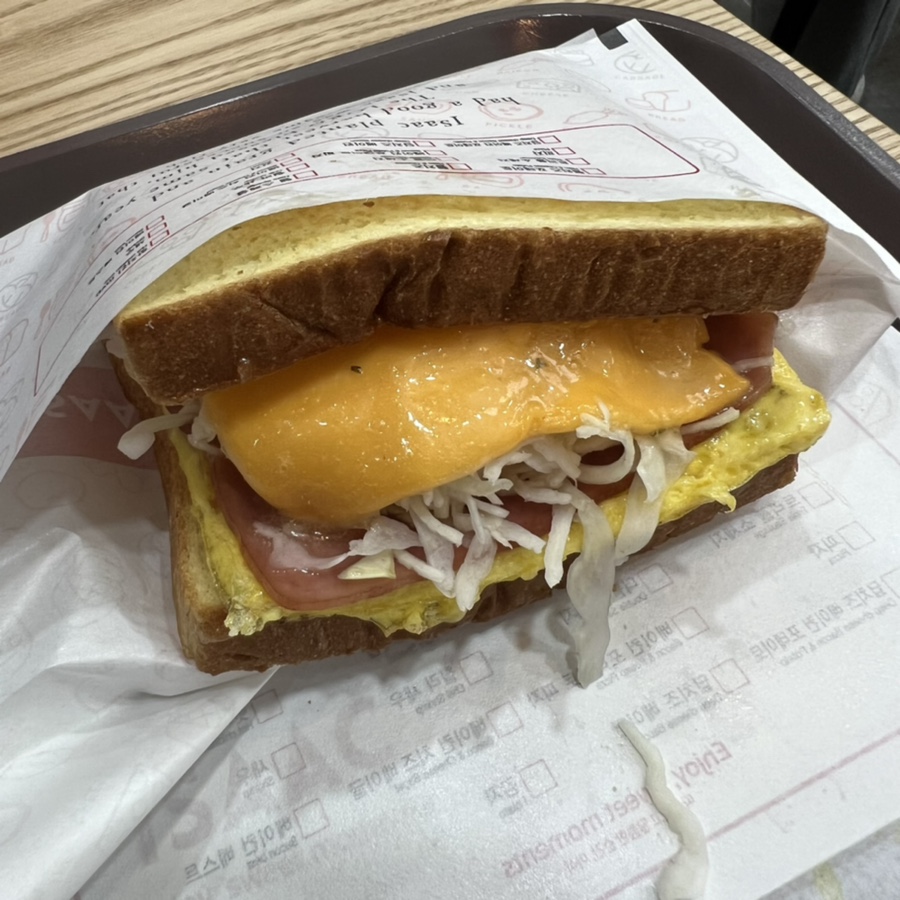
The toast itself is familiar to first-timers: bread, egg, cabbage, ham and cheese, finished with a sweet sauce.
An Isaac toast with ham, cheese, egg and cabbage on its paper wrapper
The jams are sold in Korea
Unlike the sauce, the fruit jams can be bought in Korea. From Jan. 26, Isaac Toast offered its jam line, led by kiwi jam, through 29CM's "29 Limited Order" promotion, News1 reported.
On Aug. 14, Isaac Toast said four jams, kiwi, peach, apple and strawberry, had launched on the Olive Young online mall, with same-day Today Dream delivery in some areas. It had earlier expanded sales to 29CM, Kurly and Shinsegae Duty Free.
Through its Sauce with You campaign, the company sets aside 100 won (about 7 cents) per bottle of sauce sold to fund meals for children at risk of going hungry.
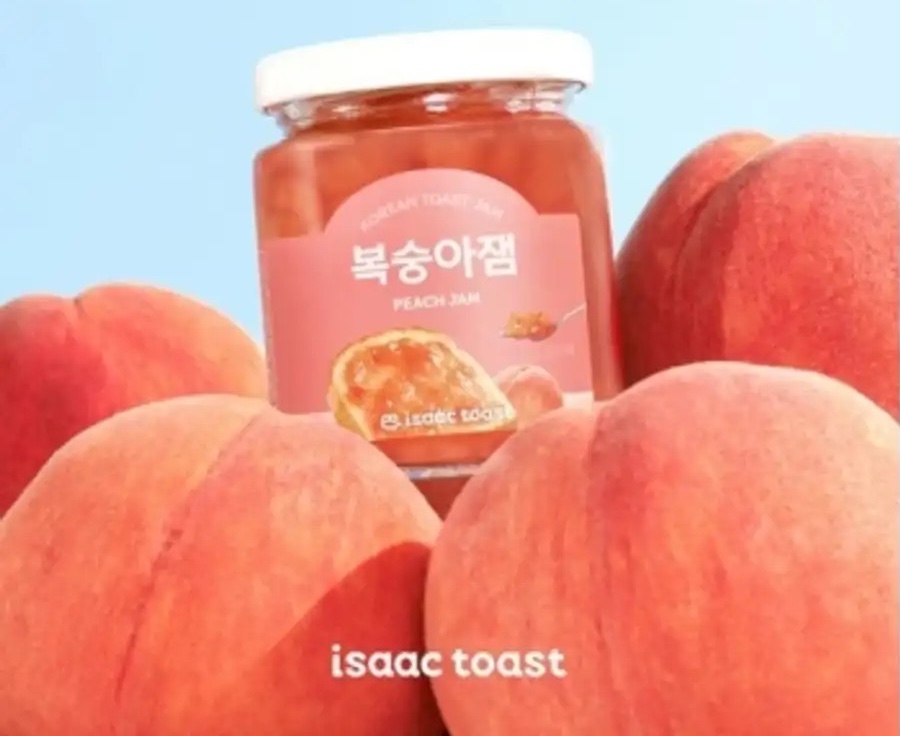
A jar of Isaac Toast peach jam nestled among ripe peaches
Before you buy
The sauce is available only through duty-free channels such as Shinsegae Duty Free stores and its online mall.
The sauce may be treated as a liquid at security. According to ANA, liquids bought at departure-airport duty-free shops in Korea can be carried on if sealed, unopened, in a tamper-evident bag (STEB) with the receipt. Transit countries apply their own rules.
A Ham Special toast at an Isaac Toast shop in Yangsan-dong, Gwangju (May 2022). A file photo of the toast, not the sauce product. CC BY 2.0 KR, 봄삐 (Bomppi).
The Korea Heritage Service on Oct. 16 designated “Wolchulsan and Surroundings” a Scenic Site, a category of national natural heritage. The roughly 2.26 million square meters in Yeongam and Gangjin counties, South Jeolla, were recognized for a granite mountain landscape layered with state rites and Buddhist culture.
71 lots in Yeongam and Gangjin
The Korea Heritage Service announced the designation on Oct. 16. The site lies in Yeongam-eup and Gunseo-myeon in Yeongam County and Seongjeon-myeon in Gangjin County.
The designated area covers 71 lots, 2,256,208 square meters. The province, Gangjin County and Yeongam County manage it.
A mountain of state rites and Buddhism
Wolchulsan first appears in the Samguk Sagi as “Wollaeak” in Wolna-gun. Cheonhwangbong peak hosted state rites from the Unified Silla period.
From Goryeo to Joseon it was a center of Buddhist culture in the south-west. Muwisa temple keeps its Geungnakbojeon hall and murals; Dogapsa holds records of the monk Doseon and traces of royal patronage.
A granite massif rising from the plain
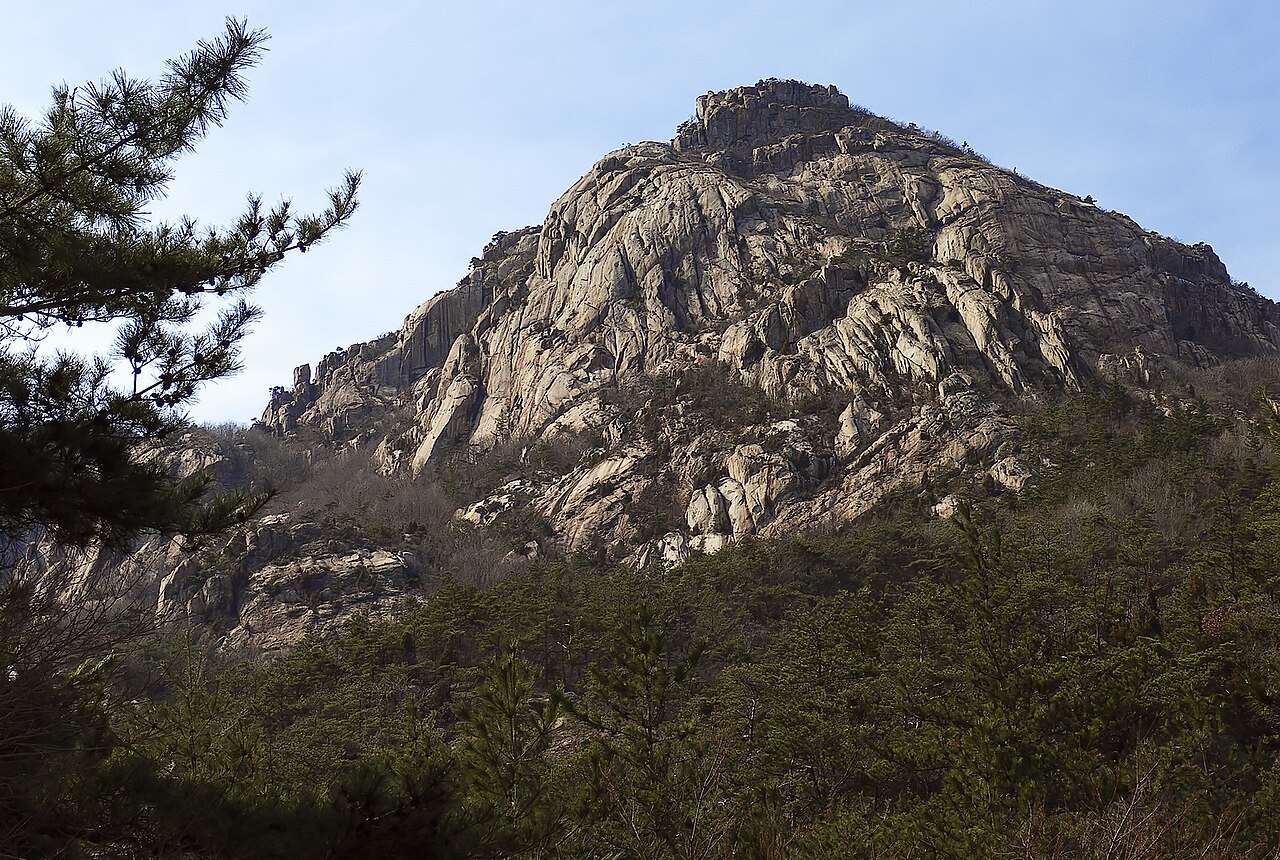
The mountain is an isolated granite massif that rises sharply from the plain. Dome-shaped peaks, castle-like ridges, tors and tafoni have developed. A sharp northeast-southwest skyline and the cliffs of Cheonhwangbong and Gujeongbong anchor the scenery.
Insectivorous plants grow there, and vegetation shifts from warm-temperate at the base to temperate at the summit.
Names and records
Gujeongbong carries beliefs and tales about nine wells. The mountain has been called Wollaeak, Sogeumgang and Cheonbul in different eras, and travel accounts by Jeong Yak-yong and Kim Chang-hyeop survive.
The service said it will manage the site systematically based on follow-up research and prepare ways for the public to experience its value.
South Korea’s employed population grew by 113,000 from a year earlier in September, and manufacturing jobs rose for the first time in 27 months, since June 2024. The youth employment rate kept falling.
113,000 more people employed
The Ministry of Employment and Labor and the Ministry of Finance and Economy released the September data on Oct. 16. Employment rose by 113,000 from a year earlier, the third straight month of gains above 100,000. Seasonally adjusted, it rose by 40,000 from August.
The employment rate for people 15 and older was 63.5%, down 0.2 percentage point. The 15–64 rate was 70.6%, up 0.2 point and the highest for a September on record. Unemployment was 2.0%.
Manufacturing up 16,000
Manufacturing employment rose by 16,000 after a 38,000 drop in August. The government said strong exports fed through to hiring with a lag. Average daily exports rose 104.9% in September, with semiconductors up 262.8%.
Health and welfare added 207,000 jobs and transport and storage 54,000. Accommodation and food service lost 97,000 and construction 48,000.
Permanent jobs at a September record share
Permanent employees rose by 253,000, the biggest gain since November 2025, lifting their share of all workers to 57.8%, the highest for a September. Temporary workers fell by 81,000 and daily workers by 55,000.
The employment rate for ages 15–29 fell 1.1 points to 44.0%. The number of young people not working and “just resting” fell for an eighth straight month, to 364,000.
Government response
The government said tension in the Middle East remains a downside risk. It plans to draft a “National Jobs Project” covering private and public job creation, and a task force will look for measures for construction and agriculture.
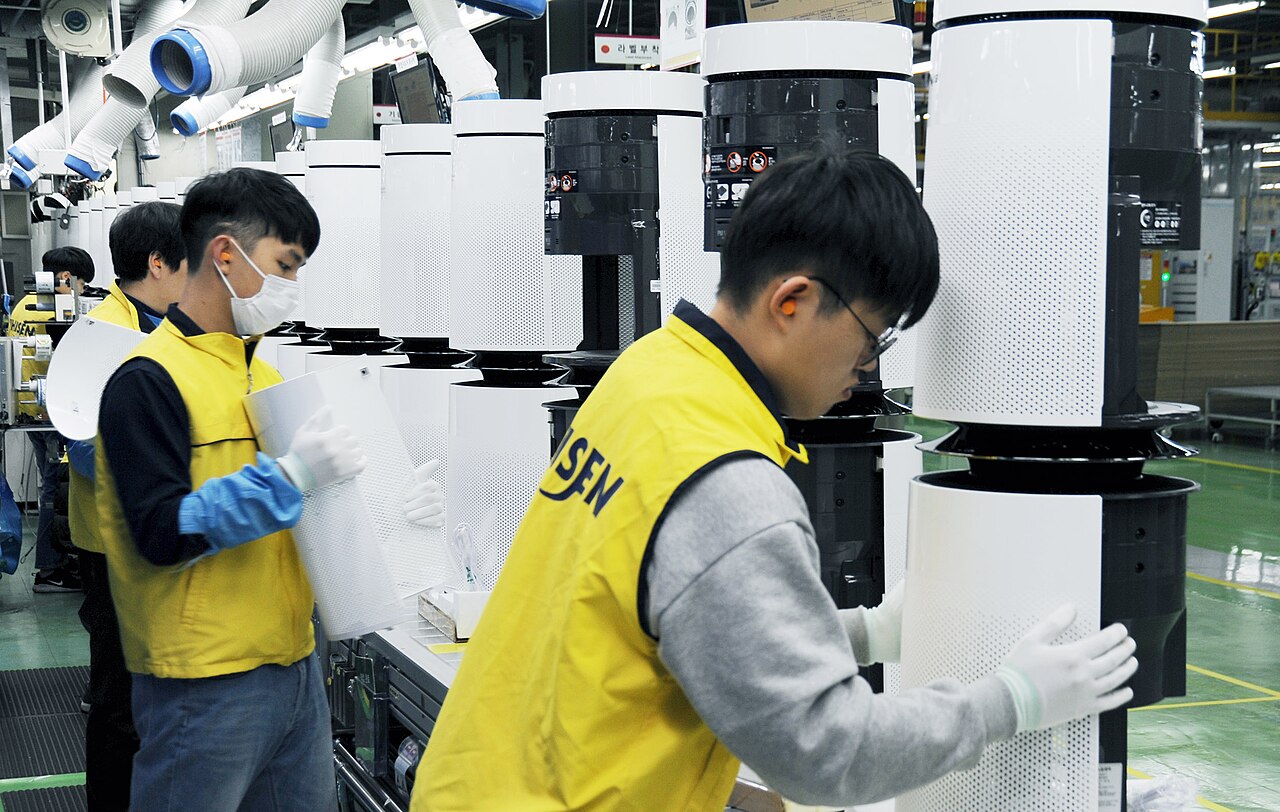
LG Electronics staff on an air-purifier production line in Changwon (photographed Nov. 2017). A file photo, not a workplace covered by the statistics. CC BY 2.0, LG Electronics.
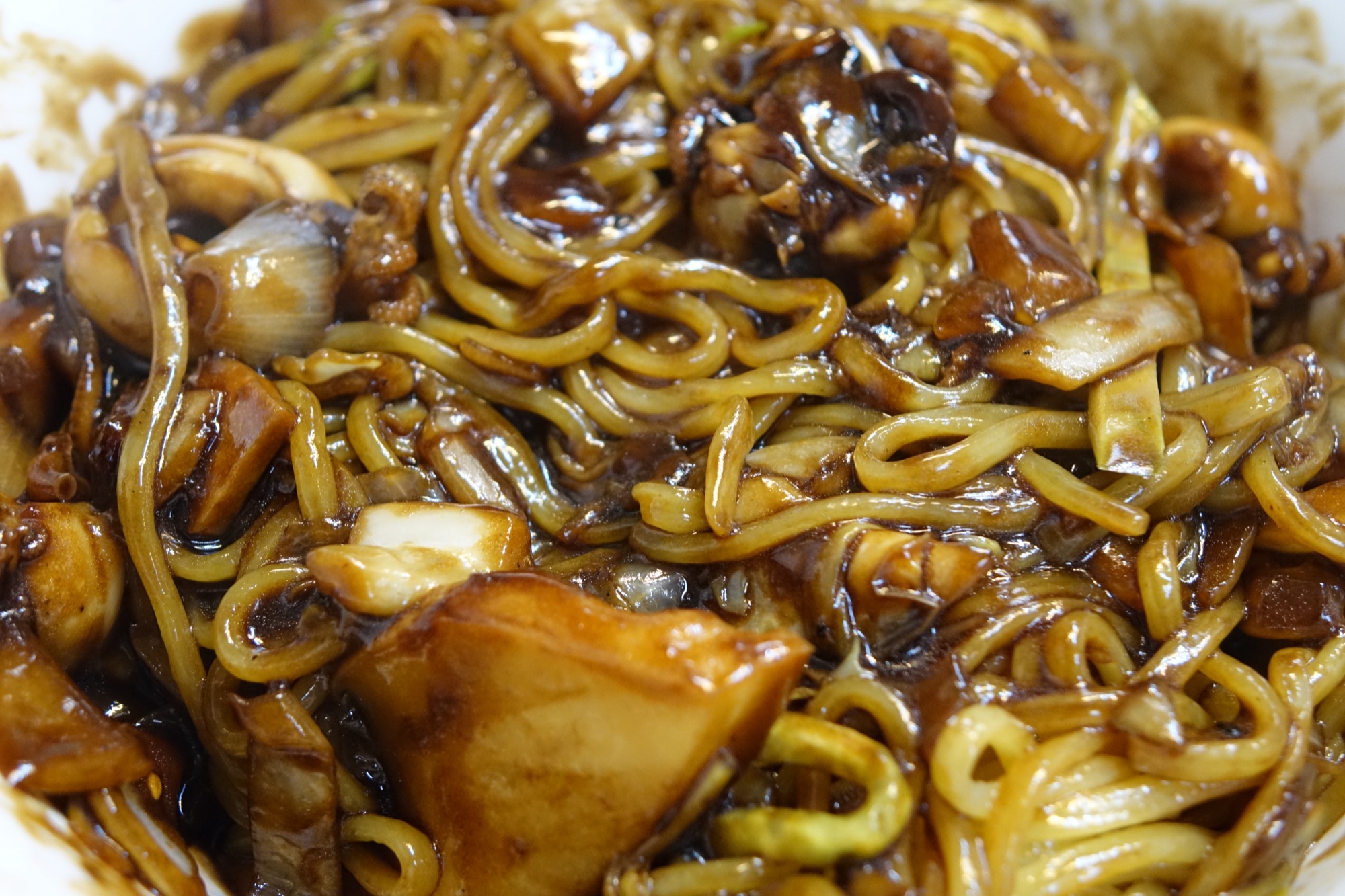
Korean Chinese restaurants had long written “jjajangmyeon” on their menus, but the National Institute of Korean Language did not accept that spelling as standard until Aug. 31, 2011. Until then the only correct form was “jajangmyeon.”
Accepted with 38 other items in 2011
On Aug. 31, 2011, the National Institute of Korean Language recognized 39 items, including jjajangmyeon and meokgeori (food), as standard and added them to the online Standard Korean Language Dictionary. The Korean Language Council had finalized the list at a plenary session on Aug. 22.
The institute said it had previously accepted only jajangmyeon, taekgyeon spelled 태껸 and pumse spelled 품세, but would now also accept the widely used forms 짜장면, 택견 and 품새. Both spellings of each became standard.
Jajangmyeon is still correct
Recognizing two standard forms followed a principle already allowed under the 1988 Standard Language Regulations. The institute said both the existing and the newly accepted words may be used in textbooks and official documents.
In a February 2026 reply on its Online Ganada Q&A service, the institute again said both jajangmyeon and jjajangmyeon are correct. A June reply added that jjajang on its own is also listed in the Standard Korean Language Dictionary.
From Shandong noodles to Incheon
The Encyclopedia of Korean Culture traces the dish to chaojiangmian (炒醬麵), noodles topped with fried sweet bean paste from China’s Shandong Peninsula. Chinese restaurants followed the opening of Incheon’s port in 1883, and the encyclopedia says Gonghwachun, opened in 1905, was the first to sell jajangmyeon.
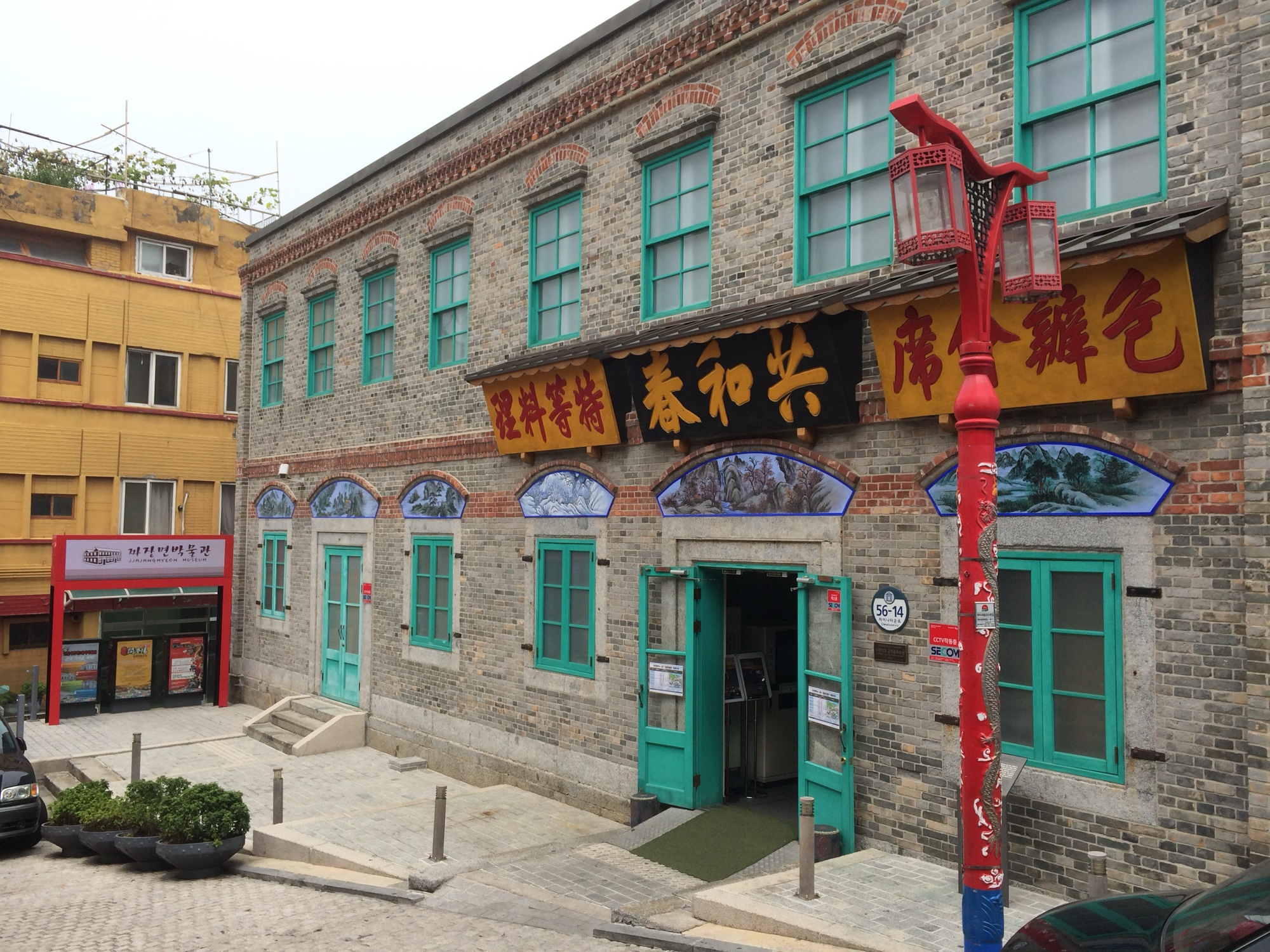
Gonghwachun closed in 1984. Its two-story red-brick building became a registered national cultural heritage site in 2006.
Front of a two-story red-brick building
Chunjang and the flour-food campaign
The black sauce comes from chunjang. According to the encyclopedia, Wang Song-shan, a member of Korea’s ethnic Chinese community, created it in 1948 by adding caramel to tianmianjiang, a sweet fermented wheat paste.
The encyclopedia credits the government’s campaign to promote flour-based foods in the 1960s and 1970s with making jajangmyeon an everyday dish.
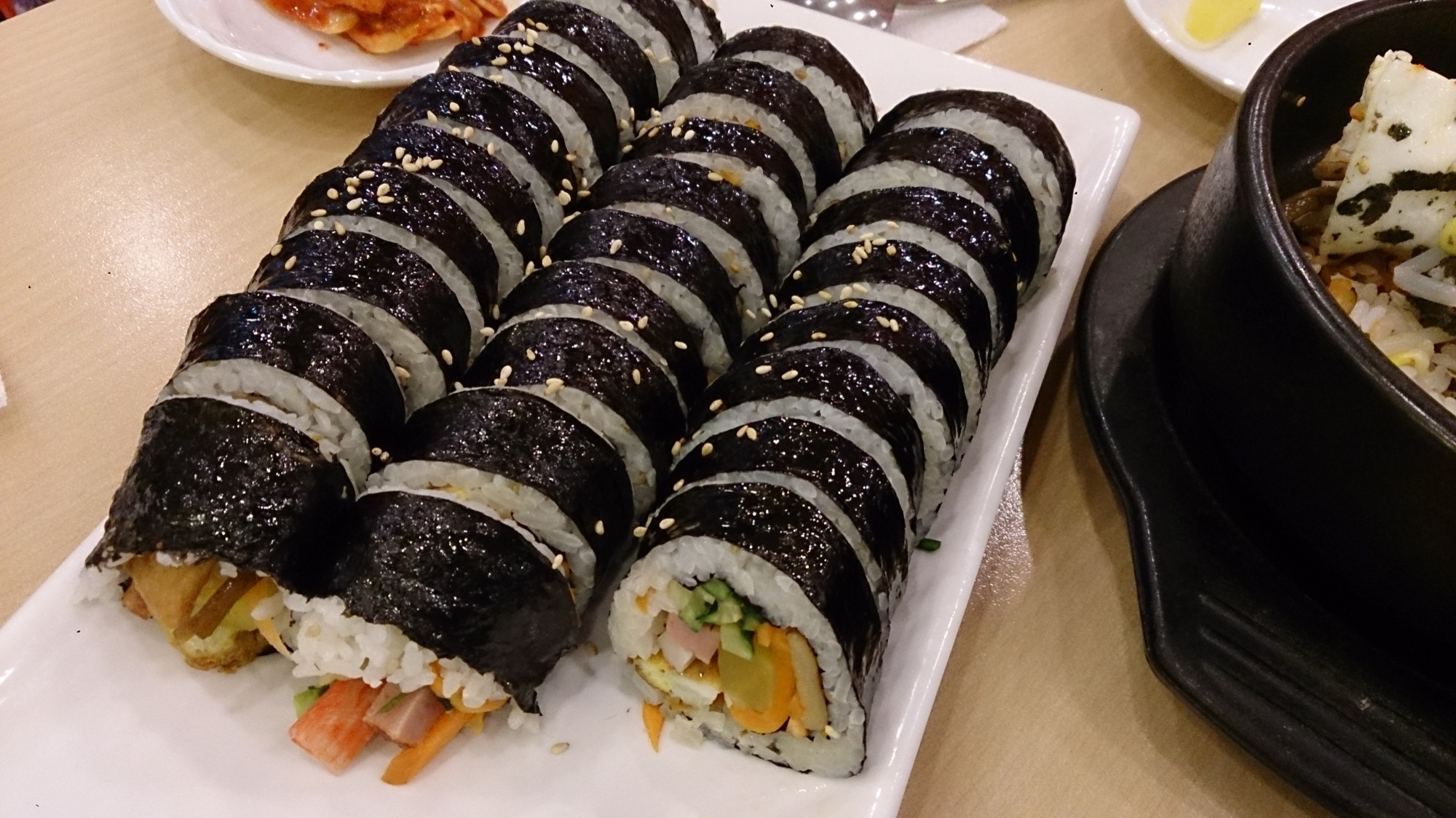
All 12 gimbap rolls tested by the Korea Consumer Agency from the four major convenience-store chains met safety and labeling standards. Filling ratios and sodium varied widely, and prices ranged from 2,800 to 3,600 won a roll.
All 12 products pass safety checks
The Korea Consumer Agency on Oct. 16 published a quality comparison of 12 gimbap products sold at 7-Eleven, emart24, CU and GS25: four tuna, four bulgogi and four plain rolls.
All products met standards in tests for preservatives and sweeteners in the pickled radish and burdock, heavy metals, microbes and foreign matter. Nutrition, allergen and country-of-origin labels also complied with the rules.
How much tuna or beef is inside
Tuna made up 16.5% to 21.9% of the four tuna rolls by weight, with 7-Eleven’s All New King Deumppuk Tuna Gimbap the highest. Bulgogi rolls varied more, from 13.1% to 23.7%, led by CU’s PBICK THE KITCHEN Bulgogi Gimbap.
Among plain rolls, GS25’s Original Geunbon Gimbap had the highest share of fillings at 45.1%. In the agency’s survey, filling ratio was the information consumers most wanted (51.9%, multiple answers allowed).
Sodium equals 38–70% of the daily value
One roll contained 760 to 1,393 milligrams of sodium, or 38% to 70% of the 2,000-milligram daily value. The lowest was 7-Eleven’s Hando Choegwa charcoal-flavor bulgogi roll at 760 milligrams. Calories came to 18% to 27% of a 2,000-calorie day, light for a full meal.
In the survey, 68.9% said they eat convenience-store gimbap with cup noodles, whose 100-gram reference serving carries 1,355 milligrams of sodium. The agency said adding milk or eggs gives a more balanced meal.
Prices from 2,800 to 3,600 won
Plain rolls cost 2,800 to 3,000 won, tuna rolls 3,100 to 3,400 won and bulgogi rolls 3,200 to 3,600 won, a gap of up to 200 to 400 won within each type.
The agency noted that telecom membership discounts, store subscription plans, payment-method offers and monthly promotions can lower the price. Product-by-product results are posted on the Consumer24 website (consumer.go.kr).
A government check of AI character chatbots usable without adult verification found some characters producing sexual and violent descriptions and replies encouraging self-harm, suicide or crime. The Ministry of Gender Equality and Family asked operators to strengthen youth protections.
Testing chats outside adult verification
The Ministry of Gender Equality and Family announced the results on Oct. 15. The check was carried out by the Youth Media Environment Protection Center, which the Korea Youth Counseling and Welfare Institute runs on the ministry’s behalf.
The center examined replies actually generated by characters on some services in the standard environment, without adult verification. In AI character chatbots, users pick or create a character with a personality and backstory and continue a conversation through generative-AI replies.
What the inspectors found
Reviewers applied the criteria for media harmful to minors under Article 9 of the Youth Protection Act and Annex 2 of its enforcement decree. They found detailed sexual content and depictions of sexual acts, violence and cruelty, and replies encouraging self-harm, suicide, crime or illegal acts. Some characters produced several types.
The release does not name the services that were checked.
What operators were asked to do
The ministry shared the findings with the operators and requested voluntary improvements. Characters likely to produce inappropriate conversations for minors should have their search, recommendation and chat scope adjusted according to adult-verification status.
The ministry also asked that seriously harmful content, such as encouragement of self-harm or suicide and help in carrying out specific crimes, not be generated for users of any age. The step is a request, not a sanction.
Follow-up checks
The ministry plans to continue working-level talks with operators and keep checking their self-inspections and safeguards. Youth policy director Yoon Se-jin said active efforts and ongoing management by operators are essential.
Lee Chang-ho, head of the center, said generative AI creates new content during each conversation, so protections must account for the replies themselves.
OH MY GIRL's Hyojung released her first mini album, Lost&Found, at 6 p.m. on Oct. 15 along with a music video for the title track, Unfinished (미완성일지도). She co-wrote the lyrics and music of all three songs.
A writer on every song
According to the album page on Melon, Lost&Found has six tracks: Unfinished, Maybe Getting Hurt Is Better Than Regret (후회하는 것보다 상처인 게 더 나을지 몰라), 8 (if), and an instrumental of each.
Hyojung is credited for lyrics and composition on all three songs and is listed as the album's music producer. Melon classifies the genre as rock/metal and ballad.
The title track
Hyojung wrote the lyrics of the title track with Grizzly, Kim Ho-yeon and Cracker; Lim Min-gi joined them on composition and arranged it with Cracker.
The album notes describe the song as the story of trusting one's own instinct rather than other people's views or set answers, and moving forward as an unfinished self even after stumbling.
Video and first stage
The 3-minute-46-second music video went up on OH MY GIRL's official YouTube channel at release time.
She performed the title song for the first time on Mnet's M Countdown episode 949, broadcast the same day. A highlight medley previewing the tracks was posted three days before the release.
First mini album after a May single
Hyojung released the single Purple Note in May. Lost&Found is her first mini album since then.
The album notes describe it as a record about passing through moments of feeling lost and gradually finding one's own path among many choices.
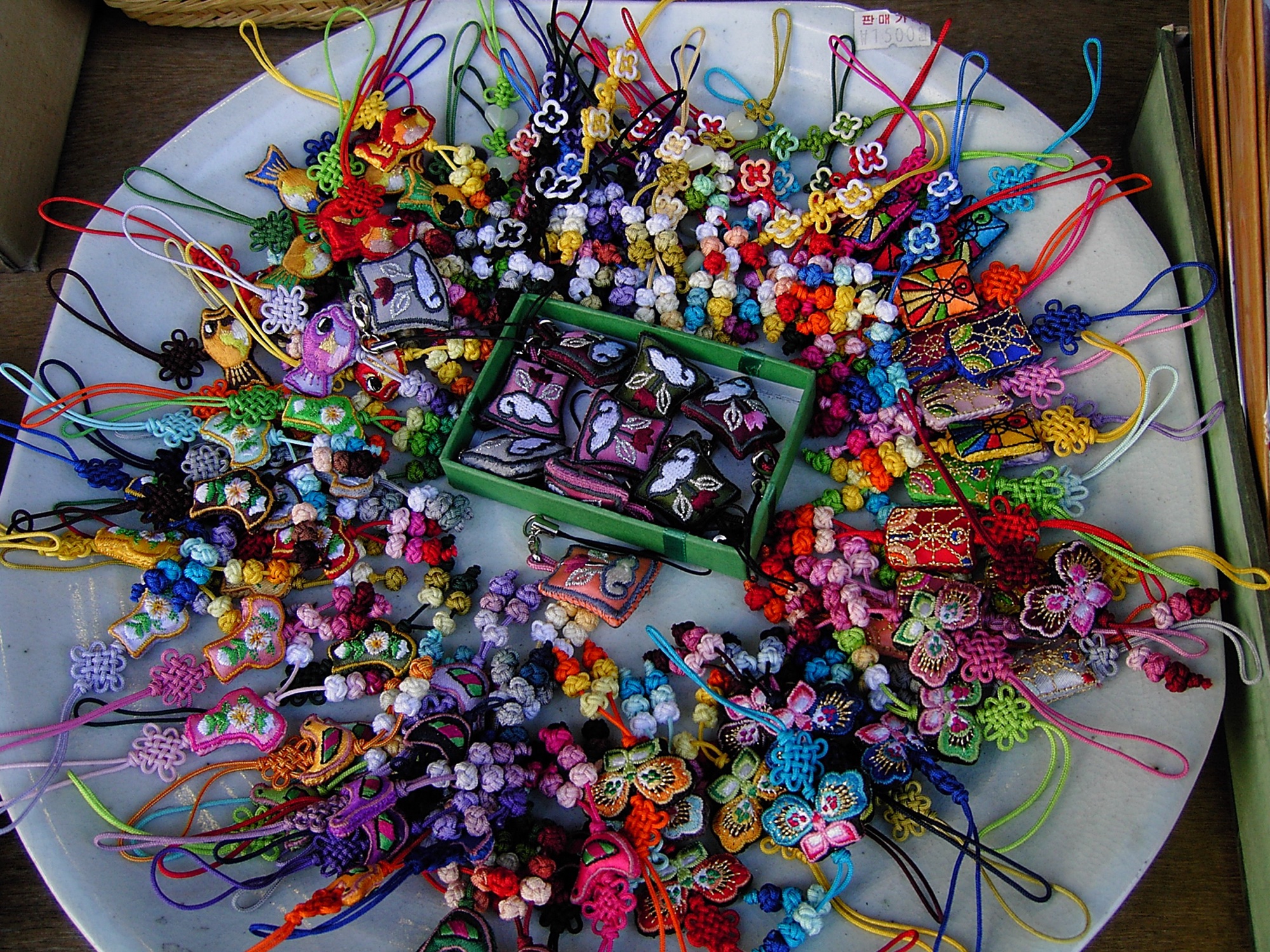
Donglim Knot Workshop on Bukchon-ro 12-gil in Seoul shows traditional knotwork such as norigae pendants and yuso tassels in a hanok gallery and runs short classes in which visitors make a knotted bracelet or necklace. Groups of one to four can walk in without booking.
Norigae and tassels in a hanok gallery
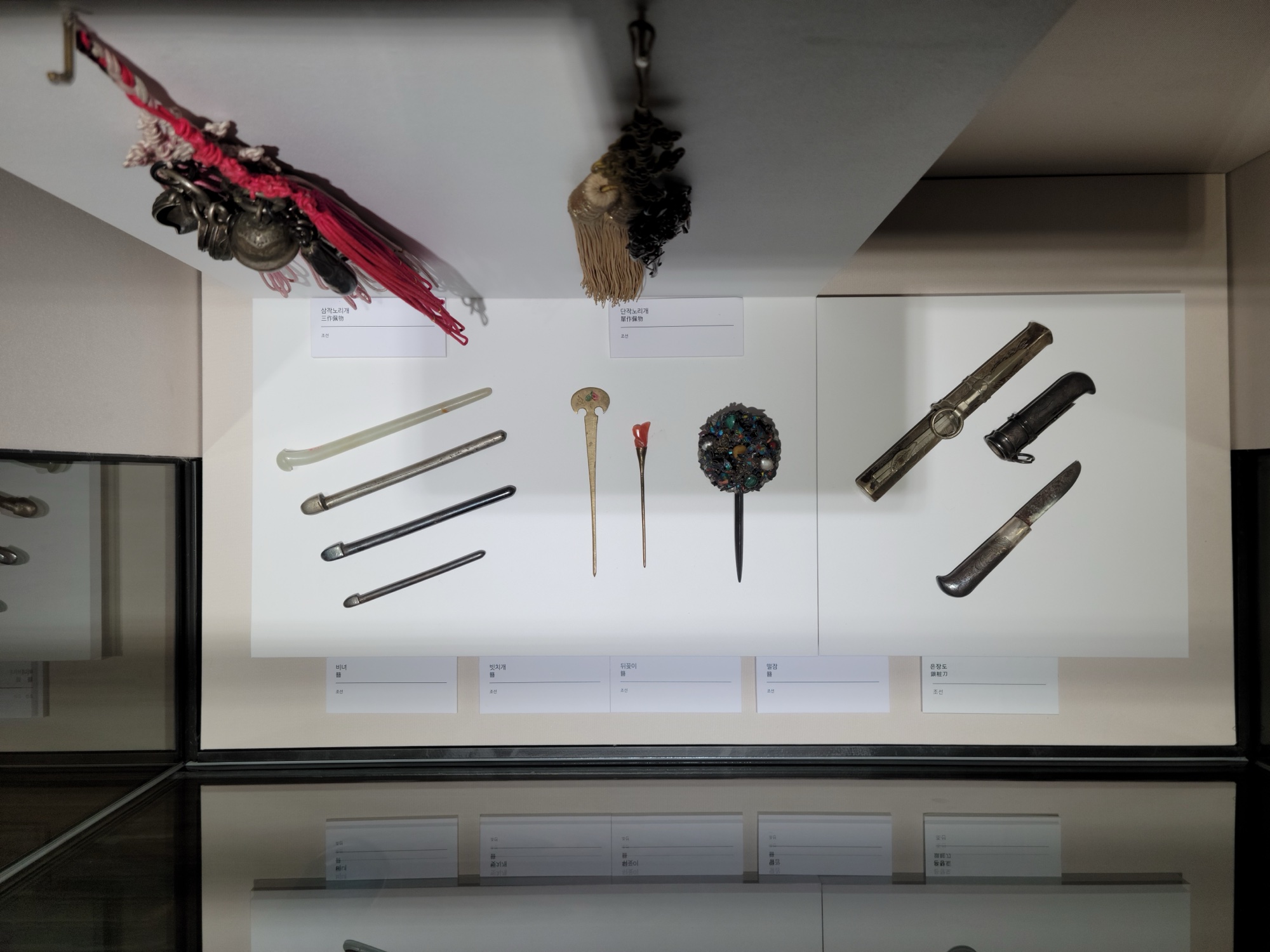
According to its website, the workshop opened in April 2004 with support from the Seoul city government. Its hanok gallery displays decorative knotwork, including norigae, belts, pouches, fan tassels and yuso tassels, along with threads and cords.
Antique pieces and reproductions sit alongside contemporary creations. The Seoul Tourism Organization describes it as a knotting workshop passed down for four generations.
Tasseled norigae hanging above hairpins and a small silver knife in a display case
A craft traced to the royal court
The website says director Shim Young-mi learned knotting from her husband’s great-aunt, who made knots at the Joseon royal court, and from her father-in-law, who inherited the skill. In 2009 the Labor Ministry designated her a knotting skills transmitter, No. 09-03.
She made the cords for the national seal in 2007 and recreated the yuso tassels for King Taejo’s portrait at Gyeonggijeon in Jeonju in 2008. In 2025 the family held an exhibition titled “Four Generations of a Family Craft, Knots.”
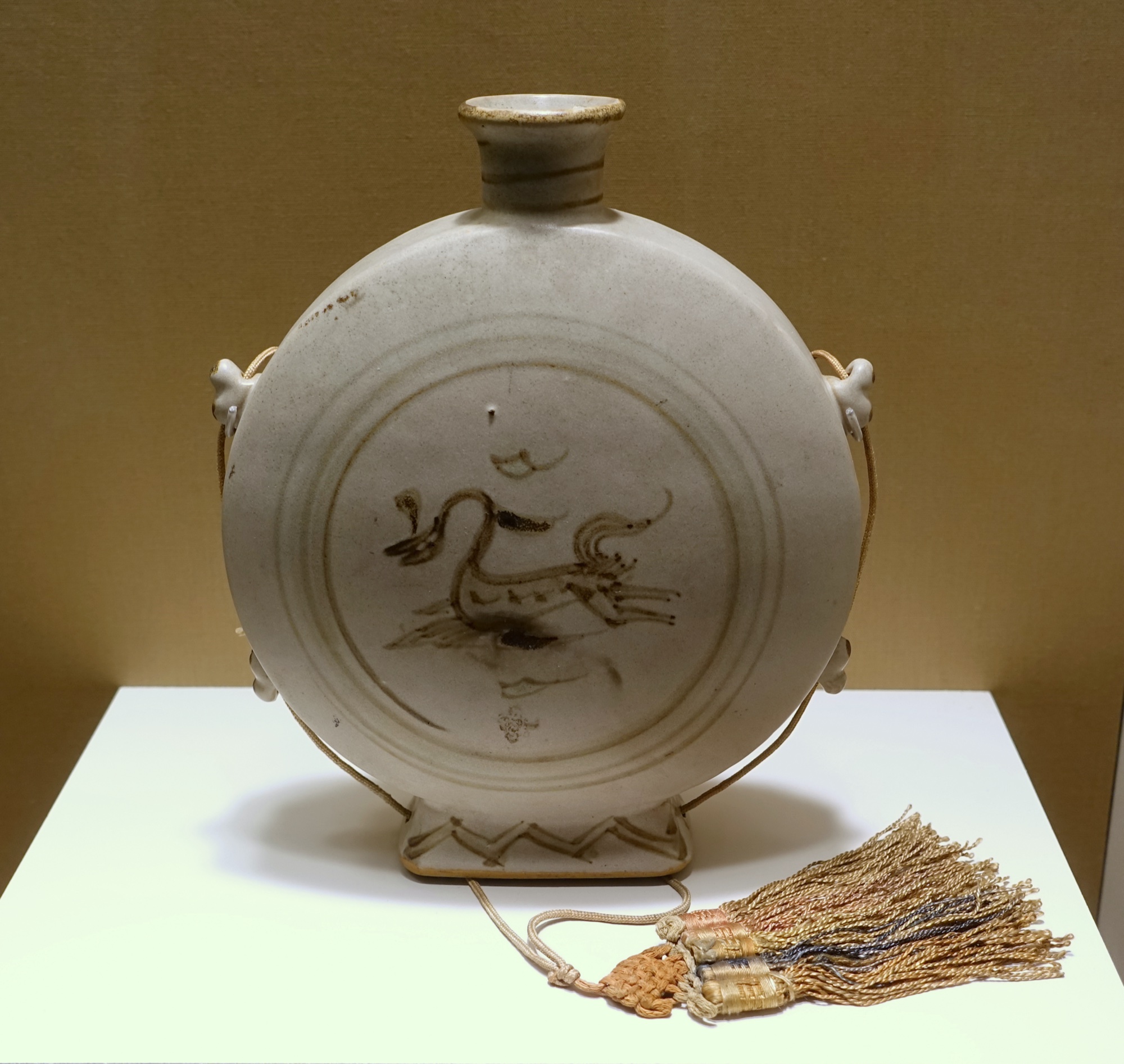
A round white ceramic flask with a cord and golden tassel hanging below
Classes from 20 minutes
The class page lists a dragonfly-knot phone strap or bracelet at 12,000 won each, taking 20 to 30 minutes, and a necklace or chrysanthemum-knot bracelet at 15,000 won each, taking 30 to 50 minutes. Korean nationals under 18 pay 10,000 and 12,000 won.
One to four people are taken in order of arrival, without reservations; groups of five or more must book. A May 28 notice said prices would rise from June 1; the figures above are those now on the website and on the Seoul Tourism page, last edited Sept. 29.
Getting there and hours
The address is 10 Bukchon-ro 12-gil, Jongno-gu. The Seoul Tourism Organization gives the distance from Exit 2 of Anguk Station on Line 3 as 571 meters. The website suggests a 10-minute walk toward Gahoe-dong, or village bus No. 2 from outside the exit to the Donmi Pharmacy stop.
It opens Tuesday through Sunday, 10 a.m. to 6 p.m., and closes Mondays. Phone: 02-3673-2778. Official sources give no parking information.
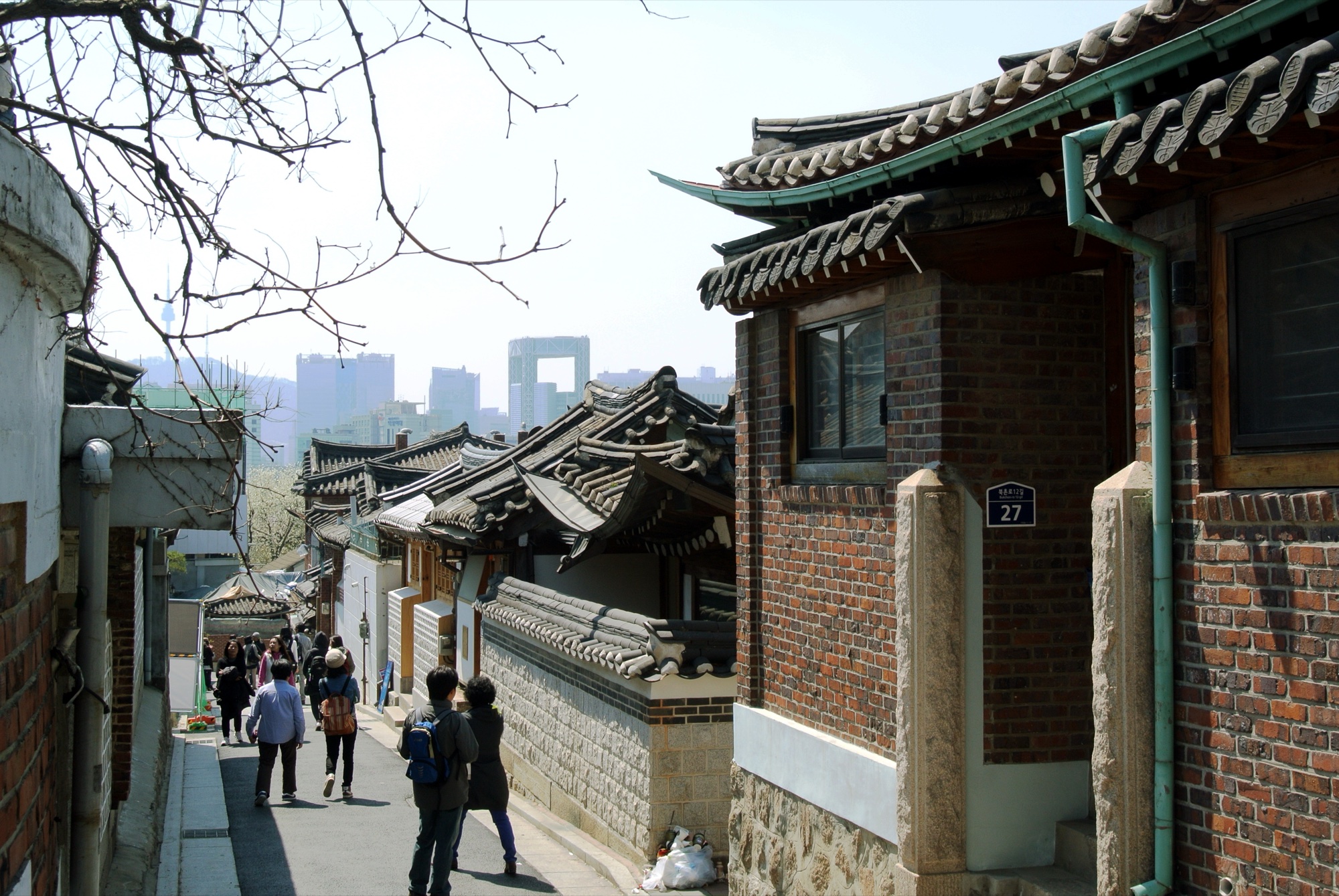
Tiled-roof hanok along a Bukchon lane with modern buildings behind
Notes for overseas visitors
The website is available in Korean, English, Chinese and Japanese, and the workshop takes questions by email at maedeup@hanmail.net. Because small groups simply walk in, a Korean mobile number is not needed for a class.
Foreign-card payment, tax refunds, overseas shipping, English service in the shop and prices of finished pieces are not confirmed in official sources.
STORE INFO
WorkshopDonglim Knot Workshop
HoursTue–Sun 10:00–18:00
Closedclosed Mondays
ClassesBracelet or phone strap 12,000 won (20–30 min) · necklace or chrysanthemum bracelet 15,000 won (30–50 min)
Booking1–4 people walk in, first come first served · 5+ book ahead
Contact02-3673-2778
NoteForeign cards, tax refund, overseas shipping and in-store English not confirmed
LOCATION
동림매듭공방 Donglim Knot Workshop, Bukchon, Jongno-gu, Seoul; opened April 2004 with Seoul city support; displays norigae, belts, pouches, fan tassels (선추), yuso tassels and knot materials in a hanok exhibition room.서울 종로구 북촌로12길 10 / 10 Bukchon-ro 12-gil, Jongno-gu, Seoul
Knotted ornaments laid out on a round tray (2005; a general photo of Korean knotting, not Donglim products). SJ Yang / CC BY-SA 2.0. Proportionally downscaled.
A three-piece norigae with hairpins and a silver ornamental knife in a museum case (2020; location not stated on the file page). Not from Donglim’s collection. 고려 / CC BY 4.0.
A 15th-century Joseon flask with a cord and tassel at the John and Mable Ringling Museum of Art in Florida (2017). Not a Donglim work. Daderot / public domain.
The Seoul city government is holding the Seoul Global Art Night with Receipt Concert at Seoul Plaza on Oct. 16 and 17. Both nights start at 6 p.m. and admission is free. Visitors with receipts from Seoul small businesses get seats near the stage.
Receipt seating
Receipts from small businesses in Seoul, dated this October, must total at least 30,000 won. Several receipts can be combined, and they are checked at an on-site booth on the day.
Verified visitors sit in the front “Sangsaeng Zone.” Those without receipts can still watch for free but are seated in a different area.
Friday, Oct. 16
The traditional music stage “Pungnyu Seoul” features Kim Su-in, Ko Young-yeol, Yoo Tae-pyeong-yang and Lee Bong-geun.
The pop stage “Soul Seoul” features Lee Mu-jin, Kassy, Gummy and Kim Kwang-jin.
Saturday, Oct. 17
The 2026 K-Pop Cover Dance Festival World Final takes place, with finalist teams from 13 countries.
A street dance show, “Seoul Street Wave,” follows. A booth showcasing small and medium-sized business products chosen by the Ministry of SMEs and Startups will also operate.
Purpose
Seoul officials say they want the event to bring customers to restaurants, cafes and shops around City Hall and to build night-time cultural tourism. Min Su-hong, head of the city’s Culture Headquarters, said the city aims to turn rich cultural experiences into a livelier night economy.
Reports did not describe a separate process for foreign visitors. The receipt check is the only seating rule announced.
The 2026 Nowon Moonlight Walk: New Moon opened on the 16th along Danghyeoncheon stream in Seoul’s Nowon District. It runs 24 days through Nov. 8, daily from 5:30 p.m. to 10 p.m., and the Seoul culture calendar lists it as free.
Dates and route
Nowon District is holding the seventh edition of the public-art light festival along a 1.3-kilometer stretch of Danghyeoncheon, from Danghyeon 1 Bridge near Junggye Station to Yangji Bridge.
It opened with a lighting ceremony at Danghyeon-maru on the 16th and continues until Nov. 8.
Artworks
Twenty-four Korean artist teams are showing more than 30 works under the theme “New Moon.”
Gadget Workshop’s “Pulse of the Earth” stands at the stream’s floor-fountain plaza, and “Moon Gate” is at Yangji Bridge. Works by Kim Chang-gyeom, Eom Hyeok-yong and Lee Gil-rae are also on show.
Programs
Weekend performances are scheduled, along with moonlight tours led by resident guides. Tailored guided programs are offered for groups and visitors with disabilities.
“Pulse of the Earth” becomes a pop-up playground on the 20th, 22nd and 29th.
Visitor notes
Nowon District says about 1.32 million people visited last year. The Seoul culture calendar lists this year’s admission as free.
Hours and some programs may change, so check the Seoul culture calendar and Nowon District notices.
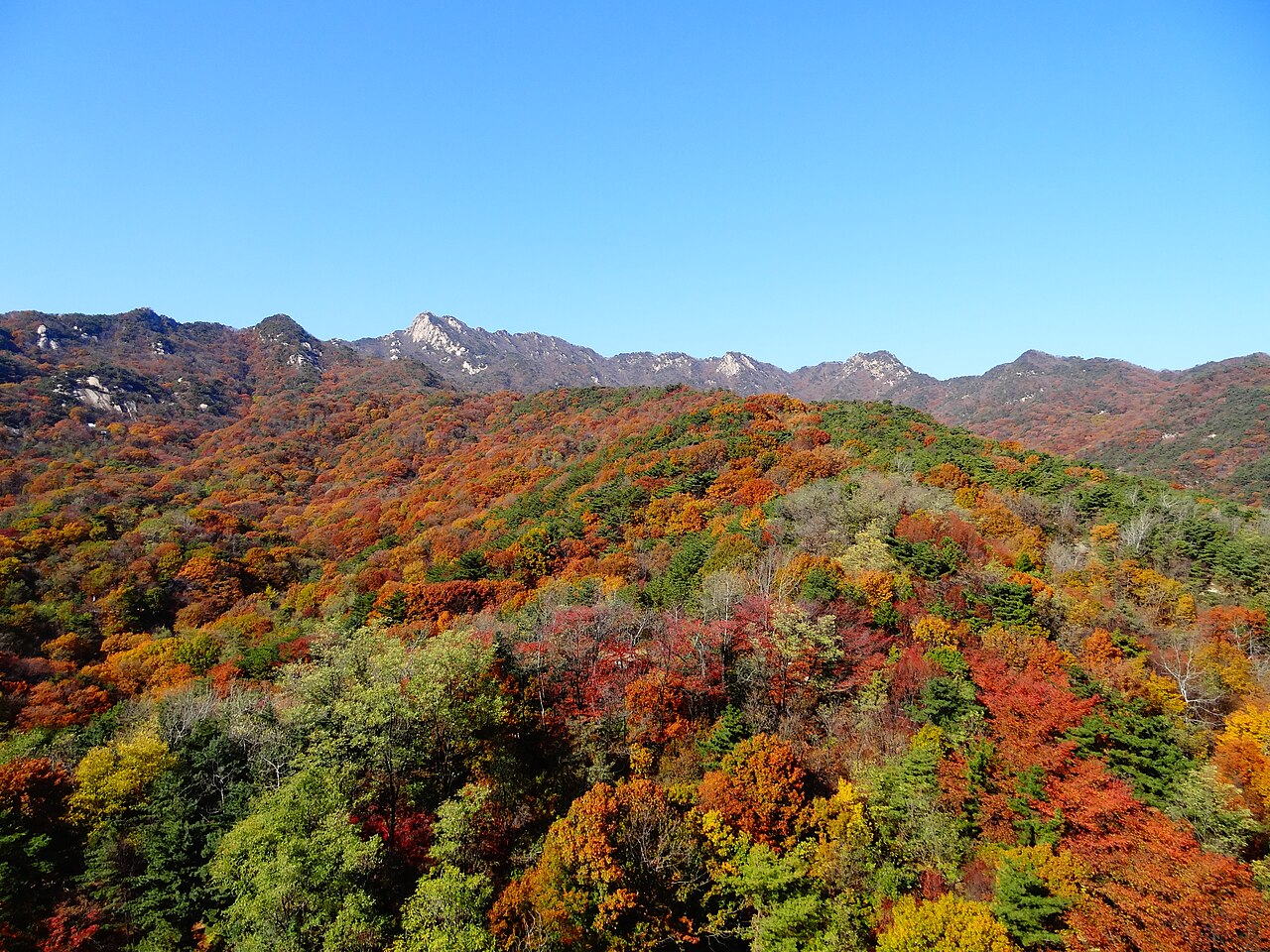
Autumn colour peaks at Odaesan on Oct 16 and Seoraksan on Oct 25, reaches Bukhansan in Seoul on Nov 4 and ends at Naejangsan (Nov 11) and Hallasan (Nov 13), according to forecaster WeatherI. This guide lists first-colour and peak dates for 14 mountains in date order, with the nearest weekends and park contacts. The Korea Forest Service uses a different yardstick, and its dates run a few days earlier.
When does the colour peak this year?
This year’s colour will come late, according to the forecast private forecaster WeatherI issued on September 4: peaks across its 15 mountains average 8 days later than normal. WeatherI defines first colour as the point when about 20% of a mountain has turned, from the summit down, and peak as about 80%. The Korea Meteorological Administration uses the same yardstick.
The Korea Forest Service map released on September 22 sets the peak at 50%, so its dates come a few days earlier: Seoraksan Oct 20, Songnisan Oct 28, Naejangsan Nov 4 and Hallasan Nov 6. Forecasts differ by several days between agencies.
Of WeatherI’s 15 mountains, Geumgangsan, in North Korea, is excluded.
Odaesan · peak Oct 16 (Fri)
Odaesan — first colour Oct 7 · peak Oct 16 (Pyeongchang, Gangwon; 1,565 m)
Against normal: first colour 6 days later than normal, peak 1 day later than normal
Nearest weekend: Oct 17–18 (the weekend right after the peak)
Park contact: Odaesan National Park Office: 2 Odaesan-ro, Jinbu-myeon, Pyeongchang-gun, Gangwon (033-332-6417)
Note: WeatherI has Odaesan peaking before Seoraksan (Oct 25). As of Oct 15, the forecast peak is the next day.
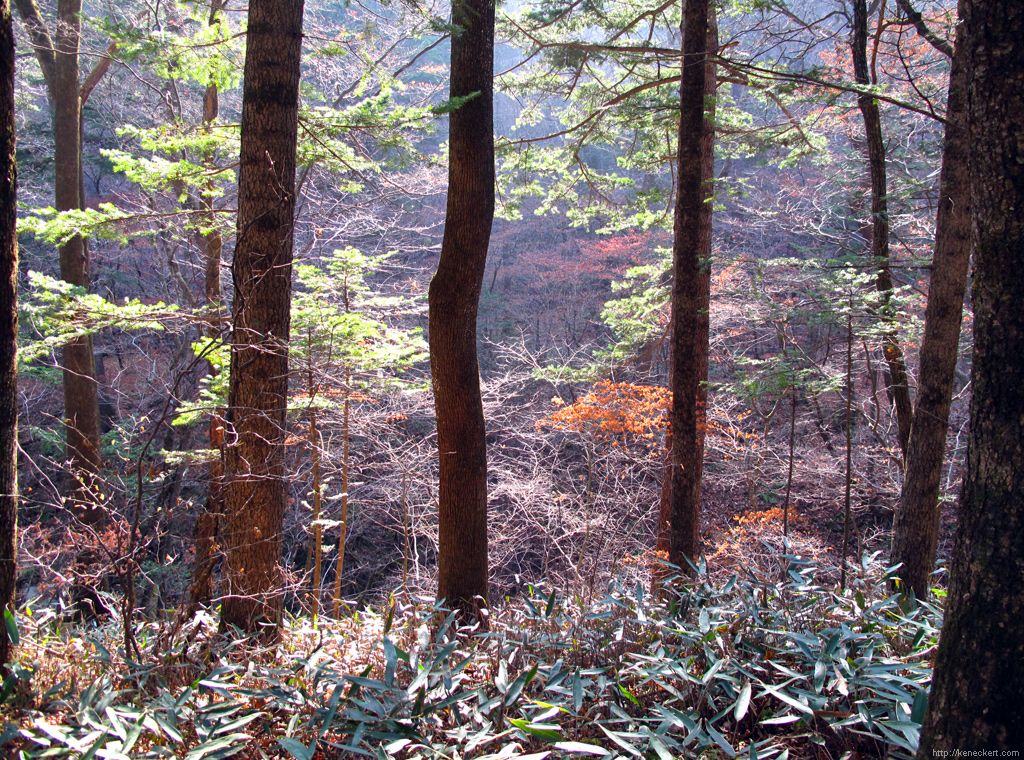
Straight tree trunks above red and yellow undergrowth in the Odaesan forest
Seoraksan · peak Oct 25 (Sun)
Seoraksan — first colour Oct 3 · peak Oct 25 (Sokcho/Inje/Yangyang, Gangwon; 1,708 m)
Against normal: first colour 5 days later than normal, peak 8 days later than normal
Nearest weekend: Oct 24–25 (the peak falls on a Sunday)
Park contact: Seoraksan National Park Office: 833 Seoraksan-ro (Seorak-dong), Gangwon (033-801-0900)
Note: The KMA’s Gangwon office observed Seoraksan’s first colour on Sep 28, the same date as normal. KMA records put the normal peak at Oct 17; last year it came on Oct 24. The Korea Forest Service map (peak = 50%) says Oct 20.
Cable car: The Gwongeumseong cable car sells same-day tickets on site only, and weekend queues form from about 7–8 a.m., Maeil Shinmun reported.
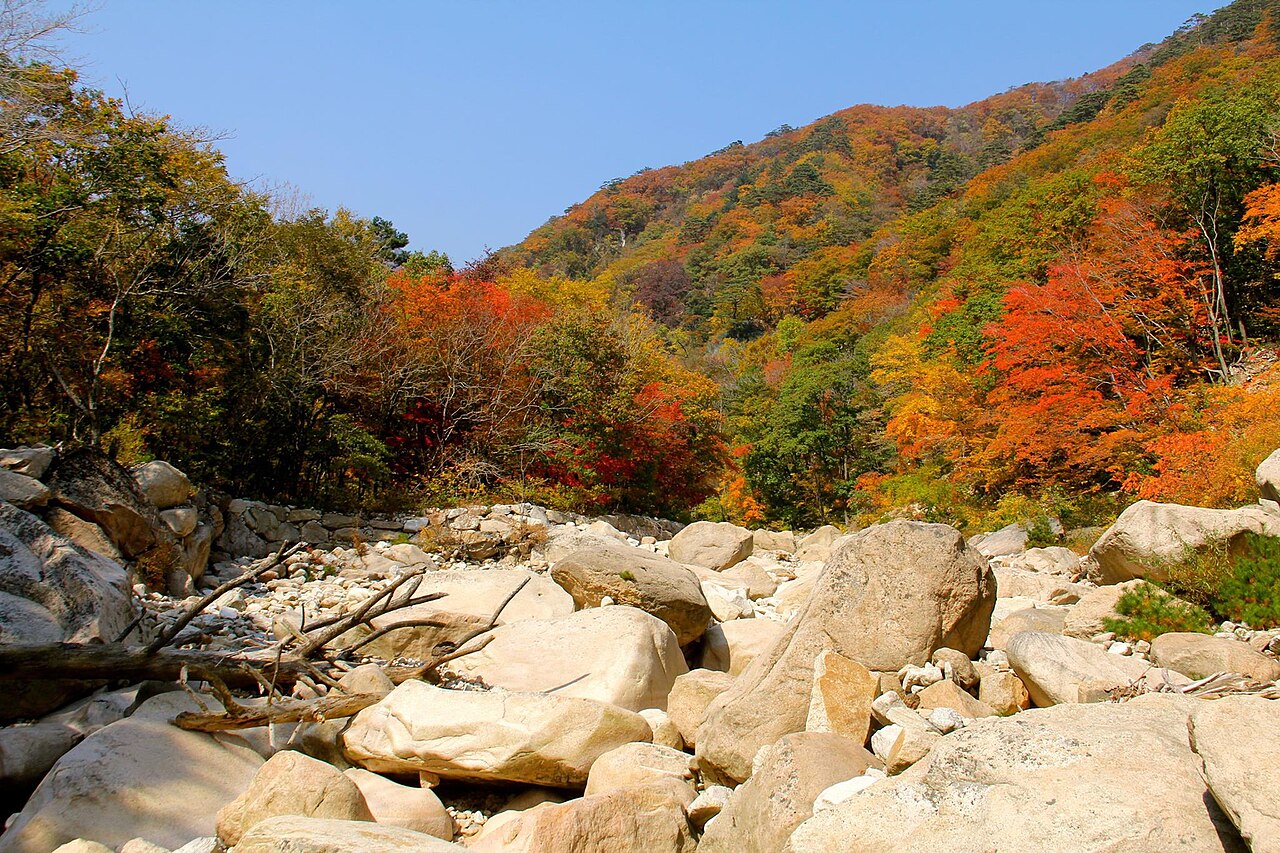
Red and yellow foliage covering Seoraksan slopes above a rocky stream bed
Chiaksan · peak Oct 31 (Sat)
Chiaksan — first colour Oct 10 · peak Oct 31 (Wonju, Gangwon; 1,282 m)
Against normal: first colour 3 days later than normal, peak 10 days later than normal
Nearest weekend: Oct 31–Nov 1 (the peak falls on a Saturday)
Park contact: Chiaksan National Park Office: 26 Musoejeom 2-gil, Socho-myeon, Wonju, Gangwon (033-740-9900)
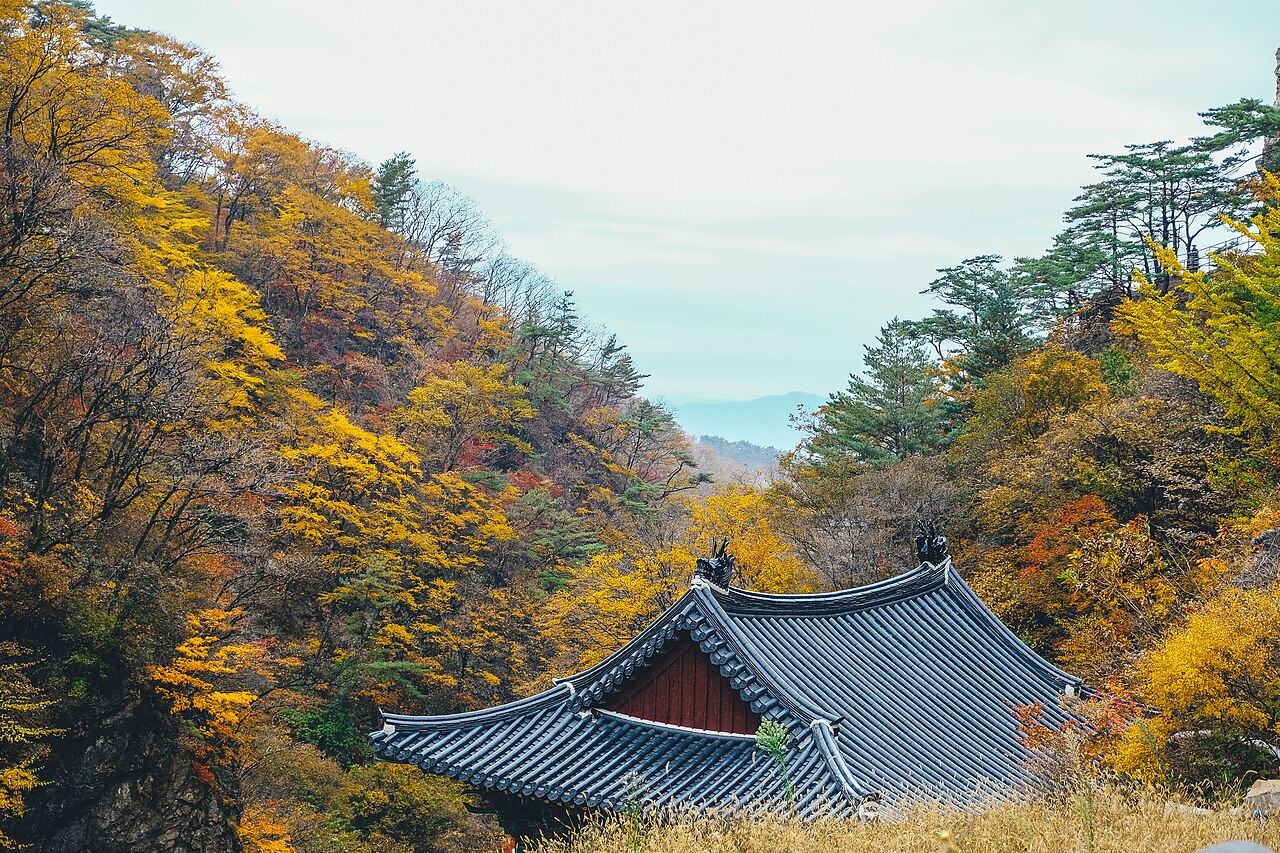
A tiled temple roof below a valley of yellow and red leaves on Chiaksan
Bukhansan · peak Nov 4 (Wed)
Bukhansan — first colour Oct 23 · peak Nov 4 (Seoul and Gyeonggi; 835 m)
Against normal: first colour 8 days later than normal, peak 7 days later than normal
Nearest weekend: Oct 31–Nov 1 or Nov 7–8 (the peak falls on a Wednesday)
Park contact: Bukhansan National Park Office: 262 Bogungmun-ro, Seongbuk-gu, Seoul; Dobong Office: 69 Hoeryong-ro, Uijeongbu, Gyeonggi
Getting there: From exit 2 of Gupabal Station (Line 3), buses 34, 704 and 8772 (weekends) stop at Bukhansanseong, next to the Bukhansanseong visitor centre. The routes are from a November 2023 Seoul Media Hub guide; check them before you go.
Note: KNPS lists Bukhansan among the parks where it will check for illegal vending in valleys this season.
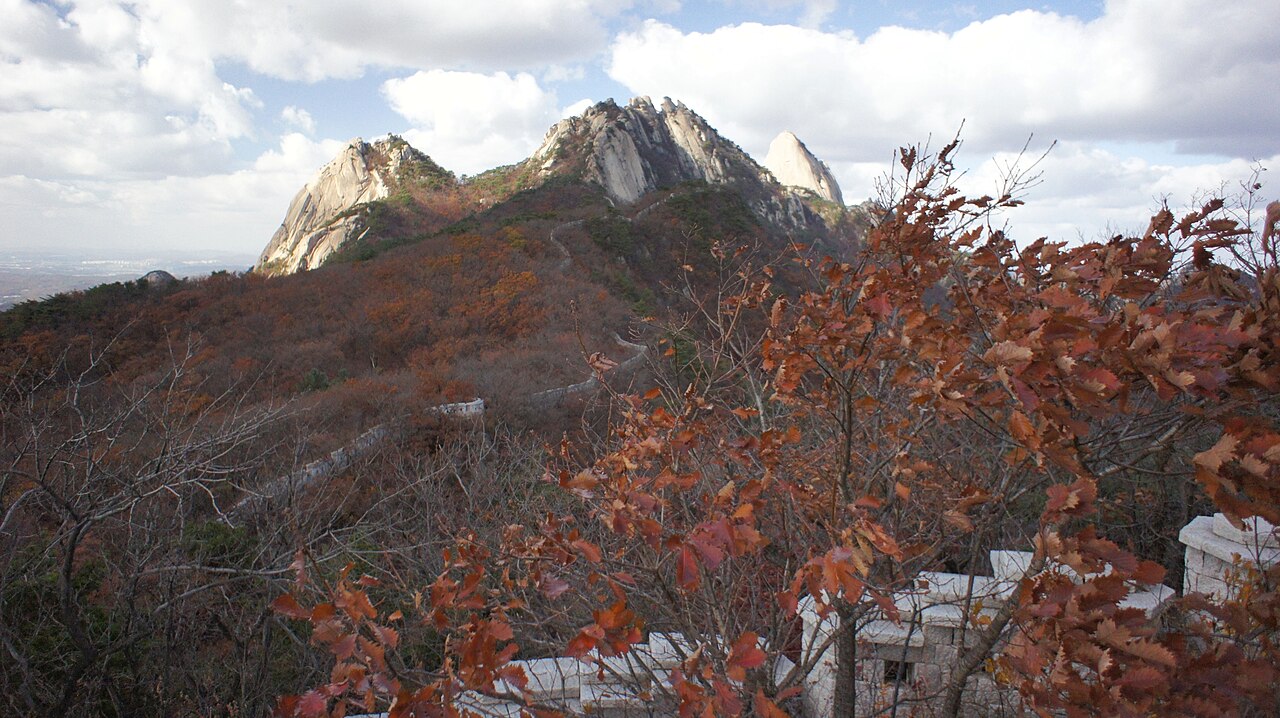
Bukhansan granite peaks rising beyond reddened leaves
Songnisan · peak Nov 4 (Wed)
Songnisan — first colour Oct 27 · peak Nov 4 (Boeun, North Chungcheong; 1,058 m)
Against normal: first colour 12 days later than normal, peak 6 days later than normal
Nearest weekend: Oct 31–Nov 1 or Nov 7–8
Park contact: Songnisan National Park Office: 84 Beopjusa-ro, Songnisan-myeon, Boeun-gun, North Chungcheong (043-542-5267)
Note: The Korea Forest Service map (peak = 50%) says Oct 28, a week ahead of WeatherI.
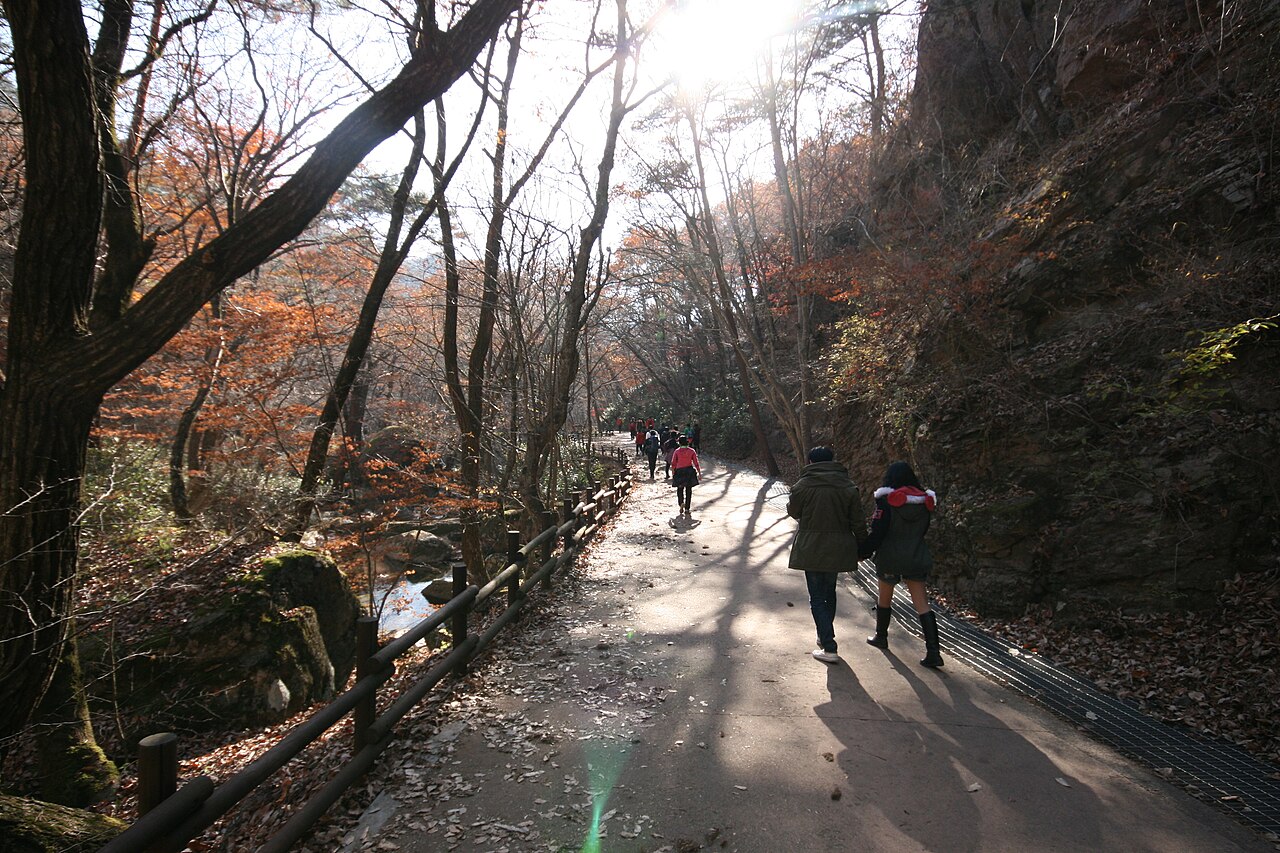
Hikers walking a paved trail between autumn trees on Songnisan
Gyeryongsan · peak Nov 4 (Wed)
Gyeryongsan — first colour Oct 24 · peak Nov 4 (Gongju, South Chungcheong / Daejeon; 846 m)
Against normal: first colour 8 days later than normal, peak 8 days later than normal
Nearest weekend: Oct 31–Nov 1 or Nov 7–8
Park contact: Gyeryongsan National Park Office: 86 Donghaksa 2-ro, Banpo-myeon, Gongju, South Chungcheong (042-820-3100)
The painted Donghaksa gate beside trees in yellow leaf
Woraksan · peak Nov 5 (Thu)
Woraksan — first colour Oct 25 · peak Nov 5 (Jecheon/Chungju, North Chungcheong; 1,095 m)
Against normal: first colour 13 days later than normal, peak 12 days later than normal
Nearest weekend: Oct 31–Nov 1 or Nov 7–8
Park contact: Woraksan National Park Office: 1647 Mireuksongye-ro, Hansu-myeon, Jecheon, North Chungcheong (043-653-3250)
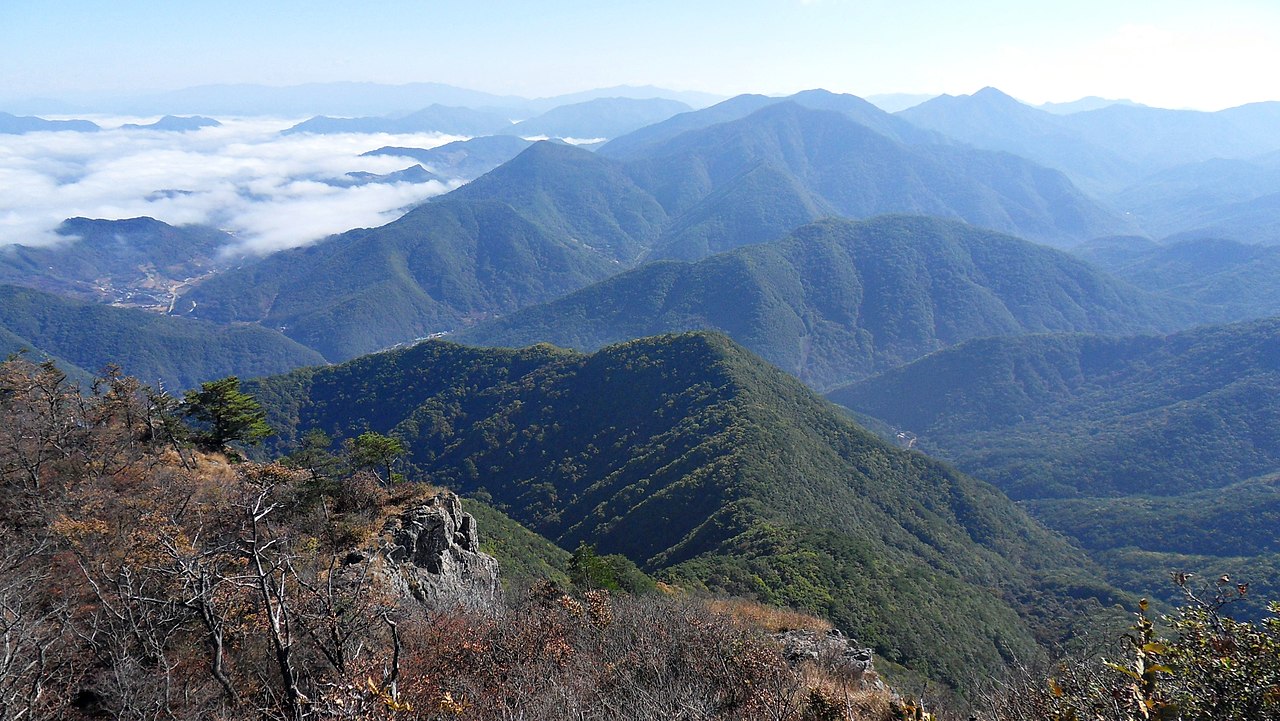
Layers of Woraksan ridges and a lake beyond a rocky outcrop
Gayasan · peak Nov 5 (Thu)
Gayasan — first colour Oct 22 · peak Nov 5 (Hapcheon, South Gyeongsang / Seongju, North Gyeongsang; 1,432 m)
Against normal: first colour 9 days later than normal, peak 9 days later than normal
Nearest weekend: Oct 31–Nov 1 or Nov 7–8
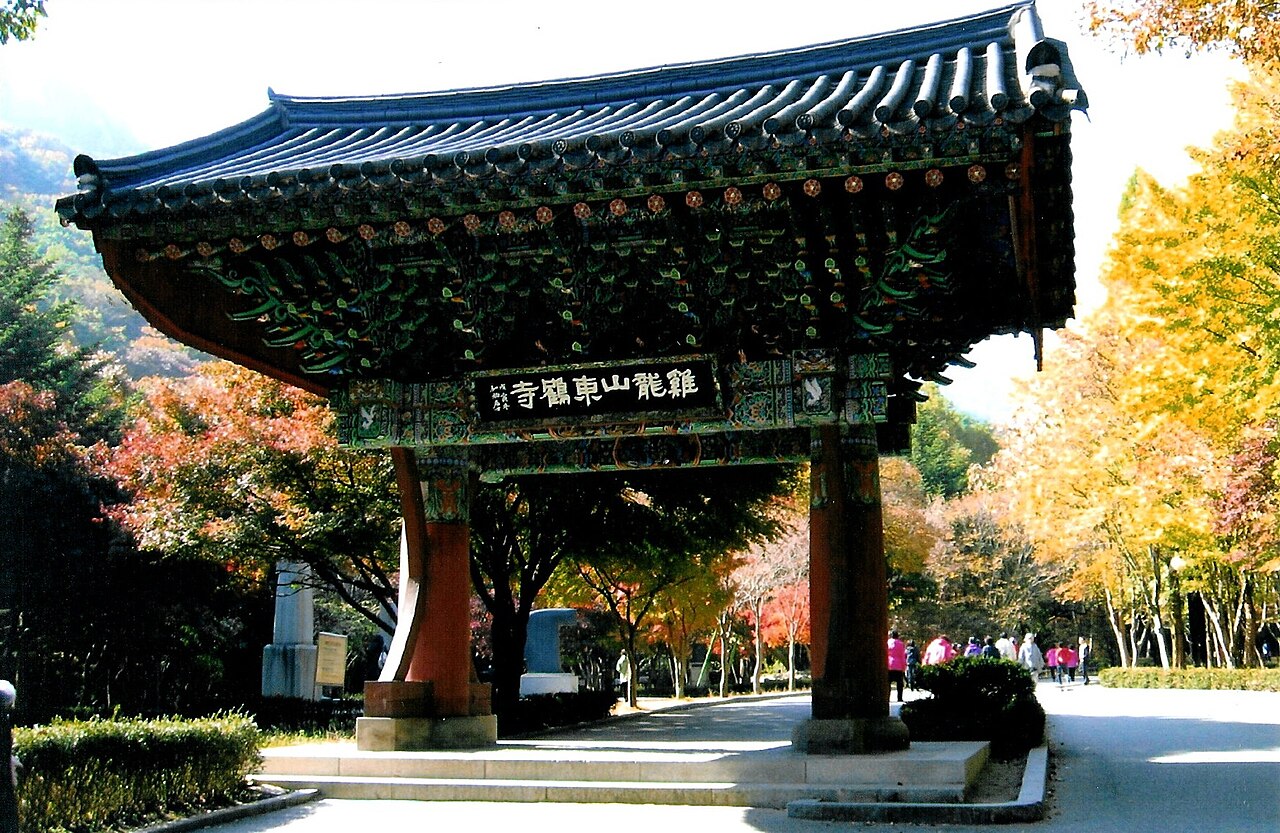
Park contact: Gayasan National Park Office: 1200 Gayasan-ro, Gaya-myeon, Hapcheon-gun, South Gyeongsang (055-930-8000)
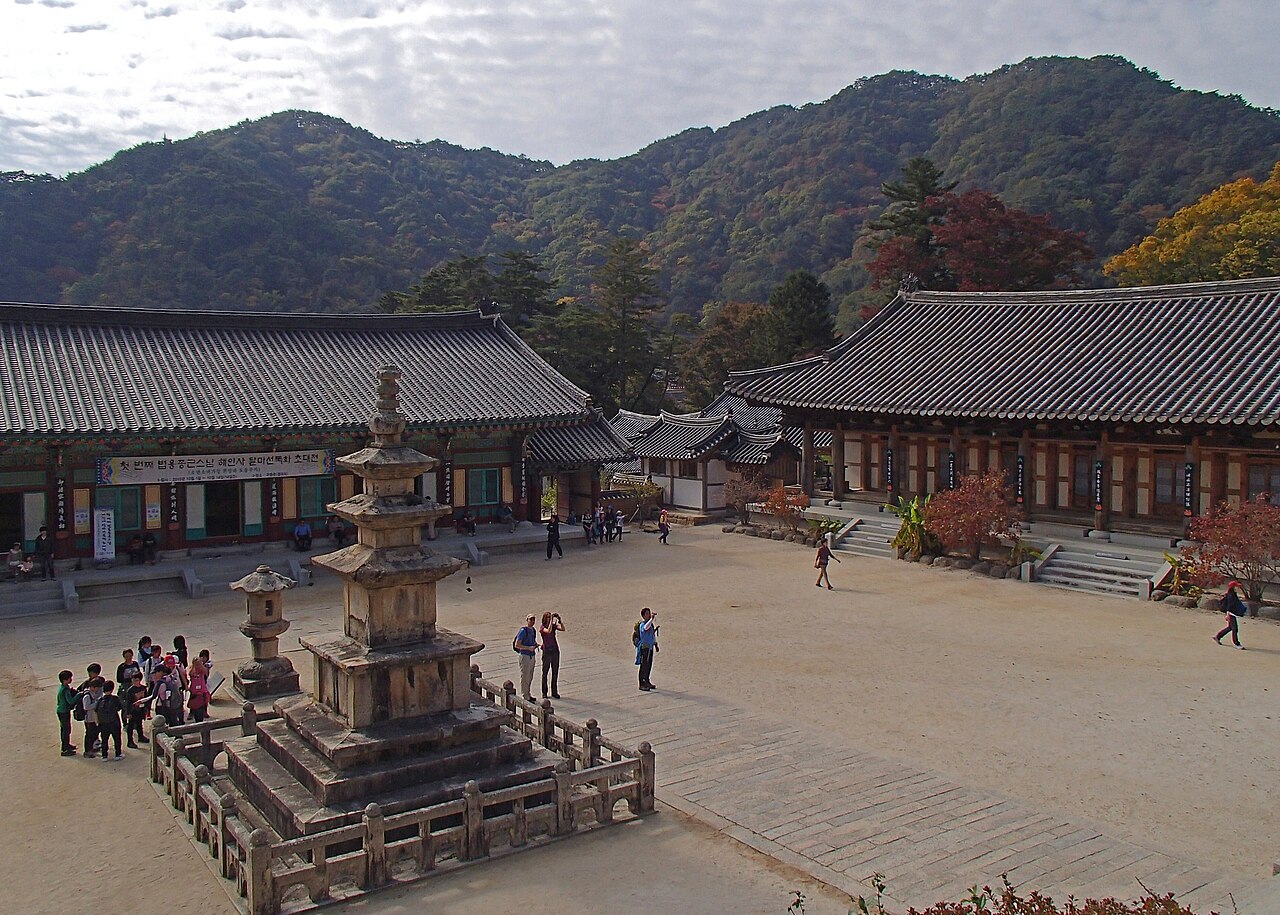
Haeinsa courtyard and stone pagoda against mountains starting to turn
Jirisan · peak Nov 5 (Thu)
Jirisan — first colour Oct 28 · peak Nov 5 (Sancheong/Hamyang/Hadong, Namwon and Gurye; 1,915 m)
Against normal: first colour 17 days later than normal, peak 13 days later than normal
Nearest weekend: Oct 31–Nov 1 or Nov 7–8
Park contact: Jirisan National Park offices: 376 Nammyeong-ro, Sicheon-myeon, Sancheong (Gyeongnam); 356 Hwaeomsa-ro, Masan-myeon, Gurye (Jeonnam); 81 Jeongnyeongchi-ro, Jucheon-myeon, Namwon (Jeonbuk)
Note: Jirisan is among the latest against normal in the WeatherI forecast: first colour 17 days and peak 13 days behind.
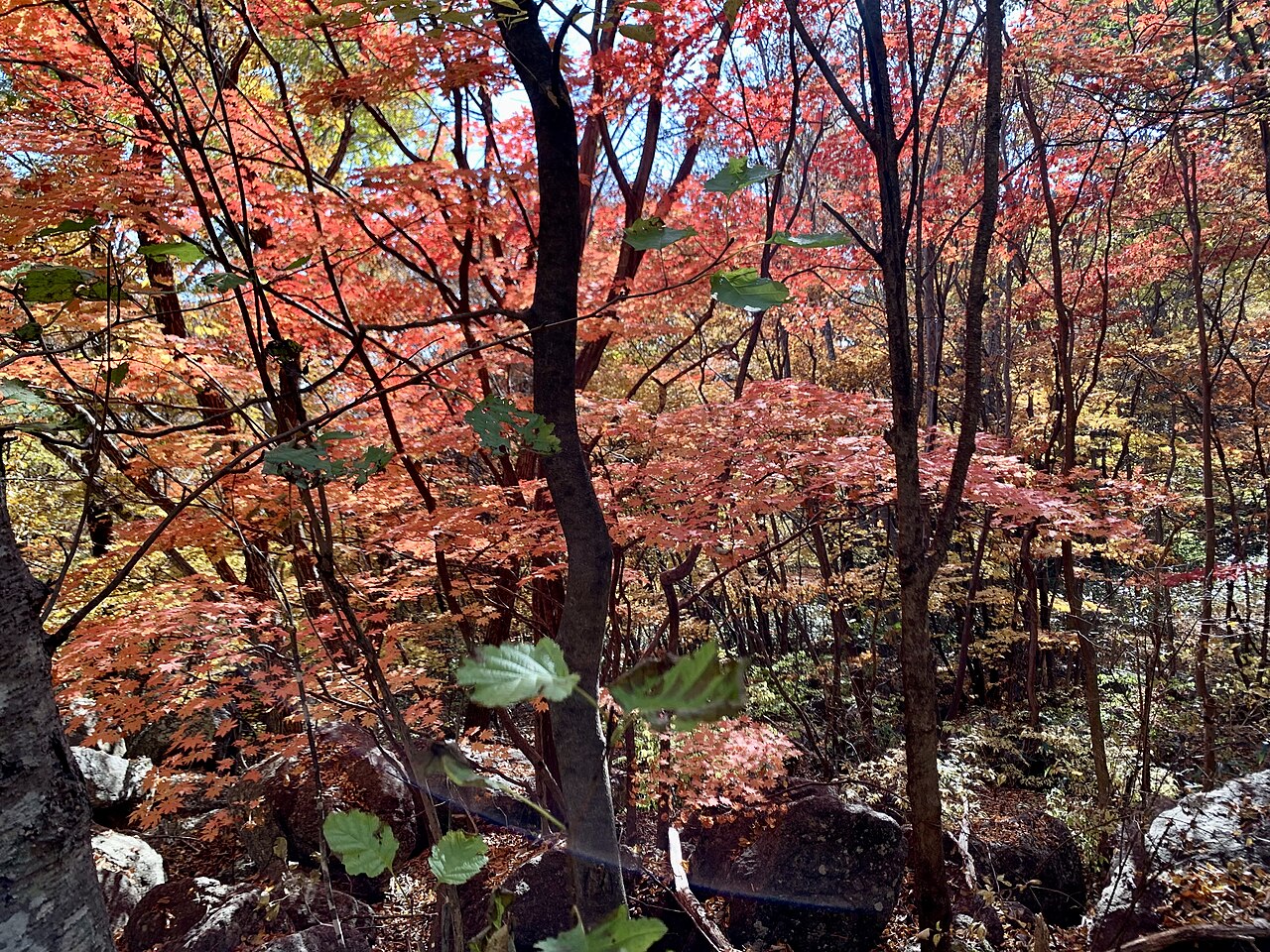
Red maple leaves among slender trunks on Jirisan
Mudeungsan · peak Nov 6 (Fri)
Mudeungsan — first colour Oct 27 · peak Nov 6 (Gwangju and Hwasun; 1,186 m)
Against normal: first colour 6 days later than normal, peak 2 days later than normal
Nearest weekend: Nov 7–8 (starting the day after the peak)
Park contact: Mudeungsan National Park Office: 5 Dongsan-gil 7beon-gil, Dong-gu, Gwangju (062-227-1187)
Note: KNPS lists Mudeungsan among the parks where it will check for illegal vending in valleys this season.
Browning hillsides with the city of Gwangju in the distance
Naejangsan · peak Nov 11 (Wed)
Naejangsan — first colour Nov 5 · peak Nov 11 (Jeongeup, Jeonbuk / Jangseong, Jeonnam; 763 m)
Against normal: first colour 16 days later than normal, peak 5 days later than normal
Nearest weekend: Nov 7–8 or Nov 14–15 (the peak falls on a Wednesday)
Park contact: Naejangsan National Park Office: 328 Naejanghoban-ro, Jeongeup, Jeonbuk; Baegam Office: 1116 Baegyang-ro, Bukha-myeon, Jangseong
Note: The Korea Forest Service map (peak = 50%) says Nov 4, a week ahead of WeatherI.
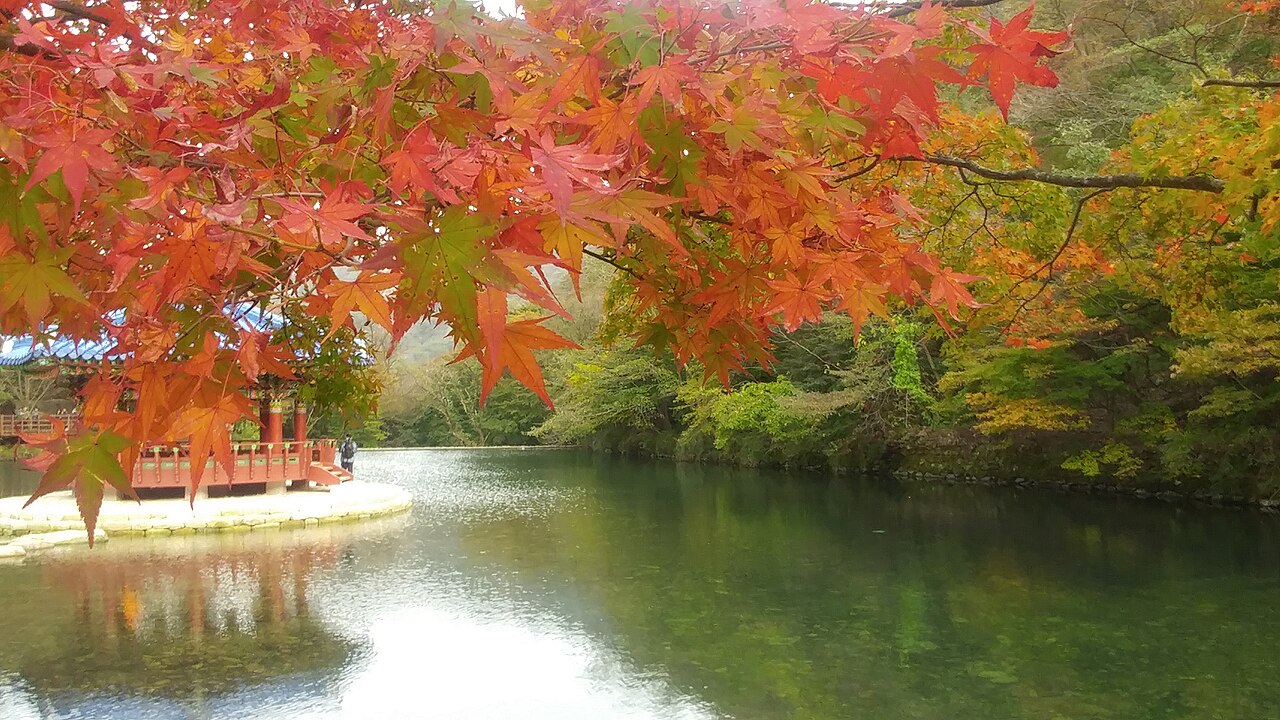
Red maple leaves hanging over a pond with a pavilion on the bank
Duryunsan · peak Nov 11 (Wed)
Duryunsan — first colour Oct 29 · peak Nov 11 (Haenam, South Jeolla; 700 m)
Against normal: first colour same as normal, peak same as normal
Nearest weekend: Nov 7–8 or Nov 14–15
Park contact: A provincial park; its main temple Daeheungsa is at 400 Daeheungsa-gil, Samsan-myeon, Haenam
Note: WeatherI says first colour here comes about a month after Seoraksan because of the mountain’s position at the southern tip of the peninsula. This year’s forecast matches normal.
Palgongsan · peak Nov 12 (Thu)
Palgongsan — first colour Oct 26 · peak Nov 12 (Daegu and Chilgok/Gunwi; 1,192 m)
Against normal: first colour 9 days later than normal, peak 15 days later than normal
Nearest weekend: Nov 7–8 or Nov 14–15
Park contact: Palgongsan National Park East Office: 68 Palgongsan-ro 185-gil, Dong-gu, Daegu (053-989-8300); West Office: 175 Palgongsan-ro, Dongmyeong-myeon, Chilgok
Note: Its peak is 15 days later than normal, the second-largest delay in the WeatherI forecast after Hallasan (16).
Hallasan · peak Nov 13 (Fri)
Hallasan — first colour Oct 31 · peak Nov 13 (Jeju; 1,947 m)
Against normal: first colour 17 days later than normal, peak 16 days later than normal
Nearest weekend: Nov 14–15 (starting the day after the peak)
Entry hours: Since Oct 1 the Hallasan National Park office has applied earlier winter cut-offs: last entry at noon at Eorimok and Yeongsil, 11:30 a.m. at Seongpanak and Gwaneumsa, and 10 a.m. at Donnaeko. All trails open at 5 a.m.
Note: The Korea Forest Service map (peak = 50%) says Nov 6.
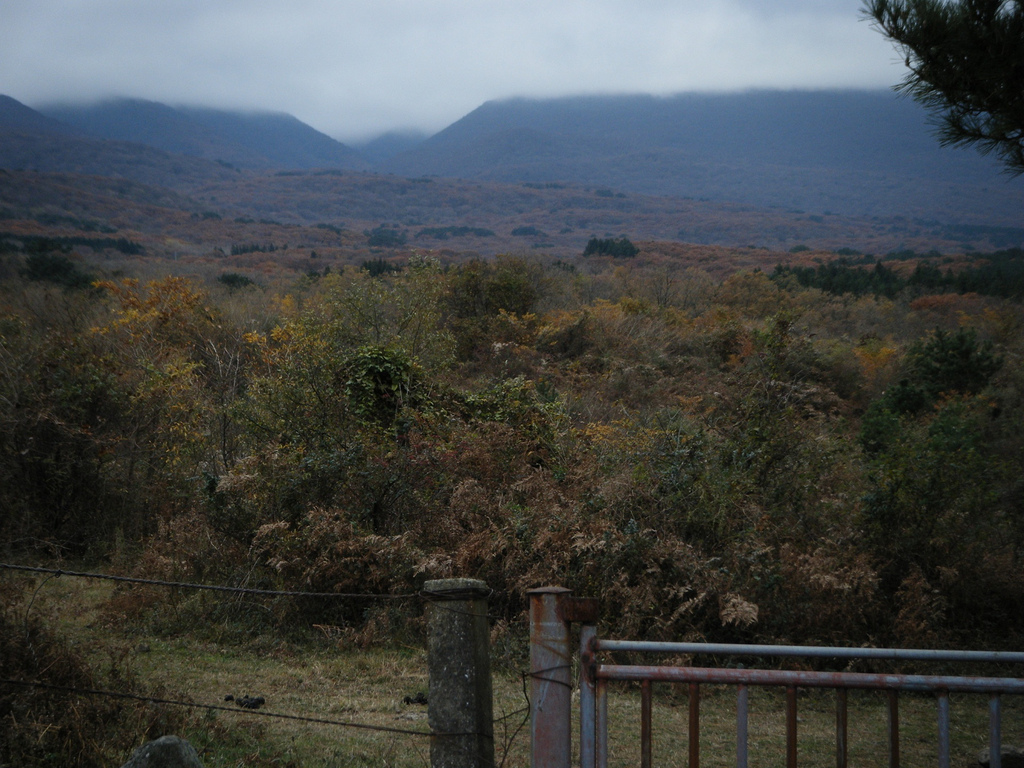
Brown and red autumn scrub below cloud-covered Hallasan ridges
Before setting out
About 24% of last year’s 43.31 million national park visits, or 10.21 million, came in October and November, according to KNPS. Weekdays are less crowded.
The KMA Weather Nuri “famous mountain foliage” page posts photos of 21 mountains until November 27, and the KMA Gangwon foliage service streams live views of Gangwon national parks. Partial closures are listed by park on the KNPS trail-control page. From September 21 to November 30, KNPS is cracking down on off-trail shortcuts, cooking, camping or parking outside designated areas, smoking and gathering forest products.
Dobongsan, Gwanaksan, Suraksan and other mountains have no mountain-level forecast and are not listed. The Korea National Arboretum’s foliage-peak search, opened September 29, estimates a peak date for any address.
The 25th Seoul Silver Grass Festival runs from Saturday, Oct. 17, to Oct. 23 at Haneul Park in Seoul. It is open daily from 10 a.m. to 9 p.m., and admission is free.
Dates and venue
The Seoul Metropolitan Government said the festival will take place around Haneul Park in World Cup Park from Oct. 17 to 23. This year’s theme is “Silver grass, nature’s comfort.”
Hours are 10 a.m. to 9 p.m. daily. FT Sports reported that an opening ceremony and celebration performance are scheduled for 6 p.m. on Oct. 17.
What is on
According to Fun Seoul, the opening ceremony includes a lighting show and a celebration performance. A busking zone at the central stage hosts acts from different genres.
There is also an activity zone with hands-on programs such as making silver grass bouquets, photo spots and a wish zone where visitors write and hang wishes. A “Re-born” market sells upcycled goods and silver grass products.
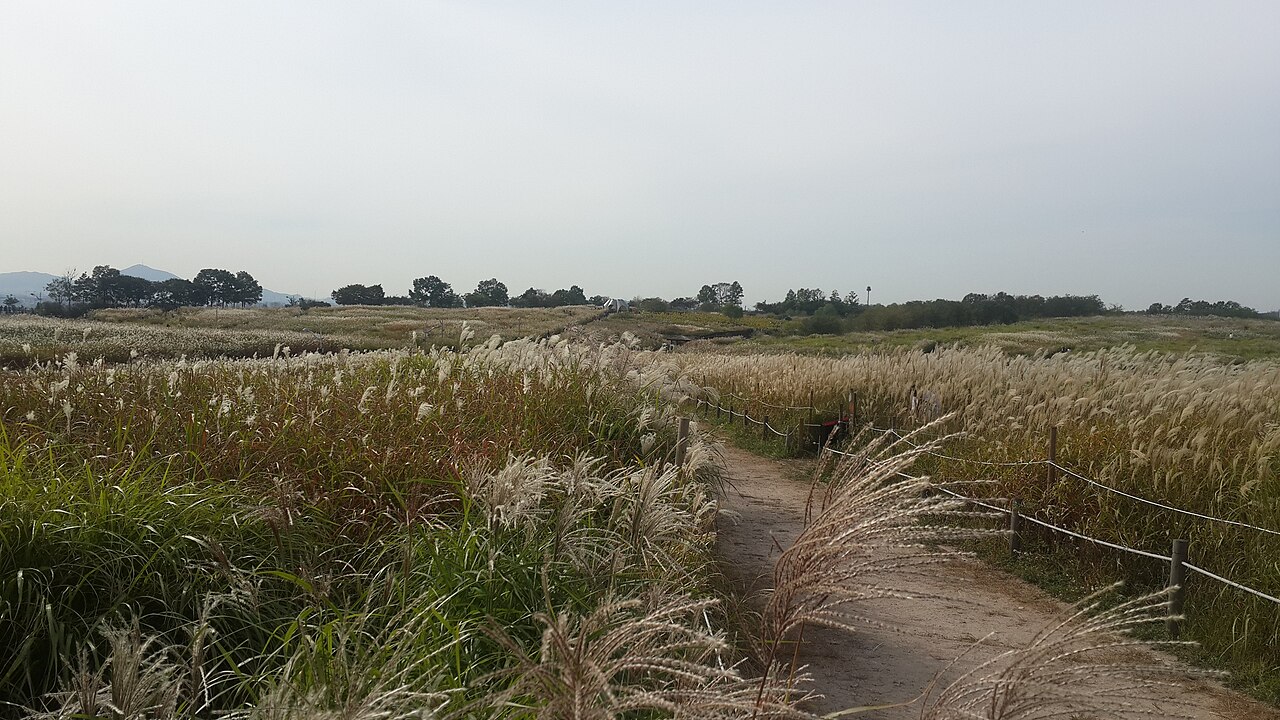
A dirt path crossing the silver grass beside a rope fence
Getting there
Seoul advises taking Line 6 to World Cup Stadium Station or Mapo-gu Office Station and walking up, about 40 minutes.
The Maenggongi electric car leaves from the Nanjicheon Park parking lot. FT Sports reported a round-trip fare of 3,000 won for adults and 2,200 won for children. The city urged visitors to use public transport because of congestion.
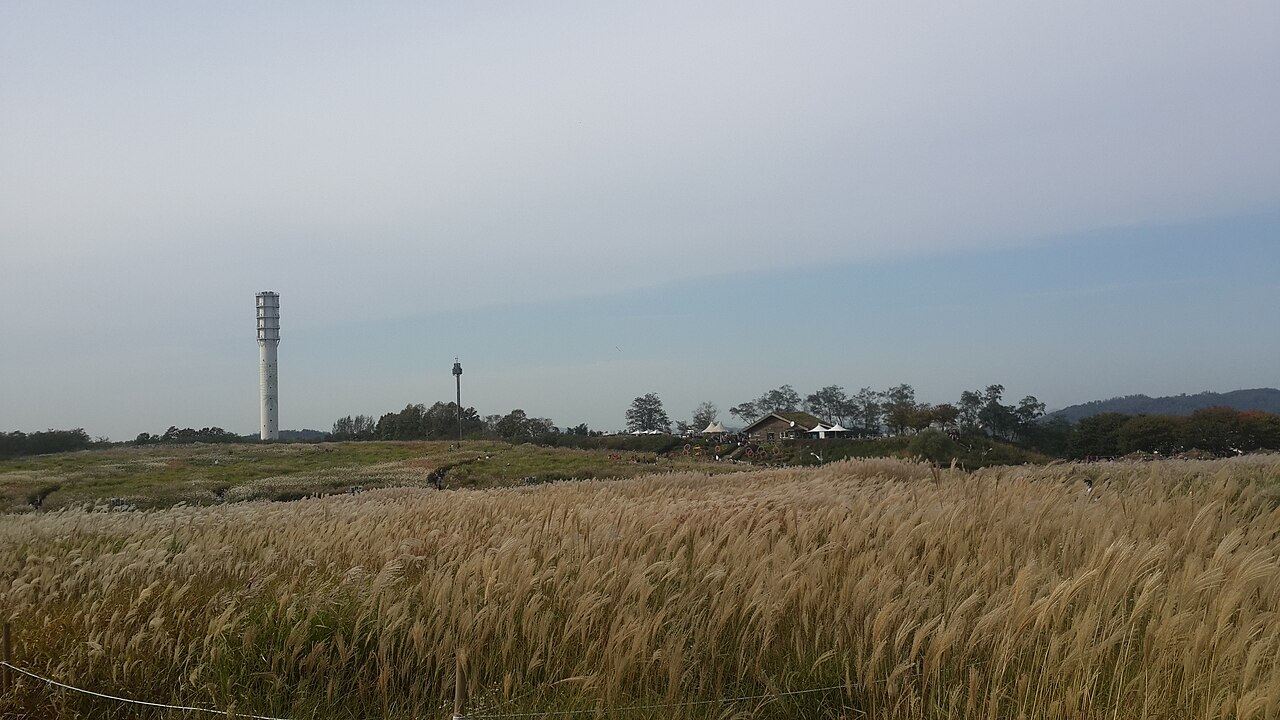
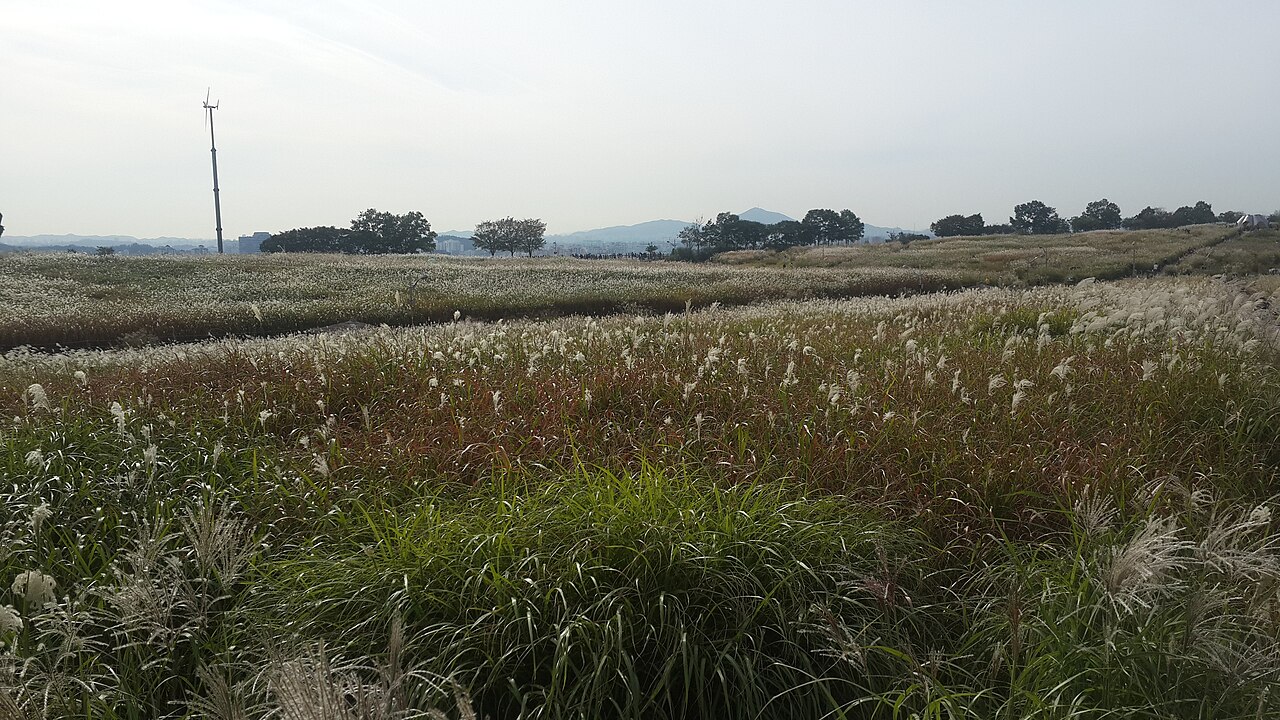
Stands of silver grass with silvery plumes against distant hills
Driving and inquiries
FT Sports reported that Nanjicheon Park Parking Lot 1 is closest to the electric car ticket booth. Parking fees differ between sources, so follow on-site notices.
Inquiries go to the Seobu Park Leisure Center (02-300-5574).
Silver grass stands at Haneul Park with ridgelines in the distance, October 2015. Archive photo, not from this year’s festival. Photo: Ji-soo Seo · CC BY-SA 4.0