The Seoul Tourism Organization is running MY “VISIT SEOUL” STARTER PACK for foreign travelers from October 12 to 31. Participants browse four Seoul travel themes and comment on where they want to go and why. The Incheon Airport activity is closed on October 28.
Four themes
The event page groups destinations under ICONIC SEOUL, NIGHT SEOUL, TRENDY SEOUL and TASTE SEOUL. They include Gyeongbokgung, Banpo Hangang Park and Lotte World Tower; Namsan Seoul Tower, Naksan Park and DDP; Seongsu’s Yeonmujang-gil, The Hyundai Seoul and Hannam-dong; and Ikseon-dong Hanok Street, Sindang-dong Tteokbokki Town and Gwangjang Market.
Gyeongbokgung and Sindang-dong
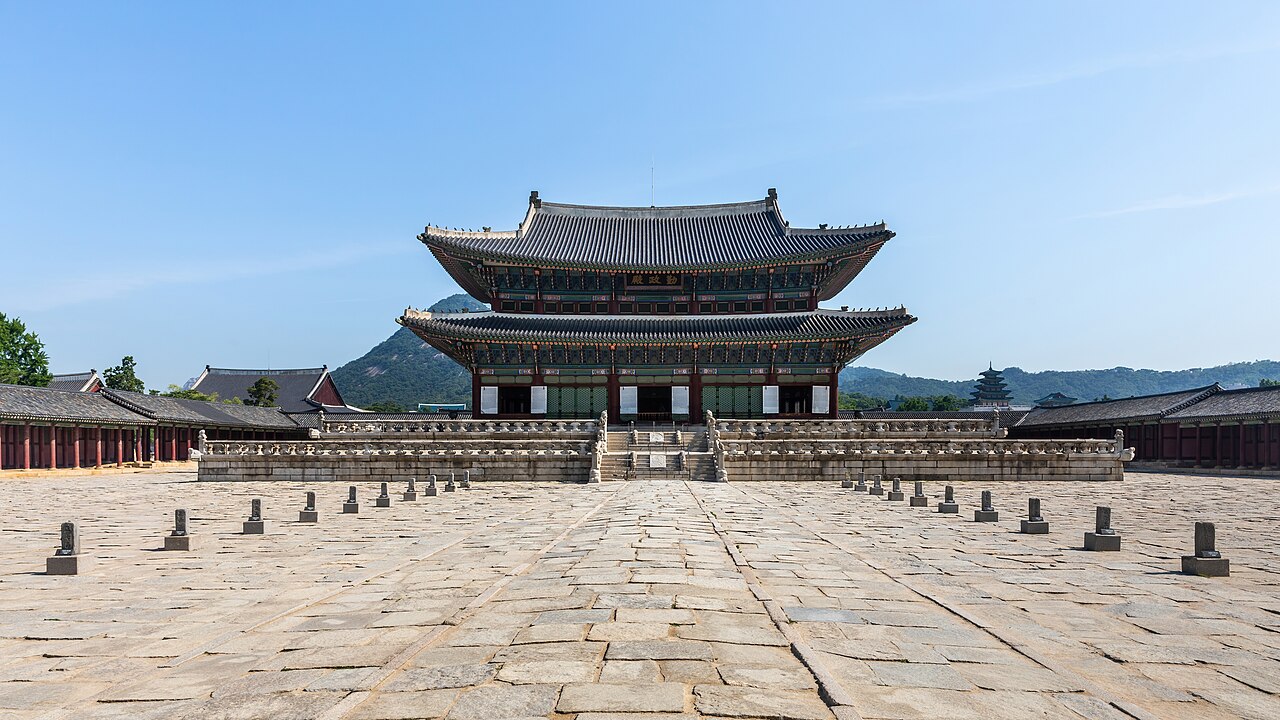
Founded in 1395, Gyeongbokgung was the main palace of the Joseon dynasty. The archival photograph of Geunjeongjeon shows one of the destinations featured in the event, not the airport venue.
Visit Seoul presents Sindang-dong Tteokbokki Town as a place to try jeukseok tteokbokki, rice cakes cooked at the table in a shared pot with sauce and other ingredients.
Comment online, verify at the airport
Online entry does not require an airport visit. Participants browse the English, Japanese, Simplified Chinese or Traditional Chinese page and comment during the event period with their preferred destination and a reason. The English and Japanese rules allow one entry per person; additional comments do not count as extra entries.
At HiKR Station in Incheon Airport, foreign visitors who show proof of participation receive a coin for an on-site prize draw. Prizes include travel multi-adapters and toothbrush sterilizers, determined by the draw. The official announcement does not give remaining quantities.
Online prize terms
The English page offers US$10 Amazon e-gift cards to ten winners, and the Japanese page JPY 1,500 Amazon gift cards to ten winners, usable only on Amazon.co.jp. Winners on both pages are scheduled to be announced on November 6, KST, on the Visit Seoul event page.
Winners must provide the requested information by the deadline. Prizes cannot be transferred or exchanged for cash and may be replaced with items of equal value depending on availability. The online lottery is separate from the airport draw.
HiKR Station
HiKR Station is on the west side of B1 in the Terminal 1 Transportation Center at Incheon Airport. It opens 10:00–19:00 KST, with admission ending 20 minutes before closing, and general admission is free. The airport event runs on 19 days, excluding the regular closure on October 28.
The address is 271 Gonghang-ro, Yeongjong-gu, Incheon, inside the Transportation Center connected to Incheon Airport Terminal 1 Station on the airport railroad. Facility enquiries: +82-2-729-9499 or hikrstation@knto.or.kr.
Geunjeongjeon Hall at Gyeongbokgung, Seoul, in an archive photograph taken on 5 June 2024. Photo: Basile Morin / Wikimedia Commons, CC BY-SA 4.0. Wikimedia 1280px reduction; cards display a centered 4:3 crop under the same license. This is not a photograph of the 2026 event. Original title: Front view of the Imperial Throne Hall Geunjeongjeon at Gyeongbokgung Palace with blue sky in Seoul. Source: https://commons.wikimedia.org/wiki/File:Front_view_of_the_Imperial_Throne_Hall_Geunjeongjeon_at_Gyeongbokgung_Palace_with_blue_sky_in_Seoul.jpg. License: https://creativecommons.org/licenses/by-sa/4.0/
JENNIE and Tame Impala’s “Dracula” climbed from No. 10 to No. 6 on the Billboard Hot 100 dated October 17. It held No. 1 on Radio Songs for a fourth straight week and has now spent 20 cumulative weeks in the top 10.
No. 6 on the Hot 100
“Dracula” rose four places to No. 6 on the Hot 100 dated October 17, according to Billboard’s October 12 announcement in the U.S. Its peak remains No. 5.
Counting the weekly charts and the latest announcement, the song has spent 20 cumulative weeks in the top 10. Its current unbroken run is 16 weeks, starting with the July 4 chart; it first entered the top 10 in spring and has stayed there into autumn.
62.5 million impressions
“Dracula” leads Radio Songs for a fourth consecutive week with about 62.5 million audience impressions, essentially unchanged from the previous week. The figure is neither a count of distinct listeners nor a streaming total.
Radio Songs estimates reach by combining monitored airplay with audience data by time of day and station, so a single play counts differently depending on when and where it airs.
Behind the climb
The Hot 100 combines U.S. streaming, radio airplay and sales; Radio Songs measures radio reach alone.
This week the song rose on the Hot 100 while its radio reach held steady. Chart rank also reflects movement by other songs. The figures alone do not show whether a streaming surge or a rise in radio exposure drove the climb.
The February remix
The collaboration is officially titled “Dracula (JENNIE Remix).” Sony Music Japan’s February 6 release announcement says Kevin Parker and JENNIE alternate vocals, with a new JENNIE rap in the middle section that was not in the original. Billboard lists the entry as “Tame Impala & JENNIE.”
The original music video and the remix’s official lyric video are available.
Archival photograph. BLACKPINK perform at Coachella on April 15, 2023, with JENNIE at far left. Photo: @aanglerrr (aang) / Wikimedia Commons, CC BY 4.0. Cropped 171 pixels from the top and reduced to 1600 × 1000 pixels.
Guided tours of the interiors of Huijeongdang and Daejojeon halls at Seoul’s Changdeokgung Palace run October 20–30. Behind the tiled roofs of the king and queen’s living quarters are Western-style interiors and paintings of the Geumgangsan mountains. Applications close at 10 a.m. KST on October 16 and places are drawn by lottery; the tour is free, but palace admission is separate.
A special interior tour
The Royal Palaces and Tombs Center’s program, whose Korean title means entering the king and queen’s living quarters, takes visitors inside both halls with a guide. Traditional Korean exteriors enclose Western-style facilities and decoration.
Public sessions run Tuesday through Saturday from October 20 to 30, 2026. The event heading gives October 31 as the end date, but that day is invitation-only.
Royal living and working rooms
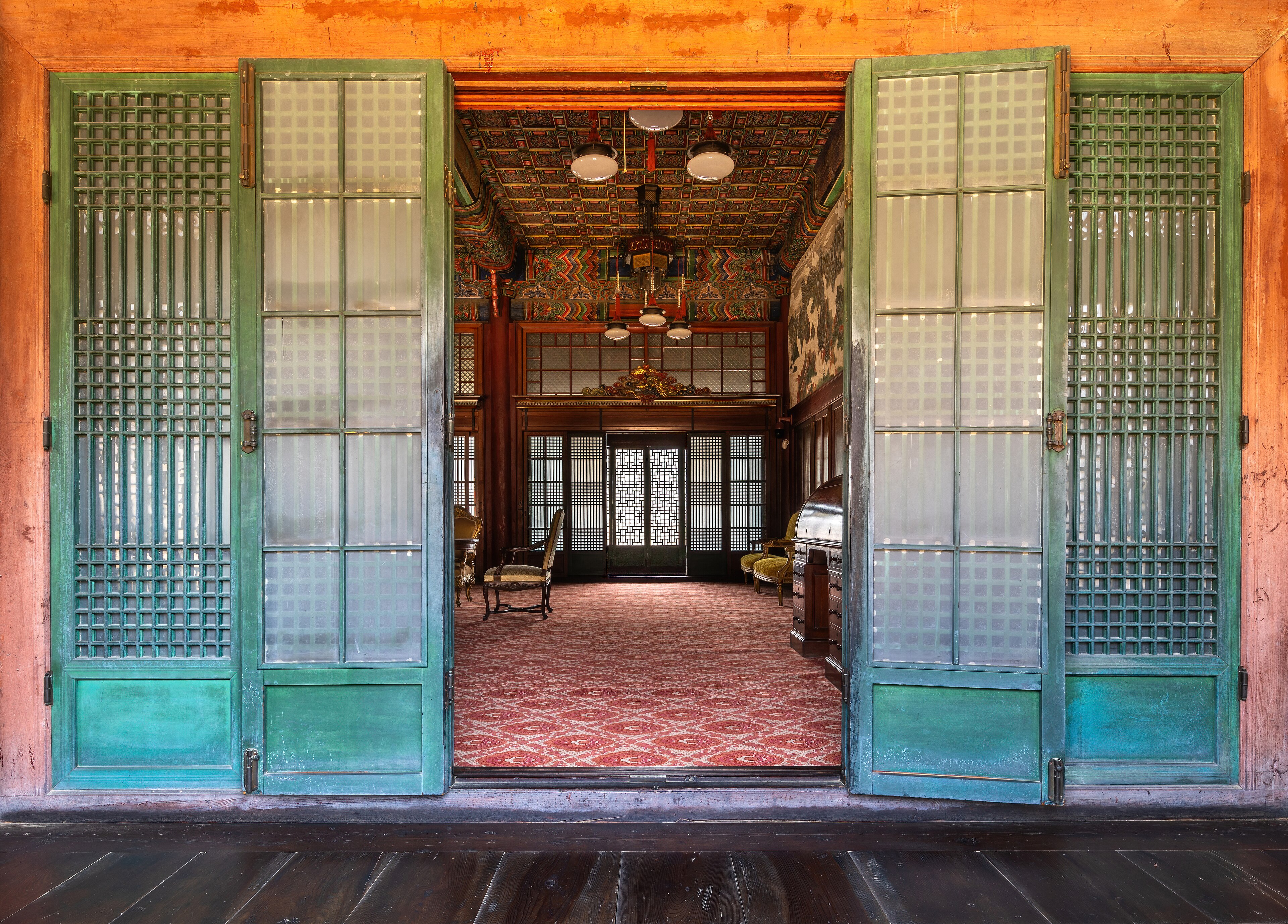
Naejeon refers to the palace’s inner residential quarters. The National Palace Museum describes Huijeongdang as both a residence and an office for Emperor Sunjong. After Japan’s annexation of Korea in 1910 stripped him of governing power, it served as an audience room for meeting family, officials and dignitaries. Daejojeon was the imperial couple’s private residence.
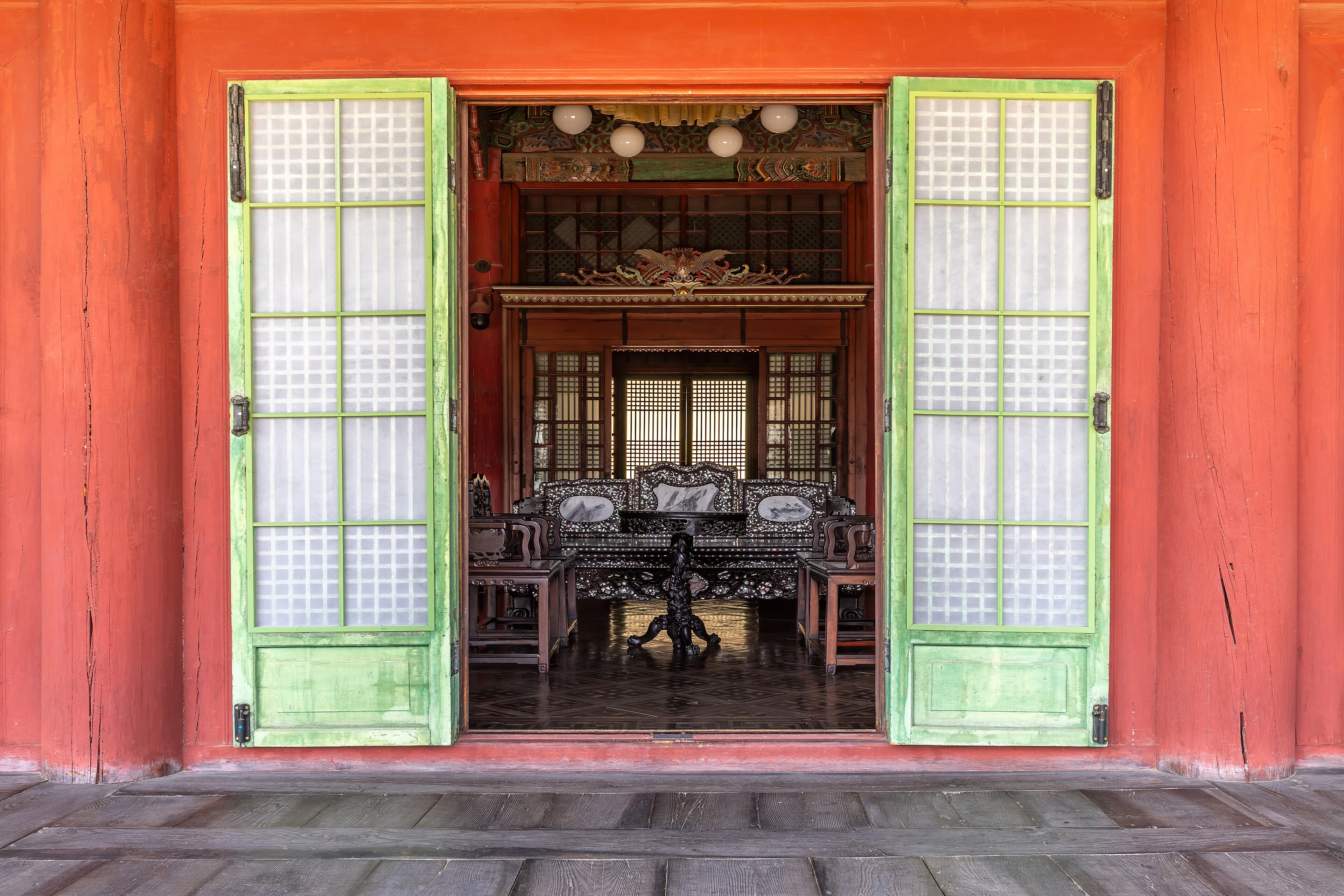
Open green doors reveal ornate dark chairs and a table inside Daejojeon.
Interiors rebuilt in 1920
Changdeokgung was founded in 1405, but the two halls are much later. A fire in 1917 destroyed the residential halls, including Huijeongdang and Daejojeon, which were rebuilt in 1920 with building materials moved from Gyeongbokgung. The National Palace Museum says the reconstructed halls kept traditional exteriors while adding Western facilities and interior decoration.
The interiors are also bound up with the royal family’s changed position after annexation. The accompanying interior photographs are archival and may not match the arrangement or lighting on tour days.
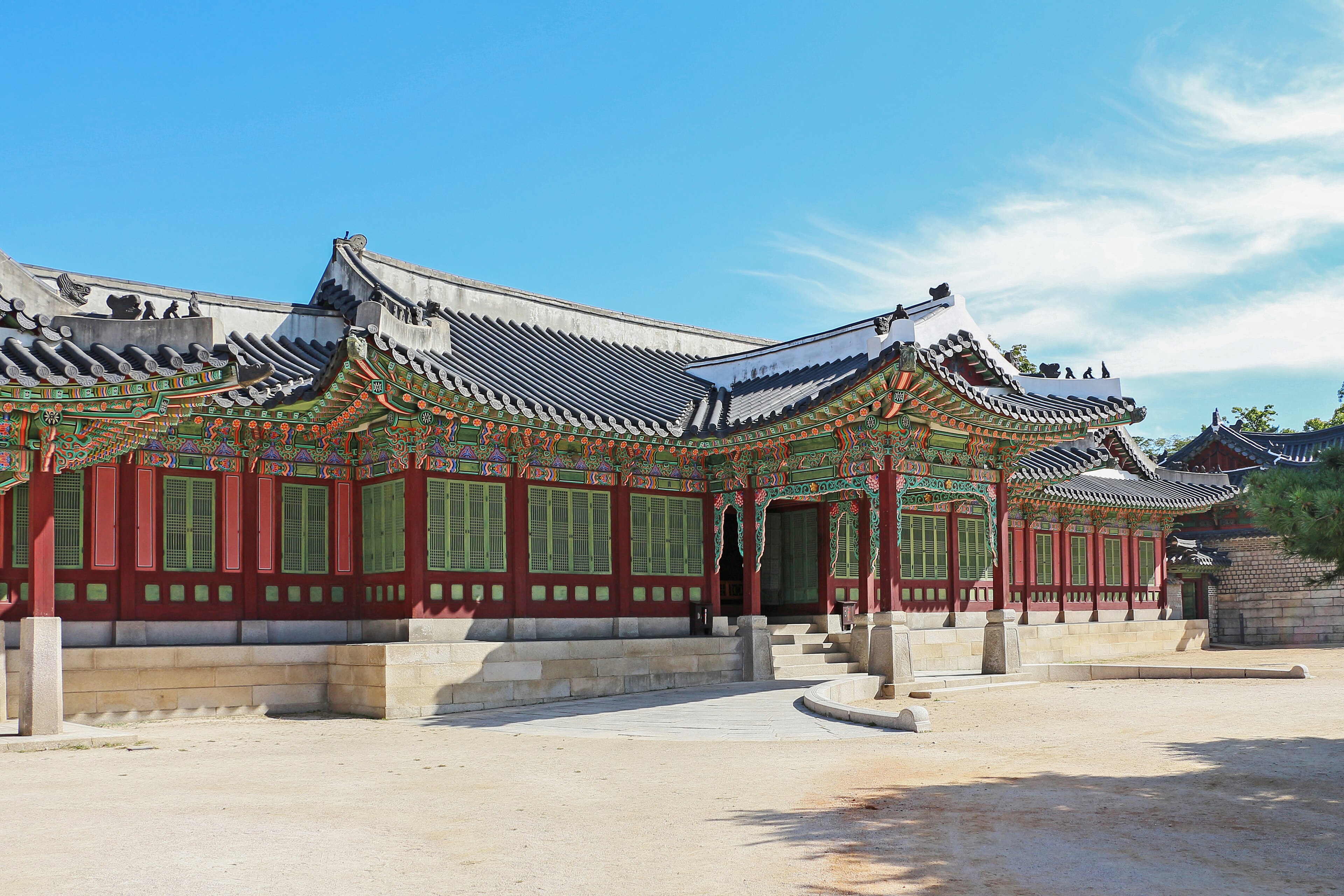
Huijeongdang’s tiled roof, painted wooden exterior and entrance beneath a blue sky.
Mountains, phoenixes and cranes
Huijeongdang holds murals by Kim Gyu-jin depicting Chongseokjeong and Manmulsang in Geumgangsan. Daejojeon’s Phoenixes and White Cranes feature those birds. The Korea Heritage Service links the phoenix with peace and marital harmony and the crane with longevity in court painting.
The works were not painted directly on the walls. Made in 1920, they were painted on silk, backed with paper and mounted on the walls, a form called bubyeokhwa. The originals were moved to the National Palace Museum for conservation, and reproductions hang in the halls.
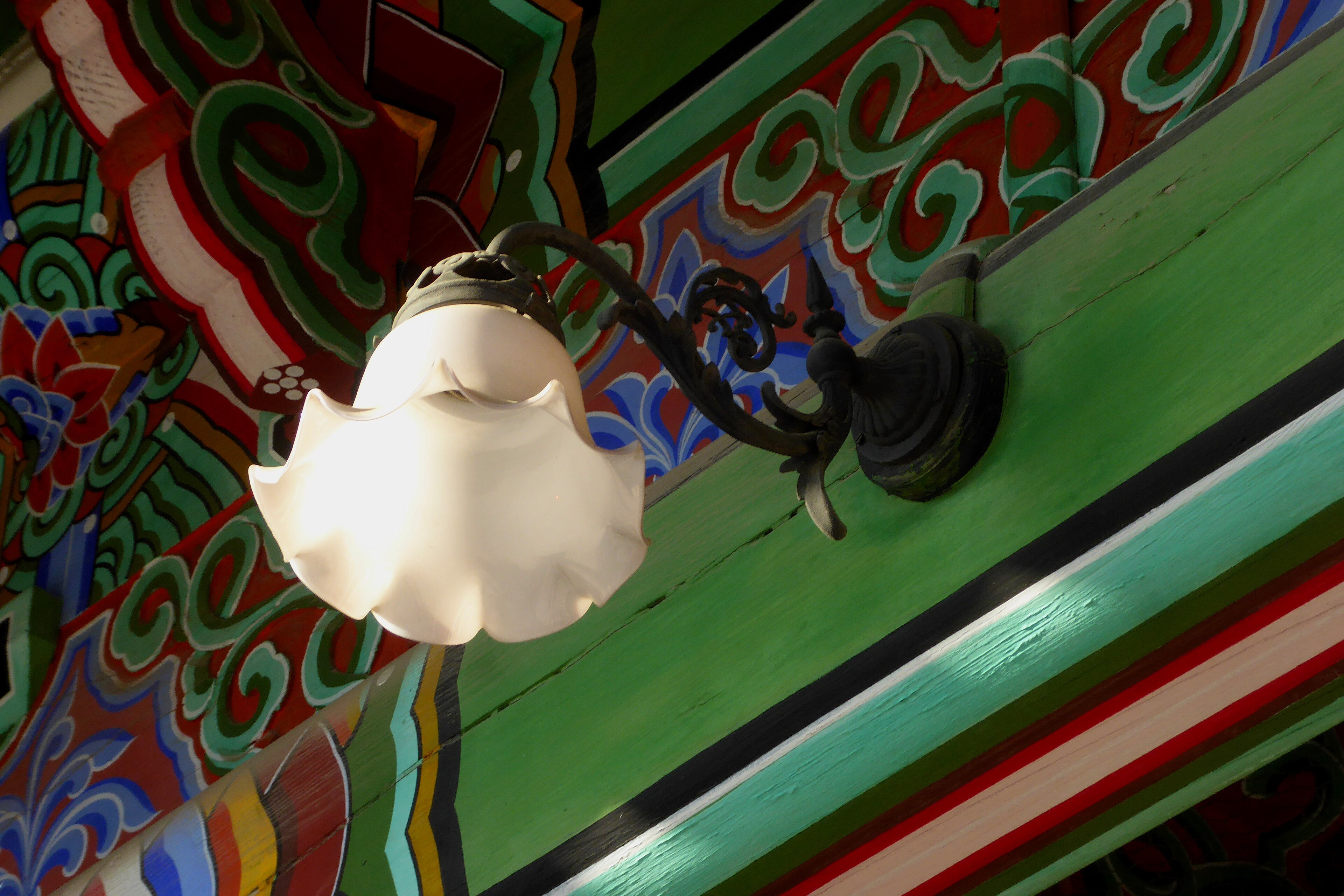
A white glass-shade lamp on a dark bracket against green timber and colorful painted decoration.
Lottery closes Oct 16, 10 a.m.
Applications are taken through the Changdeokgung section of the Royal Palaces and Tombs Center website from 10 a.m. on October 13 to 10 a.m. on October 16 KST, under the reservation entry “왕과 왕비의 생활공간, 창덕궁 내전에 들다 관람 예약”. Each ID may apply once for up to two places. Participants must be 19 or older, and each session has 24 places. There are no group bookings or walk-ins.
Winners will be notified by Alimtalk and text message after 10 a.m. on October 16. The acknowledgement sent on application is not a winning notice. Only winners may take part, and places can be transferred only to family members with a family-relationship certificate. All times are Korea Standard Time, UTC+9.
Times and admission
Sessions run from 10 to 11:10 a.m. and from 2:30 to 3:40 p.m., about 70 minutes each, on October 20–24 and 27–30. The tour is free, but palace admission is not. The standard ticket for foreign visitors aged 19–64 is KRW 3,000, and those 65 or over qualify for free entry. Free-admission days and other exemptions are on the official fee page.
Winner check-in runs 9:30–9:50 a.m. for the morning session and 2–2:20 p.m. for the afternoon. Winners show their notification and ID at the information desk in Changdeokgung’s visitor support center to receive a pass and brochure, then buy palace admission and wait at the World Heritage monument inside Geumhomun Gate, where the tour starts at the session time.
Conditions for foreign visitors
The notice does not say whether overseas mobile numbers can be used, which ID documents foreign visitors may present, or whether English or Japanese interpretation is offered. Enquiries: Changdeokgung office, +82-2-3668-2300.
Late arrivals cannot join. Wheelchairs and strollers cannot enter the interiors, and food and drinks are prohibited. The palace is at 99 Yulgok-ro, Jongno-gu, Seoul. Details were checked on October 13, 2026.
Official directions give a five-minute walk from Exit 3 of Anguk Station on Line 3, or ten minutes from Exit 7 of Jongno 3-ga Station on Lines 1, 3 and 5. Check-in and assembly take additional time. There is no on-site parking, and public transport is recommended.
Huijeongdang’s interior seen through open doors at Changdeokgung. Archival photograph, 4 June 2024. Photo: Basile Morin / Wikimedia Commons. Original title: Huijeongdang Hall interior through open doors at Changdeokgung Palace in Seoul.jpg. CC BY-SA 4.0 (https://creativecommons.org/licenses/by-sa/4.0/). Source: https://commons.wikimedia.org/wiki/File:Huijeongdang_Hall_interior_through_open_doors_at_Changdeokgung_Palace_in_Seoul.jpg. The supplied image preserves its aspect ratio; the card displays a centered 4:3 crop. No scene alteration, AI generation, stretching or padding. Open the photo for the full supplied frame. This is a Wikimedia proportionally resized rendition. The same license applies to the display crop.
Furniture inside Daejojeon, viewed through open doors at Changdeokgung. Archival photograph, 4 June 2024. Photo: Basile Morin / Wikimedia Commons. Original title: Interior front view of Daejojeon Hall through open doors at Changdeokgung Palace in Seoul.jpg. CC BY-SA 4.0 (https://creativecommons.org/licenses/by-sa/4.0/). Source: https://commons.wikimedia.org/wiki/File:Interior_front_view_of_Daejojeon_Hall_through_open_doors_at_Changdeokgung_Palace_in_Seoul.jpg. The supplied image preserves its aspect ratio; the card displays a centered 4:3 crop. No scene alteration, AI generation, stretching or padding. Open the photo for the full supplied frame. This is a Wikimedia proportionally resized rendition. The same license applies to the display crop.
Huijeongdang’s tiled roof and painted exterior at Changdeokgung. Archival photograph, 27 September 2022. Photo: Bernard Gagnon / Wikimedia Commons. Original title: Huijeongdang Hall.jpg. CC0 1.0 (https://creativecommons.org/publicdomain/zero/1.0/). Source: https://commons.wikimedia.org/wiki/File:Huijeongdang_Hall.jpg. The supplied image preserves its aspect ratio; the card displays a centered 4:3 crop. No scene alteration, AI generation, stretching or padding. Open the photo for the full supplied frame. This is a Wikimedia proportionally resized rendition.
A light fixture and painted architectural detail at Daejojeon. Archival photograph, 7 November 2019. Photo: Ethan Doyle White / Wikimedia Commons. Original title: Lighting Fixture on the Daejojeon at Changdeokgung Palace.jpg. CC BY-SA 4.0 (https://creativecommons.org/licenses/by-sa/4.0/). Source: https://commons.wikimedia.org/wiki/File:Lighting_Fixture_on_the_Daejojeon_at_Changdeokgung_Palace.jpg. The supplied image preserves its aspect ratio; the card displays a centered 4:3 crop. No scene alteration, AI generation, stretching or padding. Open the photo for the full supplied frame. This is a Wikimedia proportionally resized rendition. The same license applies to the display crop.
RESCENE will release its fourth mini-album, PULSE, on November 3 at 6 p.m. KST. A heart-shaped scheduler posted on the night of October 12 lays out the pre-release rollout, from concept photos to music previews.
An 18-second scheduler
The official announcement sets the release for November 3 at 6 p.m. KST, with the music video at the same time and a showcase at 8 p.m.
The Muze Entertainment presents the group as linking scenes and scent. The new album’s title, PULSE, refers to a heartbeat.
An opening heart
The official Instagram video sets an ornate grey heart outline against a pale blue background. Two central panels close to show the PULSE title, then open to reveal the dates. The curling ornament and opening panels suggest a treasured keepsake.
Photos and tracklist
Pre-orders open on October 13 at noon. Concept Photos A and B follow on October 19 and 20 at 6 p.m., and a concept trailer on October 22 at 6 p.m. Album details arrive on October 23 at 3 p.m., followed by the tracklist at 6 p.m.
Music previews and teaser
A highlight medley is scheduled for October 26 at 6 p.m. and a title preview for October 27 at 6 p.m. October 27 also lists a separate entry at 10 p.m., marked only with hearts and not yet named. A title-track music-video teaser follows on October 30 at 6 p.m.
All times are KST, and the schedule may change with later official announcements.
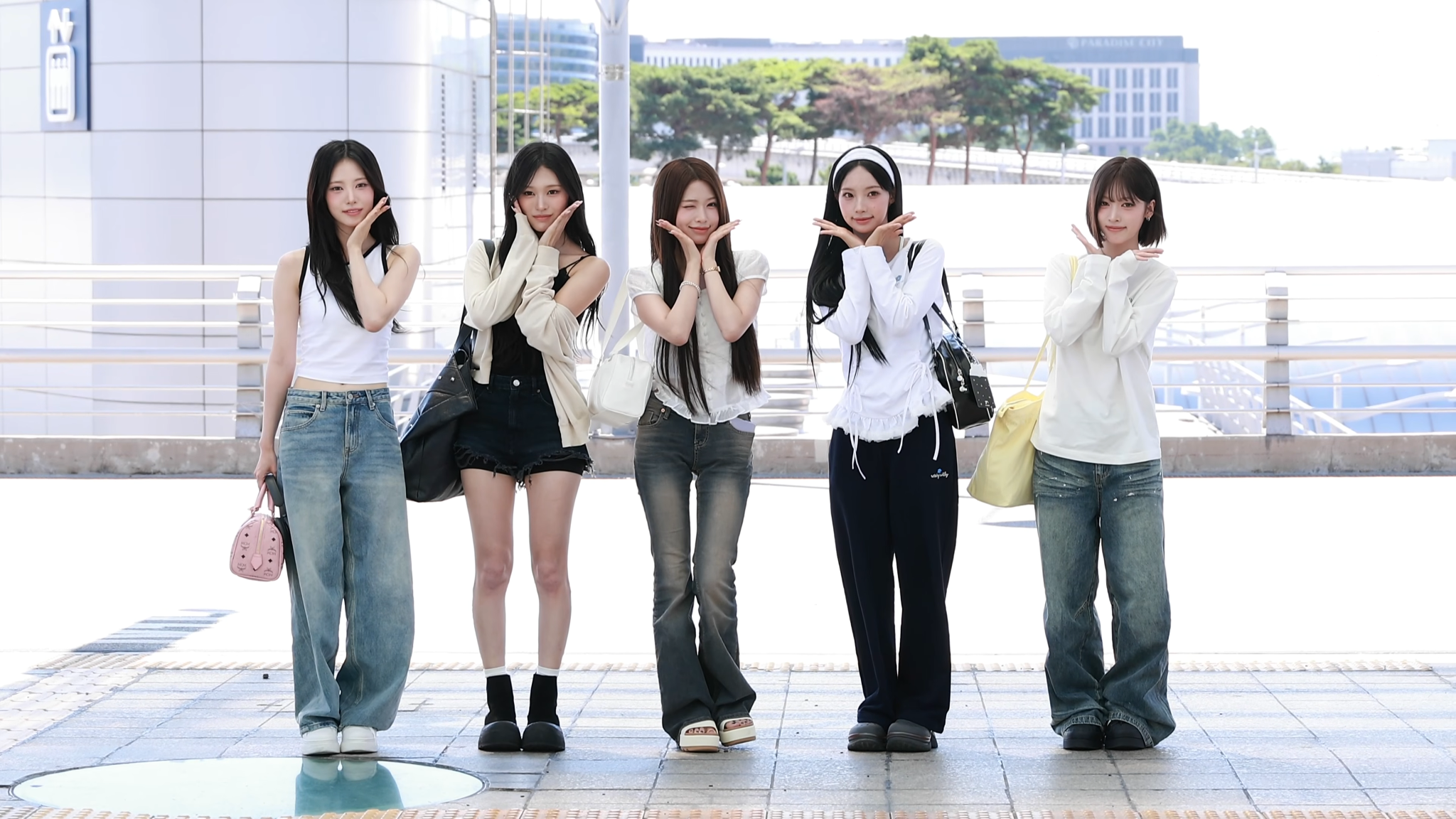
RESCENE at Incheon International Airport, August 12, 2026. Video still: K-POPIT 케이팝잇 / Wikimedia Commons, CC BY 4.0. Archival image, not a PULSE concept photo. The entire 2048×1152 original is used unchanged.
The 18th Gangneung Coffee Festival runs October 21–25 on Gangneung Coffee Street and across the city. A coffee culture that began with beachside vending machines now extends to local-café tastings built on Chodang tofu and pine.
Vending machines at Anmok
A Korea Tourism Organization retrospective describes coffee vending machines lining Gangneung’s Anmok Beach in the 1980s and 1990s, with people gathering over cups facing the sea. Coffee was a way to spend time together here before large café windows and specialist brewing equipment arrived.
According to the Gangneung Culture Foundation’s coffee history, published in December 2012, customers chose favourite machines, while operators varied blends, sometimes adding grain or soybean powders.
Chodang tofu and pine pollen
Chodang is a Gangneung neighbourhood known for tofu traditionally set with seawater. The city presents this heritage alongside newer sundubu coffee and gelato.
In a 2025 interview, Fine Pine owner Kim Seong-yong said Gangneung’s pine trees inspired the café’s songhwa coffee and cream. Songhwa powder is pine pollen, not pine needles or pine nuts. KTO’s April 2026 profile also featured the café’s songhwa desserts and coffee.
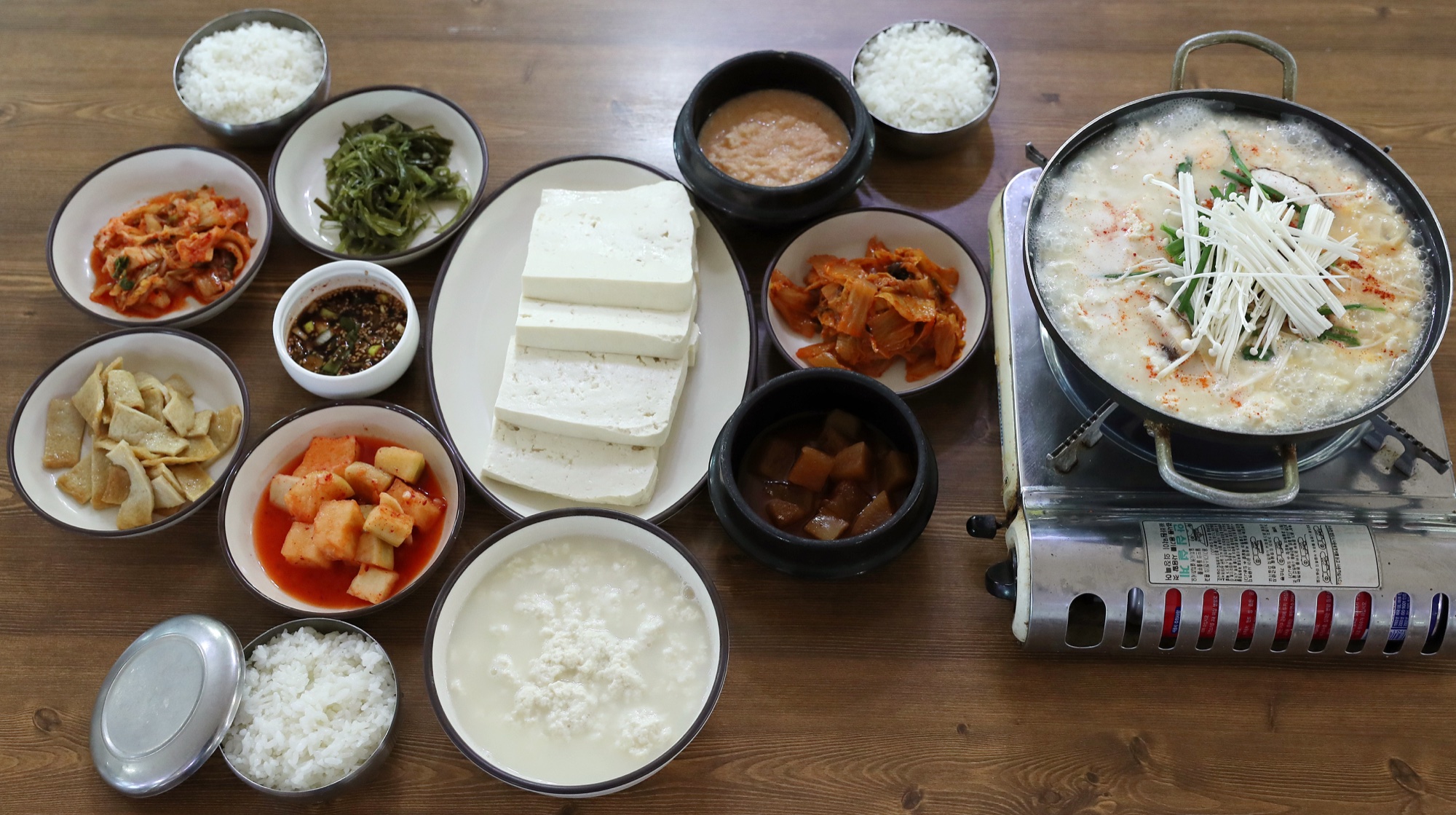
A Chodang tofu meal with block tofu, soft tofu, stew and side dishes
Schedule and café tastings
The festival runs 21–25 October 2026 on Gangneung Coffee Street and at other city venues, with general hours of 10:00–20:00. The local-café tasting program, Byeorui-byeol Gangneung Coffee, starts daily at 11:00, 13:00, 15:00 and 18:00 near the general information desk, listed in the official program as in front of Pepsi Cola. All times are Korea Standard Time (KST).
Sessions featuring local ingredients are Gabae Chodang’s Sundubu Gabae Latte on 21 October, 15:00–16:00; Chodang Coffee’s Chodang Dubu Latte on 23 October, 15:00–16:00; and Fine Pine’s Songhwa Coffee on 24 October, 13:00–14:00.
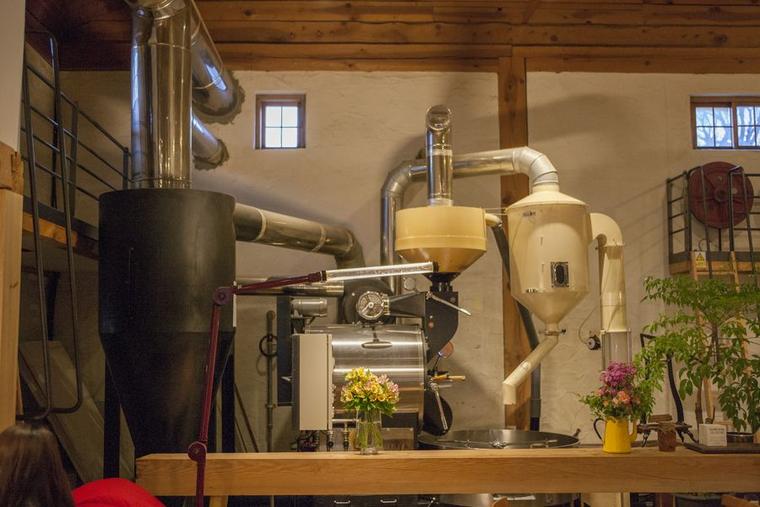
A coffee roaster behind a wooden ledge inside a café
100 citizen baristas, paid table
At 14:00 on 24 October, the Global Coffee Lounge hosts the 100 People, 100 Tastes performance, with 100 Gangneung citizen baristas, selected through a public call, brewing coffee.
The separate paid Barista’s Table pairs signature coffee with Gangneung traditional dessert in the same lounge at 14:00 on 21, 22, 23 and 25 October. It costs KRW 20,000 per person, with 30 places per session and both advance and on-site registration. There is no session on 24 October.
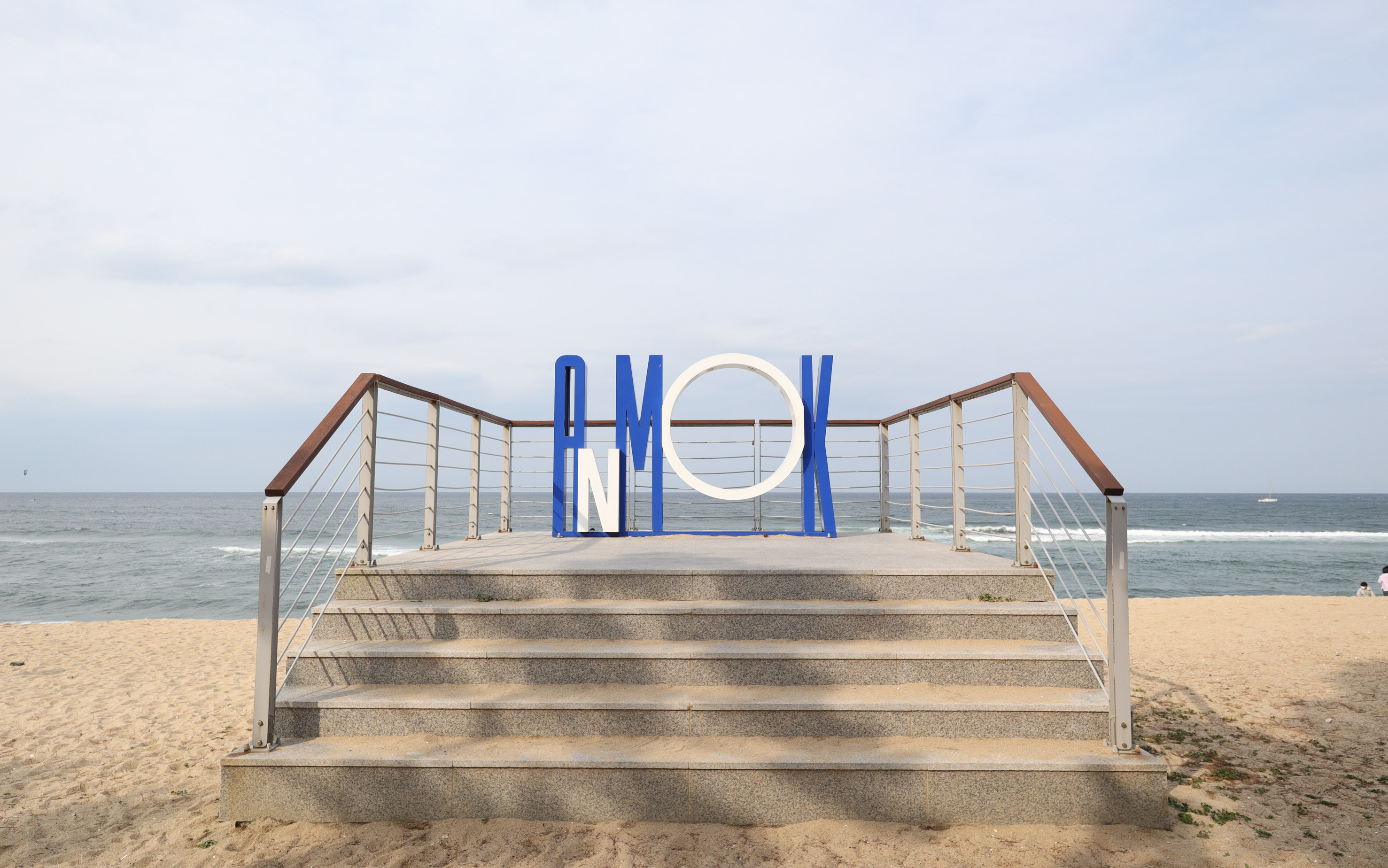
An ANMOK sign above beach steps, facing the sea
Open-air café and pine grove
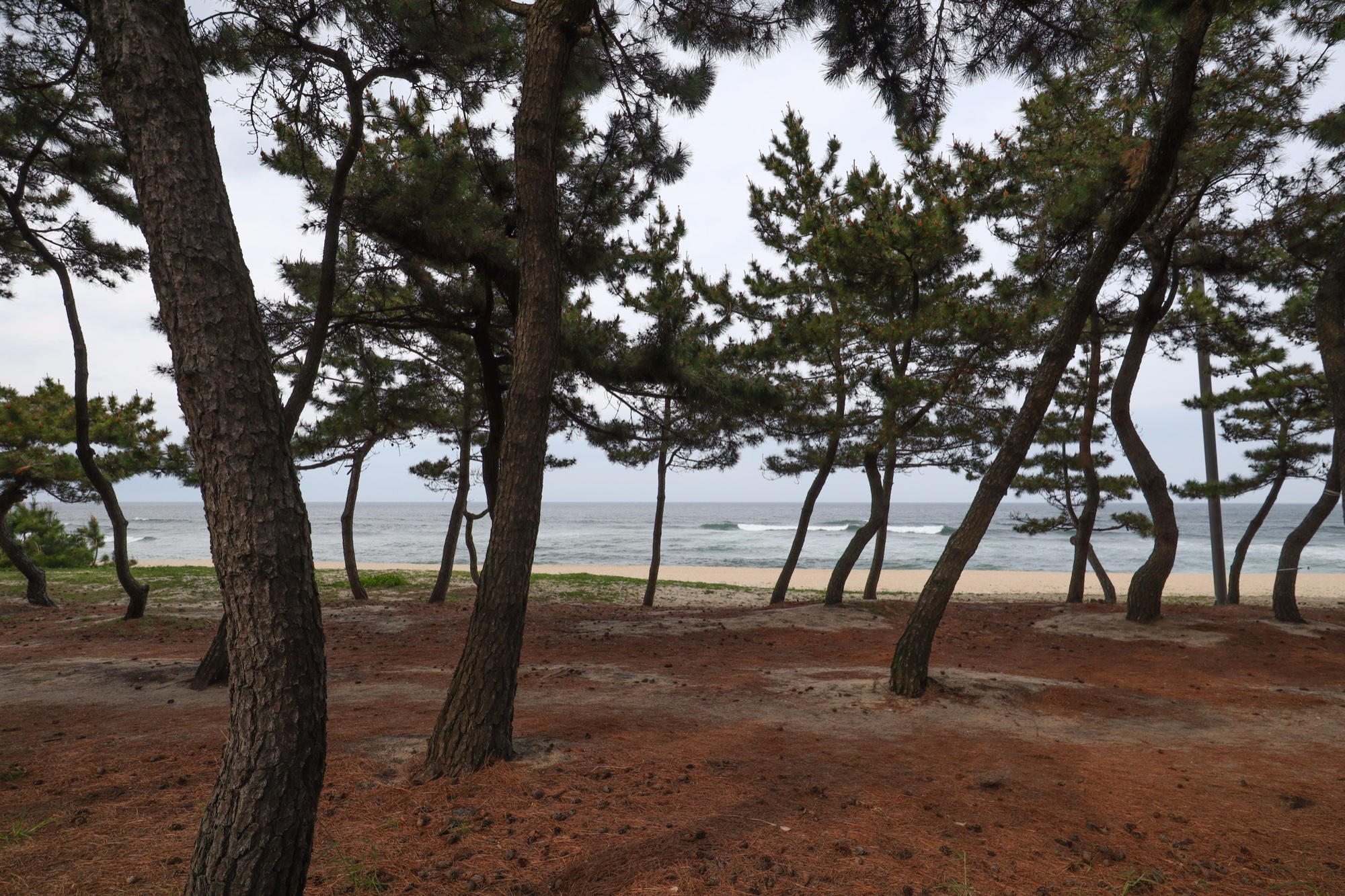
The official program sets out outdoor tables along about 350 metres of the coffee street as the Anmok open-air café. The coffee-picnic area is in the Songjeong pine grove, between Haemaji Park and the Songjeong futsal court.
For a first visit, the editors suggest a half-day built around one tasting, with time for a beach walk or a rest at an outdoor table.
Twisting pine trees on sandy ground with the sea beyond, Songjeong Beach
Transport and enquiries
The main venue is at 20-1 Changhae-ro 14beon-gil, Gangneung Coffee Street. The official free shuttle runs 10:00–20:00 every 15 minutes, circulating from the festival to Gangneung Station, the Sports Complex, the ITS World Congress venue, the Green City Experience Center (e-zen) and back. From Gangneung Station it makes several stops before the festival.
The official program does not give fees or registration methods for the café tastings; the KRW 20,000 fee applies to the Barista’s Table. The organizer, on +82-33-647-6802, can advise on registration, remaining places, foreign-language hosting, interpretation and overseas-card payment.
Visitors avoiding ingredients such as milk or soy should check each drink’s actual recipe on site rather than relying on its name.
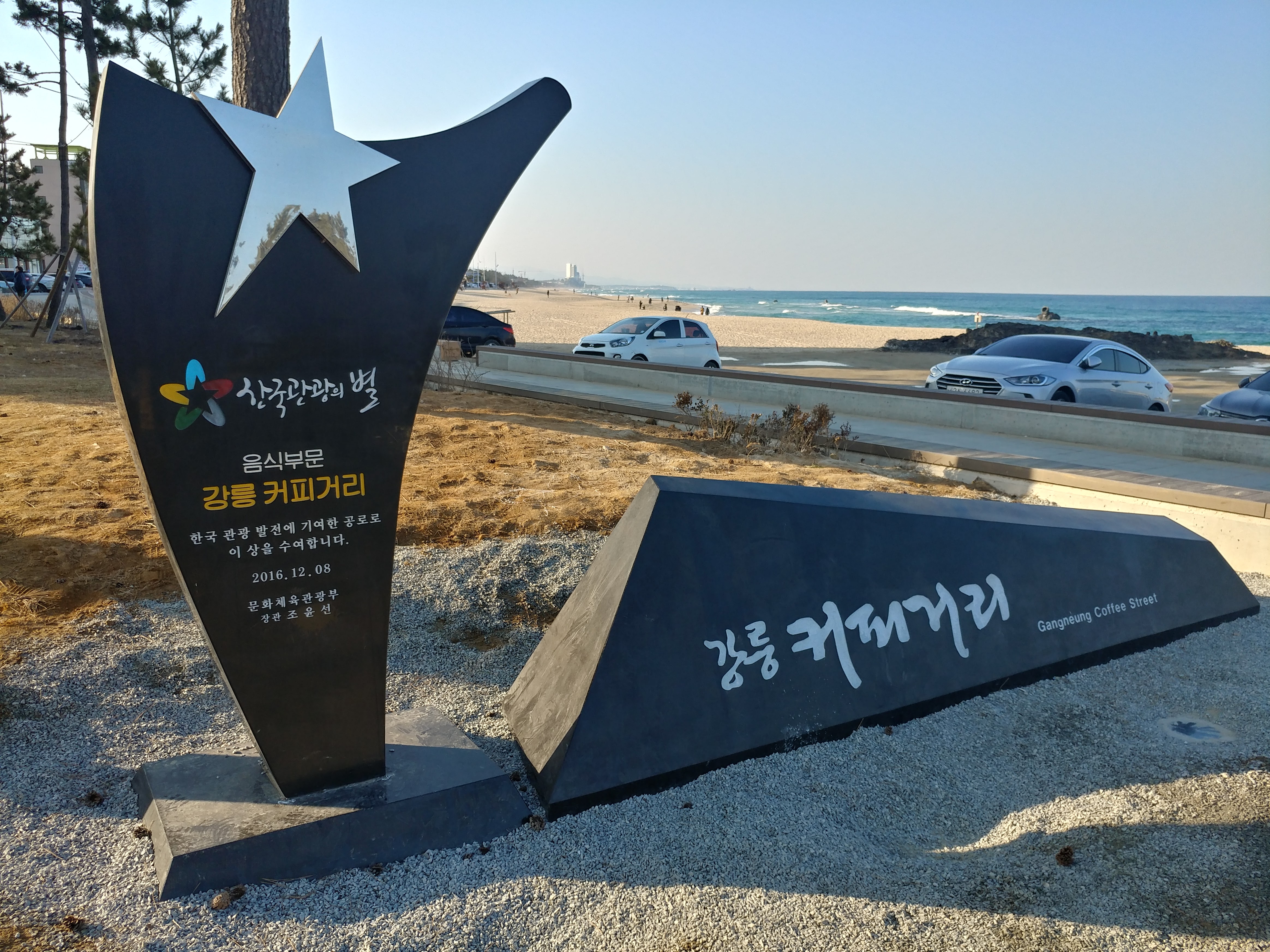
The Gangneung Coffee Street marker with the beach beyond. Archival photograph taken 2017-02-14; not the 2026 festival or its tasting drinks. Photo: Altostratus, “Gangneung coffee street entrance.jpg”, Wikimedia Commons / CC BY-SA 4.0. The supplied JPEG is byte-for-byte unchanged. The 8:5 card display may crop its edges; enlarge for the complete supplied photograph. Any display crop retains the same licence.
An ANMOK sign above beach steps, facing the sea. Archival photograph taken 2022-04-30; not the 2026 festival or its tasting drinks. Photo: Mobius6, “Anmok Beach 20220430 001.jpg”, Wikimedia Commons / CC BY-SA 4.0. The supplied JPEG is byte-for-byte unchanged. The 8:5 card display may crop its edges; enlarge for the complete supplied photograph. Any display crop retains the same licence.
Block tofu, white soft tofu, a soft-tofu stew on a burner and side dishes such as kimchi laid out together. A file photo titled “Chodang Sundubu”, taken in Chodang-dong, Gangneung, on 20 March 2017. It does not show tofu coffee or festival tasting menus. Photo: Korea.net (Korean Culture and Information Service) / Chodang Sundubu 05 / Wikimedia Commons / CC BY-SA 2.0
A large coffee roaster and its ducts stand inside a café with a timber ceiling and white walls; vases sit on a wooden ledge in front. An interior shot from the KOGL set “Terarosa” (filed under Gangneung, photographed 2014). It does not show a festival tasting session or participating café. The provided preview file is used unaltered. Photo: Academy of Korean Studies / Terarosa / KOGL / KOGL Type 1
Twisting pine trees stand on sandy ground strewn with fallen needles, with the beach and sea visible between the trunks. Taken at Songjeong Beach, Gangneung, on 30 April 2022. It does not show this year’s festival picnic area. Photo: Mobius6 / Songjeong Beach 20220430 001 / Wikimedia Commons / CC BY-SA 4.0
Gwangalli Beach Book Fair runs October 23–28 around Mannam Square on Busan’s Gwangalli Beach. Author talks on a book comparing Busan and Daegu and a critique of Korean trends are scheduled, along with sessions on the printed book.
A third beachside fair
The 2026 Gwangalli Beach Book Fair runs from Friday, October 23, to Wednesday, October 28, around Mannam Square, with overall hours of 13:00–21:00 KST. Suyeong-gu hosts and organizes it, with the Busan Publishing Culture Industry Association as co-planner. The program includes a book market, reading lounge, author talks and curated exhibitions.
Participating publisher Sanzini says the fair began in 2024 and is now in its third year. Fifty participants, including publishers, bookshops, writers, reading communities and creators from Busan and across Korea, are taking part.
Busan publisher Sanzini
Sanzini was founded in Busan in February 2005. Its introduction states an aim of supporting cultural decentralization and cultural democracy through publishing.
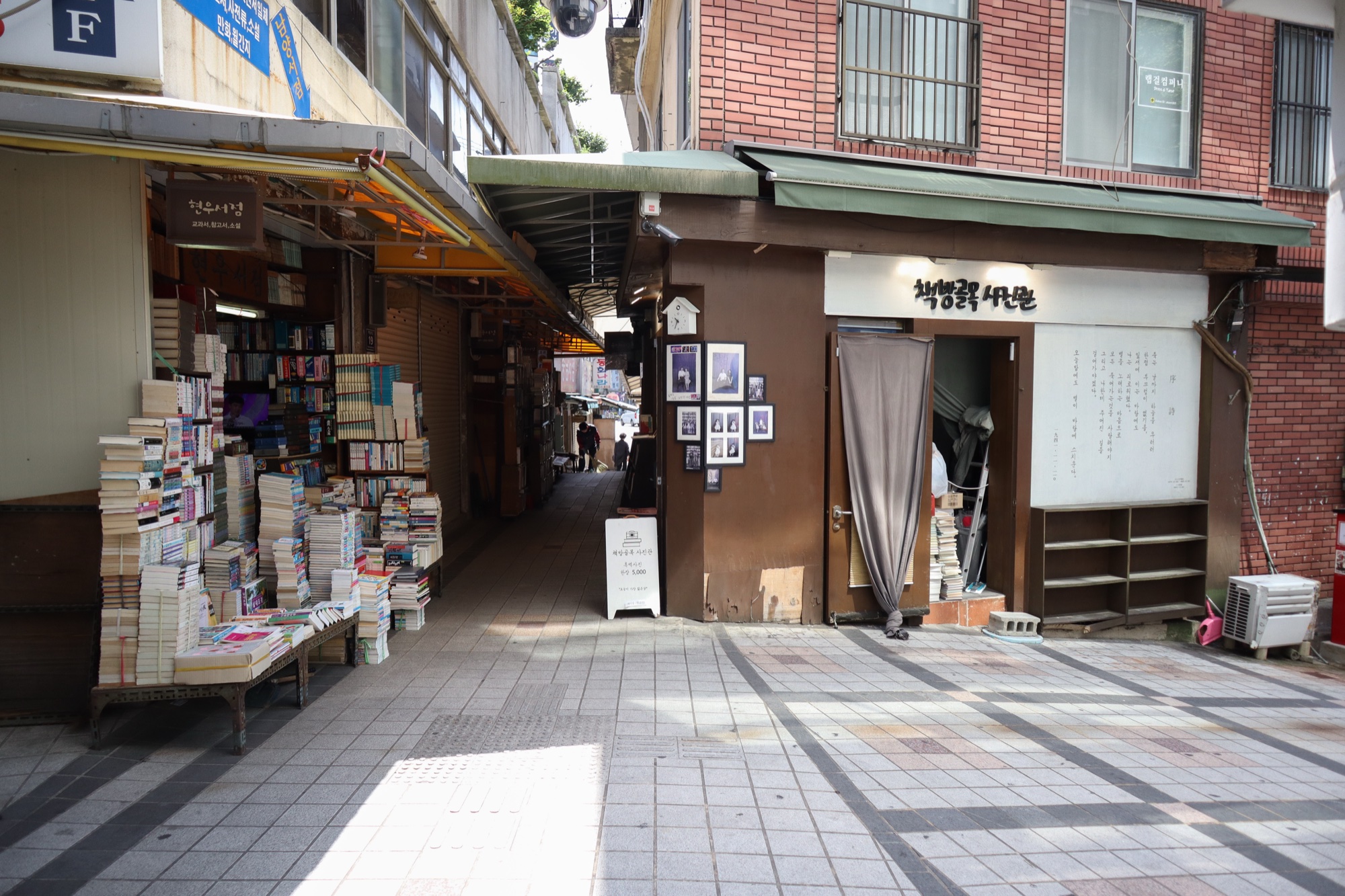
Books stacked outside shops in Busan's Bosu-dong Bookstore Alley
“Daegu vs Busan” talk
At 17:00 on Friday, October 23, Park Chang-hee (박창희) and Lee Min-hye (이민혜) discuss “대구 vs 부산” (“Daegu vs Busan”). The publisher’s latest announcement describes the book as forthcoming. It compares the two cities’ history, food, language and culture through family experience and dialogue between generations.
“Uncomfortable Trends” talk
Do Woori (도우리) discusses “불편한 유행,” descriptively “Uncomfortable Trends,” at 16:00 on Sunday, October 25. Published by Sanzini on June 8, 2026, the 232-page work of pop-culture criticism examines the conflicts and exclusions within light entertainment such as MBTI culture and fast-moving consumer trends.
At an earlier Seoul International Book Fair conversation, the author said the book collects columns written from late 2022 to October 2025, with topics chosen for their social significance as well as their popularity.
Talks on the printed book
The paper-themed talks list Kim Hwa-jin (김화진) at 17:00 on Saturday, October 24, on making room within fiction, and Kim Ae-hyun (김애현) at 17:00 on Sunday, October 25, on paper books navigating a digital sea. These English phrases describe the Korean session titles.
Handling display copies depends on each stall, and books and displays should not be photographed without permission.
Registration and perks
The author and paper-themed talks fall on October 23–25. The official form accepts advance applications through October 20, first come, first served per session. Sessions run about 50 minutes, and the first 15 registrants per author talk and 30 per paper-themed talk receive a KRW 1,000 book-market discount. Companions must apply individually.
The editors suggest one to two hours to browse and attend one talk.
Getting there and enquiries
Map searches should use “광안리 만남의광장” (Gwangalli Mannam Square); the event address is 29 Millak-ro 6beon-gil, Suyeong-gu, Busan. The Korea Tourism Organization gives a walk of about ten minutes from Exit 3 or 5 of Gwangan Station on Busan Metro Line 2 to the beach.
The official listing does not give general admission charges or stall operating dates, and books cost extra. Programs are in Korean, and English or Japanese interpretation has not been confirmed. Enquiries go through the official links or +82-70-7309-1947. The registration form’s introductory date and weekday line contains errors, so individual session times apply. Rain or strong wind may change plans.
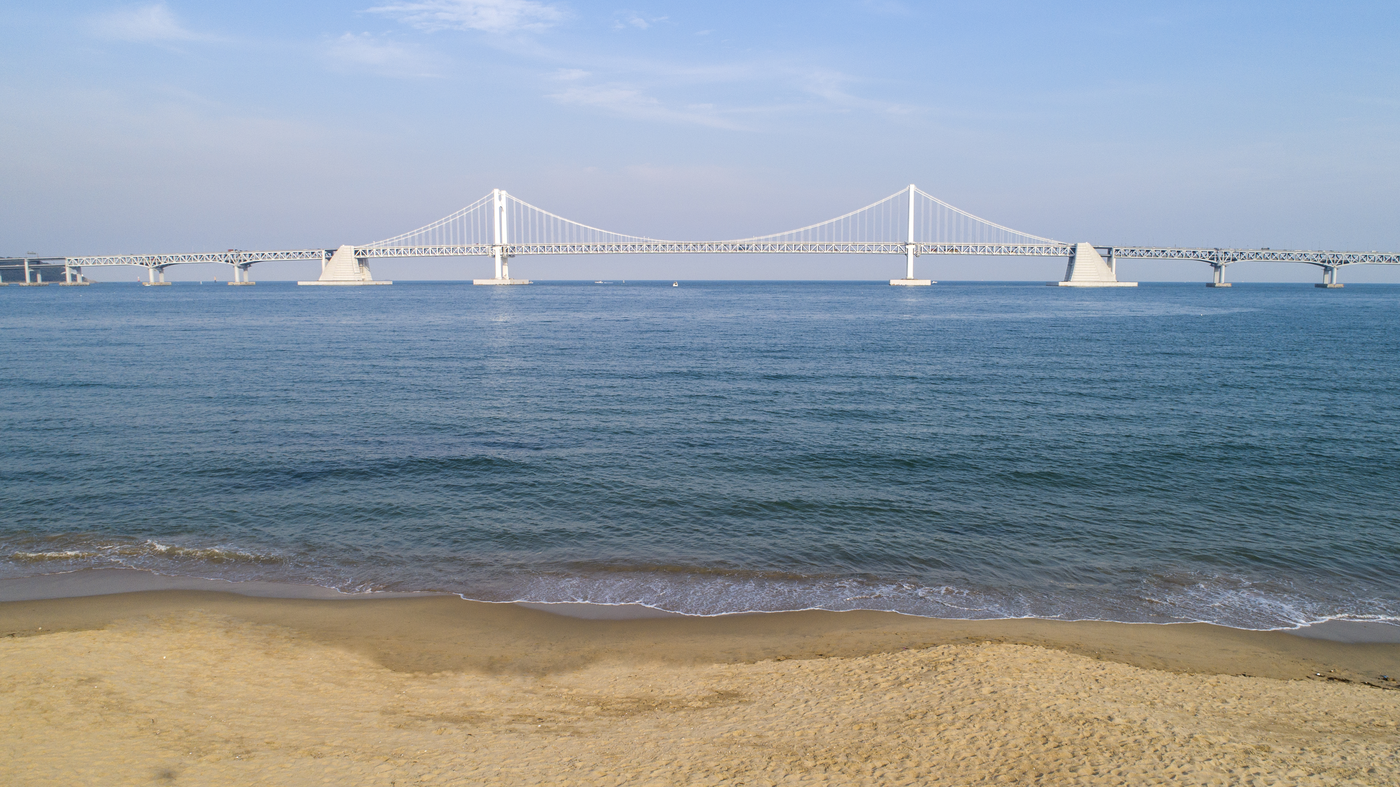
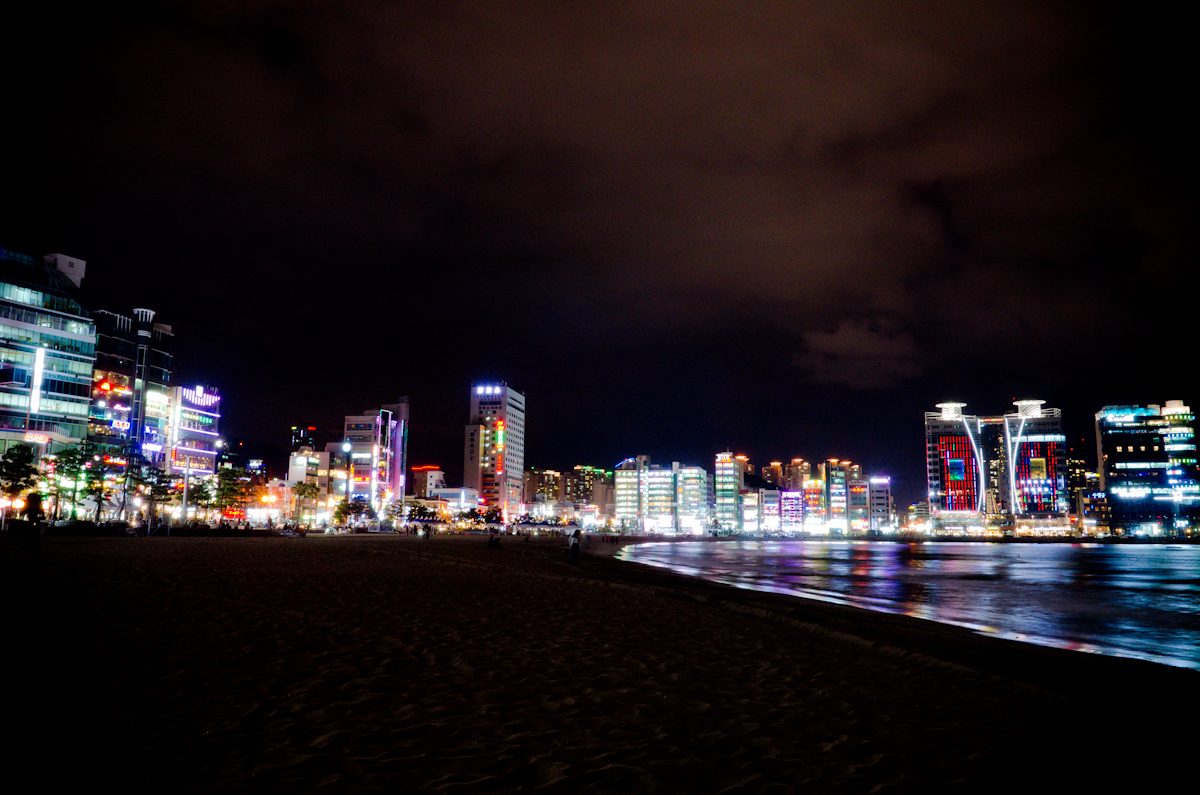
The photographs are archival day and night views of Gwangalli and do not show this year’s fair or the current state of its shops and lighting.
EVENT INFO
DatesOctober 23–28 · overall 13:00–21:00 KST
ApplicationsThrough October 20, by program
CostGeneral admission not stated; purchases separate
Archival view of Gwangalli Beach and Gwangan Bridge. The source entry does not state an exact capture date. This is not a photograph of the 2026 book fair. Photo: 부산광역시 시민사진기자 정을호 / 부산광역시 / 부산관광아카이브. Original title: “광안리해수욕장 · METADATA006340”. Source: https://archive.visitbusan.net/dataSearch/view.nm?dataSid=METADATA006340&menuCd=36 · KOGL Type 1: https://www.kogl.or.kr/info/licenseType1.do. Supplied file is byte-for-byte identical to the public source file. No retouching, generated content, padding or stretching. An 8:5 display may trim edges; opening the image shows the full supplied frame.
Gwangalli at night, photographed October 19, 2011. This archival shoreline view does not show today’s shops or lighting, or this year’s book-fair installation. Photo: Carey Ciuro / Flickr / Wikimedia Commons. Original title: “Busan Gwangalli Night.jpg”. Source: https://commons.wikimedia.org/wiki/File:Busan_Gwangalli_Night.jpg · CC BY 2.0: https://creativecommons.org/licenses/by/2.0/. Supplied file is byte-for-byte identical to the public source file. No retouching, generated content, padding or stretching. An 8:5 display may trim edges; opening the image shows the full supplied frame.
Bosu-dong Bookstore Alley in Busan on May 23, 2020, with books stacked outside the shops. Archive photo of a Busan bookshop street, not the Gwangalli fair. Photo: Mobius6 / Bosu-dong Bookstore Alley 20200523 014 / Wikimedia Commons / CC BY-SA 4.0
ZEROBASEONE’s Sung Han-bin released his first solo EP, DEAD:ALIVE, on 12 October. Among its eight tracks, the title song “UNDEAD,” about moving through fear, and the fan song “Seomgwang,” with lyrics he co-wrote, anchor the record.
Eight tracks
Sung Han-bin released DEAD:ALIVE at 6 PM Korea time on 12 October 2026. Its eight tracks include the title song “UNDEAD.” Melon credits THE L1VE LABEL as the label and Dreamus as the release company.
A title song about moving through fear sits on the same record as a song written for fans.
Title track “UNDEAD”
The titles DEAD:ALIVE and “UNDEAD” set death and survival side by side. The official album introduction frames the record around moving through fear and changing oneself rather than waiting for fear to pass.
The title-track notes name guitar riffs, choral textures and drums as its main ingredients.
Fan song “Seomgwang”
Track seven, “섬광,” has lyrics co-written by PUFF and Sung Han-bin; the album introduction describes it as a song for fans. Its composition credits list PUFF, Duck, SOFTSERVEBOY, SQVARE and Tim Tan.
The Korean word 섬광 means a sudden flash of light; Seomgwang is a romanization. Where “UNDEAD” deals with overcoming personal limits, this song turns to his relationship with listeners.
Track order
The track order is “Killin' Me,” “UNDEAD,” “Insidious,” “3AM,” “Bloody Gravity,” “Other Side,” “섬광” and “Steal the Thunder.” The title track comes second, and one more song follows the fan song.
The official note for the closing track extends the story from personal growth toward bringing hope to others in darkness.
Album and official video
Melon’s “성한빈 — DEAD:ALIVE” page lists the eight tracks and their credits. The official “성한빈(SUNGHANBIN) - UNDEAD M/V” is on the THEL1VE YouTube channel. The sources below link to the album and video pages; access depends on the platform and region.
Sung Han-bin at the Love Your W event on 24 November 2023. Photo: K-POPIT 케이팝잇 / TV10, “231124 Sung Han-bin (1).jpg”, Wikimedia Commons / CC BY 3.0. Cropped 25 px from the top and 735 px from the bottom; saved as a 1088×680 JPEG. An archival video still, not an image from the 2026 EP, showcase or music video. No generative retouching, expansion or distortion.
The photograph is an archival still from the Love Your W public appearance on 24 November 2023. It does not depict the new EP’s styling or performances. The official video is linked as a source, with no embedded player in this article.
In Andong’s Hahoe Village, a free performance of Hahoe Byeolsingut Tallori, the village’s mask dance drama, starts at 2 p.m. Tuesday through Sunday. Behind the familiar smile of the Hahoe mask is a sharp comedy about aristocratic power, pretence and ordinary lives.
Masks that change with movement
Andong’s official account of Hahoe masks says that lifting or lowering the face changes the emotion a viewer perceives, while separately made jaws help the performer animate speech. The angle of the head matters as much as the carved lines.
The performance combines movement, music, dialogue and the watching crowd. A dignified figure can become ridiculous without changing masks.
Clan village and satire
UNESCO describes Hahoe and Yangdong as clan villages shaped by Joseon-period Confucian culture, where the arrangement of leading families’ houses, smaller dwellings, pavilions and places of study makes the community’s social order visible.
The drama’s aristocrat and scholar hold respected positions, yet their vanity is open to ridicule. Linking the village layout with the stage satire is an interpretation, not evidence that every joke refers to a particular household.
The two UNESCO listings are separate. The historic villages of Hahoe and Yangdong were inscribed on the World Heritage List in 2010. Talchum, the broader Korean mask dance drama tradition that includes Hahoe, entered the Representative List of the Intangible Cultural Heritage of Humanity in 2022. One recognizes a place, the other a living practice.
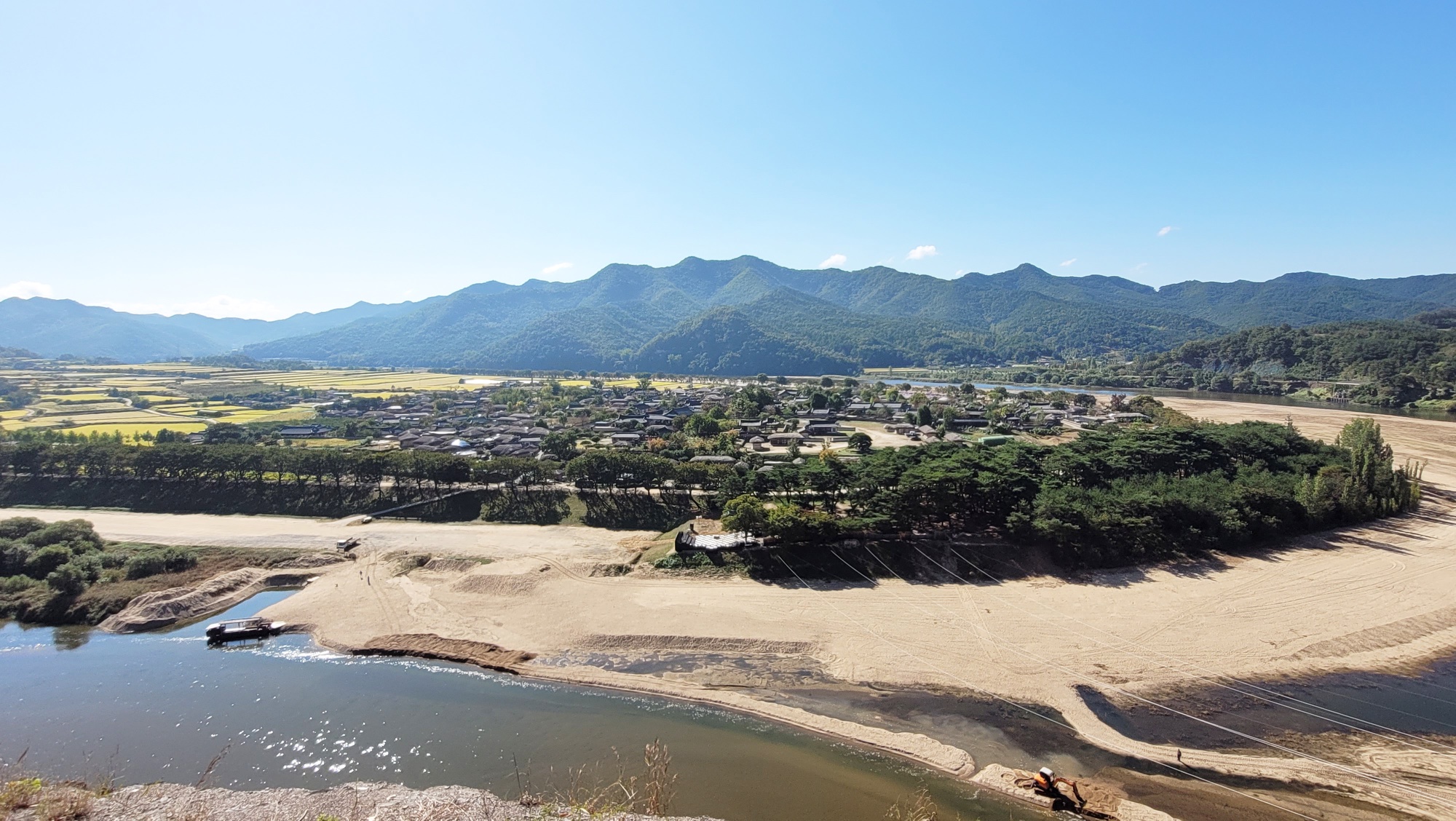
Hahoe Folk Village seen across the river sandbank, Andong
Five characters
Yangban, the aristocrat, wears a broad smile, but his actions expose the weakness behind his status. Seonbi, the scholar, claims respect through learning. The aristocrat–scholar scene mocks the boasting and hypocrisy of both.
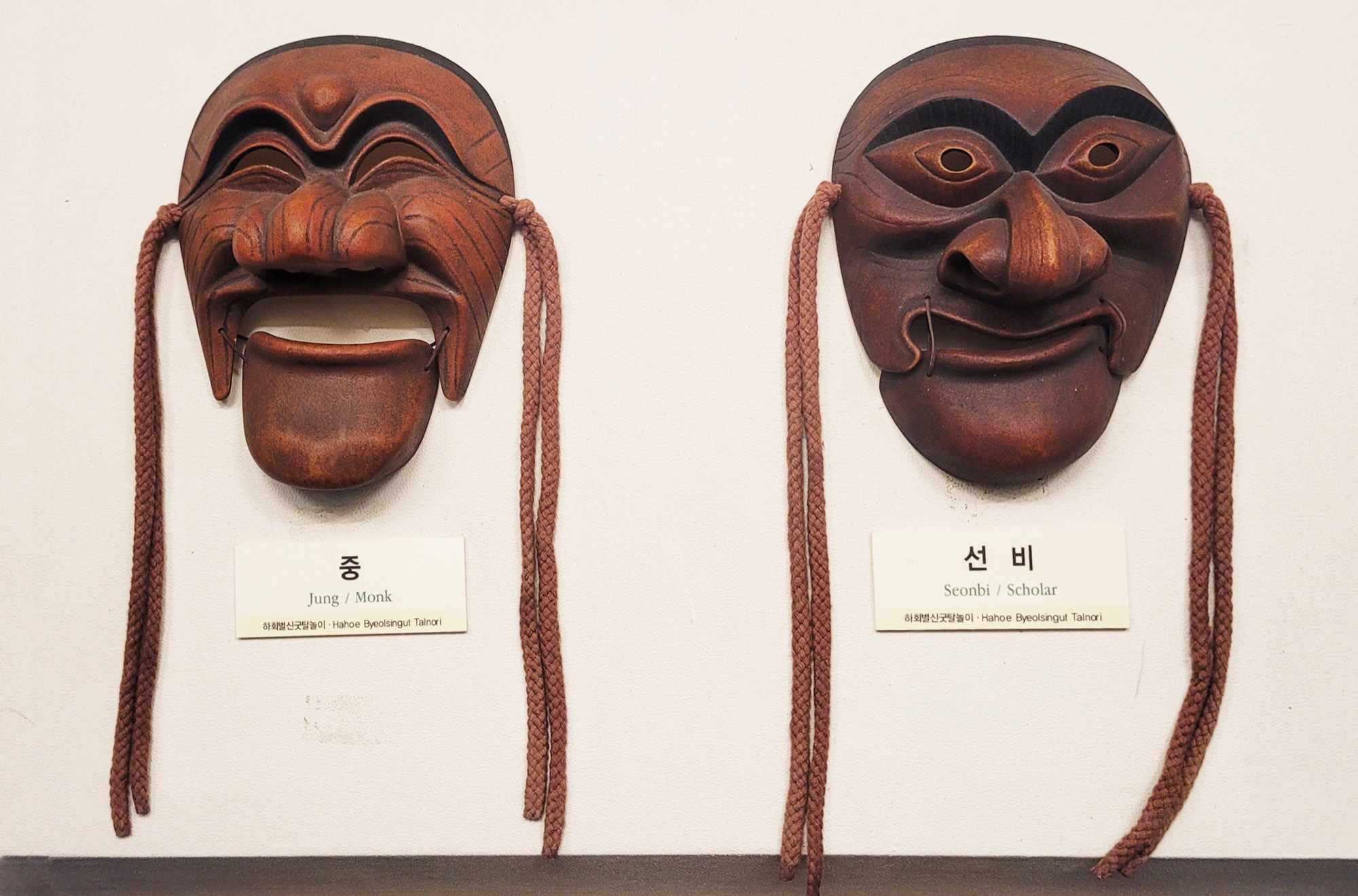
Choraengi, the aristocrat’s servant, interrupts and unsettles the dignity around him. Jung, the monk, fails to keep the discipline his position demands, and the wayward-monk scene turns that into comedy. Halmi, an elderly widow, sings a weaving song about hunger and the hardships of married life.
These five are the principal figures, not the full cast. The relationships of master and servant, rival men of standing, a cleric and his desires, and an older woman recounting hardship drive the scenes.
Monk (Jung) and Scholar (Seonbi) masks on display
Dialogue and rhythm
Who addresses whom, who waits or interrupts and whose posture shifts reveal the relationships in each scene. The gestures are not a fixed code but the performers’ way of making social relations visible.
The official programme for the annual presentation lists musicians on gongs, drums and the taepyeongso, a wind instrument. Gestures lock into the rhythm, and dialogue gives way to dance.
According to Andong Tourism, the regular performance presents six scenes in its main hour, with an introduction at 13:50, the show from 14:00 and an audience finale at 15:00–15:10. It does not reproduce the full ritual, and audience participation follows the performers’ and venue’s directions.
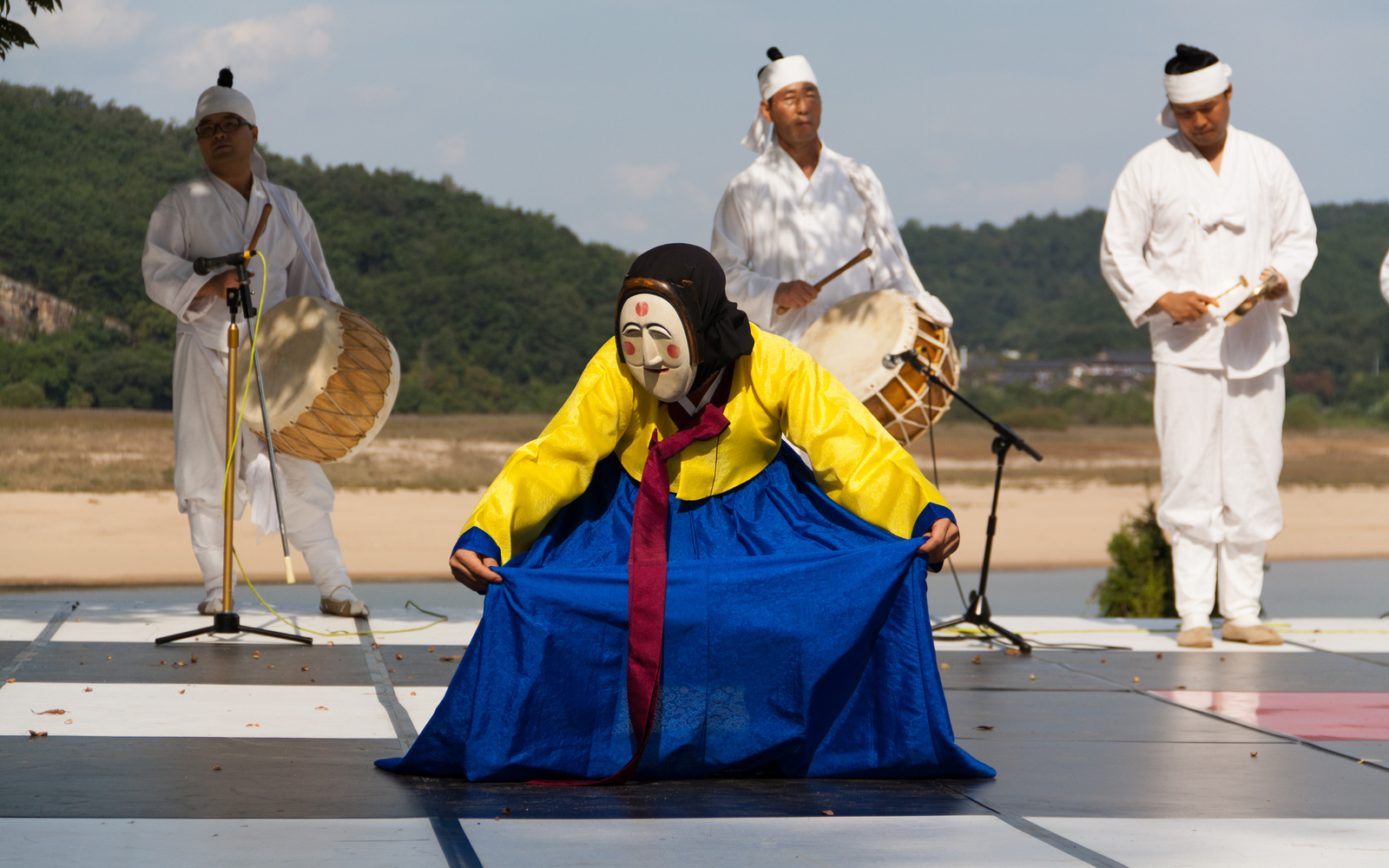
Archival 2012 Hahoe mask-dance photograph: a masked performer in yellow and blue bends forward, with white-clad percussionists behind.
A tradition revived
The Korean Studies Institute’s historical account says transmission stopped after the 1928 performance. A research group formed in 1973 began reconstruction from a recorded script and sought people who remembered the earlier event. Meeting Yi Chang-hui, who had performed as a young man, helped recover details the text alone could not supply.
Research in the mid-1970s led to revival performances and to designation as an important intangible cultural property in 1980. The same account dates the regular visitor performances to 1997; the older timetable it gives no longer applies.
A mask can survive in storage, but movement, costume, dialogue and scene order continue only if people learn and teach them. Calling the drama “unchanged for 800 years” obscures that work of recovery and transmission.
Without Korean
Without Korean, some dialect, wordplay and social references will be lost. The five characters, along with changes in pace, distance, gesture and gaze, still make the scenes readable.
UNESCO describes audience response as an essential part of talchum. Spectators are not expected to force a reaction or join in.
Current English or Japanese subtitles and live interpretation have not been confirmed. The preservation society can advise on language support.
Schedule and transport
The published regular schedule is Tuesday–Sunday, 14:00–15:00, from March through December, and Saturday and Sunday, 14:00–15:00, in January and February. The operator’s October 2026 calendar lists shows on October 13–18, 20–25 and 27–31; the Mondays, October 19 and 26, are blank.
Saturday, October 24 differs. The National Intangible Heritage Center lists the annual presentation from 13:00 to 16:00, with an invited performance and opening proceedings followed by the main Hahoe presentation of nine scenes at 14:00–15:30 and a finale until 16:00.
Andong Tourism lists bus 210 from Andong Station or the bus terminal to the Hahoe area; downtown, it stops opposite Kyobo Life. Departures and return services are on Andong’s live bus information system.
Venue and admission
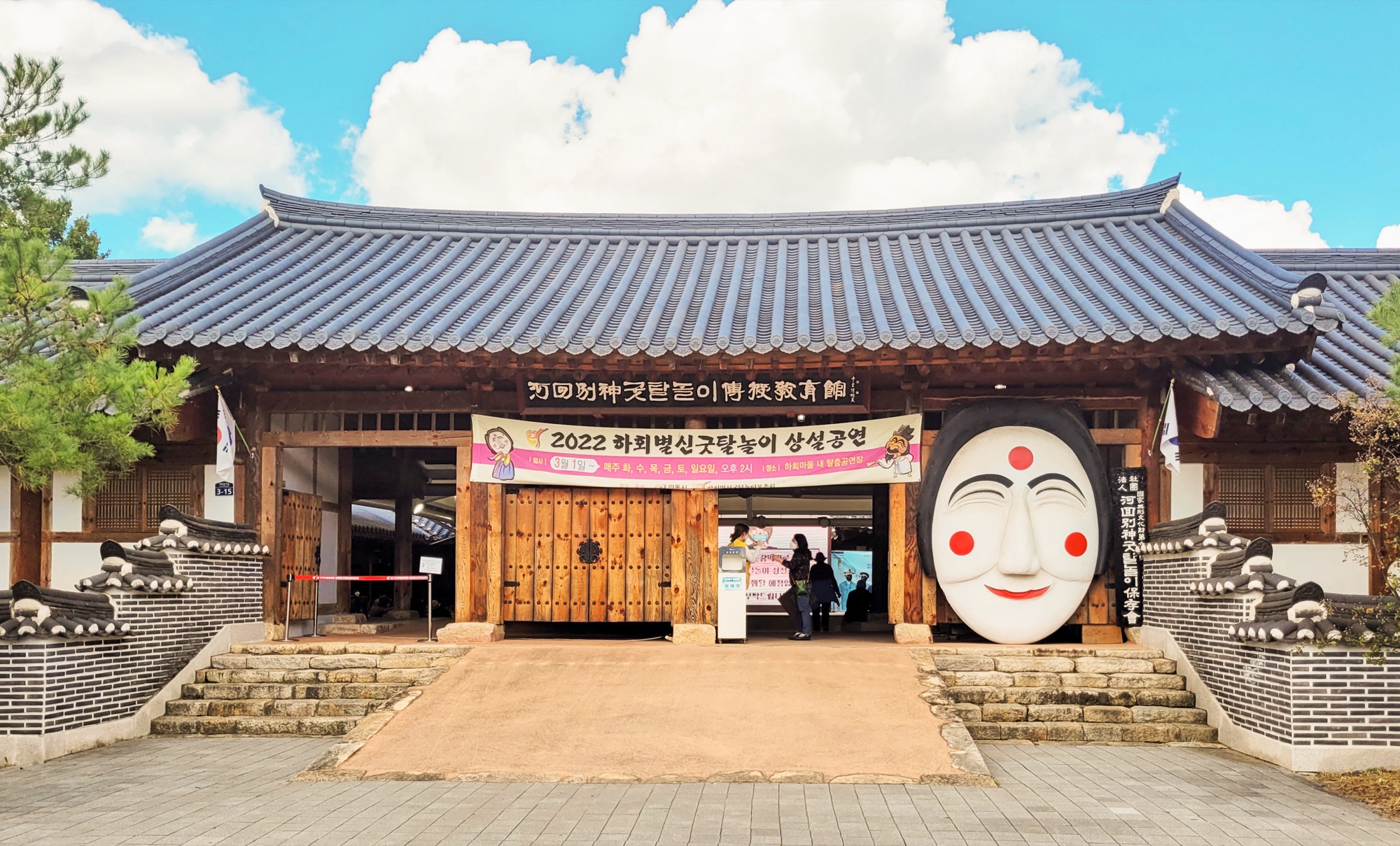
The performances take place at the Hahoe Byeolsingut Tallori Training Center, 하회별신굿탈놀이 전수교육관, at 3-15 Hahoejongga-gil, Pungcheon-myeon, Andong, opposite the village-entrance management office. Visitors buy village admission at the parking area and take a free shuttle to the village entrance.
The show is free; village admission is ₩5,000 for adults, ₩2,500 for teenagers and ₩1,500 for children. Public parking and the Hahoe World Mask Museum are free. From October to March, admission closes at 16:30, though not every building stays open until then. The village is inhabited, and private courtyards are off-limits.
Information was checked on October 12, 2026, KST. The regular show requires no advance booking, but seats are not guaranteed. For groups, seating, subtitles or step-free access, contact the preservation society at +82-54-854-3664.
Entrance of the Hahoe Byeolsingut Tallori Training CenterSources & context
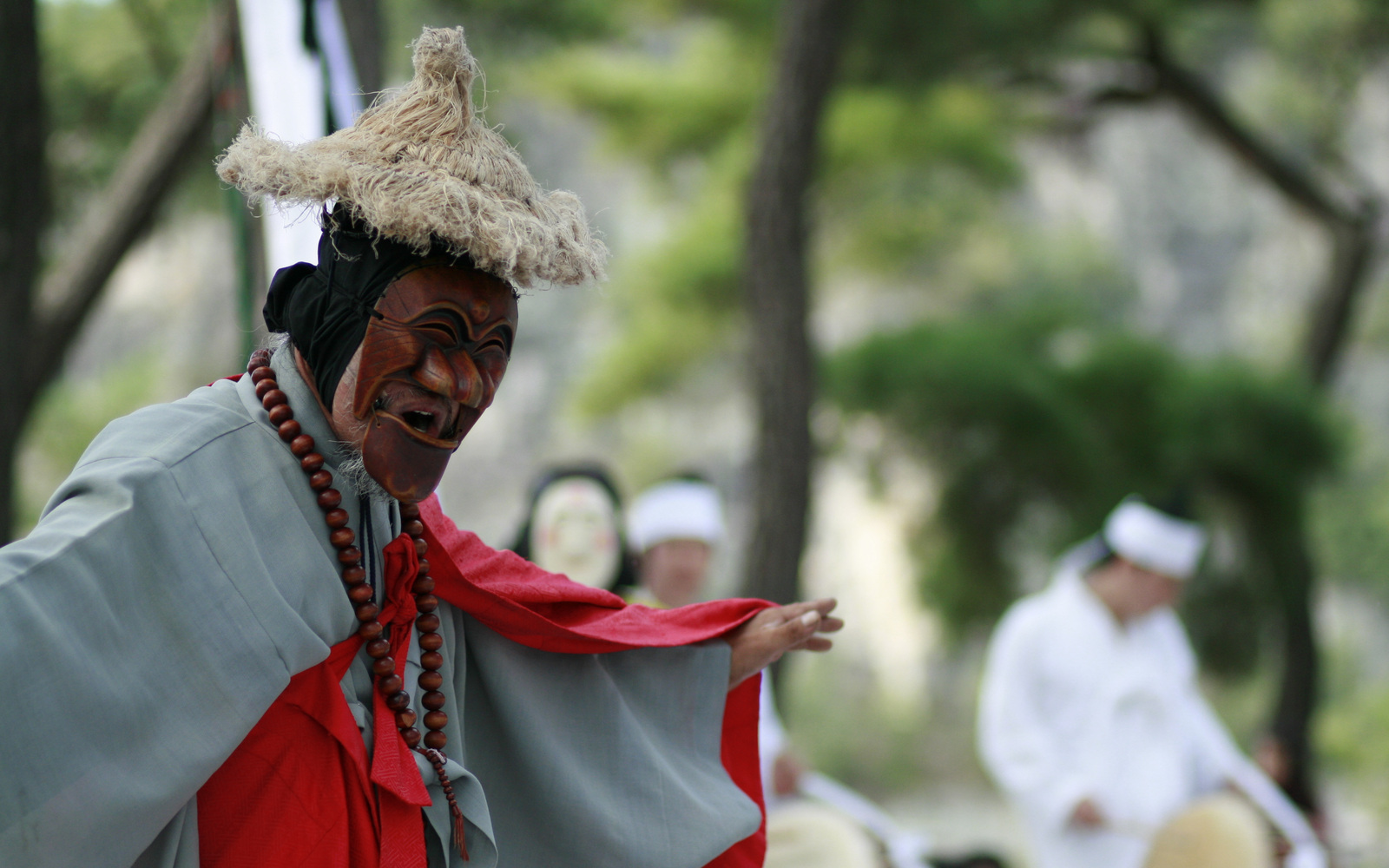
Archival Hahoe mask-dance photograph of a masked performer in grey and red robes. Captured 2008-09-28. Author/credit: Korea.net / Korean Culture and Information Service; photo: Andong Festival Tourism Foundation. Title: “Mask dance in Hahoe village (4459428890).jpg”. Source: https://commons.wikimedia.org/wiki/File:Mask_dance_in_Hahoe_village_(4459428890).jpg. License: CC BY-SA 2.0 (https://creativecommons.org/licenses/by-sa/2.0/). Modification: 8:5 crop removes 162 pixels from the lower edge, preserving the hat, mask and extended hand; proportionally reduced to 1600×1000 and recompressed as JPEG. No padding, stretching, retouching, generated content or text overlay. The original full frame is available at the source link. This adapted image remains under the same license. An archival image, not a view of the current venue.
Archival Hahoe mask-dance photograph showing a performer in yellow and blue with percussionists behind. Captured 2012-09-28. Author/credit: Idobi. Title: “Hahoe 8747.jpg”. Source: https://commons.wikimedia.org/wiki/File:Hahoe_8747.jpg. License: CC BY-SA 3.0 (https://creativecommons.org/licenses/by-sa/3.0/). Modification: 8:5 crop removes 89 pixels from both the upper and lower edges, preserving the performer and the musicians; proportionally reduced to 1600×1000 and recompressed as JPEG. No padding, stretching, retouching, generated content or text overlay. The original full frame is available at the source link. This adapted image remains under the same license. An archival image, not a view of the current venue.
The houses and trees of Hahoe Folk Village, Andong, with mountains behind, seen across the river and its sandbank. Photo: Bernard Gagnon / Hahoe Folk Village 01 / Wikimedia Commons / CC0 1.0
The Monk (Jung, left) and Scholar (Seonbi, right) Hahoe masks hanging side by side at the Hahoe World Mask Museum, Andong. Photo: Bernard Gagnon / Hahoe World Mask Museum 06 / Wikimedia Commons / CC0 1.0
The entrance of the Hahoe Byeolsingut Tallori Training Center in Andong, with a banner for the regular performances and a giant mask sculpture beside it (photographed in 2022). Photo: Bernard Gagnon / Hahoe Byeolsingut Tallori Training Center 01 / Wikimedia Commons / CC0 1.0
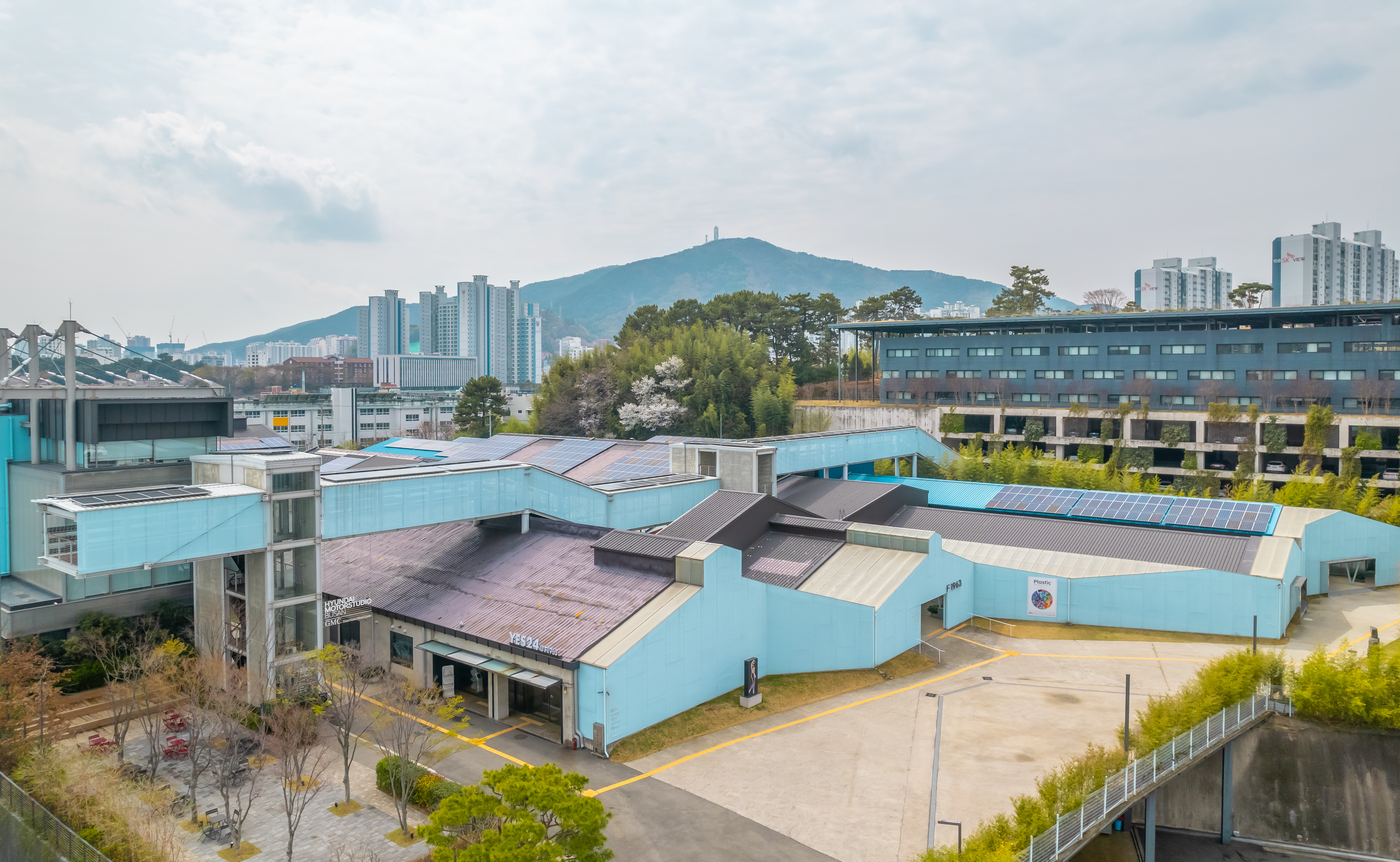
F1963, in Busan’s Suyeong district, is a former wire factory turned cultural complex, where the stepping stones beneath a bamboo grove were cut from the old factory floor. Its garden was named one of Korea’s 30 Beautiful Private Gardens by the Korea Forest Service in September 2026.
From wire factory to garden
The irregular stepping stones beneath F1963’s bamboo were cut from the old factory’s concrete floor, and bamboo leaves now rustle overhead.
Kiswire completed its Suyeong factory in 1963 and produced wire there for 45 years, until 2008. The 2016 Busan Biennale prompted its conversion into a cultural complex, named with the F of Factory and the year of completion. The roofs and structural frame show that today’s exhibition rooms and bookshop began as industrial space.
On September 22, 2026, Busan announced that the Korea Forest Service had included F1963 Garden among its 30 Beautiful Private Gardens of Korea for 2026, the only Busan selection from 194 private gardens nationwide. The listing recognized an existing landscape combining gardens and industrial buildings, not the opening of a new garden.
Only Here
- A factory floor beneath a bamboo grove: the concrete stepping stones along Sori Trail vary in surface and colour. The operator links bamboo’s straight, flexible qualities to the wire once made here.
- An open courtyard made by removing a roof: F1963 Square is a courtyard opened to the sky by removing the old factory ceiling. Former production space became Sukcheon Hall for exhibitions and performances. The shaded Danpung Garden and Dalbit Garden, in the former backyard, are nearby. Autumn colour depends on the season and weather.
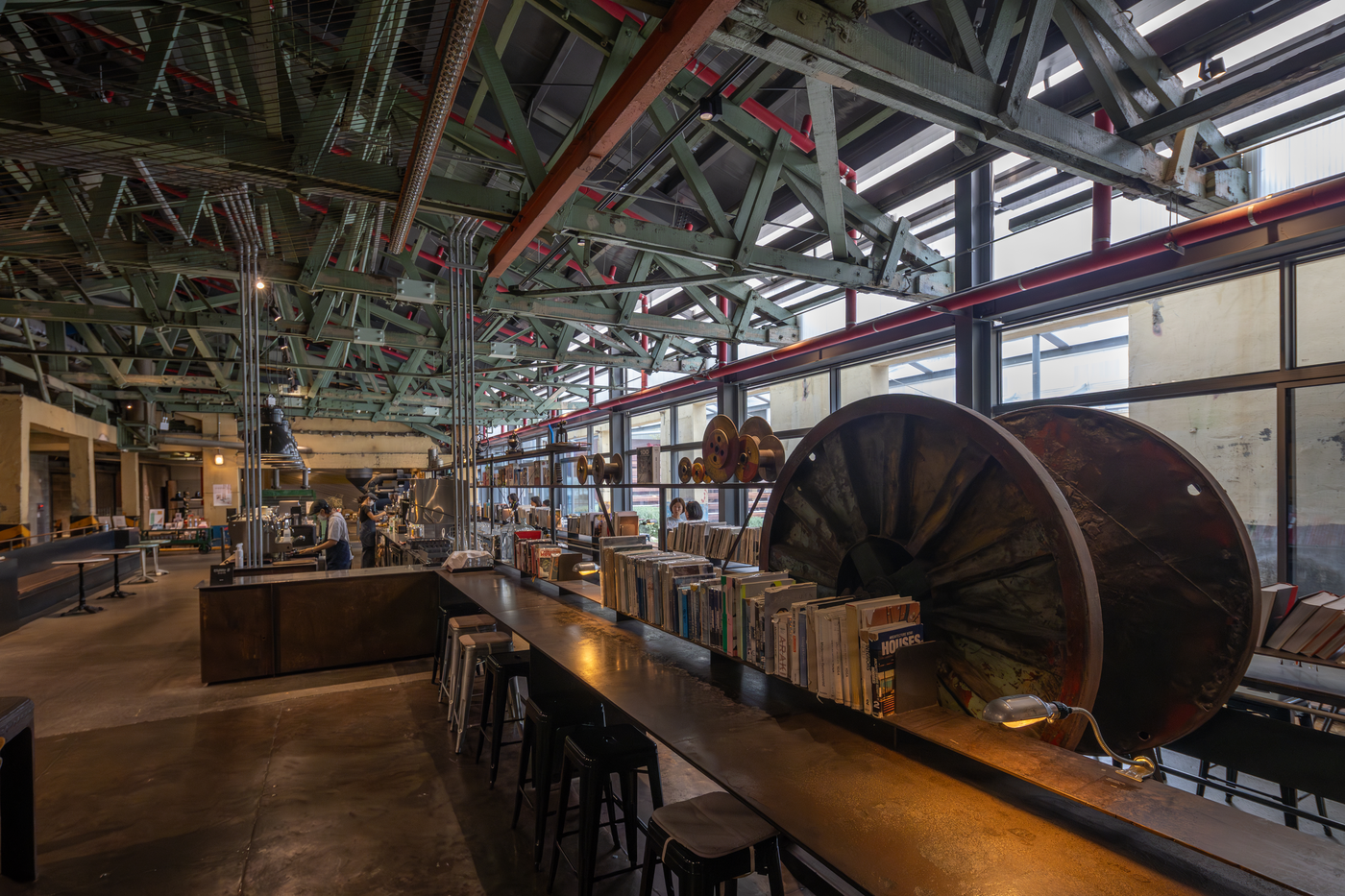
- Wire bobbins beside the coffee bar: Terarosa retains a factory generator and the large reels once used to wind wire, and old steel plates form its coffee bar and tables. Café orders cost extra.
Best Time
The editors recommend daylight for seeing the gardens and the textures of reused materials; this is not an official tour time. The operator lists the overall site as open daily 09:00–24:00, but indoor venues set their own hours: the greenhouse 10:00–20:00, the YES24 used bookstore 10:00–21:00, and Kukje Gallery Busan 10:00–18:00 Tuesday–Sunday, closed Monday.
The operator says the greenhouse, which holds art books, is open to everyone. Exhibitions and performances have their own dates, hours and admission terms.
How Long
The editors suggest 60–90 minutes for the gardens and factory exteriors, or 2–3 hours with the bookstore or a café. These are not official durations.
A visit can take in the reclaimed concrete along Sori Trail, the factory frame from the central square and the Danpung and Dalbit gardens. General admission is free; parking, purchases and individually priced programs cost extra.
Getting There
The address is 20 Gurak-ro 123beon-gil, Suyeong-gu, Busan. According to the operator, take Busan Metro Line 3 to Mangmi Station, Exit 4, then village bus Suyeong-gu 2 from the Geumho gas-station stop to Sanjeong Apartment (산정아파트). Visit Busan lists a walk of about two minutes from there. City bus 54 stops at Kiswire (고려제강), also about two minutes away.
From Busan Station, take Line 1 to Yeonsan, change to Line 3 for Mangmi, then take the village bus. General enquiries: +82-51-756-1963. The official website has English and Japanese introductions to the site.
PLACE INFO
HoursOverall site 09:00–24:00; individual venues differ
AdmissionGeneral entry free; purchases, parking and paid programs extra
Bamboo and reclaimed concrete stepping stones along Sori Trail. 하이픈그룹 / 부산관광공사 글로벌마케팅팀 / 부산관광아카이브, “F1963 · METADATA 013811”. Archive production date: 1 April 2025; exact capture date not independently established. Archival material, not an autumn 2026 site photograph. Public PNG preview copied unchanged. Source: https://archive.visitbusan.net/dataSearch/view.nm?menuCd=36&dataSid=METADATA 013811 · KOGL Type 1: https://www.kogl.or.kr/info/licenseType 1.do.
F1963’s roofs and connecting structures seen from above. 하이픈그룹 / 부산관광공사 글로벌마케팅팀 / 부산관광아카이브, “F1963 · METADATA 013878”. Archive production date: 1 April 2025; exact capture date not independently established. Archival material, not an autumn 2026 site photograph. Public PNG preview copied unchanged. Source: https://archive.visitbusan.net/dataSearch/view.nm?menuCd=36&dataSid=METADATA 013878 · KOGL Type 1: https://www.kogl.or.kr/info/licenseType 1.do.
An interior retaining the old factory framework and a large wire bobbin. 하이픈그룹 / 부산관광공사 글로벌마케팅팀 / 부산관광아카이브, “F1963 · METADATA 013837”. Archive production date: 1 April 2025; exact capture date not independently established. Archival material, not an autumn 2026 site photograph. Public PNG preview copied unchanged. Source: https://archive.visitbusan.net/dataSearch/view.nm?menuCd=36&dataSid=METADATA 013837 · KOGL Type 1: https://www.kogl.or.kr/info/licenseType 1.do.
The 33rd Gwangju Kimchi Festival runs 23–25 October around the Gwangju government complex, with tastings at a foreign-visitor lounge, a kimchi school where participants mix 1 kg of kimchi, and a food area serving dishes made with kimchi. Festival admission is free; the school charges separately.
The festival
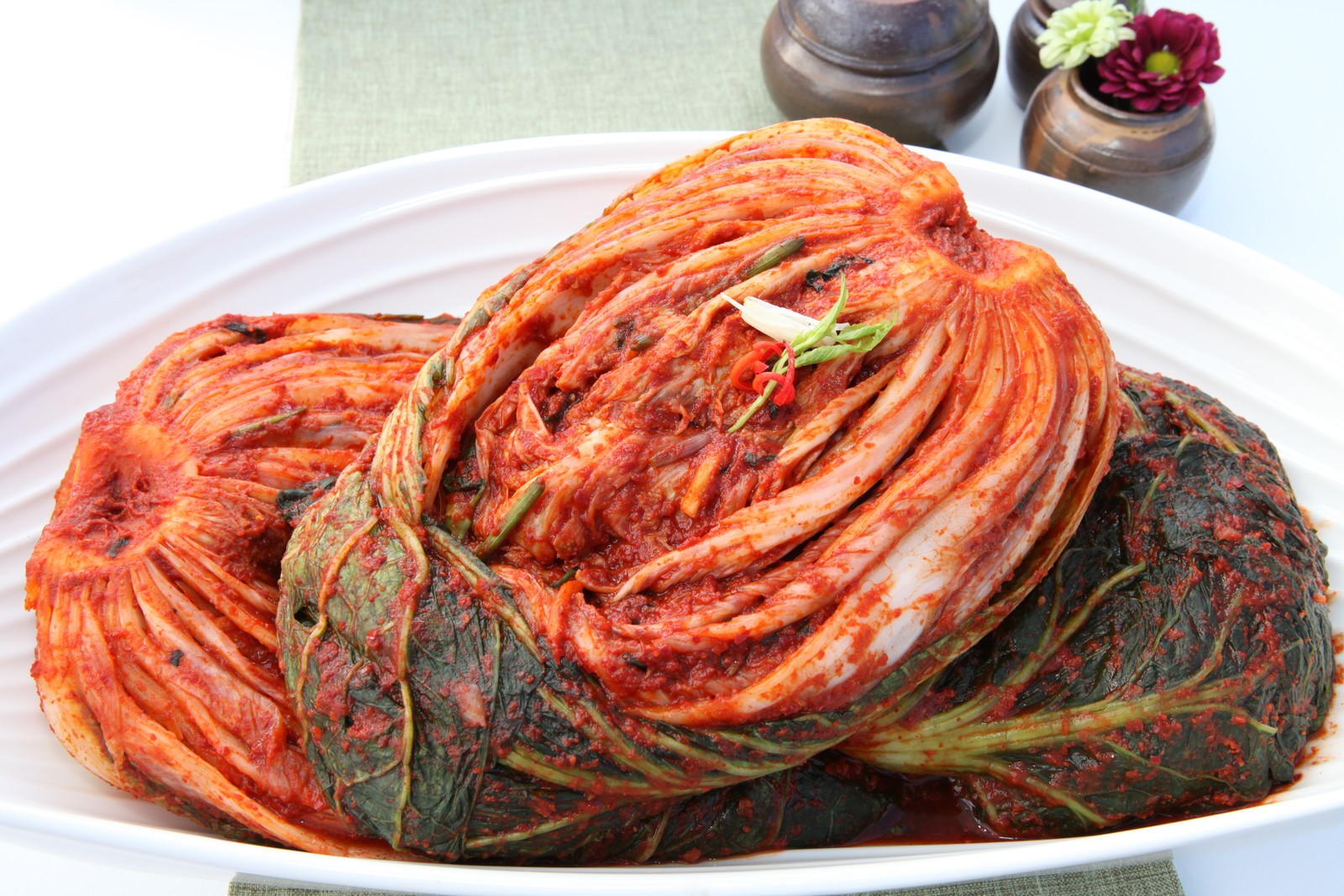
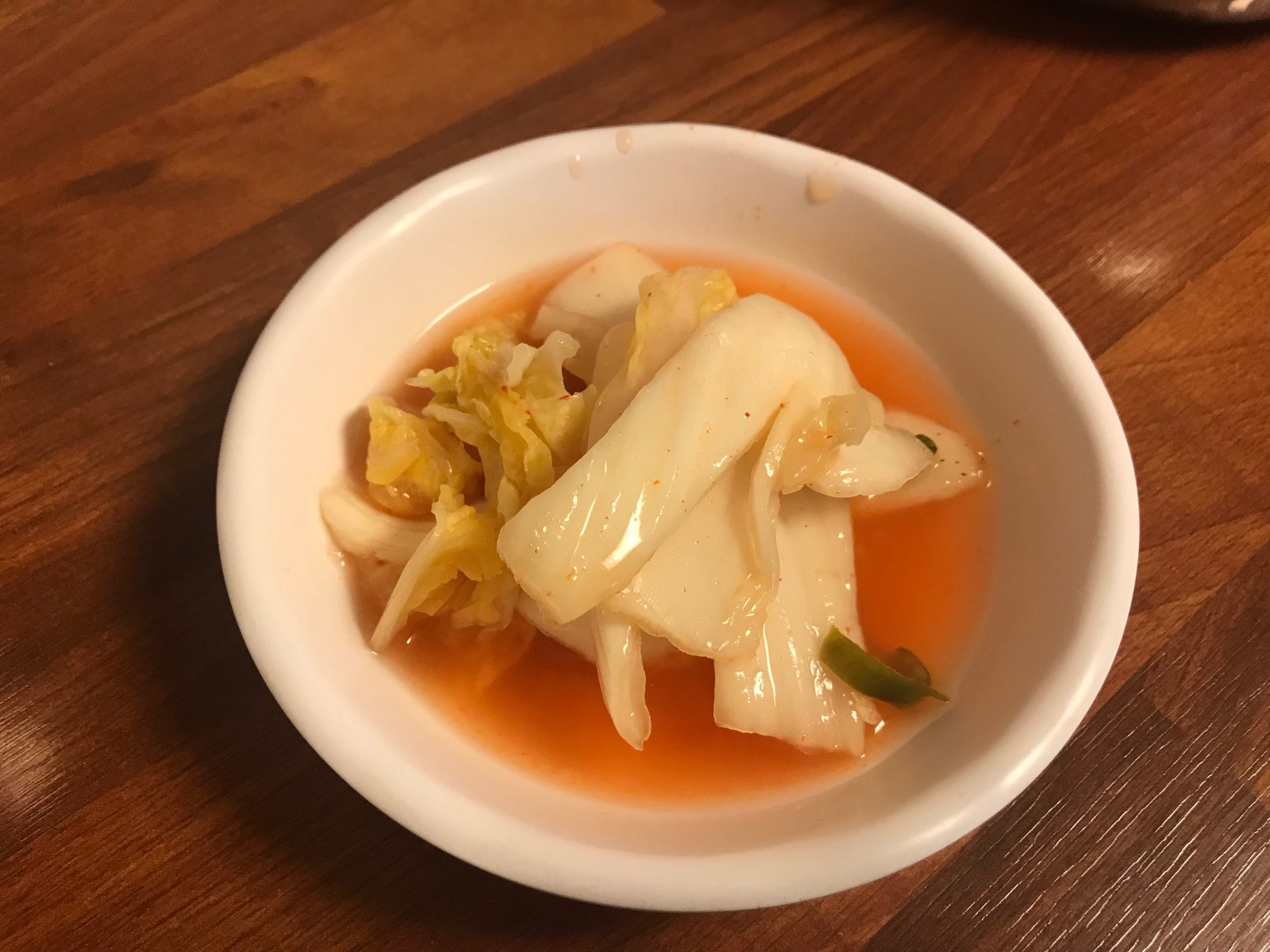
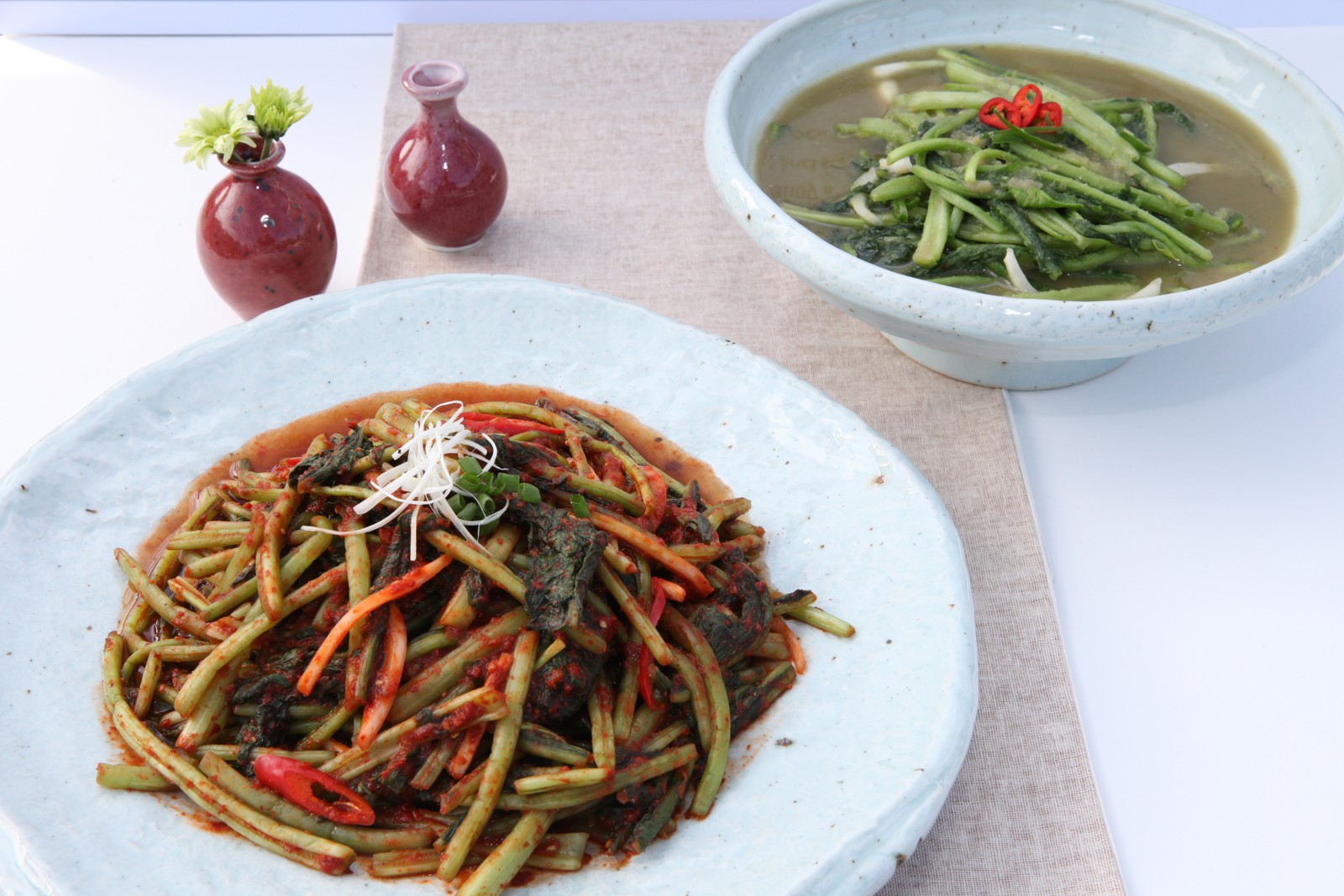
Thick cabbage stems, green young-radish leaves and cabbage in broth: each kind of kimchi differs in texture, seasoning and ripeness.
The 33rd Gwangju Kimchi Festival runs from 23 to 25 October 2026 around the Gwangju government complex. Admission is free; the Kimchi Experience School charges separately.
Seafood in white kimchi
Red cabbage kimchi and baek-kimchi, or white kimchi, differ first in colour. The National Institute of Crop and Food Science’s seasoning comparison gives a white-kimchi formula without red-chilli powder but with jeotgal, salted fermented seafood. A pale colour does not mean a dish has no animal ingredients.
Yeolmu-kimchi uses both the leaves and stems of young radish. The photographs illustrate kimchi varieties and are not a confirmed festival tasting menu.
White kimchi and broth in a white bowl on a wooden tableYoung-radish kimchi showing leafy greens and stems
Heat and sourness
The World Institute of Kimchi explains that organic acids produced by lactic-acid bacteria contribute to kimchi’s sour taste, so ripeness changes the flavour even when the vegetable is the same.
Kimchi just mixed in a workshop tastes different from a well-fermented batch. Staff give guidance on storing and eating the kimchi participants make.
Gwangju’s seasoning
The organizer’s introduction to Gwangju and Jeonnam food culture highlights ingredients including fermented anchovies, anchovy fish sauce and glutinous-rice paste, so a vegetable dish can carry flavours from the sea. This is a regional tendency, not a uniform recipe.
Visitors avoiding seafood, nuts or other ingredients should name them specifically to vendors. A useful question is “젓갈이 들어가나요?” meaning “Does it contain fermented seafood?” Appearance and names cannot establish allergen safety or suitability for vegetarians.
Lounge and kimchi school
The foreign-visitor lounge runs sessions on the lawn plaza between 10 AM and 6 PM on all three days. The official programme lists venue guidance, kimchi tasting, a look at pickling cultures around the world and pumpkin injeolmi rice cakes.
At the Kimchi Experience School, participants mix 1 kg of kimchi and make rice balls with pickled Mudeungsan watermelon. The 30-minute sessions begin daily at 1:30, 2:30, 3:30, 4:30 and 5:30 PM. Advance booking is through Naver, with walk-ins only if places remain, and a take-home container is provided. An open booking page does not guarantee a place.
Cheon-in-ui Bapsang
The Cheon-in-ui Bapsang food area in the outdoor auditorium plaza opens 10 AM to 8 PM. This year’s official menu lists aged-kimchi oil pasta, kimchi-mayo chả giò and pork boiled with mustard-leaf kimchi and doenjang, showing kimchi as an ingredient rather than a side dish. Menus may change, and meals cost extra.
Transport, booking, enquiries
The venue is at 111 Naebang-ro, Seo-gu. Official directions give a walk of about 25–30 minutes from Sangmu Station exit 4 or Uncheon Station exit 3. The City Hall bus stop is nearby.
Experience School fees and session conditions are on the official linked booking page. Operating languages, interpretation and foreign-card acceptance are not confirmed in published information. The separate master class lists eligibility as “대한민국 성인 누구나,” adults of South Korea, so foreign nationals need to check with the festival office on 062-613-3955, open 10 AM–6 PM.
LOCATION
The current official directions list Sangmu Station exit 4 or Uncheon Station exit 3, each around 25–30 minutes on foot; the City Hall bus stop is another option.exit 4
Napa cabbage kimchi, 2013-09-07. An archive illustration of a kimchi variety, not the 2026 event or a confirmed festival serving. Photo: gwangju kimchi, “Baechu-gimchi.jpg”, Wikimedia Commons / CC BY-SA 2.0. Proportionally resized and JPEG-encoded. The card may crop the edges; enlarge to see the full supplied photograph.
White kimchi, 2018-06-16. An archive illustration of a kimchi variety, not the 2026 event or a confirmed festival serving. Photo: lazy fri13th, “Baek-gimchi.jpg”, Wikimedia Commons / CC BY 2.0. Proportionally resized and JPEG-encoded. The card may crop the edges; enlarge to see the full supplied photograph.
Young-radish kimchi, 2013-09-07. An archive illustration of a kimchi variety, not the 2026 event or a confirmed festival serving. Photo: gwangju kimchi, “Yeolmu-gimchi.jpg”, Wikimedia Commons / CC BY-SA 2.0. Proportionally resized and JPEG-encoded. The card may crop the edges; enlarge to see the full supplied photograph.
These three real kimchi photographs date from 2013 and 2018. They do not show this year’s festival or its served dishes.
Seoul’s 2026 regular taekwondo performances close their season with a final weekend at Namsangol Hanok Village’s Cheonugak stage on October 17–18. Shows start at 2 p.m. and 4 p.m. both days, and admission is free. A separate hands-on session for foreign visitors runs on Sunday, October 18.
Schedule
The remaining dates on the official schedule are Saturday, October 17, and Sunday, October 18, 2026. Performances begin at 2 p.m. and 4 p.m. on both days at the Cheonugak stage in Namsangol Hanok Village. The Seoul Culture Portal lists each show at about 20 minutes. Admission is free.
The season began on May 9 and paused in July and August. The final weekend takes place only at Namsangol; the last listed DDP street performance was October 9.
The teams
Taekwondo demonstrations have long been used to present Korean culture to international audiences. Kukkiwon dates its demonstration team’s founding to September 6, 1974, and describes work that combines traditional techniques with contemporary storytelling.
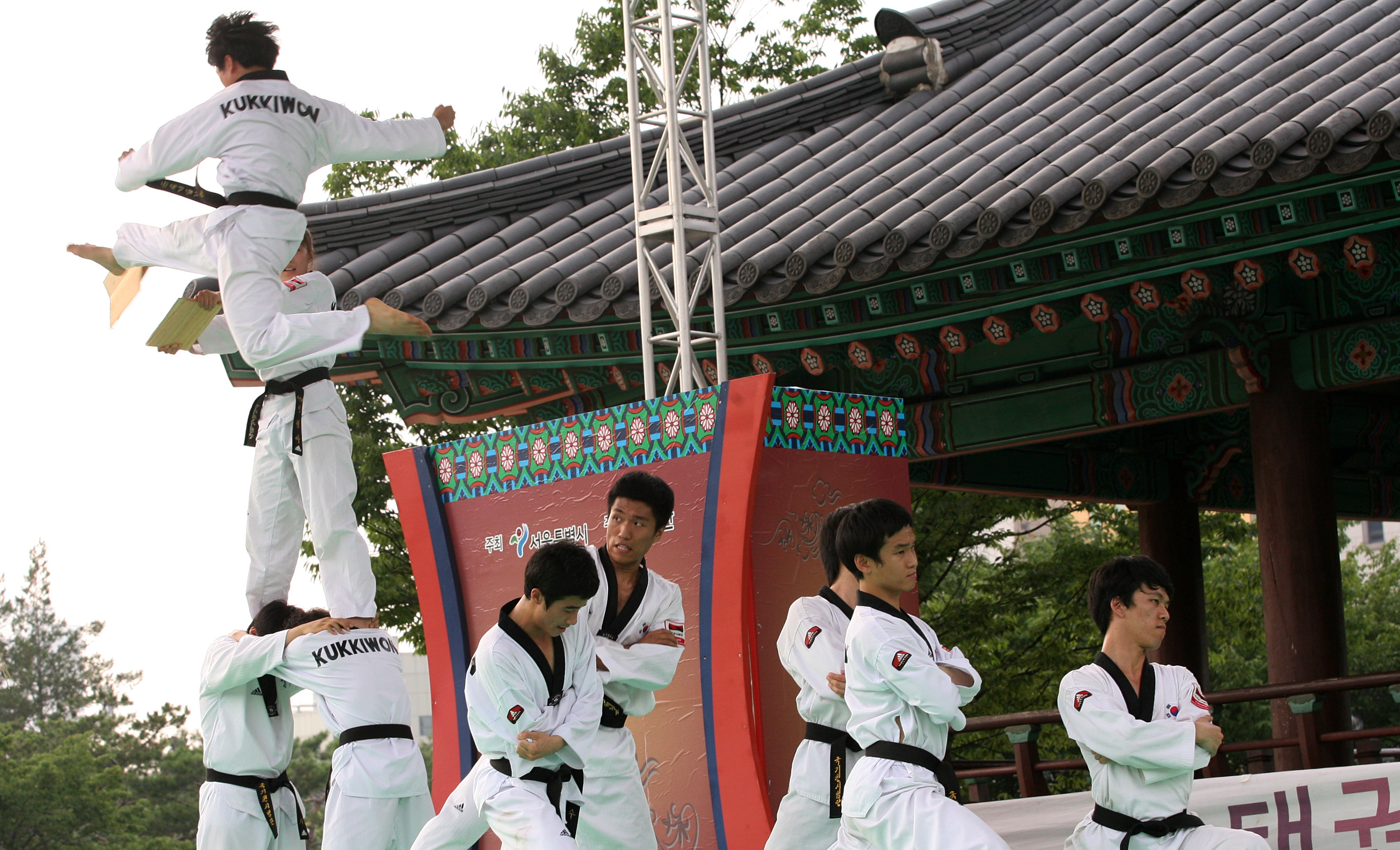
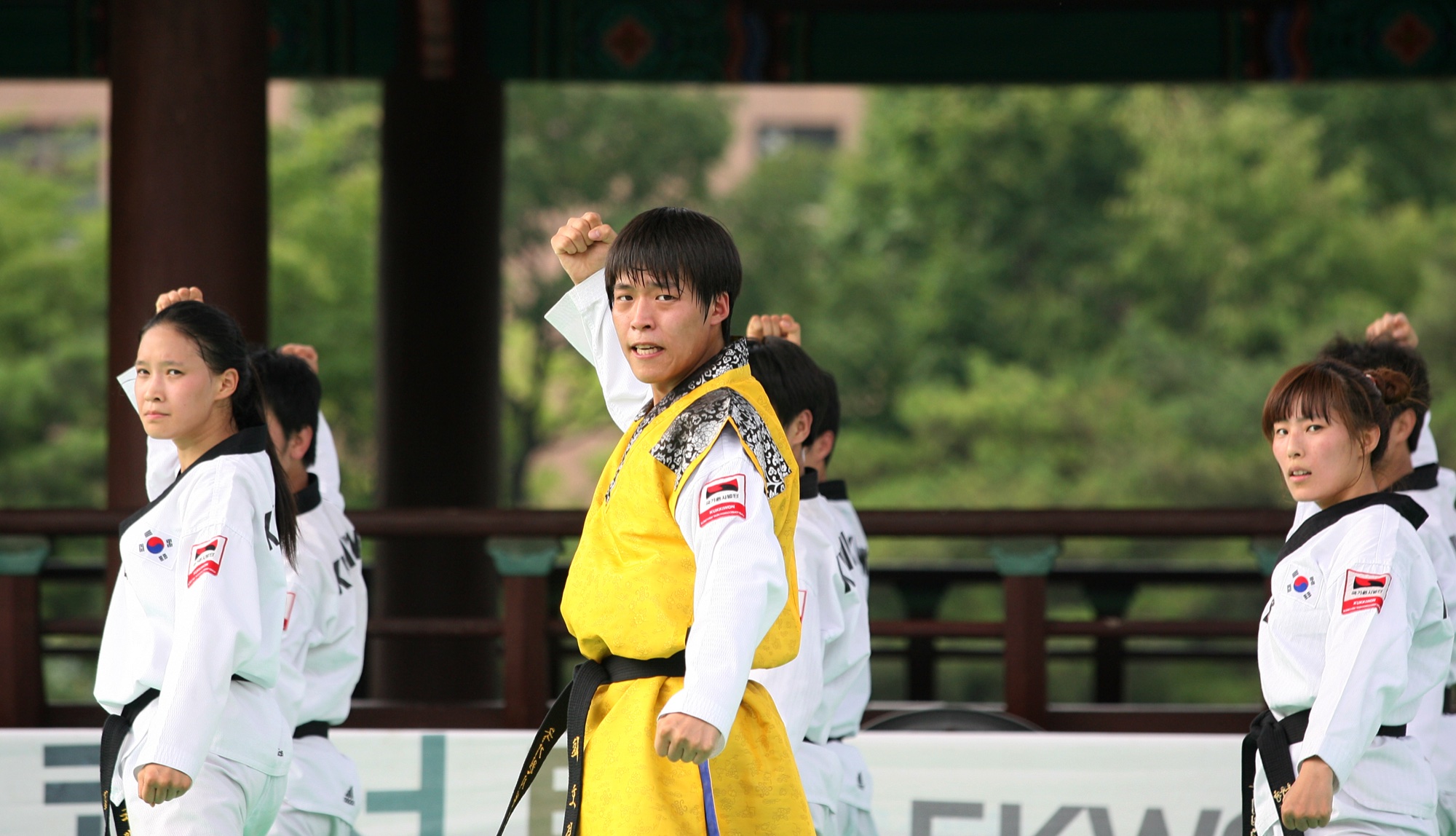
Ten teams, including Kukkiwon, BIGABI and Mirme, take part in Seoul’s 2026 season. That is the season-wide roster; the organizer’s latest notice lists who appears on the final weekend. The 2012 Kukkiwon photographs accompanying this article show an earlier performance at the same venue.
On stage
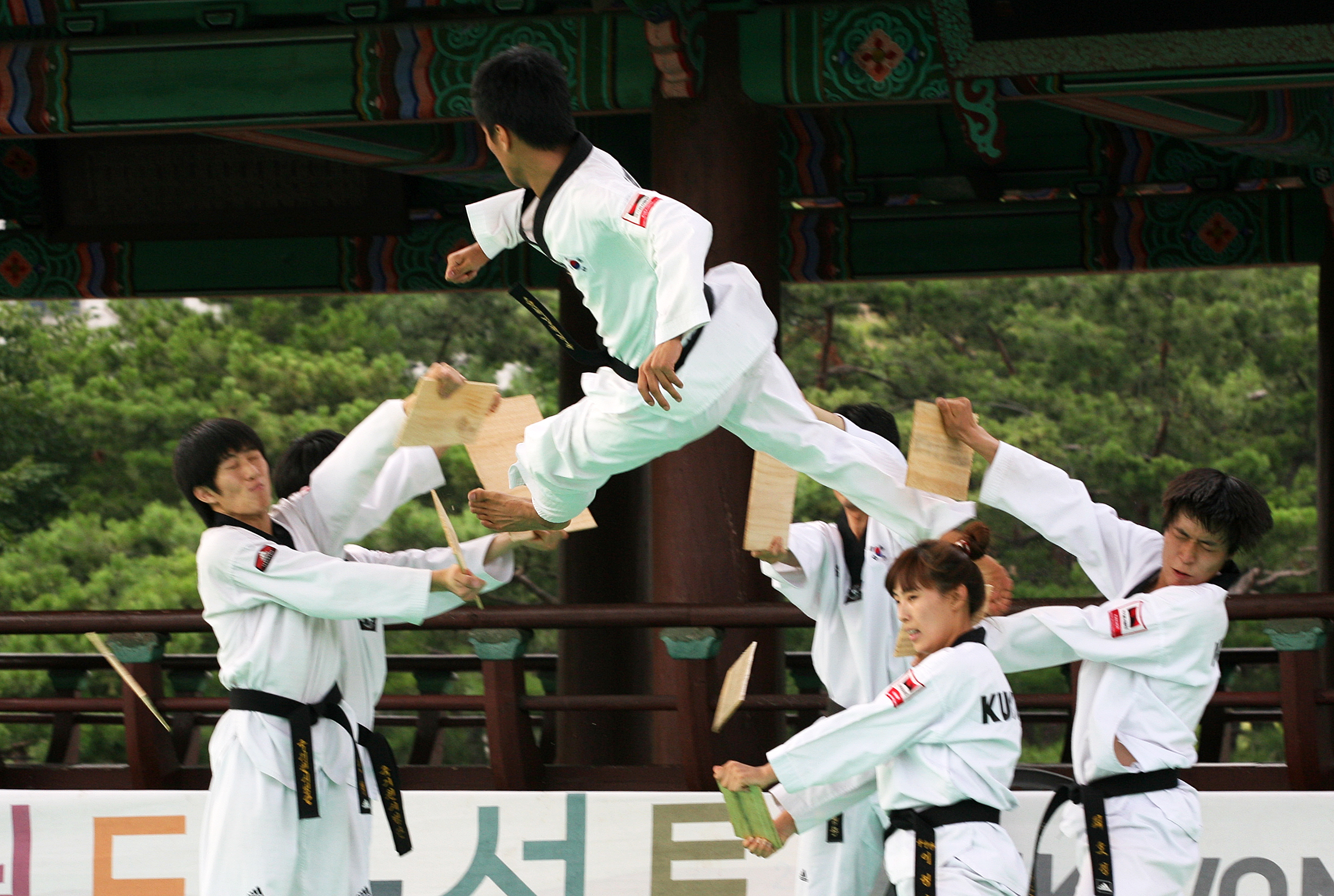
The performances are built on moments when a group starts and stops together, on the spacing as formations change and on the timing between the person breaking a board and those holding the targets. While one performer is airborne, the rest of the team moves around them.
A 2026 account by Seoul citizen reporter Jo Su-yeon describes BIGABI linking music, poomsae, group movement and breaking. That report covered an earlier performance; songs and running order may differ on the final weekend.
A Kukkiwon performer airborne between boards held by several teammates at Namsangol in 2012
Namsangol Hanok Village
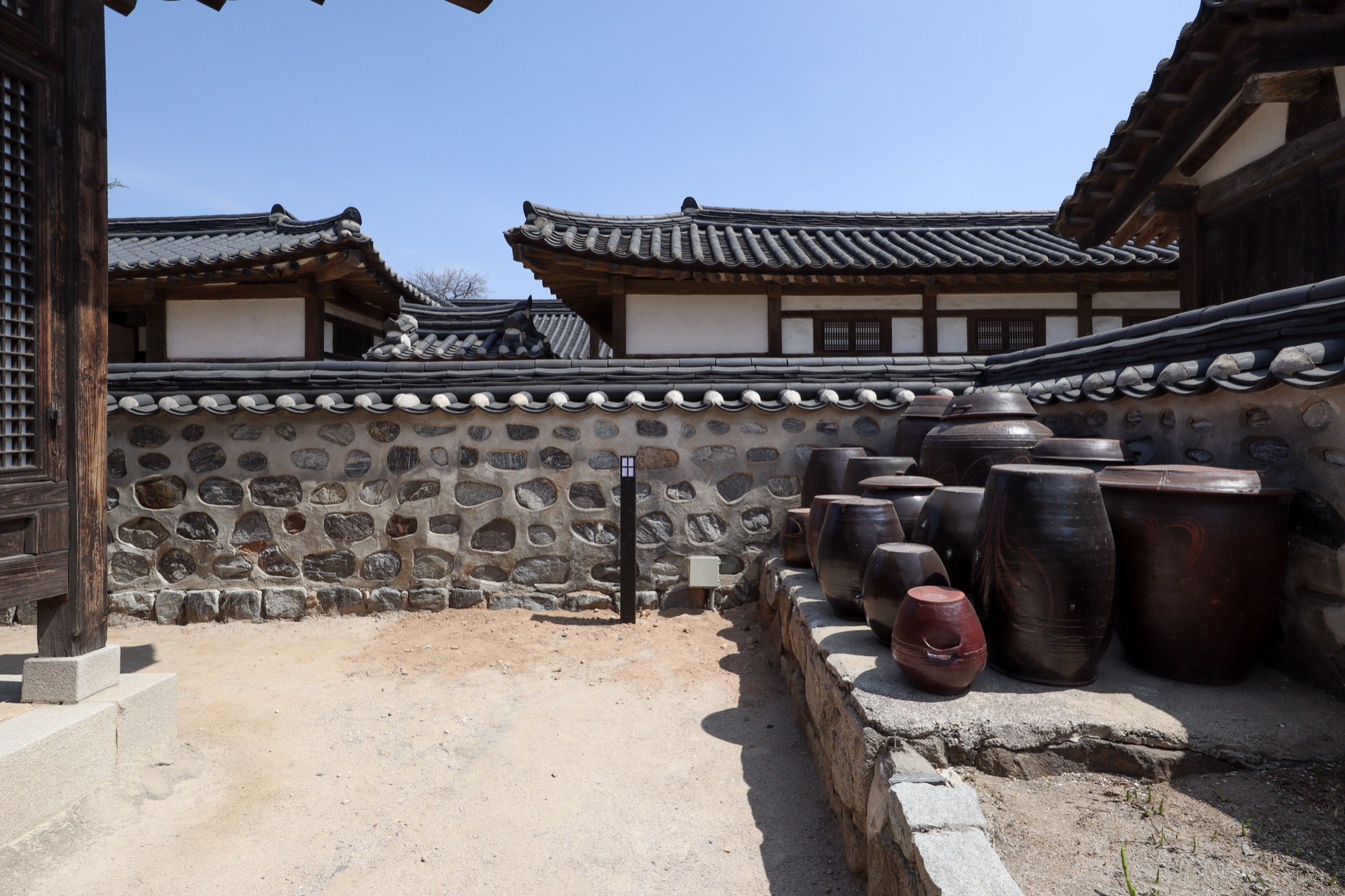
The Seoul Tourism Organization describes Namsangol as five Joseon-era hanok relocated from different parts of the city. Their interiors recreate the households of different social backgrounds.
The 2012 photographs show an airborne performer beneath the hanok eaves with teammates supporting the move. They record that earlier performance, not the 2026 cast or current stage layout; the captions give the dates.
Courtyard, stone wall and earthenware jars at Namsangol Hanok Village
Hands-on sessions
On performance days, an experience zone beside the audience area runs from 1–2 p.m. and 3–4 p.m. Saturday features punching equipment and Sunday kicking equipment. No advance application is needed.
A uniform-based class for foreign visitors is separate. In the autumn it runs on performance Sundays, leaving October 18 as the final listed date, with sessions at 2:30–3 p.m. and 4:30–5 p.m. The notice lists ten foreign participants, advance and on-site applications, and instruction in basic movements, poomsae, mitt kicks and breaking. Applications go through the official form linked from the Seoul Culture Portal.
For non-Korean speakers
Kicks, changes of direction and shifting formations are easy to follow visually, so the show works for visitors who do not speak Korean. The organizer has not said that all announcements will be in English. English event information is on Visit Seoul.
Questions about language support or space in a particular session can go to the organizer at +82-2-6204-2923. Visitors who want to try a move should use the supervised activity space rather than attempting airborne techniques from the seats.
Kukkiwon team members holding the same stance, Namsangol, 2012
Getting there
The address is 28 Toegye-ro 34-gil, Jung-gu, Seoul. The official tourism guide places it about 307 metres from Exit 4 of Chungmuro Station on subway Lines 3 and 4. Cheonugak is inside the village, a short walk from the entrance.
Rain or site conditions can change the schedule; the official Instagram account, @seoul.tkd, posts updates. Dates and times reflect the official schedule as checked on October 12. No performances have been announced after October 18.
Archive photograph of the Kukkiwon demonstration at Namsangol Hanok Village, 21 July 2012; not the 2026 event or cast. Jeon Han / Korea.net / Korean Culture and Information Service, “KOCIS Korea Taekwondo Namsan 14 (7628124388).jpg”, CC BY-SA 2.0. Original file bytes retained; no generated content, alteration or file crop. Card framing may trim edges; the larger image shows the complete frame. Source: https://commons.wikimedia.org/wiki/File:KOCIS_Korea_Taekwondo_Namsan_14_(7628124388).jpg · License: https://creativecommons.org/licenses/by-sa/2.0/
Archive photograph of the Kukkiwon demonstration at Namsangol Hanok Village, 21 July 2012; not the 2026 event or cast. Jeon Han / Korea.net / Korean Culture and Information Service, “KOCIS Korea Taekwondo Namsan 12 (7628125294).jpg”, CC BY-SA 2.0. Original file bytes retained; no generated content, alteration or file crop. Card framing may trim edges; the larger image shows the complete frame. Source: https://commons.wikimedia.org/wiki/File:KOCIS_Korea_Taekwondo_Namsan_12_(7628125294).jpg · License: https://creativecommons.org/licenses/by-sa/2.0/
Namsangol Hanok Village on April 9, 2024: a courtyard beneath tiled roofs, with a stone wall and a terrace of earthenware jars. Photo: Mobius6 / Namsangol Hanok Village 20240409 048 / Wikimedia Commons / CC BY 4.0
Kukkiwon Taekwondo Demonstration Team members strike the same fist-raised stance at a regular show for visitors at Namsangol Hanok Village on July 21, 2012. Not a photo of this year's performances. Photo: Korea.net / KOCIS (Jeon Han) / KOCIS Korea Taekwondo Namsan 32 (7628116012) / Wikimedia Commons / CC BY-SA 2.0
Both photographs document an actual performance on 21 July 2012. The 2026 schedule comes from official city information; the pictured cast and sequence are not presented as this year’s program.
Sticker photos once divided among friends and pasted into diaries have given way to four-cut prints that come with QR downloads. Newspaper reports from 1997, a 1999 diary and real photographs from Seoul in 2001 and Busan in 2024 trace how Korea’s self-photo culture has changed.
Seoul 2001, Busan 2024
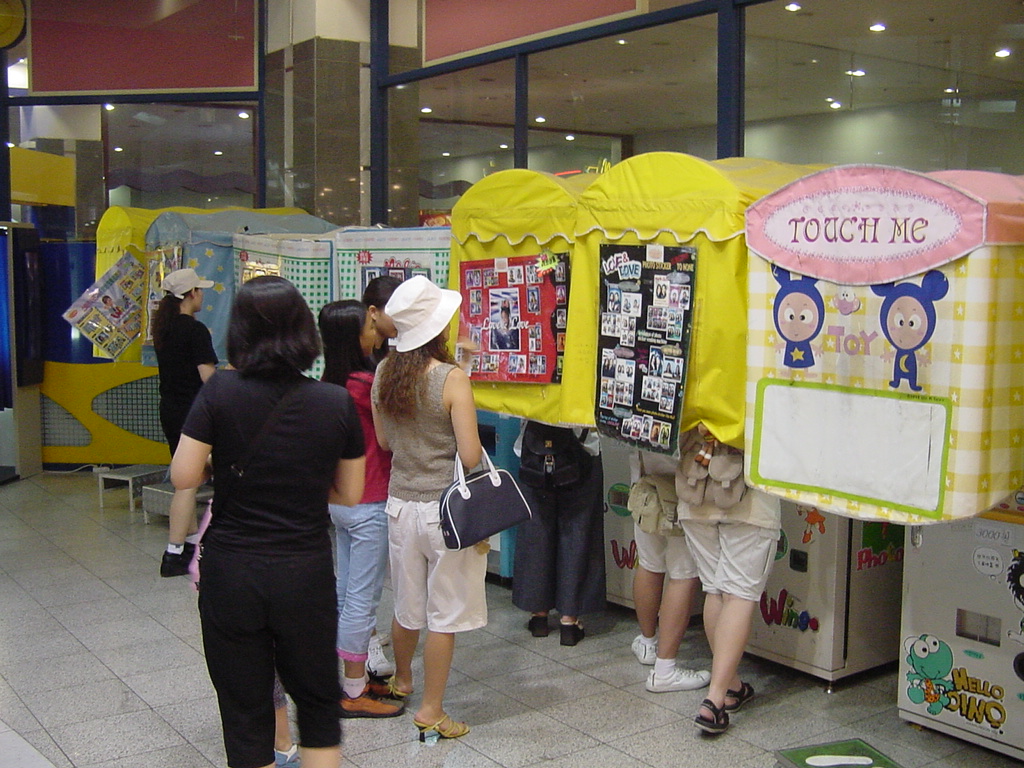
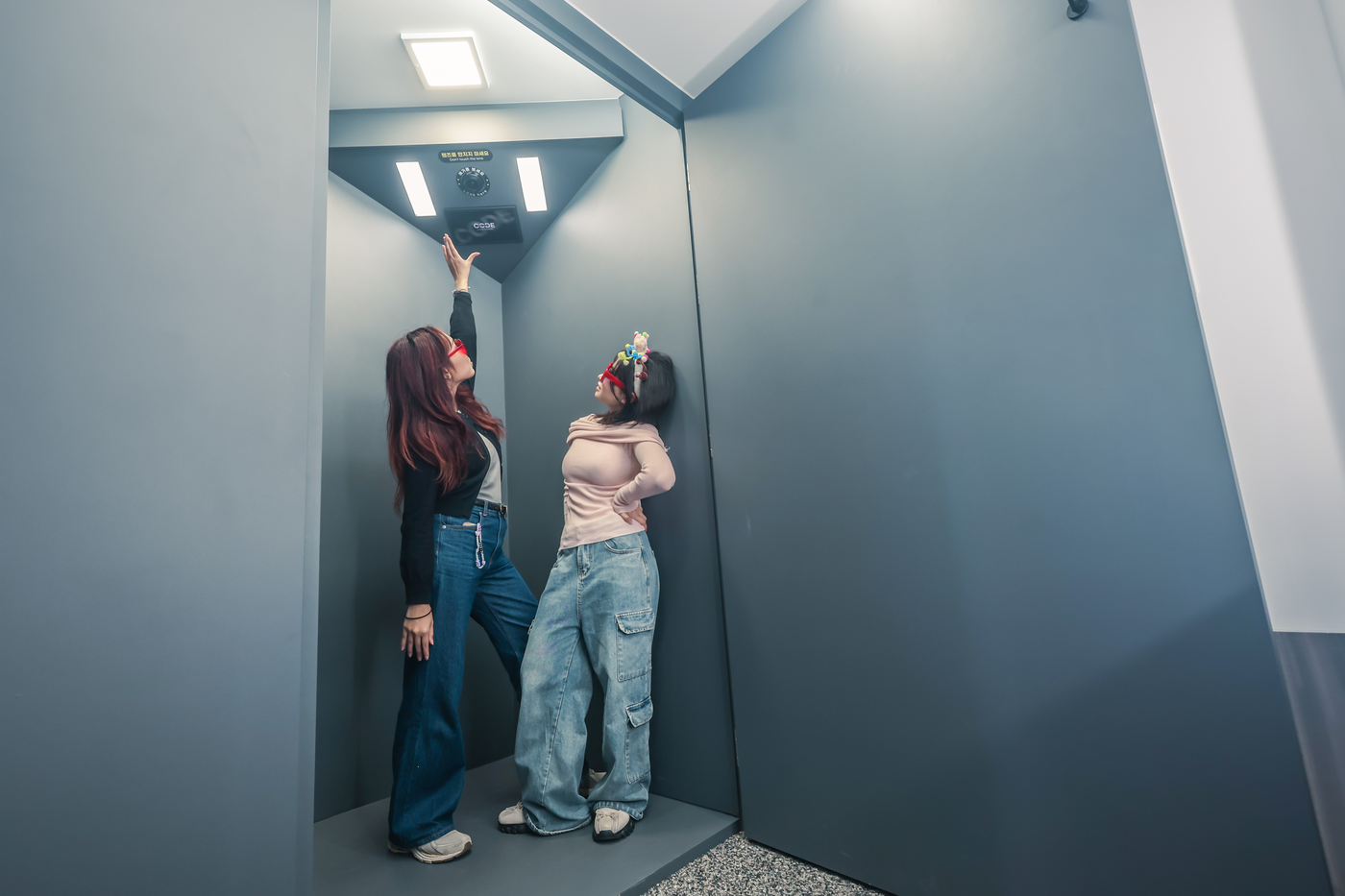
A photograph taken in Seoul in 2001 shows a row of booths with bright yellow curtains. People wait or look over their pictures outside, and sample layouts cover the machines. A Busan archive photograph produced in 2024 shows people standing beneath a high-mounted camera, posing around the room.
The older picture, taken on 19 July 2001, is an actual photograph, not a reconstruction of the 1990s. The Busan archive lists its material as produced in October 2024; it does not show the shop as it is in 2026. The two images come from different locations.
Two people wearing headbands and red glasses pose under an overhead camera in a grey booth
2,000 won in 1997
Electronic Times reported in 1997 that imported Japanese sticker-photo machines arrived in Korea in 1995. Its 22 November article described paying 2,000 won, choosing a celebrity or character background and receiving a sticker in about 30 seconds. Those figures reflect the report at the time.
Friends stepped into a chosen setting together and walked away with something they could hold. Looking at the screen together and waiting for the print were part of the fun.
Pictures in diaries
Seoul’s Museum of Everyday Life holds a 1999 diary, object 001075, donated by Kim Hye-rim. The museum’s description records friends sharing sticker photographs and decorating their diaries with them.
Koreana’s Autumn 2023 issue also recalls cutting adhesive photo sheets into individual pictures, keeping them in wallets and diaries, and scanning some for Cyworld. Paper photos and online sharing overlapped early on.
Stickers and four-cut layouts
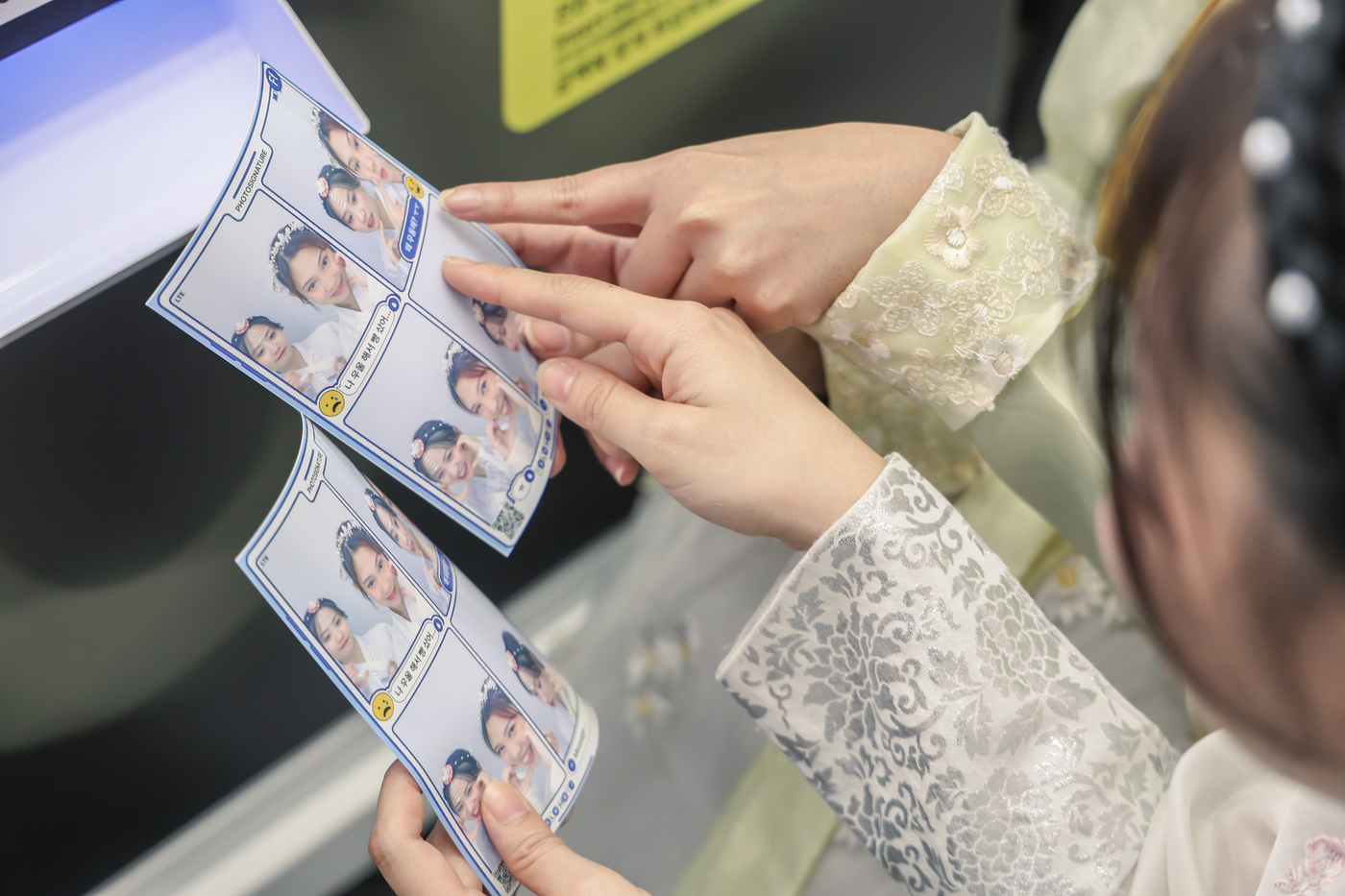
The samples on the 2001 booths gather small pictures in several layouts. A close-up of the modern Cheongsapo print shows two matching sheets, each arranging four pictures in a two-by-two grid. A four-cut photo is not always a narrow vertical strip.
Frame size, the gaps between pictures, border colour and the position of text all shape how the expressions read as a sequence. The modern photograph does not show whether the paper has an adhesive backing. “Sticker” describes a material and “four-cut” a layout, so the terms are not interchangeable.
Hands holding two blue-bordered four-picture sheets after a hanbok photo session
From backgrounds to props and poses
Elaborate backgrounds were a feature of early sticker photos. A Donga report dated 8 February 1999 described movie-poster and magazine-cover backgrounds and machines for upper-body and full-body shots. Varied poses and framing are not new.
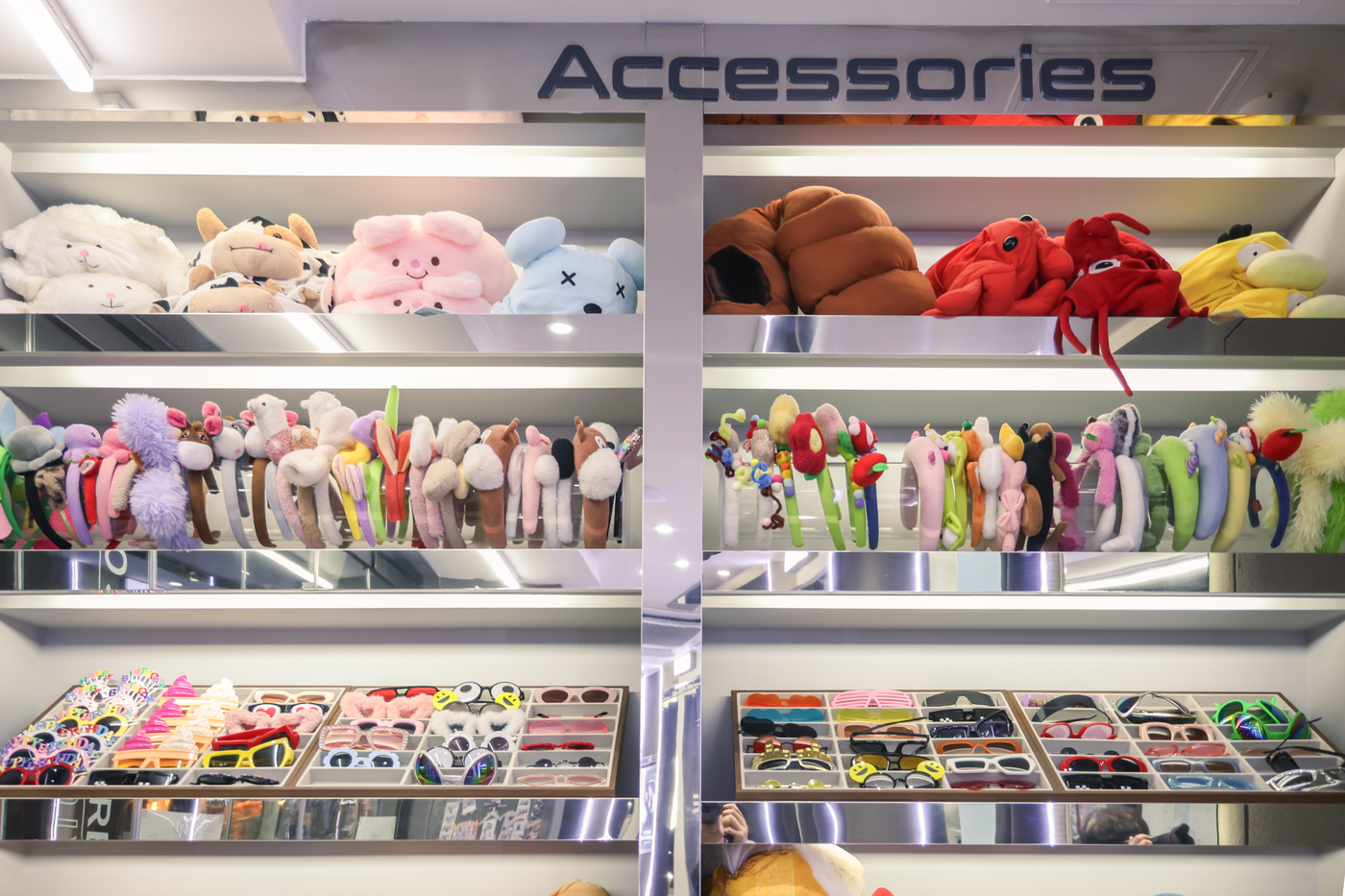
In the Cheongsapo archive, shelves hold headbands, hats and glasses, and another image shows people turning their arms and bodies beneath a high camera. The machine carries CODE lettering and the print PHOTO SIGNATURE branding. The archive’s generic “인생네컷체험” title does not identify either as a Life4Cuts outlet.
Shelves marked Accessories hold novelty headbands, hats and colourful glasses
QR downloads
Life4Cuts’ official site includes app, frame, pose and QR guides. According to its QR instructions, customers select the option when shooting, then scan the printed code to download the image and a video of the session. The posted download window is three days including the shooting date; other operators may set different terms.
A print keeps the chosen expressions; a video keeps the movement in between. Anyone posting faces or video of others should ask those pictured first.
Before the shoot
Planning a simple sequence — an everyday expression first, a glance at each other second, the same hand gesture third and a free choice last — makes the differences between frames easier to see. Props work best when they leave faces visible.
Frames, camera angles, number of copies, prices, QR options and extra prints vary by shop and machine, so the screen in front of you is the reliable guide. Props go back on the shelf afterwards, and nearby customers should be kept out of the frame.
A picture to keep
What links the 2001 booths and the 2024 prints is not a machine or a design but the short time spent looking at a screen together, choosing expressions and dividing the results. A sticker in a diary and a four-cut sheet with its digital file are two ways of returning to that moment.
Every photograph here is real and dated. The sample layouts are part of the original booth scene, not newly scanned personal sticker prints from the 1990s. The 1999 diary is described through the museum’s text because reuse permission for its image could not be established.
Sticker-photo booths and mounted sample layouts in Seoul, 19 July 2001. This was not photographed in the 1990s. Photo: Alex C, “Photo booth in South Korea, 2001.jpg”. CC BY 2.0. Source/terms: https://commons.wikimedia.org/wiki/File:Photo_booth_in_South_Korea,_2001.jpg · https://creativecommons.org/licenses/by/2.0/. Supplied file copied unchanged. The card uses centred cropping; enlarge to see the full photograph.
Posing beneath a high-mounted camera in Cheongsapo, Busan. Archive production date: 1 October 2024; exact capture date unconfirmed. CODE lettering appears on the machine. Photo: 하이픈그룹 / 부산관광공사 글로벌마케팅팀 / 부산관광아카이브, “인생네컷체험 · METADATA013266”. KOGL Type 1. Source/terms: https://archive.visitbusan.net/dataSearch/view.nm?dataSid=METADATA013266 · https://www.kogl.or.kr/info/licenseType1.do. Supplied file copied unchanged. The card uses centred cropping; enlarge to see the full photograph.
Actual PHOTO SIGNATURE-branded prints in Cheongsapo. Two matching sheets each arrange four pictures in a two-by-two grid. Archive production date: 1 October 2024; exact capture date and adhesive backing unconfirmed. Photo: 하이픈그룹 / 부산관광공사 글로벌마케팅팀 / 부산관광아카이브, “인생네컷체험 · METADATA013257”. KOGL Type 1. Source/terms: https://archive.visitbusan.net/dataSearch/view.nm?dataSid=METADATA013257 · https://www.kogl.or.kr/info/licenseType1.do. Supplied file copied unchanged. The card uses centred cropping; enlarge to see the full photograph.
Headbands, hats and glasses for a Cheongsapo self-photo experience. Archive production date: 1 October 2024; exact capture date unconfirmed. Photo: 하이픈그룹 / 부산관광공사 글로벌마케팅팀 / 부산관광아카이브, “인생네컷체험 · METADATA013261”. KOGL Type 1. Source/terms: https://archive.visitbusan.net/dataSearch/view.nm?dataSid=METADATA013261 · https://www.kogl.or.kr/info/licenseType1.do. Supplied file copied unchanged. The card uses centred cropping; enlarge to see the full photograph.
Four real source photographs and two clearly labelled side-by-side editorial layouts. Seoul was photographed in 2001; Busan material was produced in 2024. These are neither 1990s reconstructions nor 2026 site photographs or AI-generated images.