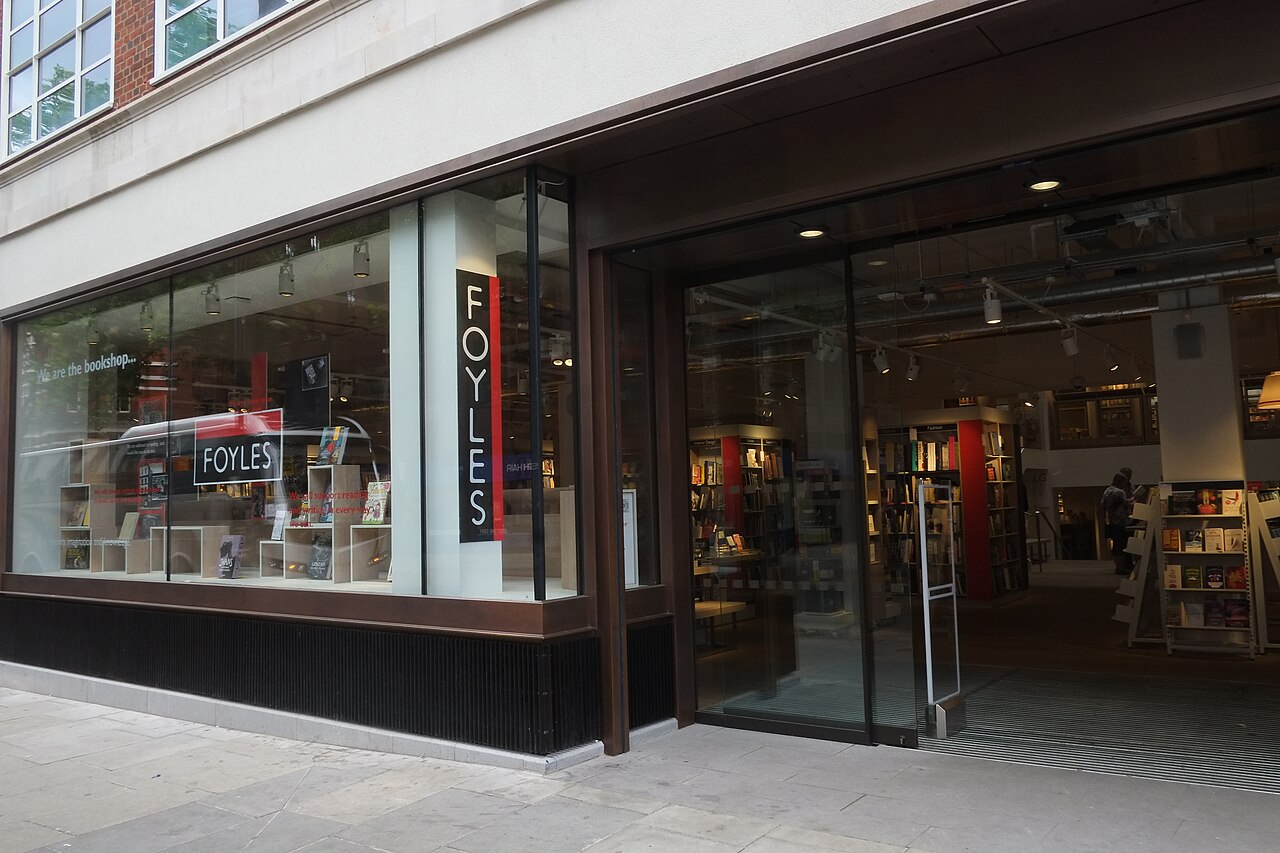
London bookseller Foyles is presenting Korean literature, drama and food culture in its K-Book Festival 2026. Its Charing Cross Road shop hosts conversations with novelist Sohn Won-pyung on October 15 and food writer Su Scott on October 21.
Korean Culture Month at Foyles
Foyles’ Korean Culture Month page features translated books alongside Korean-language editions, with author conversations and a drama screening. The festival is part of Curated Korea 2026, announced by the Korean Cultural Centre UK on October 7, whose wider programme runs October 1–21 at venues across London.
Kim Choyeop interview
Foyles has published a Q&A with Kim Choyeop in Korean and English side by side. She says she trusts translators’ judgement about how her writing reaches readers in another language.
Sohn Won-pyung and Su Scott
Sohn joins Ela Lee on October 15 to discuss Almond and Counterattacks at Thirty. On October 21, London-based Korean food writer Su Scott joins Jenny Lau to talk about Seoul’s pocha culture through her cookbook Pocha. Both events start at 7pm London time in the Level 6 Auditorium at Foyles, 107 Charing Cross Road. Ticket conditions and availability are on the official event pages under Sources & context below.
The entrance to Foyles on Charing Cross Road. Archive photograph taken June 29, 2014. Photo: Tom Morris, “Foyles new shop entrance” / Wikimedia Commons · CC BY-SA 3.0. Wikimedia-supplied resized version; no cropping or retouching.
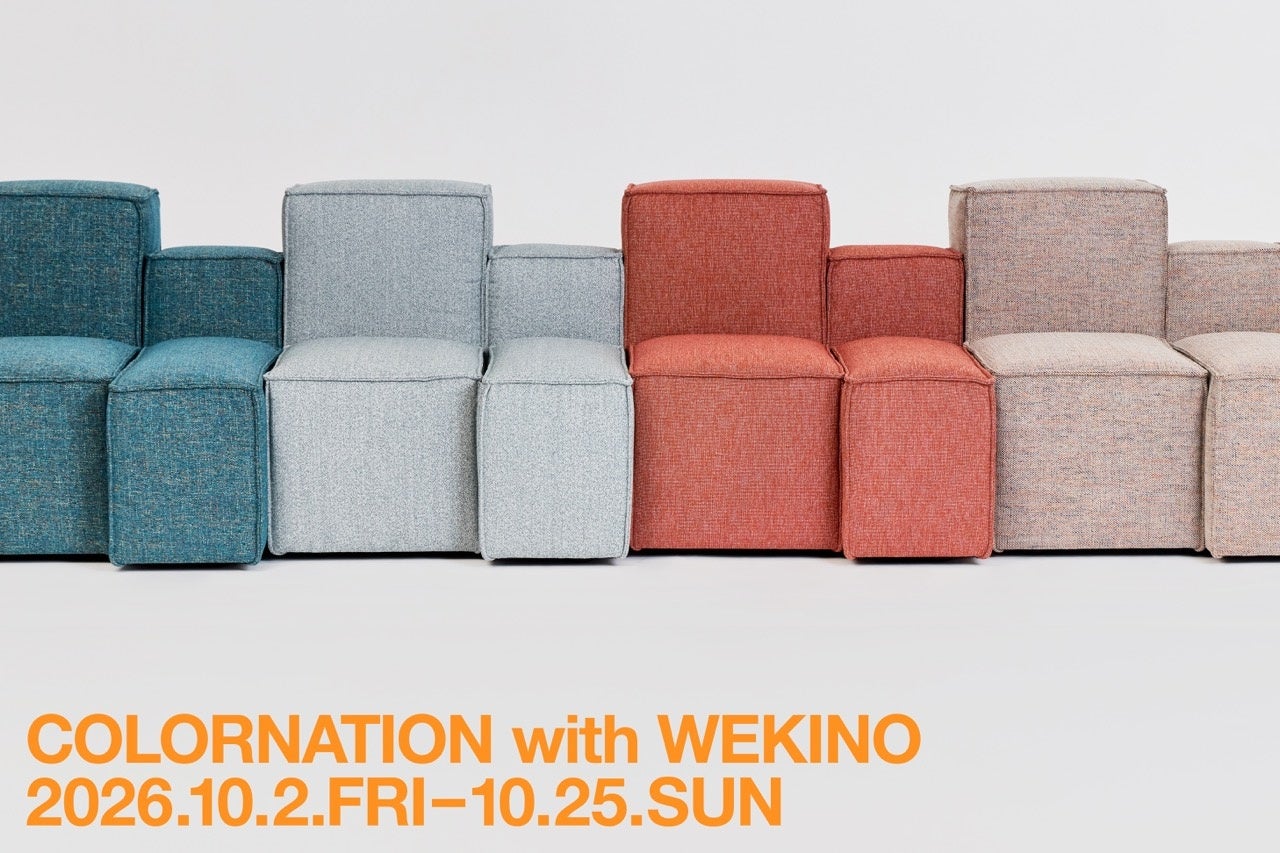
COLORNATION with WEKINO, an exhibition on the Seoul furniture brand WEKINO, runs at CIBONE in Tokyo’s Omotesando through October 25. Its image of teal, pale blue and warm red seats side by side shows how color combinations can change a space.
The exhibition
COLORNATION with WEKINO presents combinations of furniture and living space. WEKINO was founded in Seoul in 2014, with Kwangho Lee as creative director. His DDEE Sofa is among the designs on show.
Visitor information
The exhibition runs October 2–25, 11 AM–8 PM JST, at CIBONE, GYRE B1F, 5-10-1 Jingumae, Shibuya-ku, Tokyo. It is about four minutes on foot from Omotesando Station Exit A1 or three minutes from Meiji-jingumae Station Exit 4.
Korea: 2,000 years of creativity, the British Museum’s exhibition in London, has drawn contrasting reviews from local critics. Its historic objects won praise, while its handling of modern history divided opinion.
The exhibition
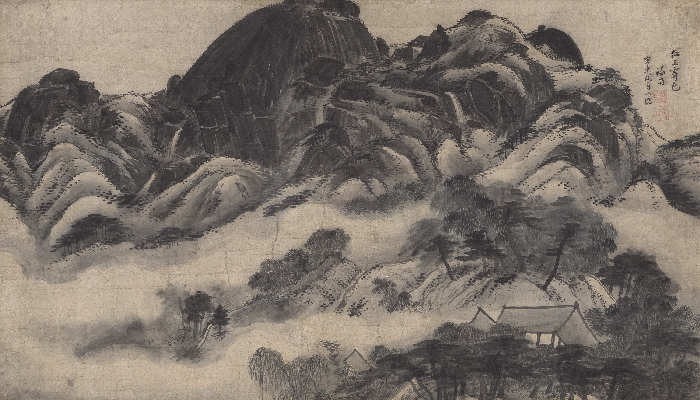
Korea: 2,000 years of creativity opened on October 1 and runs through January 31, 2027 in Room 35. According to a September 21 announcement from the National Museum of Korea, the British Museum, NMK and the National Museum of Modern and Contemporary Art, Korea jointly organize the show, which has 100 entries, including Jeong Seon’s Clearing after Rain on Mount Inwang.
Divided reviews
The Standard’s Martin Robinson praised the historical journey and its modern-art conclusion. In a September 30 review, Time Out’s India Lawrence gave three stars out of five, admiring the historic objects but finding the modern historical context insufficient. These are two critics’ assessments, not a measure of British audiences as a whole.
Questions and visitor note
The split points to a recurring question in presenting Korean culture abroad: how much historical context should accompany the works. The exhibition closes on December 1–2 for a display rotation.
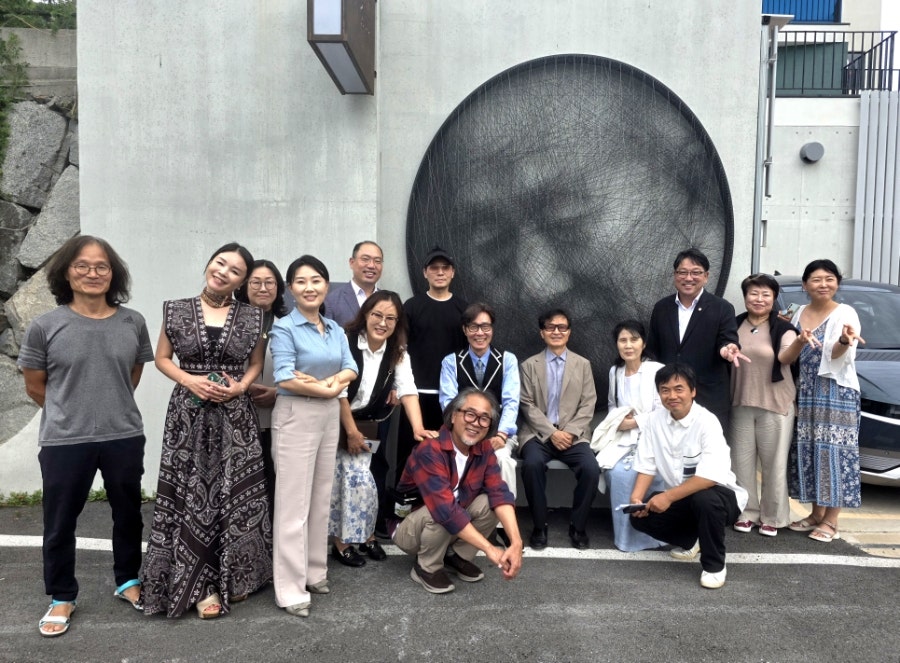
A portrait of Geoje-born painter Yang Dal-seok has been installed on the exterior of Haejoum Art Museum in Geoje. Sculptor Wi Se-bok made it from intersecting straight steel wires as the first Art Photo Zone project of the Art Island Geoje Council.
A portrait in wire
Announced by organizer Gaia on October 6, the work builds a face from the density of crossing wires instead of paint. Dense crossings read as shadow and sparse ones as light, bringing the portrait into view. The museum’s outer wall now introduces a local painter.
Visiting
The museum website directs visitors to Naver for admission reservations. It has not been confirmed that the outdoor work can be viewed at any time, so operating days and viewing hours are best checked with the museum. Visitor details are in Haejoum Art Museum’s official visitor information under Sources & context below.
“From dots to the world,” an exhibition marking the centenary of Hunmaengjeongeum, the Korean Braille system, runs at the National Museum of World Writing Systems in Incheon until February 14, 2027. The free show features the original 1926 Braille chart, tactile models and a chance to write in Braille.
A century of Hunmaengjeongeum
Park Du-seong promulgated Hunmaengjeongeum on November 4, 1926; November 4, 2026 marks its centenary. Alongside the original Braille chart are drafts on the origins of Korean Braille and of Hunmaengjeongeum, showing corrections and pasted additions.
A 1954 letter in English Braille sent to Dr Boulter of the American Foundation for Overseas Blind records the system’s links with educators abroad.
Tactile models and audio guides
The exhibition is jointly organized by the host museum, the National Hangeul Museum and Songam Braille Library. Labels include Braille, key exhibits are reproduced as models that can be touched, and audio interpretation is available. Original objects cannot be handled; touching is limited to designated tactile exhibits.
Writing in Braille
In the fourth section, visitors can read Braille and tactile books and use a Braille chart to write their names. In the final space, a Braille slate and stylus let them leave comments.
Visitor information
The exhibition runs October 7, 2026–February 14, 2027 in the museum’s first-floor special exhibition gallery. Admission is free. Hours are 10 a.m.–6 p.m., with last entry at 5:30 p.m.
The museum closes on Mondays, January 1 and the days of Seollal and Chuseok. When a Monday is a public holiday, it opens that day and closes the next weekday. Address: 217 Central-ro, Incheon (Songdo-dong 24-8). Exhibition enquiries: 032-290-2031. The official exhibition and visitor pages below post any changes.
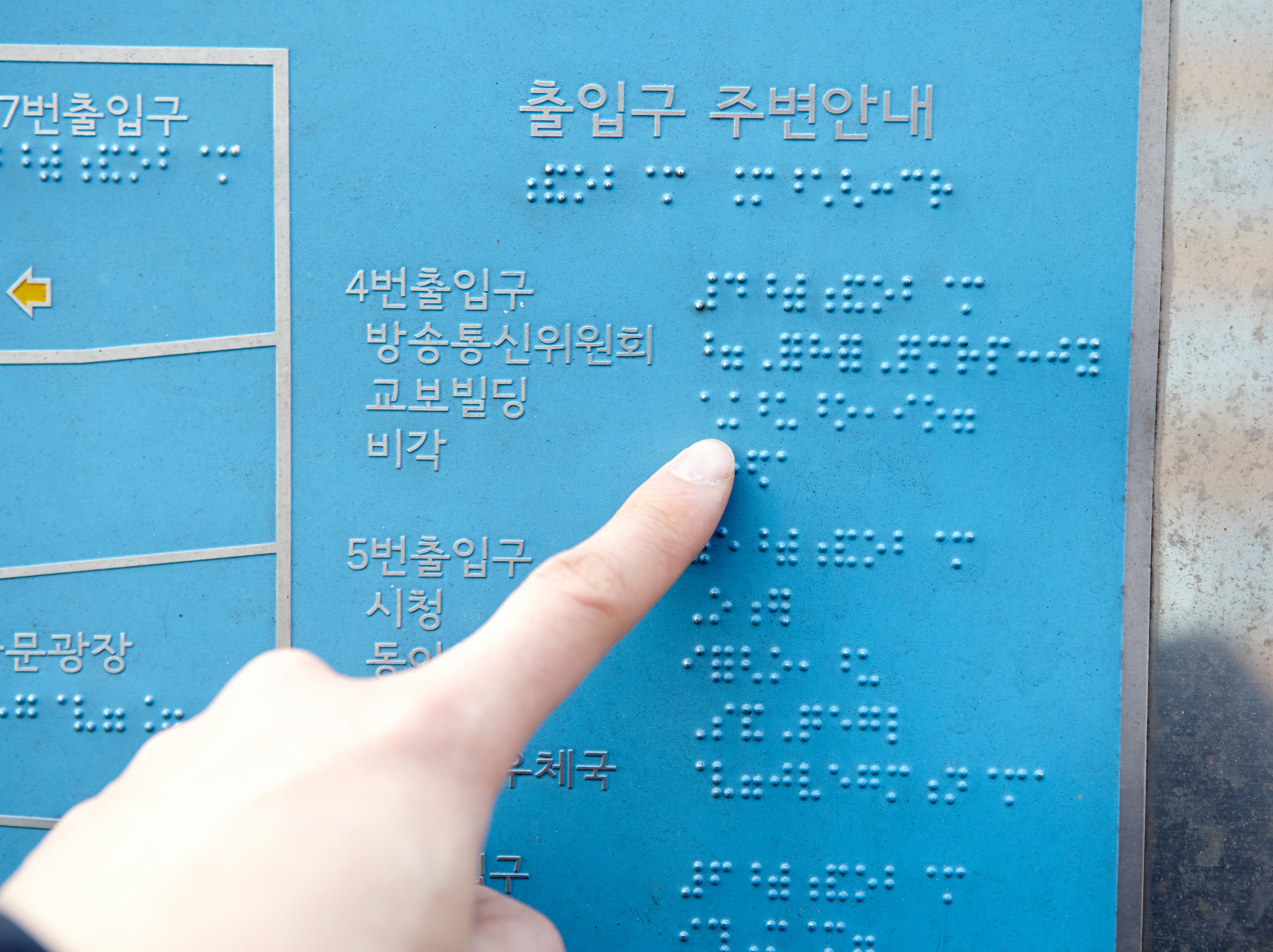
Reading a wayfinding sign with Korean text and Braille by touch. This archival image is dated December 20, 2013 according to EXIF; it does not show the 2026 exhibition or the 1926 Hunmaengjeongeum chart.
The European Academy of Dermatology and Venereology (EADV) on September 30 highlighted conference research analysing 38 TikTok “glass skin” videos. Researchers found at least one potentially misleading claim in almost 95% of them.
What 95% means
Researchers evaluated 38 videos found through five search terms in May 2026, and almost 95% contained at least one potentially misleading claim. The finding comes from a small, selected sample presented at a conference; it does not mean 95% of Korean cosmetics are unsafe or that all beauty videos are wrong.
Evidence and conditions of use
The issue is what evidence and conditions of use accompany videos promoting layered routines. An attractive result and a reliable explanation are separate matters. This report draws on the late-September presentation, not a new study released on October 11.
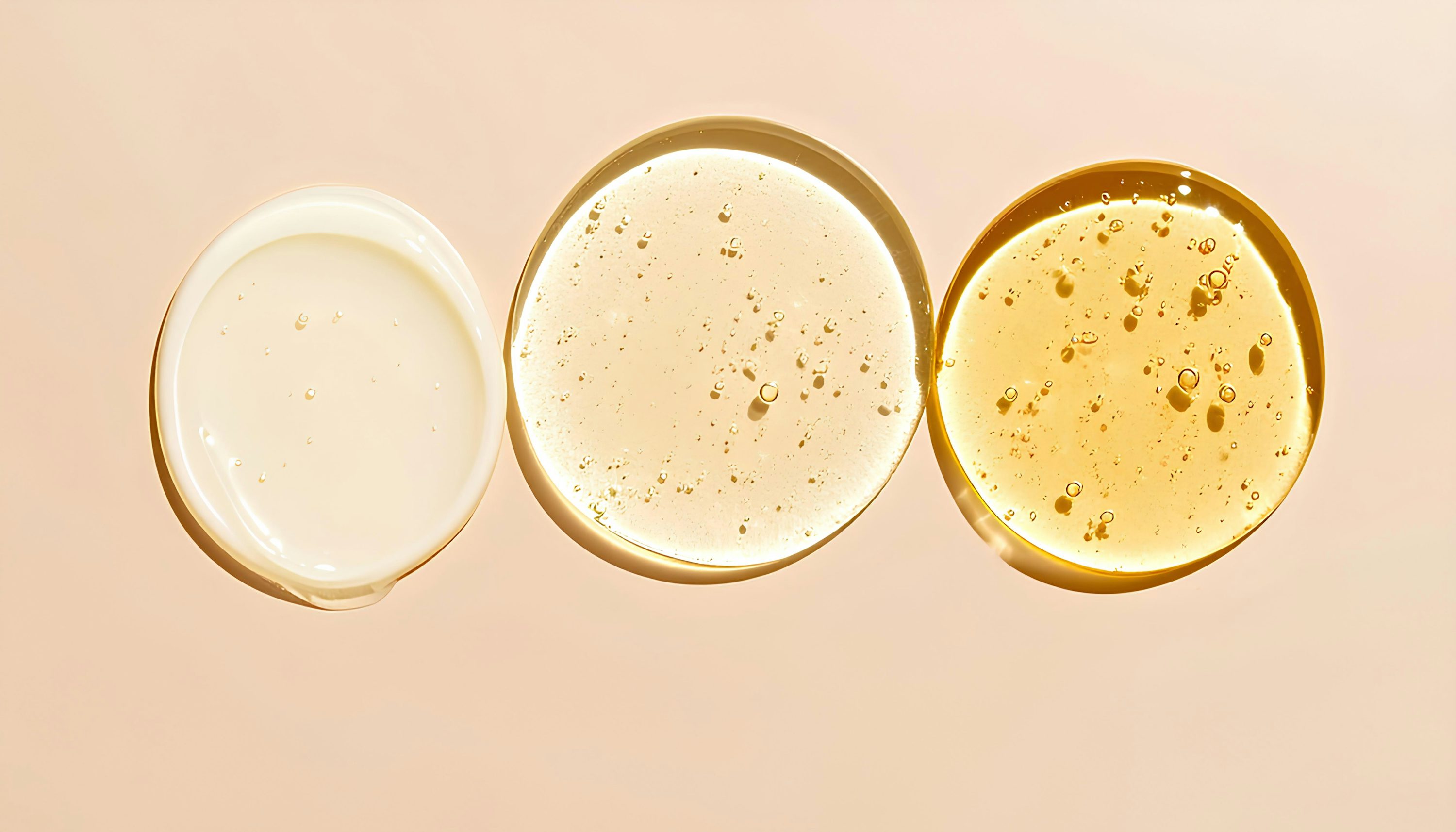
Illustrative photograph of skincare textures, not a studied video or an identified Korean product. ibnu ihza / Unsplash, published May 29, 2025. No additional edits.
Autobiography of Red and Nox by Anne Carson, winner of the 2026 Nobel Prize in Literature, ranked first and eighth on online bookseller Aladin’s daily Korean-books chart. The first is a coming-of-age novel in verse; the second is an accordion-fold record of mourning.
The laureate
Anne Carson is a Canadian poet and classicist. The Swedish Academy recognised her creation of new literary forms through dialogue with the classical tradition. Her work places emotions ranging from love in myth to grief within a family in unconventional book forms.
Aladin’s chart
At 10:50 a.m. KST on October 12, Aladin’s Korean-books “Yesterday’s Best” list placed Autobiography of Red first and Nox eighth, a sign at one bookseller of interest in the Korean editions after the Nobel award.
Autobiography of Red
Published in 1998, Autobiography of Red turns Geryon, the red monster of Greek myth, into the protagonist of a modern coming-of-age story. The verse novel follows a character’s story of love.
The Korean edition checked was translated by 민승남 (Min Seung-nam) and published by 한겨레출판 (Hankyoreh Publishing) as a 256-page revised edition on November 25, 2024.
Nox
Nox, published in 2010, remembers Carson’s late brother. Photographs, letters and text unfold in an accordion format, making the act of opening the book part of reading it.
The Korean edition, translated by 윤경희 (Yoon Kyung-hee), was published by 봄날의책 on August 31, 2022. Aladin describes its 192 pages as one continuous accordion book.
Editions and dispatch dates
At 10:53–10:54 a.m. KST on October 12, Aladin listed both Korean editions for reservation purchase, with dispatch dates of October 13 for Autobiography of Red and December 7 for Nox.
Those dates applied to the site’s default destination in Jung-gu, Seoul, were dispatch rather than arrival dates and may change. Other booksellers may differ. The YES24 links below are separate listings for the same editions, with their own dispatch dates.
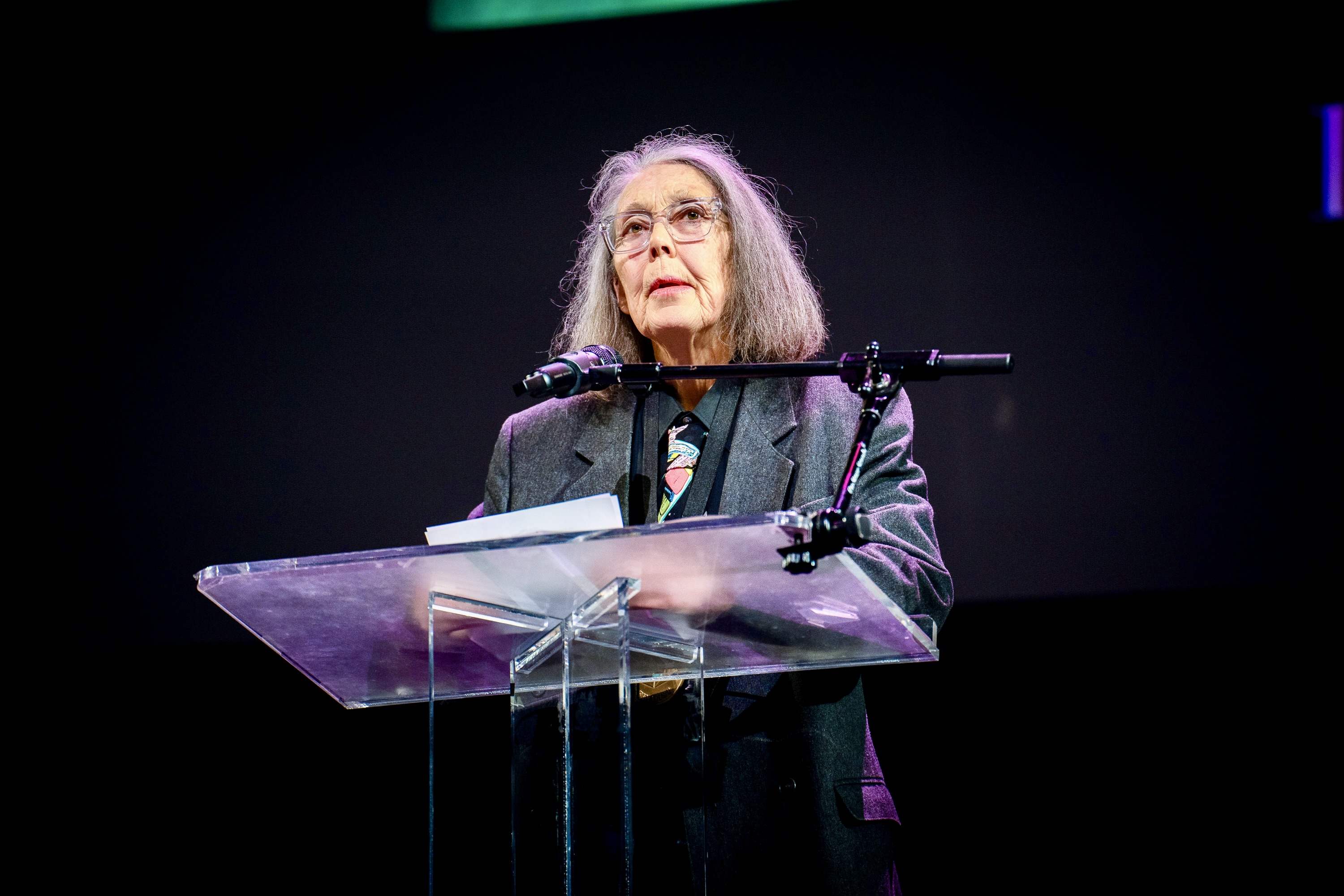
Anne Carson at the 2024 National Book Awards finalist reading at NYU Skirball Center, New York. Archive photograph. Photo: Jay Dixit / WikiPortraits · CC BY-SA 4.0. The photographer’s color-corrected version; no further edits.
Seokguram, the stone grotto on Mount Toham in Gyeongju, has featured in back-to-back reports by the French newspaper Le Monde and radio station France Culture. A special exhibition on the grotto runs at the Korean Cultural Center in Paris until March 13, 2027, with an immersive installation added from November 23.
Le Monde and France Culture
In an October 2 report from Seokguram, Le Monde’s Fabienne Darge noted the principal Buddha’s combination of strength and delicacy. France Culture followed on October 8 with a 4-minute, 21-second report. According to Edaily, the Le Monde reporter’s September visit to Gyeongju was part of a press tour arranged by the Korean Cultural Center in France. The coverage reflects journalists’ assessments, not visitor-popularity statistics.
The grotto
Built in the eighth century under Unified Silla, Seokguram is an artificial grotto made from finely fitted granite components. A rectangular antechamber and passage lead into a circular main chamber, where sculpture surrounding the principal Buddha and a hemispherical ceiling form a single space. Seokguram and Bulguksa Temple were inscribed on the UNESCO World Heritage List together in 1995.
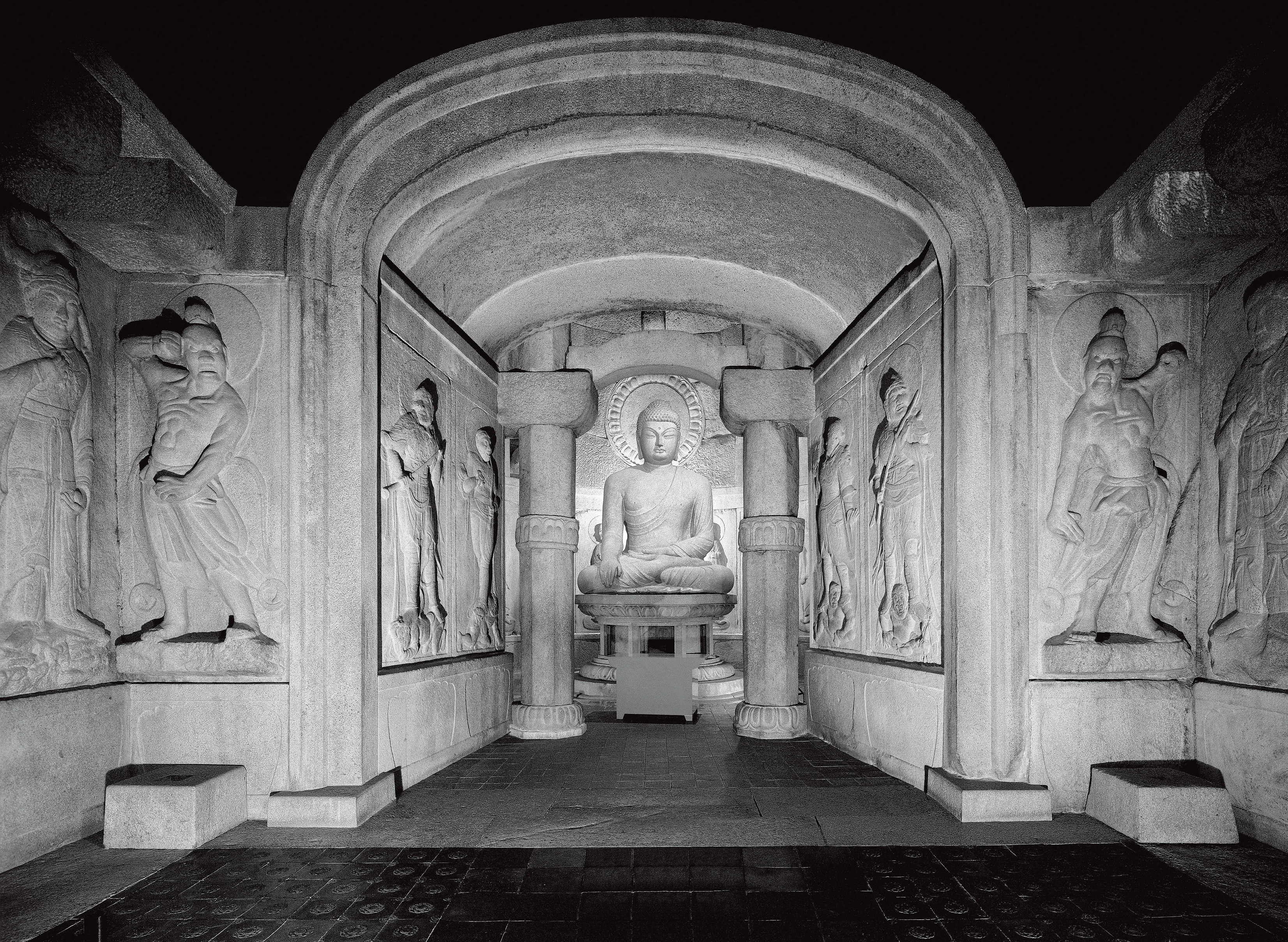
Han Seokhong’s 2000 photograph
Han Seokhong’s 2000 view from the antechamber shows the carved side walls and the principal Buddha beyond the passage in one frame. The wall figures draw the eye to the centre, and the rounded stone structure above contrasts with the straight lines of the floor. The difference in scale between the foreground carvings and the distant Buddha conveys the depth of the space. The photograph records Seokguram itself, not the Paris exhibition.
The Paris exhibition
The Korean Cultural Center in Paris presents Han’s photographs, tactile and braille materials, and contemporary works. Lee Seung-chul’s hanji-paper Buddhas reinterpret Silla sculpture in a modern material. French outlet Timodelle praised the restrained, contemplative setting around the paper figures and a pagoda. Le Monde also reported separately from Lee’s studio.
Exhibition dates
The main exhibition runs October 2, 2026–March 13, 2027. A separate immersive exhibition, Seokguram, un monde infini, with projections on four screens, opens on November 23. Until then, the display centres on photographs, sculpture and contemporary reinterpretations.
CULTURE INFO
See the originalSeokguram · 238 Seokgul-ro, Gyeongju, Republic of Korea
AdmissionOpens 9 AM · last admission 5:30 PM · free · open daily
Before visiting GyeongjuOperating hours may change with conditions on site. Ordinary viewing is from behind protective glass.
Paris venueCentre Culturel Coréen · 20 rue La Boétie, 75008 Paris
DatesOctober 2, 2026–March 13, 2027 · free, open admission
Center hoursMon–Fri 10 AM–6 PM · Sat 11 AM–6 PM · closed Sundays and the center’s designated holidays
Immersive exhibitionOpens November 23, 2026; separate from the current display
The Busan Cultural Foundation’s project ‘바다가 잇는 맛과 말’ (‘Tastes and Words Across the Sea’) runs from 14 to 22 October 2026 at F1963 and in Suyeong-gu and the old town. Marking 150 years since Busan Port opened in 1876, it examines how migration and exchange shaped dishes such as milmyeon and eomuk, and everyday language, through an exhibition, a talk, films and food walks.
Milmyeon and wartime refugees
Busan’s Future Heritage programme traces the development of milmyeon, the city’s wheat-noodle dish, to wartime refugees in Uam-dong, flour distributed by Donghang Catholic Church and a shop that turned that flour into noodles. Familiar cooking methods were adapted to the ingredients available in a new city.
The project runs from 14 to 22 October 2026 at F1963 and locations in Suyeong-gu and the old town, with an exhibition, conversations, film screenings and food-culture walks. Timed for the 150th anniversary of the opening of Busan Port in 1876, it looks at how people’s journeys remain in food names and everyday speech.
The history of eomuk
The city’s Future Heritage account of Bupyeong Kkangtong Market says fishcake-making techniques arrived with Japanese settlers, passed to Korean producers after liberation and became everyday food during the Korean War and the years of displacement. Fishcake shops stayed in the market after the factories moved out.
These histories also involve colonial rule and war. The Busan Modern and Contemporary History Museum’s account of Yeongdo links the growth of modern fisheries and fishcake production to Japanese fishing settlements and industrial facilities.
The published information does not say how milmyeon or eomuk will feature in the exhibition or what participants will eat on the walks.
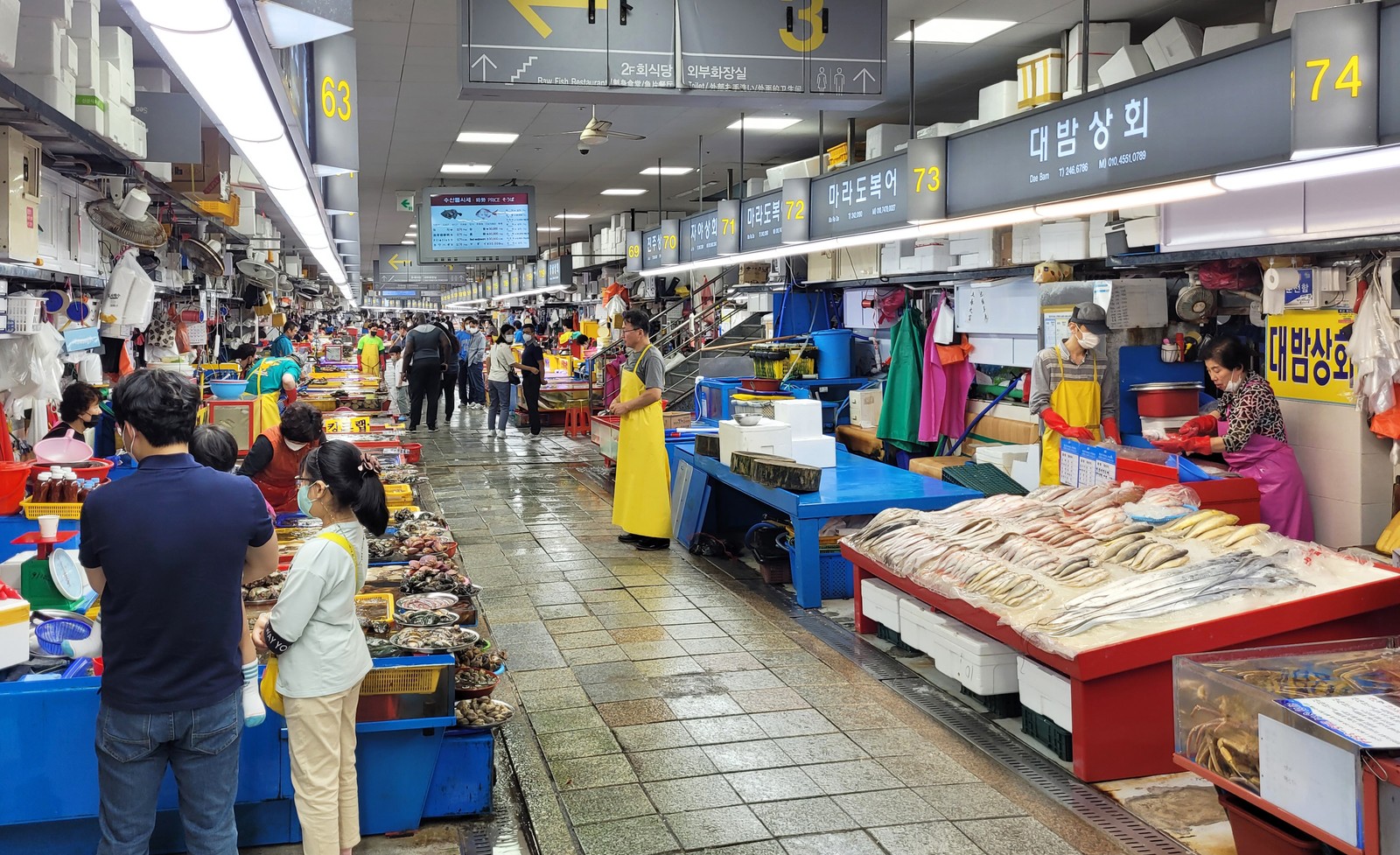
Fish counters lining an indoor aisle at Busan’s Jagalchi Market
Exhibition: ‘A Table Set by the Port’
Kiswire says it converted its Suyeong factory, built in 1963, into the F1963 cultural space in 2016. The site now houses exhibition and performance spaces, a bookstore, cafés and gardens.
The exhibition ‘항구가 차린 식탁’, roughly ‘A Table Set by the Port’, runs in the F1963 Glasshouse from 14 to 22 October, daily from 10:00 to 19:00. According to Newsis, it is organised around shortages of ingredients, cultural mixing, everyday life and the use of tools, with artworks, ingredients, tableware and video tracing movement and exchange in Busan’s food.
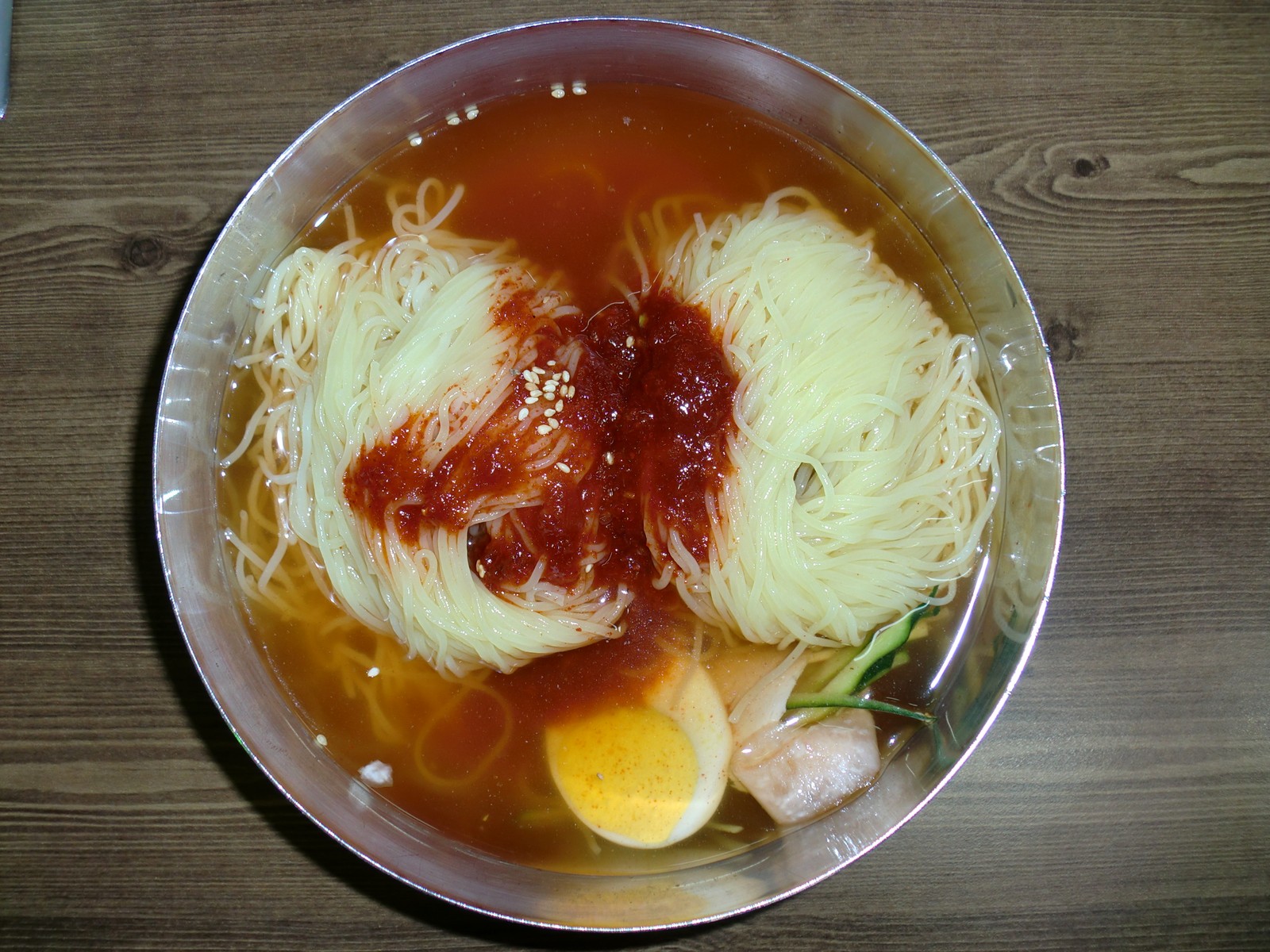
A bowl of wheat noodles with red seasoning and egg garnish
Busan–Taiwan food talk
On 17 October, from 15:00 to 17:30, the YES24 Busan Suyeong bookstore at F1963 hosts a discussion. Topics include how Busan dishes change as they travel, memories of migration in Taiwanese food, the transmission and reinvention of fishcake-making, and building relationships through food.
YES24 lists Pusan National University professor Choi Jin-a (최진아), Catherine Lee (캐서린 리) of the Taipei Culture Foundation, Jung Sung-woo (정성우) of Samjin Amook and independent curator Cho Hye-su (조혜수) as speakers, with Jang Hyeon-jeong (장현정), head of Homilbat Publishing, moderating.
Food-culture walks
The walks run from 11:00 to 15:00 in Suyeong-gu on 17 October, focusing on longstanding foods and changing tastes, and in the old town on 18 October, focusing on memories of the port and its food. Newsis reports that poet and food-culture columnist Choi Won-jun will accompany them.
The restaurants and meeting points have not been published. The Saturday walk ends at 15:00, when the bookstore talk begins, so joining both may not be practical.
Film screenings
Films will be shown at F1963 Square on 16 and 17 October, from 18:30 to 20:30. Newsis names ‘Little Forest’ and ‘Kamome Diner’ among the titles. The published material does not say which film screens on which date or how admission works.
Visitor information
The talk has a free lottery for 25 participants. YES24 lists 14 October as the entry deadline, with results at 11:00 on 15 October; conditions are on the official application page.
F1963 is at 20, Gurak-ro 123beon-gil, Suyeong-gu, Busan (부산 수영구 구락로123번길 20). The event poster directs visitors to the Kiswire stop (고려제강) on city bus 54 or Sanjeong Apartment (산정아파트) on Suyeong-gu village bus 2, and recommends public transport because of weekend traffic. All times are Korea Standard Time.
The public material does not fully cover fees and booking conditions for the exhibition, films and walks, interpretation and subtitle languages, or accessibility. Enquiries go to the Busan Cultural Foundation’s Global Culture Team on 051-745-7273, or +82-51-745-7273 from abroad.
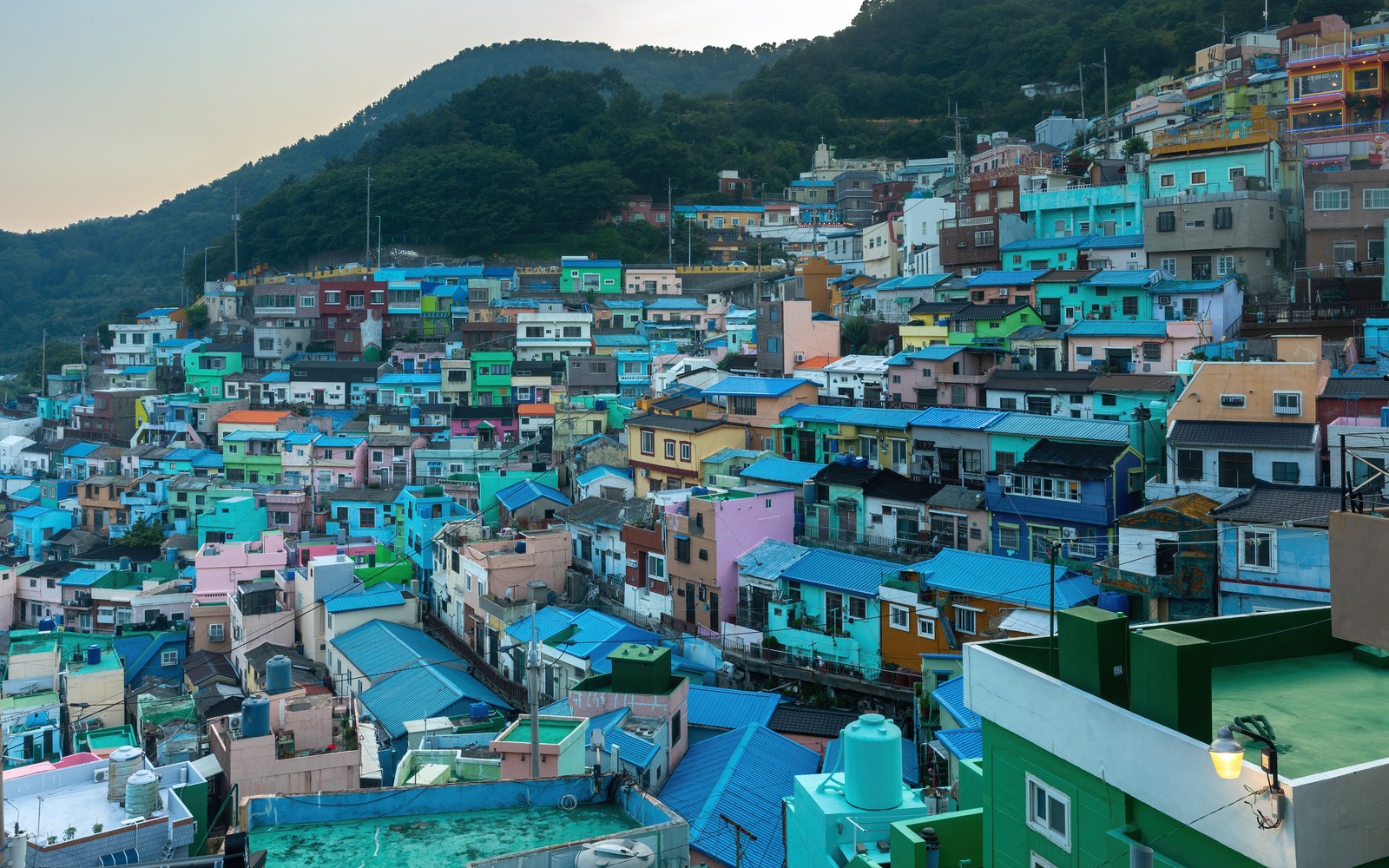
Gamcheon Culture Village, Busan, 13 June 2024. An archival illustration of city life, not this event or a confirmed tour stop. Photo: Basile Morin / “Colorful houses in Gamcheon Culture Village at sunset in Busan South Korea.jpg” / Wikimedia Commons / CC BY-SA 4.0. Proportionally resized and JPEG-encoded. The card uses a centred crop; open the photo to see the complete frame.
Inside Jagalchi Market, Busan, 2 October 2022. An archival food-culture illustration, not this event or a confirmed tour stop. Photo: Bernard Gagnon / “Jagalchi Market 01.jpg” / Wikimedia Commons / CC0 1.0. Proportionally resized and JPEG-encoded. The card uses a centred crop; open the photo to see the complete frame.
Milmyeon at Yeongdong Myeonok in Choryang, Busan, 21 October 2013. An archival food-history illustration, not an event menu or confirmed tour restaurant. Photo: hyolee2 / “Milmyeon choryang yeongdong myeonok.JPG” / Wikimedia Commons / CC BY-SA 3.0. Proportionally resized and JPEG-encoded. The card uses a centred crop; open the photo to see the complete frame.
These three real Busan photographs were taken between 2013 and 2024. They illustrate the city and its food, not the 2026 event, exhibits or walking-tour route.
Seoul Metropolitan Government holds Seoul Petlympic, a dog-sports festival, on 24–25 October at Peace Plaza in World Cup Park, Mapo-gu. Public contests, specialist events such as agility and flyball, a four-kilometre dog walk and free activity booths are planned, and visitors without dogs are welcome.
The festival
Seoul Petlympic, hosted by Seoul Metropolitan Government on 24–25 October 2026 at World Cup Park’s Peace Plaza, brings dogs and handlers together in contests built on cues and teamwork. The second edition combines public-participation contests, specialist dog sports and on-site activities.
The official FAQ says people who do not own dogs may visit, and non-competitors can watch and join selected activities.
Four public events
The public competition has four disciplines: Stay Classic, Recall Sprint, a slalom through cones and a 15-metre Team Sprint. Stay Classic tests a dog’s focus in holding position; Recall Sprint its response to the handler’s call. The slalom zigzags between cones, and in Team Sprint dog and handler run the course together.
Entrants are divided by height. The official form separates dogs under 40cm from those 40cm or taller; there is no weight category.
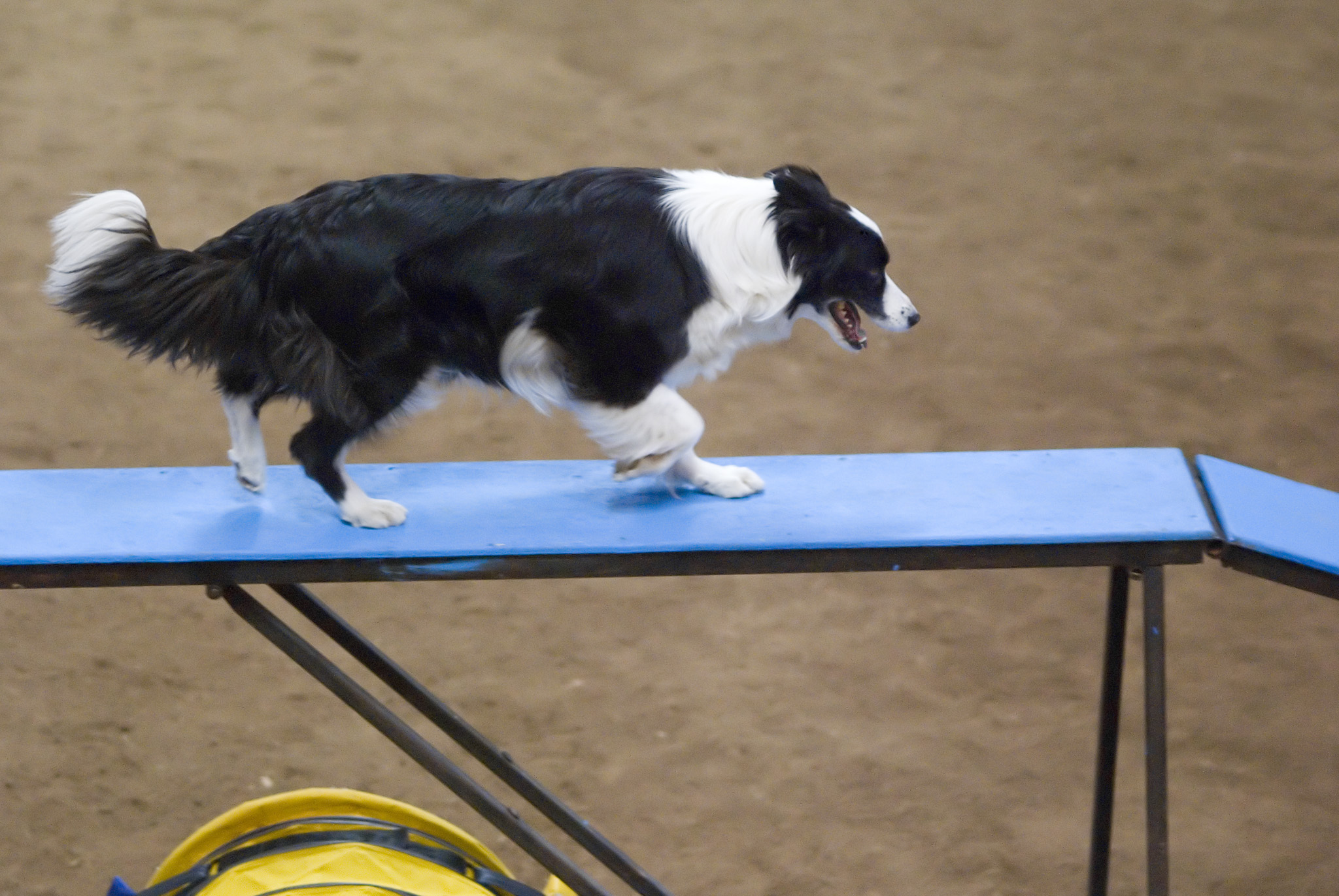
A Border Collie crossing a blue dogwalk obstacle in agility
Specialist dog sports
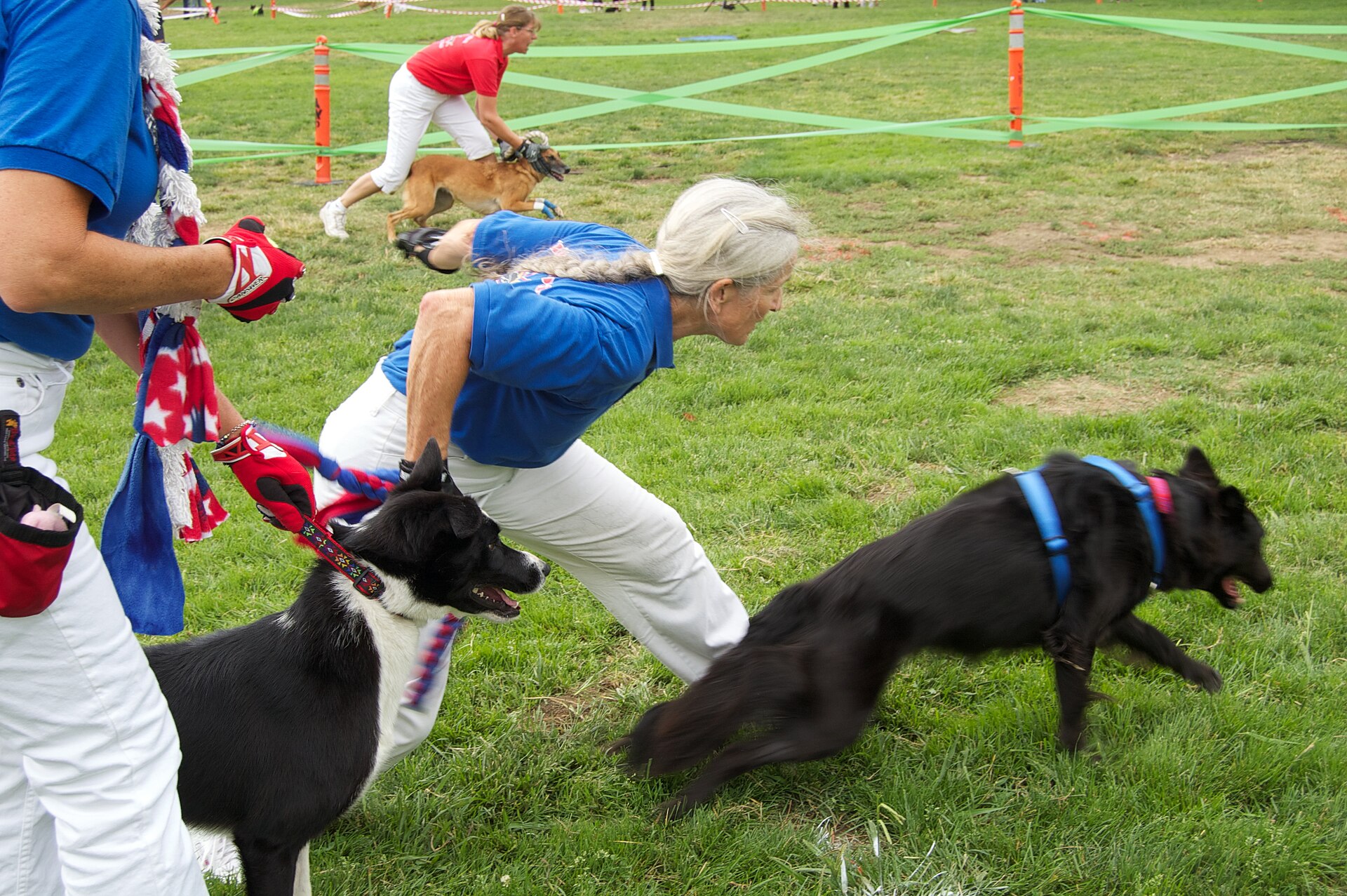
The spectator programme includes agility, disc-dog events, dog dancing and flyball. Agility dogs negotiate obstacles on the handler’s directions; disc events combine a chase and a catch; dog dancing sets movement to music; and flyball dogs clear hurdles and return with a ball.
The overall schedule lists an invited Korean national-team agility event from 2–3pm on 24 October, disc and freestyle contests on 25 October and flyball from 3–4pm that afternoon. Some discipline pages give different times, so the schedule is worth rechecking shortly before a visit. Saturday’s stage programme also includes a quiz and awards from 5–6pm.
Dogs and handlers at a flyball race on grassA dog running on grass with a white flying disc in its mouth
On-site activities
The lounge-zone “Pettiquette 5 Challenge” is open to anyone visiting with a dog. Participants try five cues — come, stay, walk, house and fetch — and earn a badge for each one completed.
Booths offer face painting and water-transfer tattoos, commemorative crafts and sports-themed profile photography, along with dog-health consultations, rehabilitation and canine CPR and first-aid education. Seoul’s press release says the booths are free. Some activities may involve queues or close early.
Dog Trail
Dog Trail runs from 10am to noon on Sunday 25 October along an approximately four-kilometre circuit in the park. Check-in begins at 9am, followed by a course briefing and safety instruction at the stage zone before groups set off in turn.
The fee is KRW 40,000 for one person with one dog. Companions need their own entry; the form notes an exception for preschool children accompanying a guardian. Registration for 400 teams is online, first come, first served; whether places remain has not been confirmed.
Competition entry
Petlympic’s fee is KRW 40,000 for two disciplines on the same day, with advance online registration for 100 teams per discipline, 400 teams in total. Competitors must attend safety instruction. The official FAQ rules out on-site registration for Petlympic and the dog-sport competitions.
The forms linked from the official site, checked on 12 October, gave 2 October as the closing date for both Petlympic and Dog Trail. A registration button still on the website does not mean places remain. The operator, Korea Kennel Agility, can be reached at 0502-1949-0514 about further registration and conditions.
Getting there and rules on site
The venue is Peace Plaza in World Cup Park, Mapo-gu, listed as the World Cup-ro 251 area. It is a 10–15-minute walk towards Peace Park from Exit 1 of World Cup Stadium Station on Line 6; the nearest bus stop is Mapo Agricultural and Marine Products Market–World Cup Park. Peace Park Parking Lot charges KRW 300 per ten minutes for cars, but the organiser recommends public transport because of limited spaces and congestion.
Leashes and prompt waste collection are required, and visitors must ask another handler before approaching their dog. Water and a portable bowl are advisable, and the lounge is available if a dog becomes tired. Accessibility needs, including step-free routes, should be raised with the operator in advance. Rain or strong winds may change or cancel parts of the programme. All times are Korea Standard Time.
Archive venue view: Peace Park within Seoul’s World Cup Park, November 2013. This is not a photograph of the 2026 Seoul Petlympic. Photo: Vanessaliam / “Pyeonghwa (Peace) Park” / Wikimedia Commons / CC BY-SA 3.0. Wikimedia’s proportionally resized rendition. The card uses a centred 8:5 crop; open the photo to see the full supplied frame.
Illustrative archive photo: a Border Collie on a dogwalk at an agility competition in 2007. This is not the 2026 Seoul Petlympic. Photo: Ron Armstrong / “HMKC Spring 2007 Agility Trial” / Wikimedia Commons / CC BY 2.0. Original file supplied unchanged. The card uses a centred 8:5 crop; open the photo to see the full supplied frame.
Illustrative archive photo: a flyball race at “Bark in the Park,” September 2010. This is not the 2026 Seoul Petlympic. Photo: Don DeBold / “Flyball race at "Bark in the Park"” / Wikimedia Commons / CC BY 2.0. Wikimedia’s proportionally resized rendition. The card uses a centred 8:5 crop; open the photo to see the full supplied frame.
Illustrative archive photo: a dog carrying a flying disc in Lodi, California, in 2006. This is not the 2026 Seoul Petlympic. Photo: Calibas / “Frisbee dog” / Wikimedia Commons / CC BY-SA 4.0. Wikimedia’s proportionally resized rendition. The card uses a centred 8:5 crop; open the photo to see the full supplied frame.
These four real photographs date from 2006–2013. They illustrate Peace Park and dog-sport disciplines, not the 2026 Seoul Petlympic or its confirmed arena layout.
The 2026 Cheongju Food and Drink Festa runs 31 October–1 November at the Culture Factory lawn plaza in Cheongju. Its programme includes cooking activities and a traditional refreshment table drawing on Banchandeungsok, a local cookbook dated to 1913, whose kimchi, rice cakes and sujeonggwa differ from today’s versions.
The festival and the cookbook
Banchandeungsok puts fish in cubed-radish kimchi, egg and chilli strips on rice cakes and dried persimmons in honey water for sujeonggwa. The names are familiar; the ingredients and methods are not.
In its 12 October announcement, Cheongju City scheduled the 2026 Cheongju Food and Drink Festa for 31 October–1 November at the Culture Factory lawn plaza, with cooking inspired by Banchandeungsok and a traditional refreshment-table experience. The historical dishes below illustrate the book; they have not been confirmed as workshop menus.
Sweets and drinks in a side-dish book
The National Folk Museum of Korea describes Banchandeungsok as a Korean-language cookbook from early-20th-century Cheongju, dated to 1913 from its cyclical-year notation, place name and writing conventions. The Sangsin-ri place name on its back cover ties the manuscript to a particular locality.
Its 46 recipes cover kimchi and preserved foods as well as rice cakes, sweets, drinks and alcohol. A separate vocabulary section records words for household goods and wedding items. As a single household’s record, it does not describe what every Cheongju resident ate.
Kkakdugi with croaker
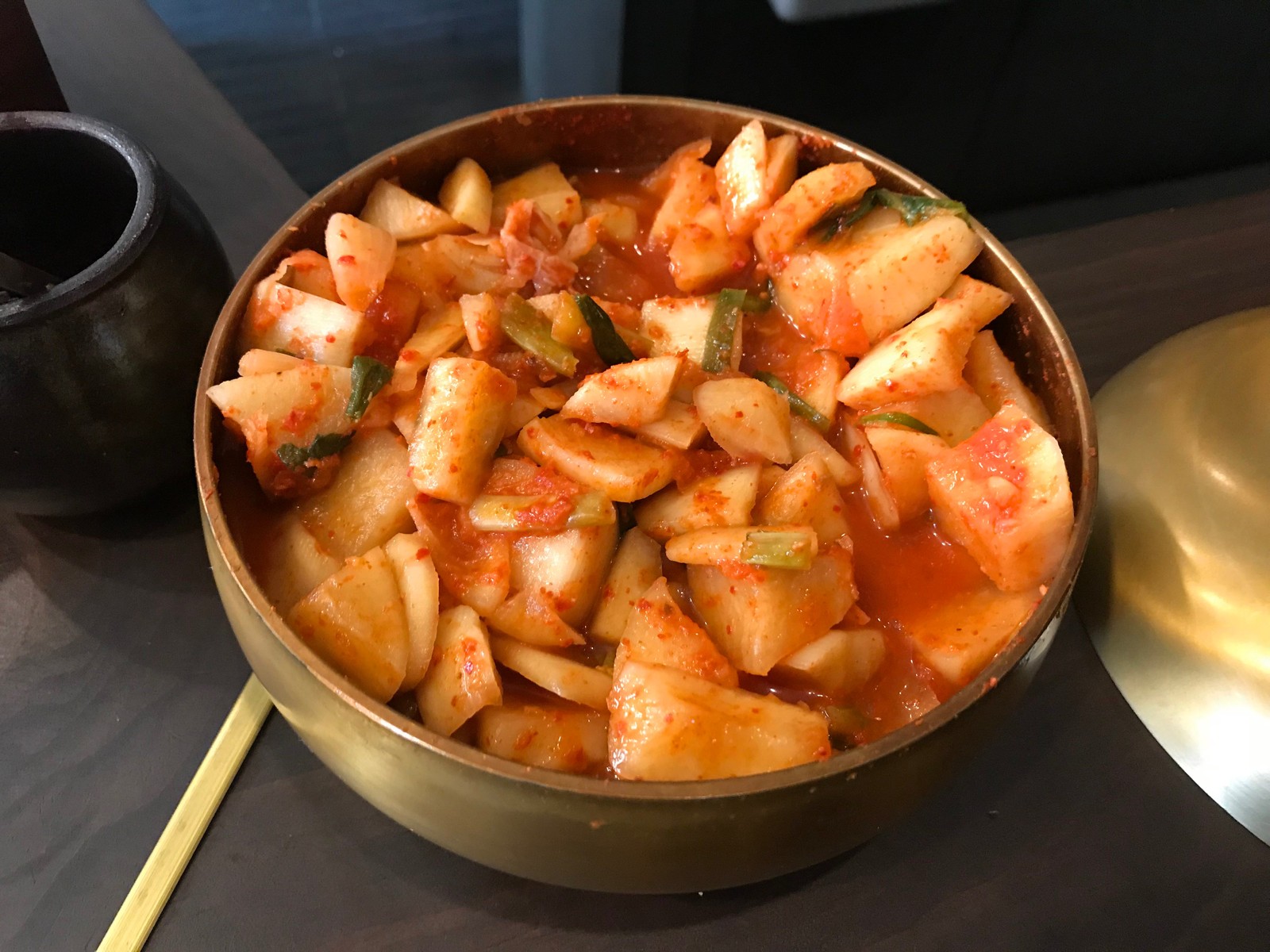
The Korean Food Promotion Institute describes modern kkakdugi as salted, diced radish mixed with chilli powder, salted shrimp, scallions and garlic. A 2015 study published by the East Asian Society of Dietary Life describes the book’s version as brined radish with chopped chilli, ginger and croaker. The fish is the main difference.
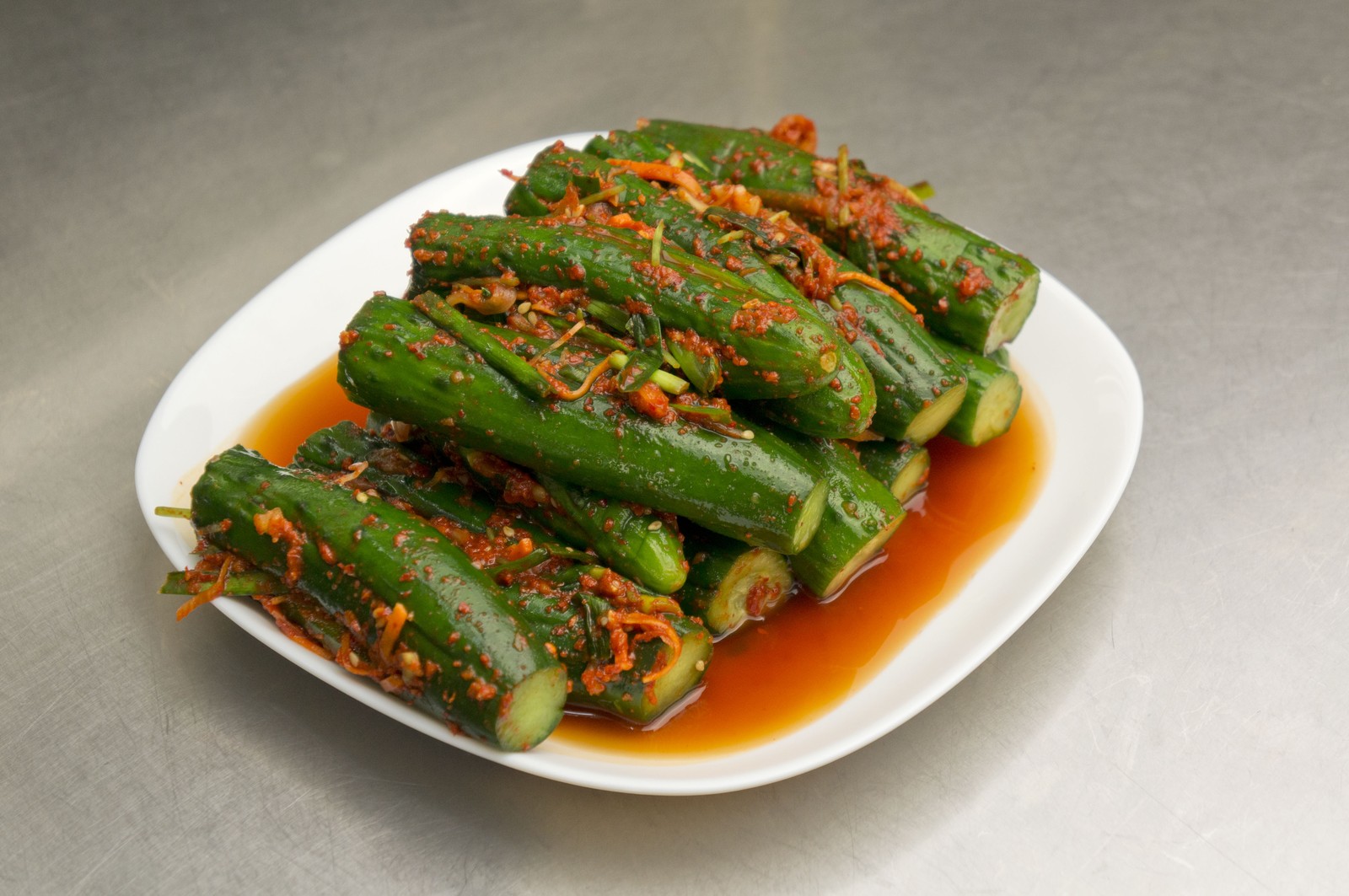
The same paper finds garlic, chilli and chopped croaker in the manuscript’s cucumber kimchi. Modern kimchi varies between households, so this compares particular documented examples. The accompanying kimchi photographs show modern dishes.
Green cucumber kimchi with red seasoning on a white plate
A rice cake with egg and chilli
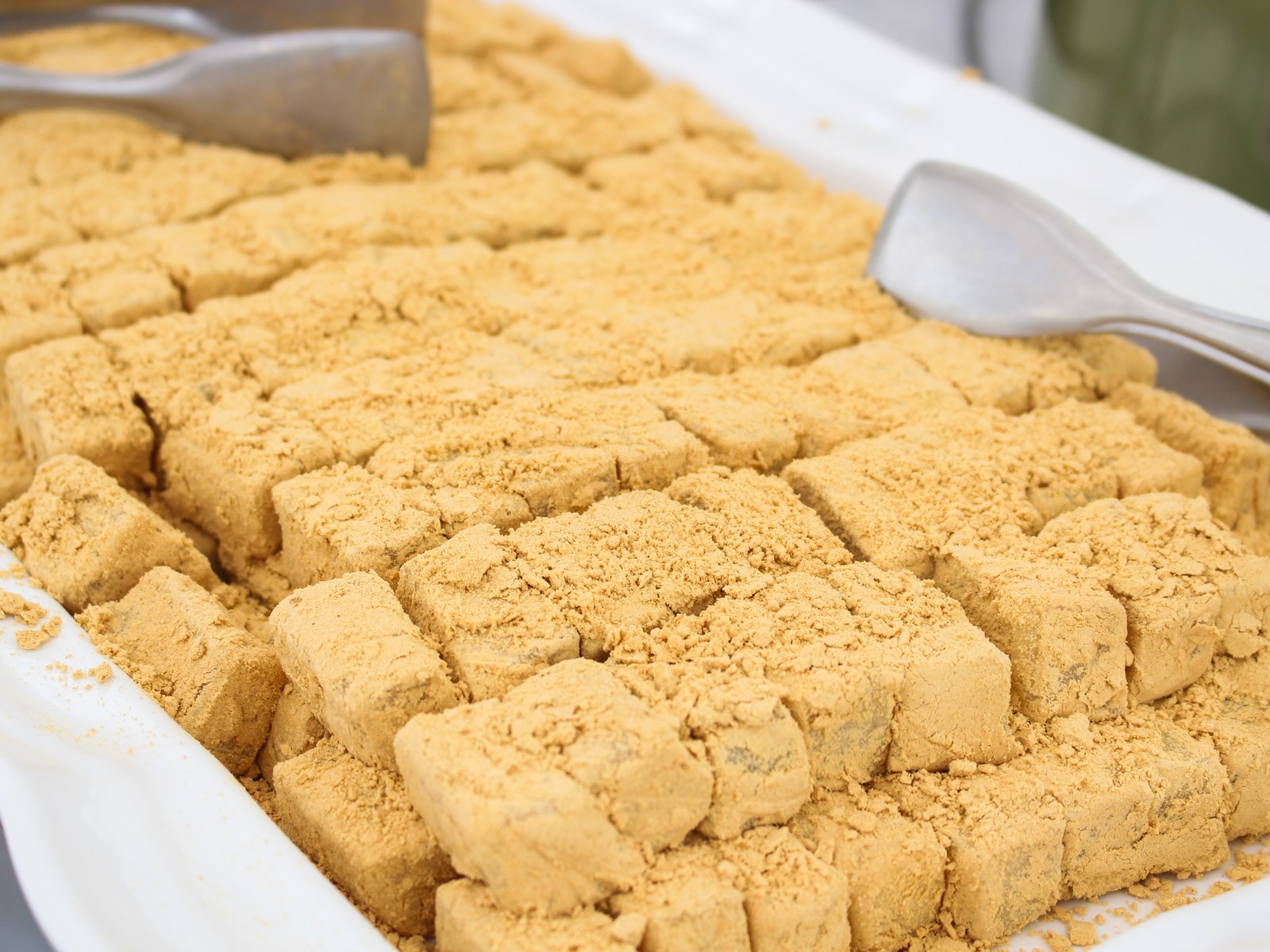
The National Folk Museum describes injeolmi as steamed glutinous rice, pounded and coated with soybean powder.
In a Korean Food Promotion Institute interview, reconstruction researcher Ji Myeong-sun describes the book’s hwabyeong as injeolmi topped with fine strips of cooked egg and chilli and green soybean powder, a more elaborate look than many would expect of an old rice cake. The photographed soybean-coated injeolmi is a comparison image, not a reconstruction of hwabyeong.
Rectangular injeolmi pieces covered with yellow soybean powder
Sujeonggwa without cinnamon
The National Folk Museum describes today’s sujeonggwa as a ginger-and-cinnamon infusion sweetened with honey or sugar and served with dried persimmons.
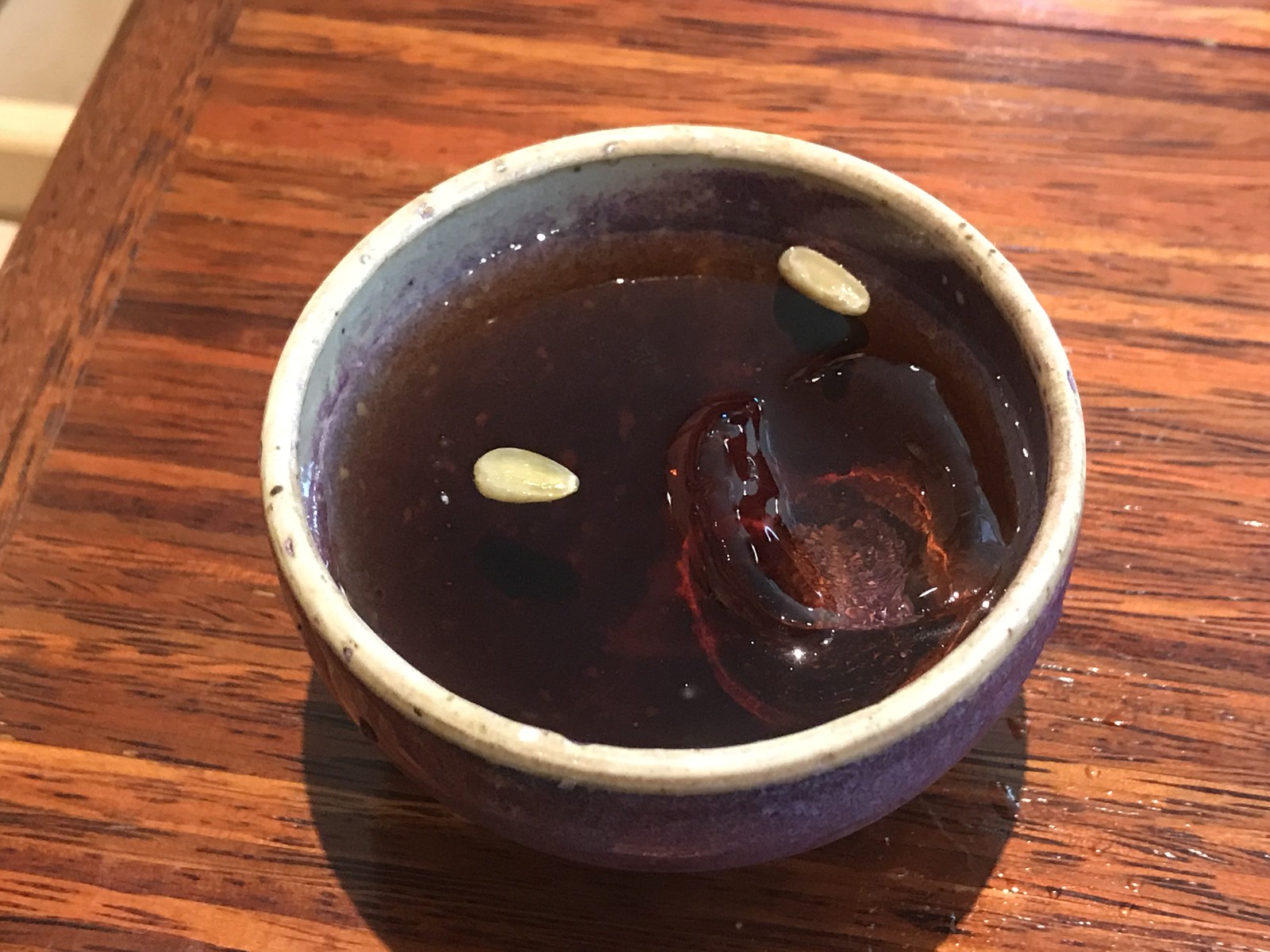
Ji’s account of the historical version describes dried persimmons steeped overnight in honey water instead. Boiling spices for aroma and steeping fruit are different methods under the same name. This is a historical description, not a home recipe with quantities and storage instructions. The photographed drink has not been identified as a reconstruction of the manuscript recipe.
A dark sujeonggwa drink with pine nuts in a bowl on a wooden table
Buckwheat dumpling wrappers
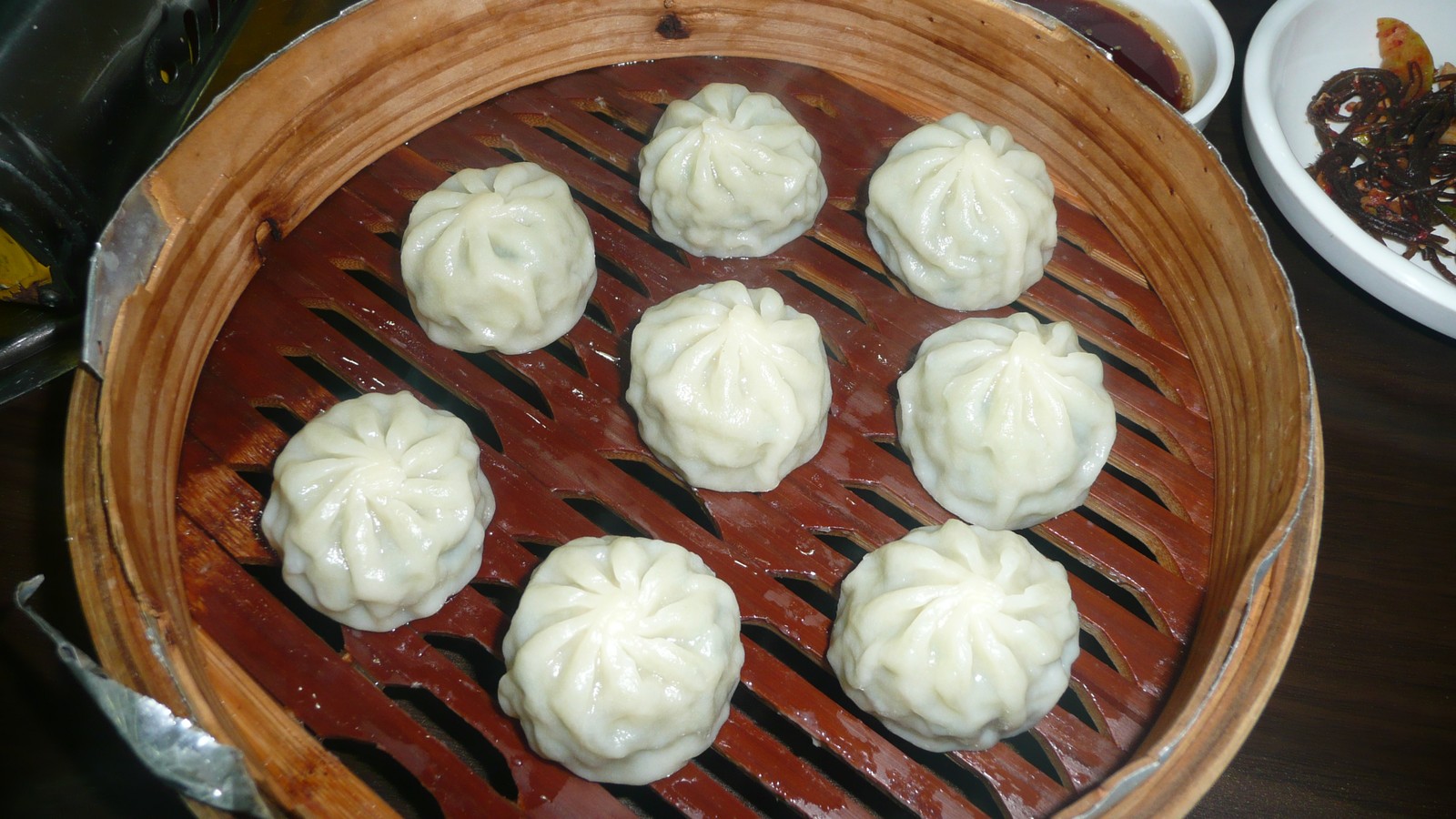
According to the Traditional Culture Portal, Banchandeungsok’s dumplings use buckwheat-flour wrappers filled with meat, cabbage and soybean pulp, then boiled. The National Folk Museum’s description of mandutguk, or dumpling soup, uses wheat-flour wrappers and tofu. Soybean pulp and tofu are distinct ingredients.
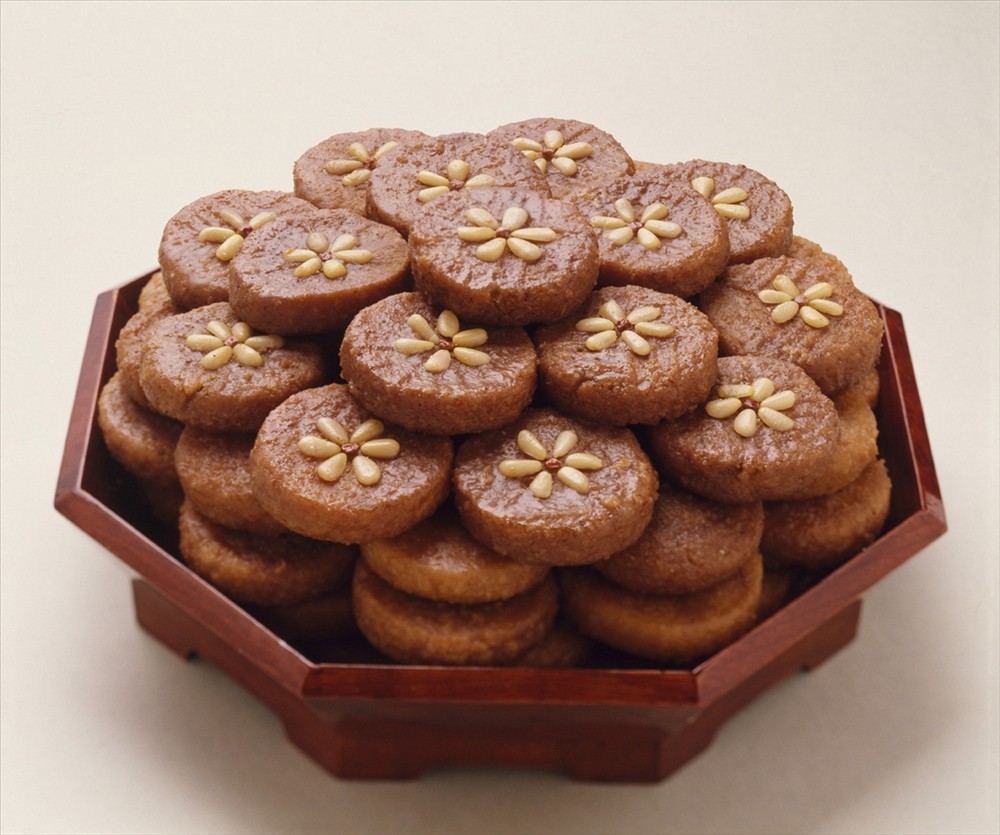
The photographs of steamed mandu and yakgwa illustrate Korean food culture generally. They do not show the book’s buckwheat dumplings or the festival’s refreshment table.
Eight round white dumplings in a bamboo steamerBrown yakgwa decorated with pine-nut flowers in an octagonal bowl
Festival details
The festival’s theme celebrates food and drink made in Cheongju. The city lists Cheongju-style samgyeopsal pork belly, jjageuli stew, local restaurants, traditional alcohol and craft beer, along with tastings and an evaluation event for traditional drinks.
The dates are Saturday 31 October and Sunday 1 November 2026, at the Culture Factory lawn plaza, 314 Sangdang-ro, Cheongwon-gu, Cheongju. The 12 October announcement did not give each activity’s dishes, session times, booking method or charges; the city’s official updates will carry those details.
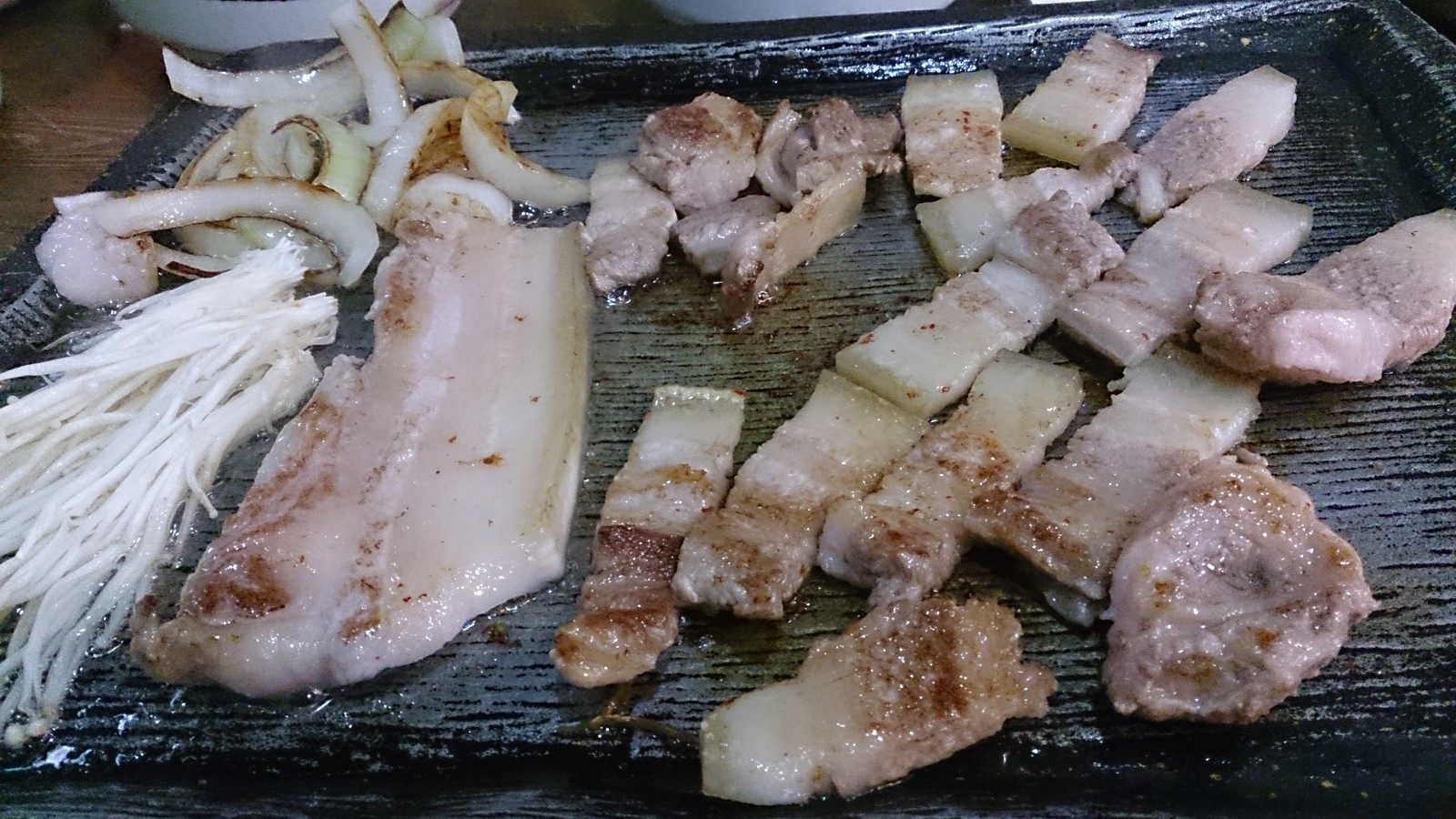
Pork-belly slices cooking on a griddle beside mushrooms and onionSources & context
Kkakdugi, 12 October 2018. A modern radish-kimchi illustration, not a reconstruction of the book’s croaker recipe or a confirmed festival dish. Photo: lazy fri13th, “Kkakdugi.jpg”, Wikimedia Commons / CC BY 2.0. Proportionally resized and JPEG-encoded. The card uses a centred crop; enlarge to see the full supplied image.
Cucumber kimchi identified as Yoshida Kimchi, photographed in Japan on 26 October 2012. A modern comparison, not the historical croaker recipe or food at the Cheongju event. Photo: Katsumi funami, “Cucumber kimchi on plate.jpg”, Wikimedia Commons / CC BY-SA 3.0. Proportionally resized and JPEG-encoded. The card uses a centred crop; enlarge to see the full supplied image.
Soybean-coated injeolmi, 18 March 2018. A modern rice-cake comparison, not hwabyeong reconstructed with egg and chilli strips. Photo: ally j, “Injeolmi.jpg”, Wikimedia Commons / CC0 1.0. Proportionally resized and JPEG-encoded. The card uses a centred crop; enlarge to see the full supplied image.
Sujeonggwa, 27 June 2019, described by its source as cinnamon punch. Not the book’s honey-water reconstruction or a confirmed festival drink. Photo: lazy fri13th, “Sujeonggwa.jpg”, Wikimedia Commons / CC BY 2.0. Proportionally resized and JPEG-encoded. The card uses a centred crop; enlarge to see the full supplied image.
Meat-filled mandu at a restaurant in Daejeon, 7 June 2011. A Korean-dumpling illustration, not the book’s buckwheat-and-soy-pulp reconstruction or a participating festival restaurant. Photo: Brücke-Osteuropa, “Mandu.jpg”, Wikimedia Commons / CC0 1.0. Proportionally resized and JPEG-encoded. The card uses a centred crop; enlarge to see the full supplied image.
A bowl of yakgwa; source dated 28 May 2010. An illustration of Korean tea sweets, not a reconstruction from the cookbook or the festival’s refreshment table. Photo: Korea.net / Korean Culture and Information Service, “KOCIS yakgwa, honey cookies (4646996556).jpg”, Wikimedia Commons / CC BY-SA 2.0. JPEG re-encoded at the original pixel dimensions. The card uses a centred crop; enlarge to see the full supplied image.
Samgyeopsal on a grill, 9 August 2014. A general Korean-food illustration, not verified Cheongju-style preparation, the 2026 festival or a participating vendor. Photo: ProjectManhattan, “Samgyeopsal.jpg”, Wikimedia Commons / CC BY-SA 3.0. Proportionally resized and JPEG-encoded. The card uses a centred crop; enlarge to see the full supplied image.
The seven photographs show real modern examples of Korean food. They do not document reconstructed 1913 recipes, the 2026 event or confirmed festival menus. Each caption identifies context and reuse conditions.
The third Unknown Book Festival runs October 17–18 in Incheon’s Baedari book street and at Changyeong Elementary School. Jiphyeonjeon, a used-book shop that began selling in 1953, partners with Bangkok’s SPACEBAR ZINE, while Nabinalda Bookshop hosts Thai artist wadfah for zine-making programmes.
Old bookshops, new zines
The festival links Baedari’s used-book shops, independent bookstores and Changyeong Elementary School. The main market occupies the school gym and forecourt, with programmes spreading into nearby shops. Bangkok’s SPACEBAR ZINE works with Jiphyeonjeon, and singer-songwriter and illustrator wadfah with Nabinalda Bookshop.
A zine is a small independent publication built around a maker’s own interests. The programme ties together choosing old books, photographing the street and cutting paper into a publication.
Jiphyeonjeon and SPACEBAR ZINE
According to Incheon’s 2022 historical account, the street grew from mobile booksellers who gathered after the Korean War, and Jiphyeonjeon began selling books in 1953. This weekend it hosts the SPACEBAR ZINE collaboration from 1–6 p.m. on both days.
SPACEBAR says it has produced more than 100 zines and art books with Thai and Asian artists and has taken part in fairs including Tokyo and Seoul. Its Independent Print Club in Bangkok combines retail with a gallery, mini-library and workshops.
Wiew’s zine consultation runs from 10–11:30 a.m. on each day on Jiphyeonjeon’s third floor and costs KRW15,000. Participants may bring works in progress or come without an idea. The session is in English with interpretation and starts before the festival’s general 11 a.m. opening. On October 12 its page showed a purchase button without a SOLDOUT label; the number of remaining seats was not confirmed.
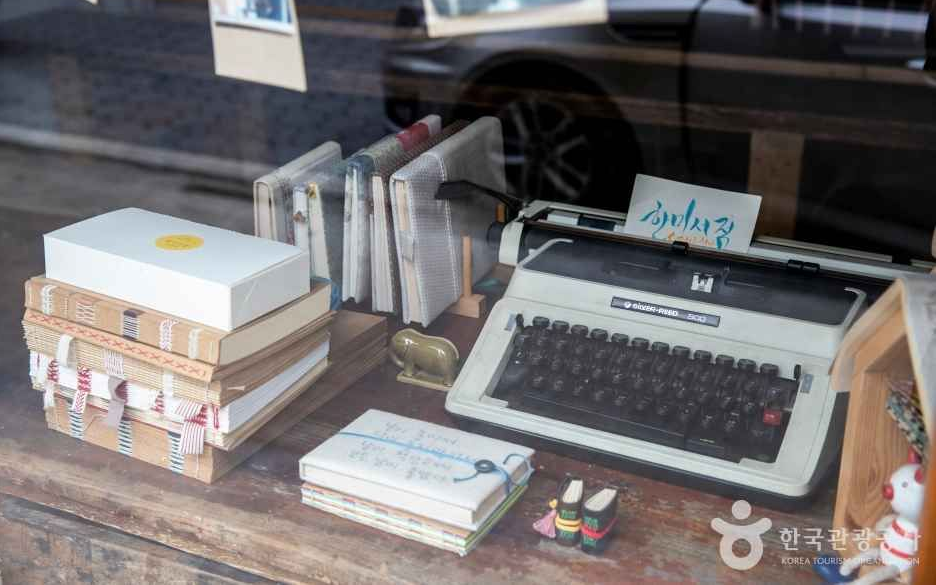
A typewriter and books sit on a wooden table behind glass reflecting a car outside.
Wadfah at Nabinalda
Wadfah’s work moves between music, illustration and video. The organizer says she made a 2025 zine with Supersonic Studio recording things she noticed in Seoul. Her Baedari workshop applies the same method: participants walk the neighbourhood, take photographs, then return to Nabinalda to turn them into drawings for a small book.
The photograph serves as a working note; redrawing it means choosing what to keep and what to leave out.
Nabinalda’s collaboration is listed for 11 a.m.–4 p.m. on both days. The separate paid English-language workshop on October 18, 4–6 p.m., showed SOLDOUT when checked at 8:44 p.m. KST on October 12. That label applies only to the class.
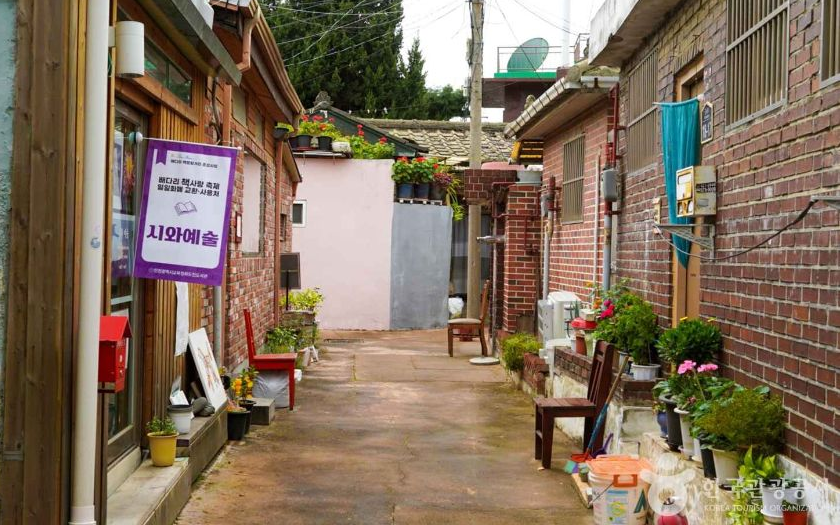
Potted plants and a small table line a narrow brick alley with a Poetry and Art sign.
Other programmes
Jeju-based duo Logout Island’s blueprint workshop combines prepared words and images, prints them by cyanotype and folds the result into an eight-page zine. The October 17 session at Abel Bookstore also showed SOLDOUT.
The programme also lists an open zine-making table with paper, glue, scissors and old magazines. Shin Jisu’s CUT-OUT NARRATIVE exhibition reworks images cut from books found in Baedari into paintings. Times and charges for individual activities are set by the organizer.
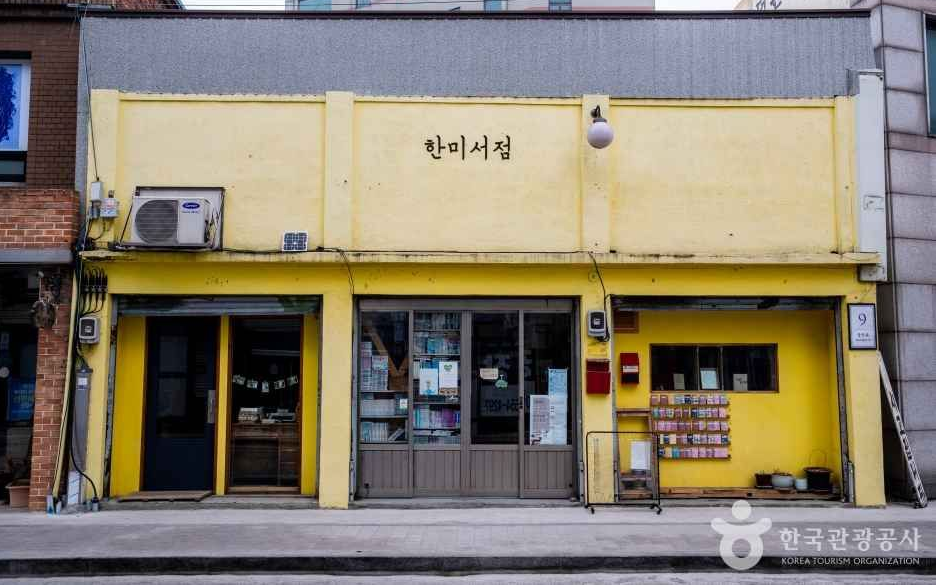
The entrance to Hanmi Bookstore is framed by yellow walls and large windows.
Visitor information
General festival hours are 11 a.m.–6 p.m. on October 17–18, across Patchwork, Changyeong Elementary School and the bookshop district. The Jiphyeonjeon consultation is at 3-1 Geumgok-ro, Jemulpo-gu, Incheon, third floor; wadfah’s workshop is at Nabinalda, 35 Ugak-ro 15beon-gil in the same district. Individual sessions keep different hours.
VISITKOREA lists free access to the street, with purchases charged and shop hours varying; not every festival programme is free. Parking is limited, and public transport is recommended. Language support varies by programme. Japanese interpretation and lift access to Jiphyeonjeon’s third floor were not confirmed.
Information was checked on October 12, 2026, at 8:44 p.m. KST. The photographs are KTO archive images taken in March 2019 and October 2023, not scenes from this year’s festival.
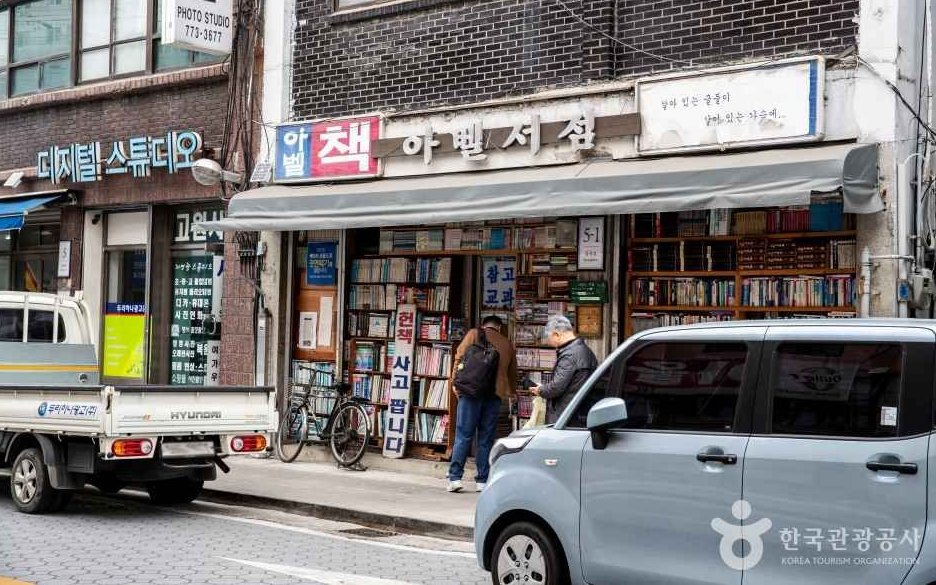
Outside Abel Bookstore in Baedari, March 2019 archive photograph. Not a photograph of the 2026 festival. Photo: ⓒKorea Tourism Organization-Lee Bumsu. Original title: “Baedari Secondhand Bookstore Alley” (2019-03; photo 2711009201903006k). Source: https://english1.visitkorea.or.kr/enu/nphotogallery/photo.kto?func_name=photo_view&newphotoDTO.photo_code=2711009201903006k&newphotoDTO.searchWord=&newphotoDTO.sub_menu=contest · KOGL Type 1: https://www.kogl.or.kr/info/licenseType1.do · Changes: cropped the 940×627 source to 936×585 (8:5), preserving the embedded KTO credit, then losslessly WebP-encoded. No resizing, padding, colour change or distortion. Card and enlargement show the same supplied crop; the uncropped original is available at the source.
Books and a typewriter in a Baedari window, March 2019 archive photograph. Not a photograph of the 2026 festival. Photo: ⓒKorea Tourism Organization-Lee Bumsu. Original title: “Baedari Secondhand Bookstore Alley” (2019-03; photo 2711009201903008k). Source: https://english1.visitkorea.or.kr/enu/nphotogallery/photo.kto?func_name=photo_view&newphotoDTO.photo_code=2711009201903008k&newphotoDTO.searchWord=&newphotoDTO.sub_menu=contest · KOGL Type 1: https://www.kogl.or.kr/info/licenseType1.do · Changes: cropped the 940×627 source to 936×585 (8:5), preserving the embedded KTO credit, then losslessly WebP-encoded. No resizing, padding, colour change or distortion. Card and enlargement show the same supplied crop; the uncropped original is available at the source.
A narrow Baedari alley with a 'Poetry and Art' sign, October 2023 archive photograph. Not a photograph of the 2026 festival. Photo: ⓒKorea Tourism Organization-Jun Jimin. Original title: “Baedari Secondhand Bookstore Alley” (2023-10; photo 2711009202310006k). Source: https://english1.visitkorea.or.kr/enu/nphotogallery/photo.kto?func_name=photo_view&newphotoDTO.photo_code=2711009202310006k&newphotoDTO.searchWord=&newphotoDTO.sub_menu=contest · KOGL Type 1: https://www.kogl.or.kr/info/licenseType1.do · Changes: cropped the 940×528 source to 840×525 (8:5), preserving the embedded KTO credit, then losslessly WebP-encoded. No resizing, padding, colour change or distortion. Card and enlargement show the same supplied crop; the uncropped original is available at the source.
Hanmi Bookstore's yellow exterior in Baedari, March 2019 archive photograph. Not a photograph of the 2026 festival. Photo: ⓒKorea Tourism Organization-Lee Bumsu. Original title: “Baedari Secondhand Bookstore Alley” (2019-03; photo 2711009201903007k). Source: https://english1.visitkorea.or.kr/enu/nphotogallery/photo.kto?func_name=photo_view&newphotoDTO.photo_code=2711009201903007k&newphotoDTO.searchWord=&newphotoDTO.sub_menu=contest · KOGL Type 1: https://www.kogl.or.kr/info/licenseType1.do · Changes: cropped the 940×627 source to 936×585 (8:5), preserving the embedded KTO credit, then losslessly WebP-encoded. No resizing, padding, colour change or distortion. Card and enlargement show the same supplied crop; the uncropped original is available at the source.