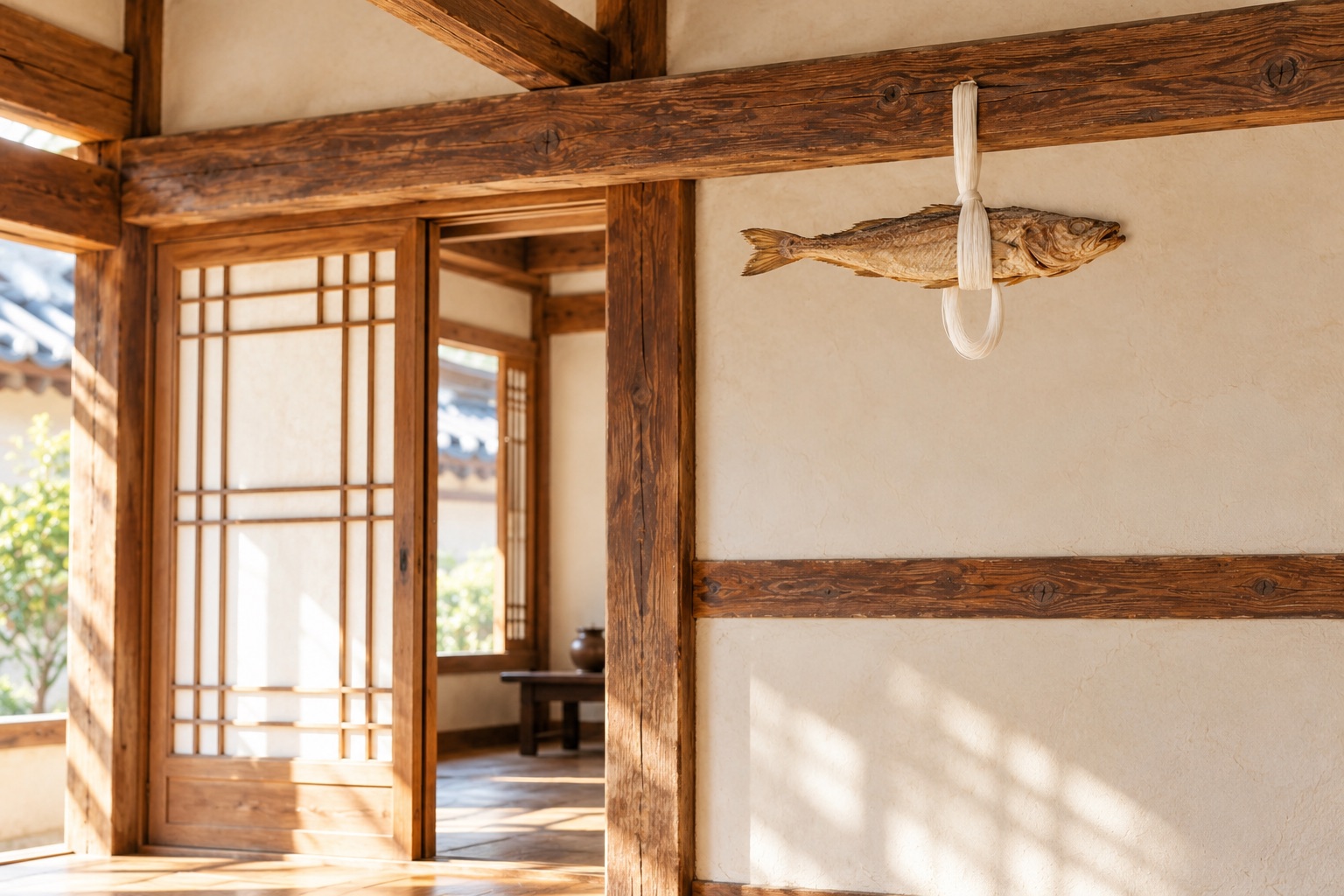
Dried pollack, a staple food in Korea, was also used in house-building rituals. Today, fish-shaped ornaments carry the same wish for a peaceful home.
Pollack at the ridge-beam ceremony
Bugeo is dried pollack. Accounts of sangnyang-gosa, a ceremony held when a house’s ridge beam was raised, describe hanging bugeo along with thread and money. The ceremony marked a major stage of construction and asked for good fortune.
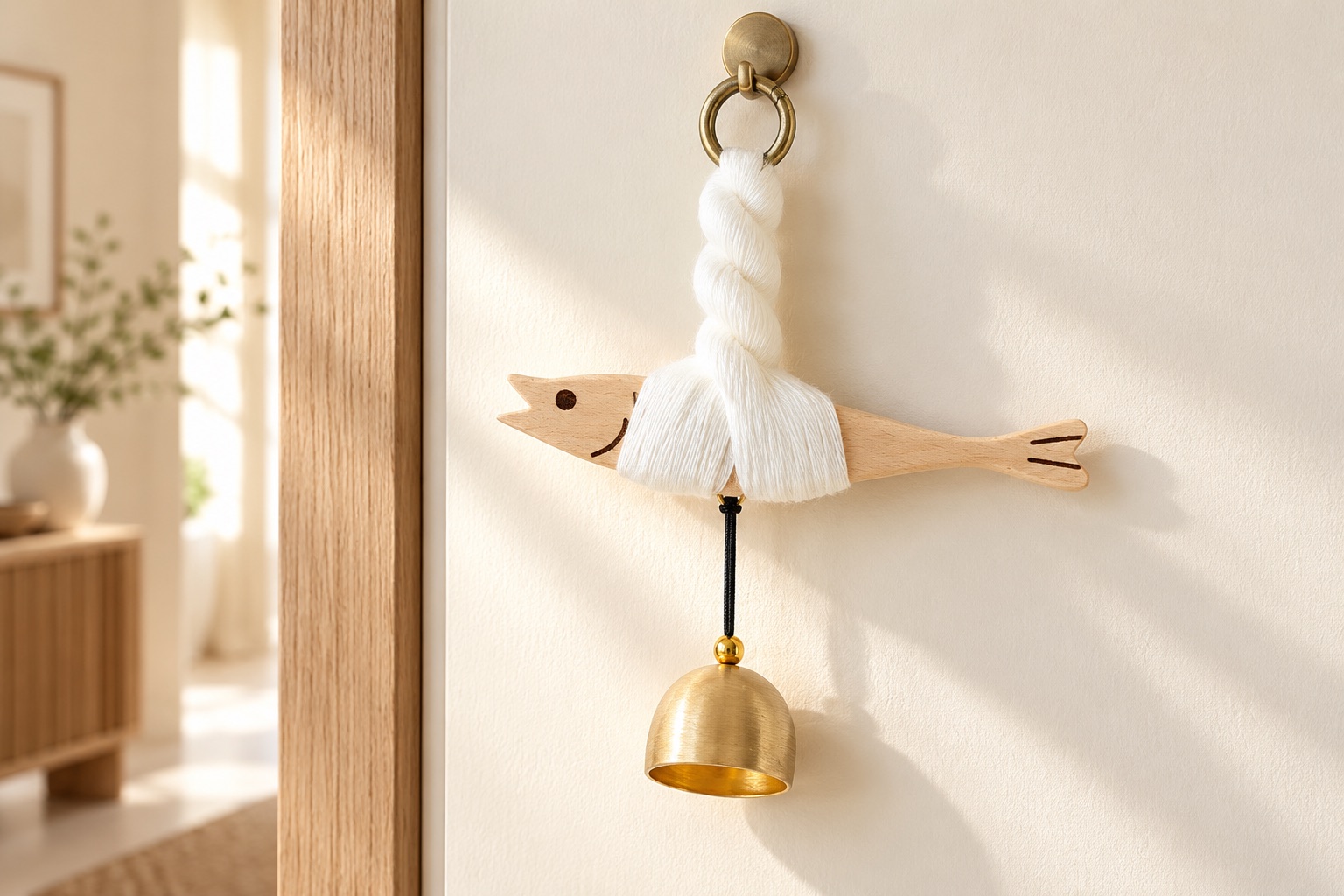
Wooden fish ornament with white silk thread and a gold bell on a modern wall
A modern craft
Aekmagi means warding off misfortune. In a 2025 craft class, the Gumi Public Health Center had participants make a door ornament from a fabric fish, cord and a bell.
The images here are not photos from that class. They are AI-generated reconstructions of a dried pollack tied with thread and of a wooden fish ornament.
Ritual and ornament
The old ritual and the modern doorbell are different uses of the same motif. Both show how an everyday food found a place in expressions of care for a home. The ornament expresses a wish for well-being, not a promise of protection.
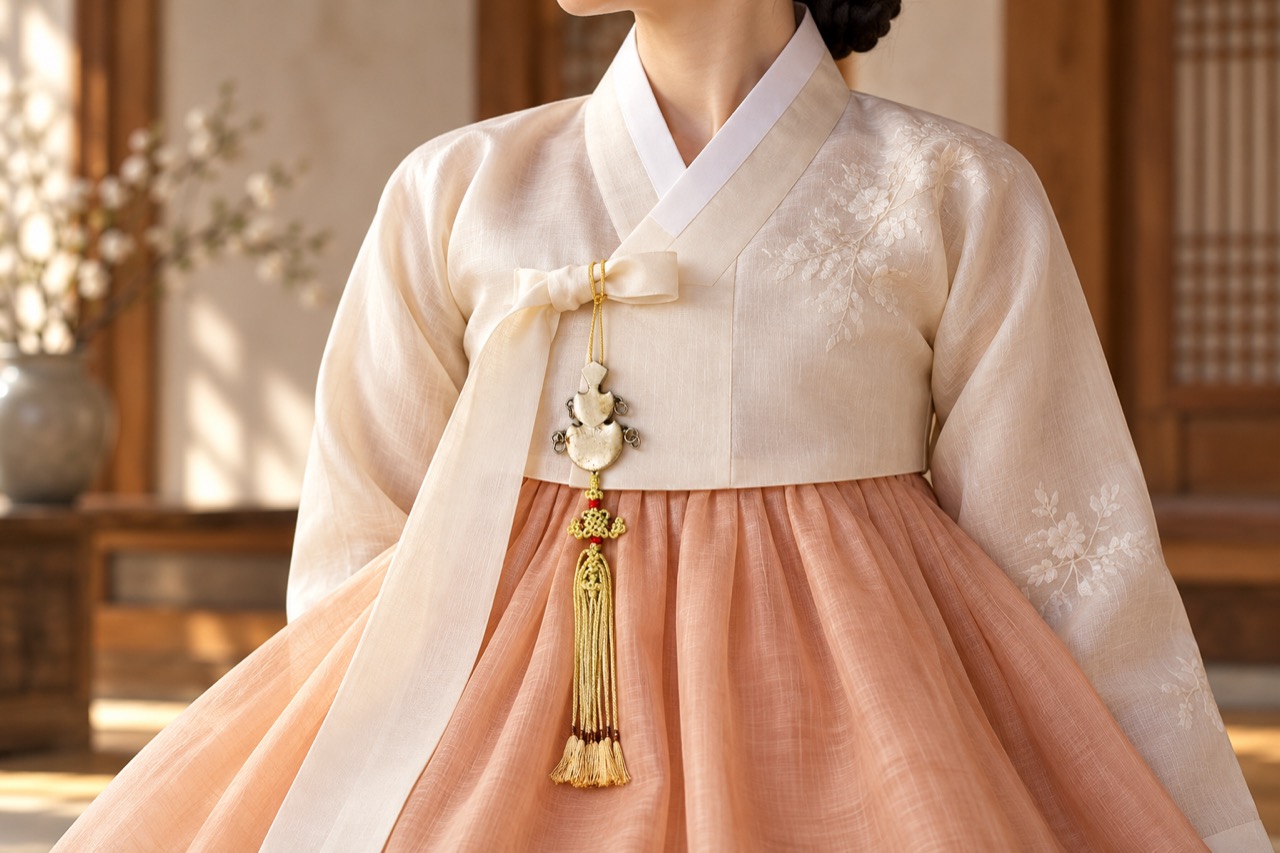
Some norigae, the knotted and tasseled ornaments worn with hanbok, held sewing needles. The needle-case norigae turned an everyday tool into an accessory.
How norigae were worn
Norigae were attached to the ties of a hanbok jacket or the waistband of a skirt. An upper fitting or cord held the ornament in place, with its decoration and tassel hanging below.
A needle-case norigae has a small container for sewing needles built into its central ornament.
Why carry needles
The case kept frequently used needles within reach. According to the Korea Heritage Agency, needle cases were made of cloth, metal, leather or paper, and hair or powder was placed inside to prevent rust. The ornament held working sewing tools.
Examples in museum collections
The National Museum of Korea’s baekdong needle-case norigae, Jeung 6526, dates to the Joseon dynasty and measures 32.5 cm overall. A separate enameled example, Jeung 6666, measures 34.5 cm and has pink knots and tassels. Its Korean name, paran, refers to the enamel technique, not the color blue.
Two other cases shown here differ in material and form: a modern embroidered textile case at the Seoul Museum of History and a lacquered case at Dankook University’s Seok Juseon Memorial Museum. The Seoul museum describes the upper part of its textile case as a lid and the lower part as the needle holder.
The photos do not show the cases open or any needles, nor do they show those two cases worn with hanbok. The hanging tassel is decoration, not the needle compartment.
Kkokdugak, Time Play, a 70-minute production rooted in traditional Korean puppetry, runs October 22–28 at Jeongdong Theater Cecil in Seoul.
Schedule and tickets
Performances are at 7:30 p.m. Monday to Friday and at 2 p.m. and 6:30 p.m. on Sunday, with no Saturday show. All seats are KRW 20,000, and the show is for ages 12 and up.
Language
Whether foreign-language subtitles are offered has not been confirmed. The theater can provide details before booking.
After washing, fabric was laid on a stone and beaten with wooden paddles. The practice, called dadeumi, straightened the weave and gave cloth a finished sheen.
What dadeumi was
Dadeumi was the work of beating washed fabric with wooden beaters. Starched cloth was straightened and smoothed so it could be worn again. A long, low stone called a dadeumi-dol supported the cloth.
Methods by fabric
The Joseon household manual Gyuhap Chongseo sets out separate finishing methods for silk, cotton and ramie. The work required knowledge of each fabric and took considerable time and effort.
A surviving stone
The National Museum of Korea’s Joseon-period dadeumi stone, accession Sinsu 13090, is 55 cm long. The photo shows the stone alone, without beaters or a worker. Washing was only one stage in the care of a well-kept garment.
Meet Kim Soo-chul through “A Flower That Never Bloomed,” from his 1983 first solo album. The video below is a KBS performance broadcast on December 30, 1984.
A defining song from his first solo album
Kim moved into his solo career in 1983, with “A Flower That Never Bloomed” among the songs that established the album. The lyrics, music and arrangement are credited to Kim Soo-chul.
Why it stayed with Korean listeners
The song held No. 1 on KBS Gayo Top 10 for five consecutive weeks in 1984. It is a useful doorway into an artist whose work later stretched across rock, popular song, film music and Korean traditional-music composition.
Watch the 1984 KBS stage
The video below is KBS archive footage from a December 30, 1984 performance. Its later YouTube publication is kept separate from the original broadcast date.
A low heel, an open instep and a gently raised toe: the outline of gomusin, Korea’s rubber shoes, carries both older footwear styles and the arrival of factory-made shoes. A practical pair for wet weather was once a coveted possession, and today it is a starting point for designers.
An older shape in a new material
Rubber alone does not explain the shape of gomusin. According to the Encyclopedia of Korean Culture, men’s versions were modeled on gatsin, or leather shoes, and women’s on a type of danghye, a traditional low shoe. A National Folk Museum of Korea account also notes their resemblance to unhye, another women’s shoe.
The gently rising toe already appears in Joseon-period shoes, and factory-made gomusin carried that outline into rubber. Shapes varied, from broad and round-toed to slender with a pronounced toe.
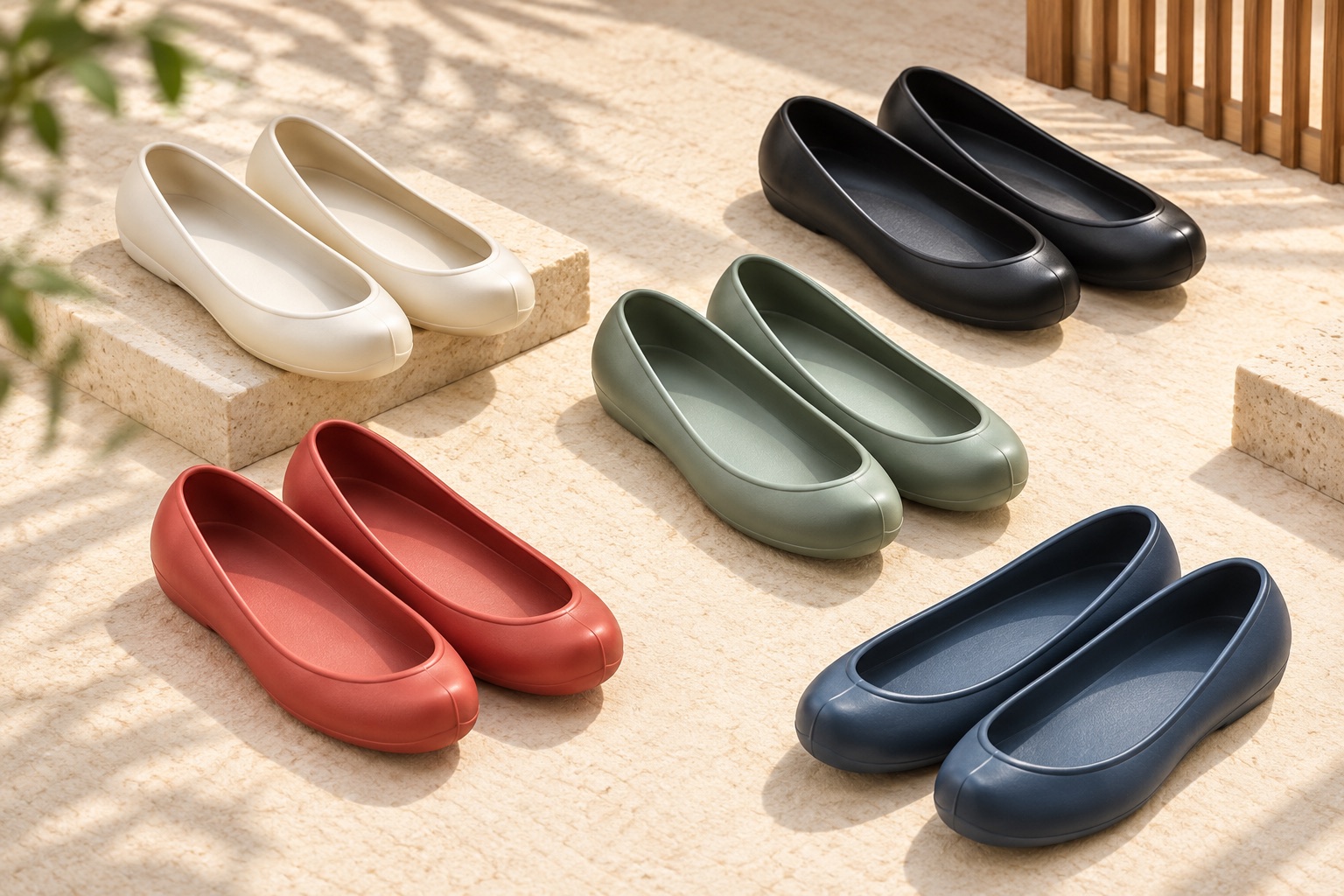
Gomusin color concepts in several shades on a light floor
A new manufactured product in the 1920s
Gomusin spread widely from the late 1910s through the 1920s, during Japanese colonial rule. Imports from Japan opened the market, and growing demand led to production on the Korean peninsula. The Joseon Rubber Works, founded in Seoul’s Jongno district in 1922, was one example.
Production centered on Gyeongseong, today’s Seoul, Pyongyang and Busan. Korean owners predominated in the first two cities, Japanese owners in Busan. The history of gomusin is one of urban factories, skilled workers and competing brands as well as rural memories.
Shoes for everyday wear
Straw jipsin wore out quickly and soaked up water. Rubber shoes resisted water and lasted longer, making them practical for daily wear.
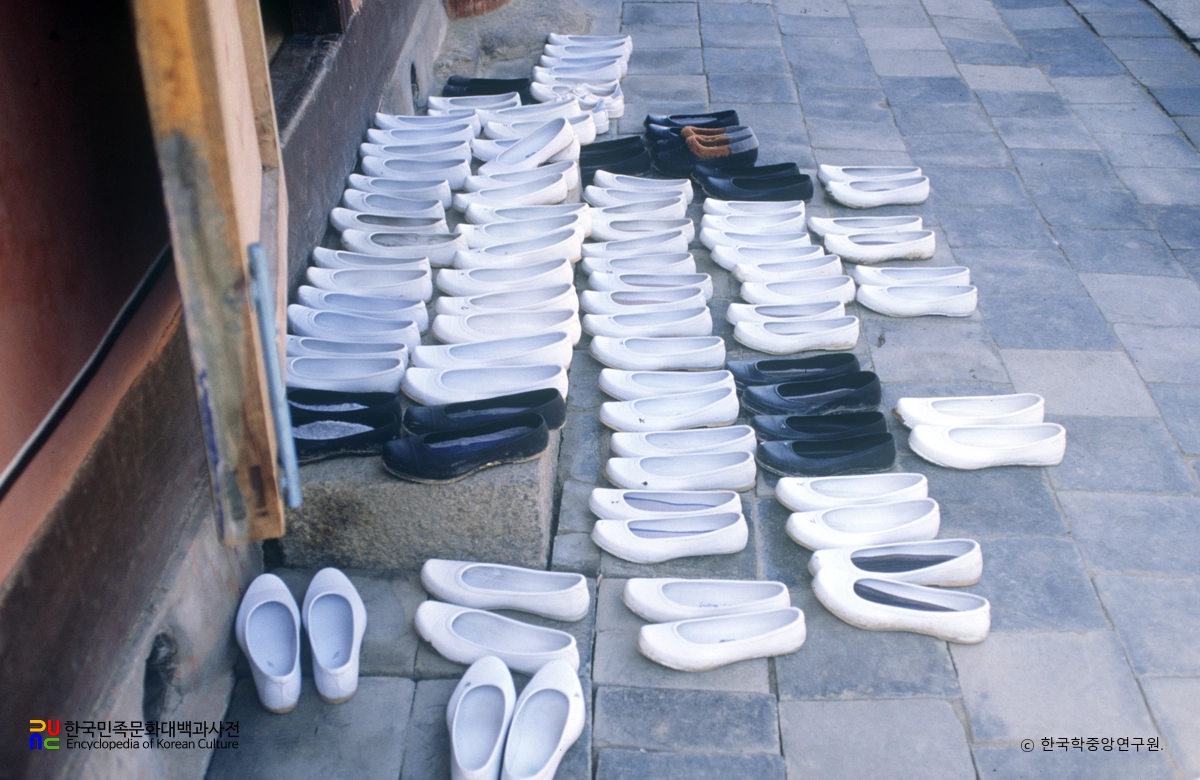
Men and women wore gomusin as their everyday outdoor shoes. An Academy of Korean Studies photograph shows rows of white and black pairs left outside monks’ quarters at Haeinsa Temple.
The joy of new white shoes
In Jeong Bi-seok’s 1937 story Seonghwangdang, cited by the National Institute of Korean History, Sun-i delightedly tries on her new white gomusin again and again. The scene shows how precious a seemingly modest pair could be.
Gomusin combined durability with the pleasure of dressing well. Factory production brought outlines associated with leather and silk shoes into more people’s daily lives.
Different shapes and colors
Archival photographs show a broad black shoe, slender white pairs and a red-and-white version. Today’s colored gomusin build on an object that already came in different shapes and colors.
From around 1960, as sneakers and leather shoes became common, demand for gomusin fell. A once-new purchase became an everyday item and, later, a reminder of the past.
Rows of white and black gomusin outside monks’ quarters at Haeinsa
New Color Gomusin, 2019
Blank Project worked with Woosung Chemical to launch PVC “New Color Gomusin” in 2019. The official crowdfunding campaign offered three colors and styled them with jeans and skirts. As of October 2026, the official product page lists seven colors: Pale Banana, Emerald, Burgundy, Eden Green, Coral Leaf, Purple Rose and Old Glory Red.
The familiar curve and open instep remain, while color and clothing change the effect. A shoe that once put an old form into a new material has itself become a basis for new design.
This is LEENALCHI’s official 2019 ONSTAGE performance of “Tiger Is Coming” with Ambiguous Dance Company. It is an archival performance, not a 2026 release.
The 2019 ONSTAGE performance
The performance puts LEENALCHI’s vocals and Ambiguous Dance Company’s choreography in the same frame. It was originally posted in 2019.
Official video and sources
The official YouTube video is embedded; full lyrics and translations are not reproduced. Background on the band at the time comes from an SBS interview.
KO1KEYZ debuted simultaneously in Japan and Korea on October 7 and released a Korean-version performance video of its debut song the same day.
Korean version on debut day
According to the group’s official notice, KO1KEYZ debuted in Japan and Korea on October 7. The Korean-version performance video went up on its official YouTube channel that day.
Video format
The official title labels it a Performance Video, not a music video. The original video is embedded.
Pizza seolgi, a cheese-topped Korean rice cake, is drawing buyers. Lotte Department Store’s Jamsil branch hosts a regional rice-cake pop-up October 9–15, and Pizza Hut added its own version on October 8.
Tteok pilgrimages
A tteok pilgrimage means visiting shops in search of particular Korean rice cakes. Pizza seolgi tops a familiar steamed-rice base with savory toppings.
The previously featured Youngmill product and Kane TV’s September 26 video are examples of the interest.
Kurly sales figures
Kurly said on September 10 that its June–August rice-cake and hangwa transaction value was about double a year earlier. Pizza seolgi reached its top sales ranks within two weeks of its August listing.
The figures are one retailer’s, not a growth rate for Korea’s overall rice-cake market.
Jamsil pop-up and Pizza Hut
According to Lotte’s announcement reported by Seoul Shinmun, National Tteok Pilgrimage 2 runs October 9–15 on the B1 floor of the Jamsil store with eight regional brands. Yeongdo Dari Tteokbang’s pizza seolgi is listed at KRW 3,300 each. Items may sell out.
Pizza Hut launched a separate KRW 3,900 version on October 8, topping milk rice cake with tomato sauce, cheese and pepperoni. Branch stock and delivery charges are shown when ordering.
Official product image on white, showing layered pizza seolgi with stretching cheese and red Pizza Hut and pizza seolgi lettering.
Pizza seolgi product image supplied by Korea Pizza Hut on October 8. This is separate from the Youngmill and Yeongdo Dari products. Korea Pizza Hut / Newswire.
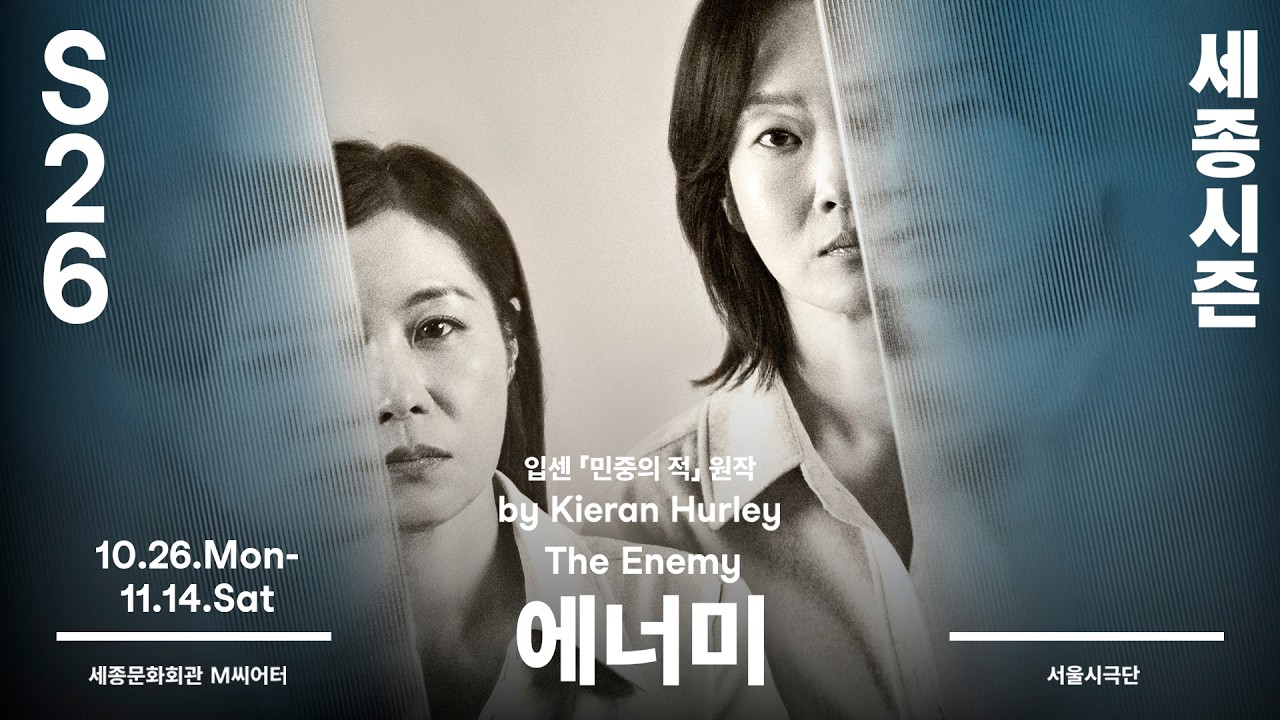
Enemy, a contemporary adaptation of Ibsen’s An Enemy of the People, has its Korean premiere at Sejong M Theater on October 26. It runs through November 14.
October 26–November 14
The production runs 105 minutes with no intermission and is for ages 13 and up. Tickets are KRW 60,000 (R), 50,000 (S) and 40,000 (A).
Official video
The video released by the Sejong Center is a cast profile shoot, not footage from the stage production.